Nice Vice

Michael Mann‘s movies are so good and so Rolls Royce that when a new one comes up 8, it’s an easy 9.5 or 10 by everyone else’s standards. If you know his stuff, you know what I’m saying is true. I’m not using the Rolls Royce analogy casually. The elation I felt yesterday from Miami Vice (Universal, 7.28) wasn’t just about tromp-down speed or engineering or a perfectly-tuned engine — that’s standard content in any Mann film. And it wasn’t quite about the sadness and the soul, which is in this film but not in the abundant qualities found in Heat and Collateral and The Insider.
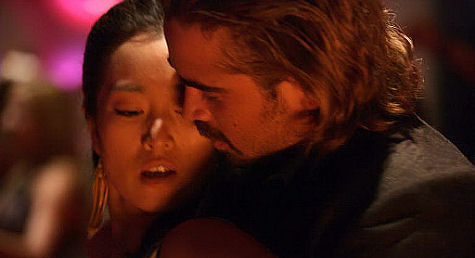
I’m talking about the fumes. The fumes of Miami Vice — the aroma, the grit, the atmospheric stuff, the digital flavor of Dion Beebe’s here-and-there photography — are superb (and sometimes in a realm so special I can’t quite describe it), and this alone makes it the supreme commercial “ride” movie of the summer.

By this I mean my kind of two-hour popcorn movie…an exquisitely configured, not-too-taxing thing for people who are smarter, hipper and more seasoned than the mainstream squealies who went nuts for Pirates 2. It sounds elitist to say this, but…

I’m talking about a crime movie that just roars in and does the job, but lingers on with so many different little moods and tones and accents and side-excursions that, like all first-rate films, it’s clearly up to a lot more than just “story” (and the more I write about movies the less I know what that term really means).

I was never that much into Mann’s Miami Vice back in the mid ’80s, so I wasn’t sitting there yesterday afternoon going “this is new” or “that’s cooler”. Forget Don Johnson and the other guy whose name I’ve never been able to remember, and who I’d rather not look up on the IMDB because that will somehow kill the mood.
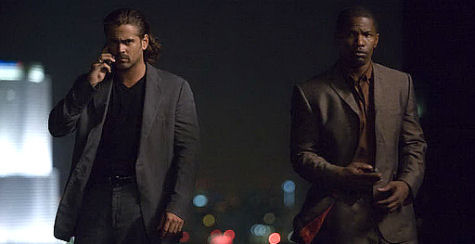
Miami Vice is right table-slam now…a combination of big expense (Universal is copping to $135 million), sweat-zone cool and wow photography, all focused on a kind of saxophone-solo story about a couple of Miami detectives looking to burn some very serious drug dealers by way of an undercover operation — a piece of elaborate theatre in which the cops pretend to be bad guys.

The way it’s been shot and cut is mainly about set-up for the first half (or do I mean two-thirds?)…mutterings, maybes, sex, whispers, half-understood’s and the radiant Gong Li, who is back at the top of the list of all-time hotties with this film — and then Big Payoffs happen during the last 30% or 35%.

Colin Farrell’s blonde hair in this film is much better — greasier, more lived in, more in synch with his age and his Irish-ness — than it was in Oliver Stone’s Alexander . Sounds like a mundane nonsequitur, but sometimes the authority of movies can be measured by such things.

Drink a strong cappucino and be well rested before you see this thing — you’ll need to pay close attention. All good movies are calibrated to stay a wee bit in front of what you think you know is going on — if this isn’t done boredom sets in. But my feeling during the first half (and I’m describing this with respect) was along the lines of “whoa, wait a minute…what’d he say? Is this Haiti or…? Rewind those last two lines…oh, I get it…well, most of it.”
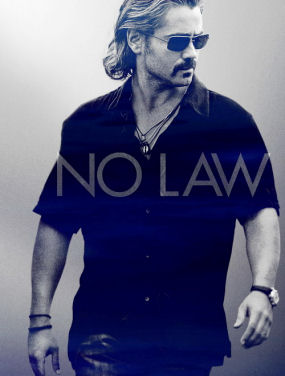
Beebe’s photography (like Collateral, most of Vice was shot with a Thomson Viper) is, as you may expect, nervy as shit — at times conventionally appealing, at times “pushed” and flecked with grain, but always sensual and photochemically “real” in a way that never stops being exciting or enticing in some “off” way.

Who, exactly, are Farrell’s Sonny Crockett and Jamie Foxx’s Ricardo Tubbs? Foxx/Tubbs seems like a relatively at-ease guy in love with his lady (Naomie Harris) but Farrell/Crockett is the kind of guy who doesn’t know what kind of guy he is outside of the rush of the job.

That’s what makes his falling in love with Gong Li’s Isabella, the girlfriend of big-time drug lord named Arcangel de Jesus Montoya (played by Luis Tosar, a balding, bearded guy with the most piercing eyes I’ve seen anywhere in a long time), so I-don’t-know-what…odd, surprising, curious, unexpected. A man in the grip of something that won’t let go and is about a lot more than tumescence.

There’s a big heartbreak factor that comes out of the Farrell-Gong relationship at the finale, but let’s be honest and admit it’s not as emotionally touching as Tom Cruise‘s Vincent asking Jamie Foxx if anyone will notice his body sitting on an L.A. Blue Line train in Collateral, and it’s not as touching as Al Pacino holding the dying Robert De Niro’s hand at the end of Heat. That’s one reason why this movie is an 8 on the Mann scale.
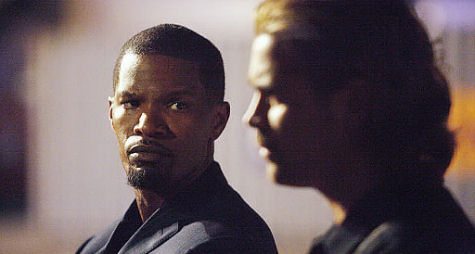
The sex scenes (Farrell/Gong’s in particular) have deep-down currents of feeling and longing that other directors wish for before they’re about to shoot their own. Dear God, let me find something between my actors that will make the audience forget the carnality, or at least put it into some kind of spiritual perspective.

All Mann movies are beautifully acted, and each and every supporting Vice actor, no surprise, is a stand-out. The big bad guys (Tosar, John Ortiz) are fearsome. Ciarin Hinds is playing a dullard but it’s good to experience him nonetheless. Barry Shabaka Henley, the jazz-club owner who got shot in the forehead twice by Cruise in Collateral, is good as an upper-level Miami cop. John Hawkes, an anemic-look- ing actor with a scuzzy goatee and an aura of insufficiency, portrays a low-level criminal during the opening few minutes. Domenick Lombardozzi (Find Me Gulity, Entourage) is very fine as another cop.

But please, please see this film for Gong Li, if for no other reason than it will help you forget how poorly she was used as the wicked bitch in Memoirs of a Geisha. This is one of the sexiest and most soulful performances by an actress in any medium in a very long time. I couldn’t quite understand everything she said, to be perfectly honest (her accent is a problem), but ooh, mama, the stuff she exudes during her scenes with Farrell.

I don’t want to get into the story any more than I have. It’s a film about lying — selling them, discovering them and the heavy cost and the smell of them.
I’m going to let this go and see Vice again on Thursday and get into it a bit more on Friday, but no one can watch this film and feel burned. The people who’ve been whispering about this film not being the thing that it could have been haven’t seen it, not really. They haven’t let it in. Or they’re just being hard-assed.

Like I said, the highlight of the set-up, exposition, planning, and planting-the-seeds portion, which is something like 65% to 70%, is the romantic white-water ride taken by Farrell and Gong. I imagine there may be some who will feel a bit lost or uncertain in terms of what’s actually going down at this or that point. I did at times, but there’s something to be said every so often for the feeling of “not knowing.”
Feel Night’s Pain

Feel Night’s Pain

Around 9:30 last night I started to read Michael Bamberger‘s book about M. Night Shyamalan‘s troubles in writing and directing Lady in the Water, intending only to sample a chapter or two. And I’d damn near finished the whole thing by 1:30 this morning.
The Man Who Heard Voices: or, How M. Night Shyamalan Risked His Career on a Fairy Tale” (Gotham, 7.20) isn’t just expertly written, and it isn’t just an intimate, fascinating, inside-the-head-of-a-filmmaker saga about the making of a movie in the style of, say, Julie Salamon‘s “The Devil’s Candy.”

It’s a very emotional story about Night’s belief in himself as both a writer and a director, and Bamberger’s writing is such that you feel Night’s anxiety very fully as the goblins start to come out. A cut of Lady in the Water gets good numbers in a research screening at the end of the book, so there’s a happy ending or sorts, but what a grueling, lonely journey it was for Shyamalan to finally get there.
Night doesn’t come off like a petulant child in this book — not to me. He comes off as a very serious, driven and super-focused dude who deep down is feeling scared and haunted and intimidated every almost step of the way. He may seem like a prima donna to Peter Bart, but Hollywood is not about making refrigerators or selling coat-hangers, and anyone who can’t roll with insecure eccentric types who listen to spirit voices probably doesn’t belong here.
< ?php include ('/home/hollyw9/public_html/wired'); ?>
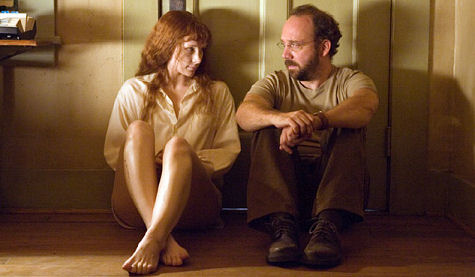
The Lady in the Water is a little bit like E.T. — about a human becoming friends with and then coming to the aid of a non-human visitor. It stars Paul Giamatti (Sideways, Cinderella Man) as an apartment-building superintendent and Bryce Dallas Howard (Manderlay, The Village) as a kind of mermaid.
The book follows Shyamalan through the writing of various drafts of his screenplay …to his breakup with Disney over Nina Jacobson, Oren Aviv and Dick Cook not getting it (which happens early on, at the end of chapter two)…to his cutting a deal with Warner Bros.’s Alan Horn and Jeff Robinov…to the location scouting and then shooting of the film…to his uncertain relationship with his erratic cinematographer Chris Doyle…to the finishing and the marketing and test-screening of the film.
I feel so closely acquainted with everything that went down that I don’t know if I can watch The Lady in the Water with any impartiality this coming Wednesday.


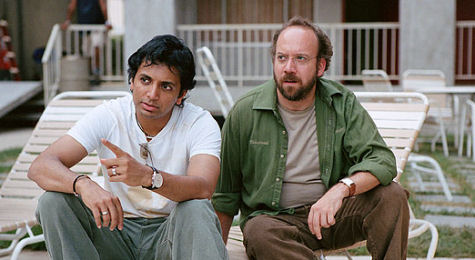
M. Night Syamalan and Ladyin the Water star Paul Giamatti

The core of the book is about Night’s certainty that he has no choice but to listen closely to voices that speak to him about creative matters as they come up (and certainly a lot more closely than to various Doubting Thomas colleagues who don’t get his script, or what he’s on about), and the very arduous process Night goes through as a result of this conviction.
It’s particularly touching in what the book implies but doesn’t quite say, which is that writing screenplays is a hellish, wandering-in-the wilderness process for some, and that Shyamalan is probably a better director than he is a writer, and that he’s also a kind of prisoner of a very rarified realm.
Night isn’t content to delight art-house audiences — he wants to reach average Joe’s in Duluth, Minnesota, and that means working in big-budget realms and with big studios and big stars, and the more money at stake the more an artist is pressured to compromise.
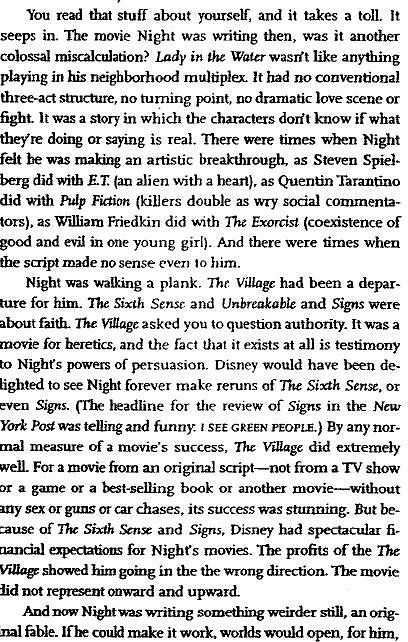
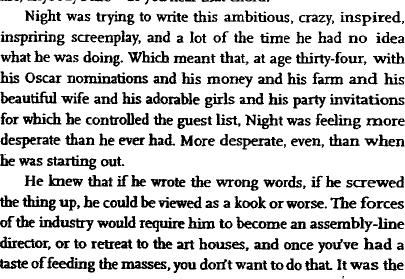
Here’s Bamberger describing Night’s concerns about reactions to his Lady screenplay: “He knew that if he wrote the wrong words, if he screwed the thing up, he could be viewed as a kook or worse. The forces of the industry would require him to become an assembly-line director, or retreat to the art houses, and once you’ve had a taste of feeing the masses, you don’t want to do that.”


Bryce Dallas Howard, Giamatti

As Neil McCauley says to Roger Van Zandt in Heat: “Forget the money.” To hell with the legend of The Sixth Sense and the huge success of Signs (“I see green people”), and fuck the $1.5 billion Shyamalan’s films have made so far…get shut of it, shut it out.
What’s so terrible with scaling down and making movies for a somewhat smaller but hipper clientele? Night is worth about $30 million bucks, give or take…how much more does he need?
Night obviously knows that corporate Hollywood doesn’t really want to take a creative journey with anyone — it just wants the power and the glory that comes from releasing a hit. He should focus on making films close to his heart, even if it means taking a pay cut. The rest will sort itself out.
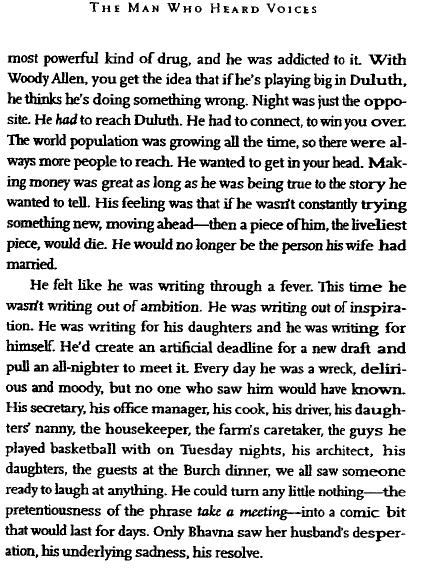
Here are some JPEGs of excerpts from the book — read them and you’ll see what I mean about the intimate tone of it. Reading them will also make it obvious to you that Bamberger is an excellent writer. I think one or two overlap, but here they are: Excerpt #1, Excerpt #2, Excerpt #3, Excerpt #4, Excerpt #5, Excerpt #6, Excerpt #7 and Excerpt #8
And if you haven’t seen Night’s American Express commercial, here it is.

A True Original

A True Original

By my own selective definition of the term, Owen Wilson is a bona fide movie star. He’s an entertaining, obviously talented actor who delivers the same personality and attitude — in film after film he plays the exact same spiritual-flotation-device spacehead — and he’s always good at it, and I’ve never tired of it and I doubt if anyone else has either.
Wilson tends to play irresponsible immature flakes, and there’s a built-in limit in playing such characters, but there is no other actor on the Hollywood landscape whose dialogue (large portions of which Wilson always seems to write or improvise himself) is focused so earnestly and consistently on matters of attitude and heart. Pretentious as it may sound, Wilson is an actor with a consistently alive and pulsing inner-ness. Is there any other actor who even flirts with this realm?


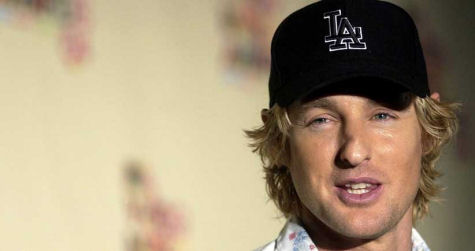
You, Me and Dupree star, producer and co-writer Owen Wilson

Stars become stars because people enjoy the fact that they do the same thing and do it well, time and again. (As Gary Cooper, Clark Gable and Cary Grant did.) Owen isn’t just Mr. Space Case, but one who really has “the spirit” — his charac- ters always seem genuinely imbued and imaginative and familiar with college philosophy basics, and there is no one else on the planet who does this sort of thing with Wilson’s particularity.
Wilson has been writing his own dialogue since forever (even in early films like Armageddon), and he doesn’t inhabit characters as much as manipulate and re-shape them in order to preach the Gospel of Owen. Wilson is nothing if not a charismatic preacher — he’s Elmer Gantry — as a clip from You, Me and Dupree called “The Mothership” proves.
< ?php include ('/home/hollyw9/public_html/wired'); ?>
This scene, by the way, is the highpoint of You, Me and Dupree — the rest of it is somewhere between sloppy and ghastly with an aura of emptiness that has to be felt to be believed. Wilson is a producer as well as costar and cowriter, and this movie is such a total comedown from The Wedding Crashers that I don’t want to think about it.
Wilson isn’t a star in the conventional sense, which is to say he’s not a romantic lead (he never lets you “in” — he’s not about manly or even childlike emotions as much as visions) and he doesn’t put arses in seats. His biggest commercial scores have always been in movies in which he plays the flaky buddy/partner of Jackie Chan or Ben Stiller or Vince Vaughn.


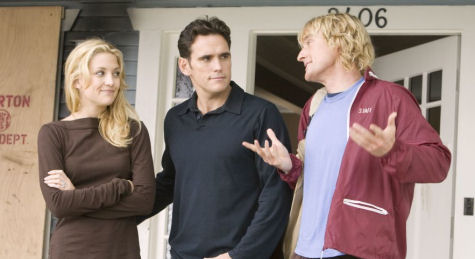
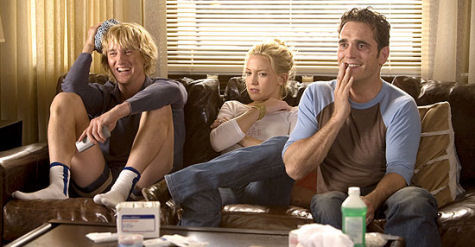
Kate Hudson, Matt Dillon, Owen Wilson in Dupree

I think it’s fair to say that Wilson’s solo turns in Behind Enemy Lines, The Big Bounce and Minus Man stopped short of seizing audiences with their primal magnetism.
The difference between Wilson and other actors who’ve become popular and rich playing best buddies is that each and every time Wilson is delivering a fine job of self-portraiture. He really and truly is Dignan in Bottle Rocket, only older, skinnier and richer with longer, expertly-cut hair.
Creatively the sky’s the limit with Owen these days, but he can’t keep playing Dupree-types for too much longer. He’ll be 40 in two and half years, and then he’ll be 45 two years after that, and the following year he’ll be 50.
In real life, brilliant funny guys are never days at the beach. It’s not in the cards. There are always demons and dark currents running within, and sometimes these manifest in behavioral tendencies that don’t merit Good Housekeeping Seals of Approval.

Owen is no different than Keith Moon or John Barrymore or Lenny Bruce in this regard, and it’s not a big deal. Mark Lisanti will tell you that all kinds of stories have circulated about Owen for years (and I don’t just mean the kind that support the legend of “the Butterscotch Stallion” or even that of “Owin'” Wilson — a nickname Owen picked up in the late ’90s after becoming a regular in an industry poker game) and I say “whatever” to that.
And you don’t get to be a big-time actor in this town unless you have the ability to be coldly aggressive and calculating. Naah…drop it.
I’m saying all this (and believe me, I know whereof I speak) because you will have to search far and wide for a profile of Owen Wilson that skirts the good stuff with more chickenhearted skill than the one that Rachel Abramowitz has written about Wilson in today’s L.A. Times.
I’m not quibbling with what she includes — the piece is well-written with good quotes and occasional insights. But her reluctance to deal with the meatier (colorful, curious, flamboyant) aspects of Wilson’s life is fairly staggering.


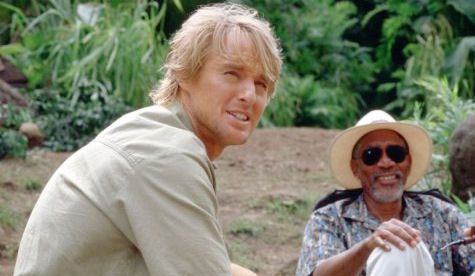
Wilson and Big Bounce costar Morgan Freeman

I’ve read Abramowitz’s piece twice, and there’s not a single line that half-seriously addresses the observations I tried to get across in the first four or five graphs of this article. And not dealing with the spiritual-philosophical current in Wilson’s work is like writing about Lou Gehrig without mentioning the fact that he played for 14 years without missing a single game.
Her piece is yet another example of the studied-Valentine style of celebrity profiles that you always get in the L.A. Times — the kind that exude smarts and flirtatious- ness and a semblance of insider authority, but which basically blows smoke up the reader’s ass.
I liked one paragraph — the one about Bottle Rocket producer Polly Platt going into a church during the tumultuous editing of that film in ’95. “I looked over to my left and Owen was in the same church praying,” Platt tells Abramowitz. “That’s the only indication I had that he was suffering.”

Party On

There’s a trend in movies about GenX guys in their early to mid 30s who’re having trouble growing up. Guys who can’t seem to get rolling with a career or commit to a serious relationship or even think about becoming productive, semi-responsible adults, and instead are working dead-end jobs, hanging with the guys all the time, watching ESPN 24/7, eating fritos, getting wasted and popping Vicodins.

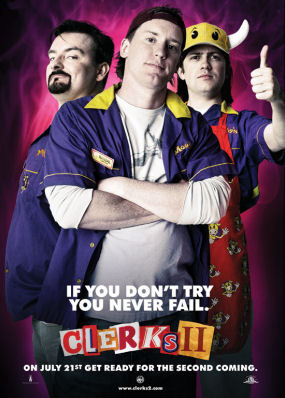
I’m thinking of four soon-to-open films that deal with this subject front-and-center: Kevin Smith’s Clerks 2 (Weinstein Co., 7.21), Tony Goldwyn’s The Last Kiss (the remake of Gabrielle Muccino’s Italian-made hit, adapted by Paul Haggis and due for release by Paramount on 9.15), You, Me and Dupree (Universal, 7.14) and The Groomsmen (Bauer Martinez, 7.14).


(l. to r.) Owen Wilson, Kate Hudson, Matt Dillon in You, Me and Dupree (Universal, 7.14)

There have probably been fifteen or twenty other films that have come out over the last four or five years about 30ish guys finding it hard to get real.

The 40 Year-Old Virgin was basically about a bunch of aging testosterone mon- keys doing this same old dance (with Steve Carell’s character being a slightly more mature and/or sensitive variation). Virgin director-writer Judd Apatow has made a career out of mining this psychology.

Simon Pegg’s obese layabout friend in Shaun of the Dead was another manifes- tation — a 245-pound Dupree.

Prolonged adolescence is an old pattern, of course. The difference these days is that practitioner-victims are getting older and older.

Martin Davidson and Stephen Verona’s The Lords of Flatbush (1974) dealt with this pattern to some extent, but the characters (played by Sylvester Stallone, Henry Winkler, Perry King) were in their mid to late 20s, as I recall.

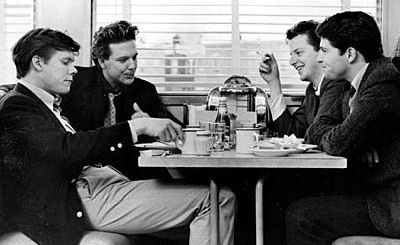
Barry Levinson’s Diner was also about guys who want to keep being kids, but his Baltimore homies were all under 30. (Was Mickey Rourke’s character older?)

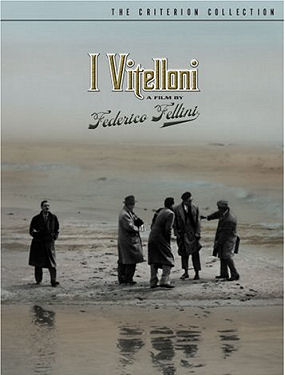
Putting off life’s responsibilities is a deeply ingrained pattern among European males, or certainly Italian ones. Federico Fellini’s I Vitteloni (1953) was about a group of guys pushing 30 who do little more but hang out and get into dumb situations in their home town on the Adriatic.

Why are immature attitudes among 30-something guys so persistent these days? Is this a breakthrough or a virus? Is it a reaction to overpopulation? Is it because the culture is telling them, “It’s okay, bro…we’re with you no matter how immature you are as long as you keep spending money on goods and services”?

Men who came of age in the 1920s and ’30s knew they had to start acting like adults and getting jobs and taking care of their families when they were just out of college.

With World War II and Korean War service eating up their early 20s, young men of the 1940s and early ’50s had to get down by their mid 20s, although many got going earlier.

When I was a pup in the 1970s the deal among pothead libertines, free-thinkers and alternative-lifestyle types was that you could mess around and duck the hard stuff in your 20s, but you absolutely had to grim up and get it together before you hit 30 or face eternal shame.
Now the GenXers have lifted that barrier and taken the I-still-want-to-fuck-around- with-my-friends-and-get-loaded-and-play-video-games aesthetic into their early to mid 30s.
What’s going to happen with GenYers? Or with my kids’ generation? Are they going to delay getting down to it while still grappling with adolescent behavior issues when they’re 40 and over?


(l. to r.) Kevin Bacon, Mickery Rourke, Daniel Stern, Timothy Daly in Barry Levinson’s Diner

Obviously we’re looking at some kind of fraying of the social fabric, a rise of a culture founded upon impulsive kick-backing and avoiding the heavy lifting and preferring to channel-surf through life rather than actually live it.

Maybe we’re headed toward a culture in which guys will never grow up, ever, and women will start running things more and more. Ladies, it’s okay with me.

Fast Footwork

Fast Footwork

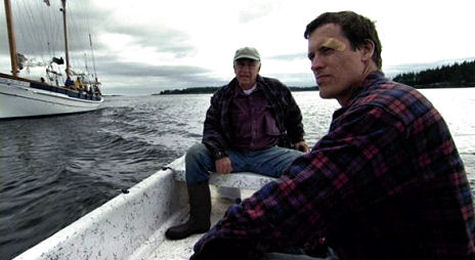
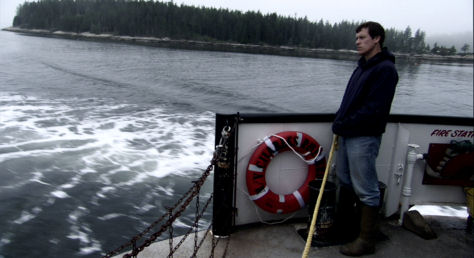
A few days ago good buzz was chasing Ian McCrudden’s Islander, an affecting drama about a Maine lobster fisherman (Thomas Hildreth) trying to get his life back on track after doing time for manslaughter, but then along came a pair of great trade reviews.
Variety‘s Justin Chang called it “powerfully atmospheric…a film that glides gently on a sea of understated emotions and character insights.” And the Hollywood Reporter‘s Kirk Honeycutt called Islander “an intelligent and compelling drama that deserves wider theatrical exposure.”
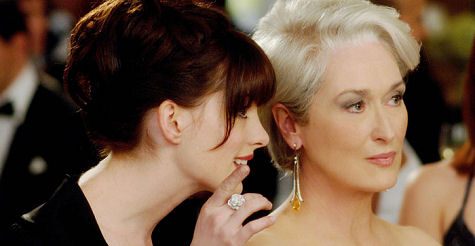

Phillip Baker Hall (l.) and Thomas Hildreth in scene from Islander

With reactions like these published on the same day (Thursday, 6.29) following two L.A. Film Festival showings, you’d think McCrudden, the film’s director and co-writer, would have been delighted.
But he wasn’t. A phrase in Chang’s review — “a lengthy, slightly awkward set-up” — compounded a feeling that McCrudden had since Islander‘s 6.26 showing at the festival that the beginning could be tighter. And so on the morning of Friday, 6.30, he decided to re-edit the opening — fast — so he could screen a slightly different version for Islander‘s last festival showing on Saturday, 7.1, at 7:15 pm.
< ?php include ('/home/hollyw9/public_html/wired'); ?>
The fact that McCrudden managed to recut Islander with time to spare shows how easy it is these days to re-shape a film on the quick.
McCrudden had the plan worked out when he called Islander‘s rep, Jeff Dowd, on Friday morning. “After watching the movie with an audience twice I said I think I can make some things work better,” he says, “and Jeff said, ‘Go ahead and do it….this is how the big boys make movies.’
“I have a low-resolution version of the film on my laptop, and I knew in my head what I wanted to do with it, so I simply sat down and did the re-edit on Final Cut Pro HD, which took me seven to eight hours with the work finished by Friday evening around dinner hour.


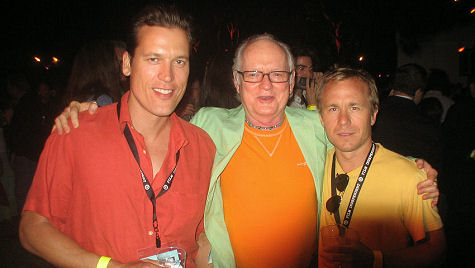
(l. to r.) Islander producer-star Thomas Hildreth, publicist Mickey Cotttrell, director Ian McCrudden

“The next morning at 8 am I took it down to Tyler Hawes at Hollywood-DI on Formosa, and we brought out the digital master and conformed it to the cuts I’d made on the computer.
“As it happened we had to eyeball it, or manually repeat the cuts, because the two programs wouldn’t speak to each other numerically, but it could have happened this way,” says McCrudden. “But the work took only two or three hours and was done by 12:15, which is when we left Hollywood-DI with a new version of the film on digital HD tape and headed over to Laemmle’s Sunset 5 and did a run-through.
After the 7:15 screening McCrudden mentioned the re-edit during the q & a. “I said it was kind of nice to have this new version and there were some people who told me they’d seen the previous version and noticed something had changed and knew it was faster, but couldn’t quite figure what,” he says.
This story doesn’t have a distribution punchline because, as Dowd said, there are “lots and lots” of distributors who haven’t seen Islander, so maybe there will be something to report down the road. For whatever reason, says Dowd, the L.A. Film Festival didn’t attract that many distributors across the board.

Honeycutt will be showing Islander to his UCLA Sneak preview class on 7.12 at the Writers Guild theatre. You’d think with those trade reviews and the fine-tuning that distributors will make the effort to show up this time.
If they don’t, says Dowd, “we’ll feed them to the lobsters.”

“Sunshine” Is It

Sunshine Is It

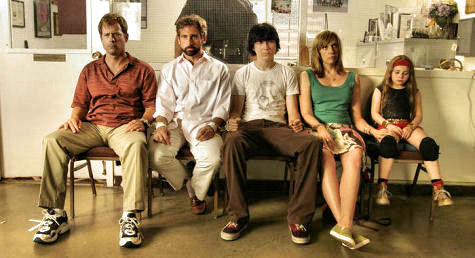
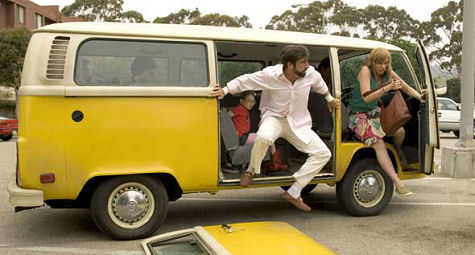
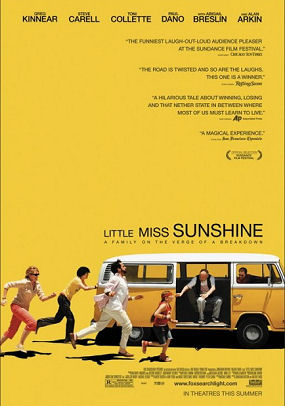
Jonathan Dayton and Valerie Faris’ Little Miss Sunshine (Fox Searchlight, 7.26) is, at the very least, this year’s Sideways — a non-formulaic character-driven comedy created by people of similar attitude and talent and emotional complexity levels, with laughs are just as rich and uproarious and particular.
There are two big differences: (1) Sunshine is a family comedy — a real family comedy about real people, as opposed to a piece of shite like Cheaper by the Dozen — and not about screwed-up middle-aged guys, and (2) it may make a lot more money than Sideways.


(l. to r.) Gregg Kinnear, Steve Carell, Paul Dano, Toni Collette and Abigail Breslin in Little Miss Sunshine (Fox Searchlight, 7.26)

Or so it would seem to judge by what happened last night, when the L.A. Film Festival ended with a Sunshine screening at the Wadsworth. The place shook like the Eccles theatre did last January before a hopped-up crowd at the start of the Sundance Film Festival. I’m talking guffaws, laughs, horse laughs and one signi- ficant “awww.” Plus heavy cheering and clapping and woo-woo’s as it ended.
The amazing thing for me is that Sunshine goes into some very dark places at times, and yet it has the balls and the spirit to bounce right out of those places and make you laugh five or ten minutes later, like nothing happened.
< ?php include ('/home/hollyw9/public_html/wired'); ?>
Watch both cuts of the trailer — the one on the Sunshine website and the one currently parked on Rotten Tomatoes — and you’ll have some idea of what I’m talking about.
It played just as well last night with me also — no diminishment at all. I can see catching it at least another couple of times and then owning the DVD.
I don’t know how big or how wide, but Sunshine is definitely a hit waiting to happen. It looks to me like a winner with all four quadrants. It may be a bit soft with young males at first, possibly, but that shouldn’t last.

The only people who may not warm to this acidly funny and touching family comedy as much, possibly, are the hideous fastidious mothers out there who delight in transforming their daughters into Jon Benet Ramsey clones so they can win at junior-miss beauty pageants.
After you see Sunshine you’ll know what I’m talking about. These women — the whole junior-miss beauty pagent culture, in fact — should be quietly rounded up and put on Army transport jets and flown to rural China and put to work on farming communes.
It’s also starting to hit me that Sunshine has a real shot at picking up some critics awards and Oscar nominations — Dayton and Faris for directing, Steve Carell and especially Paul Dano for Best Supporting Actor (the latter’s performance is especially good because two-thirds of it is done non-verbally, and yet he hits it out of the park with every facial muscle inflection and eye-roll), Michael Arndt for Best Screenplay, and so on.
I just re-read my morning-after review of Sunshine that ran six months ago, so here it is again (most of it) and screw the quote marks:
Little Miss Sunshine doesn’t exactly re-invent the wheel. It’s just a smart family comedy-slash-road movie, but the last film that got so much good humor out of such dark subject matter was maybe David O. Russell’s Flirting with Disaster, although Sunshine is a bit more of a wholesome, straight-up thing.

This is a film about hostility, feelings of futility, middle-aged career collapse, a troubled marriage, a fiercely alienated son, a dad who’s a bit of an asshole, a sudden family death, a failed suicide…and it’s often very funny and quite warm and so cleverly calculated and well-blended that it doesn’t feel like anyone calculated anything.
Sundance director Geoff Gilmore wrote last January that Little Miss Sunshine possesses a kind of “Capra-esque lunacy.” For me the word Capra (as in Frank) means cornball emotion and cloying stabs at manipulation…and Sunshine feels, to me, more natural (and naturally effective) than any Capra film I’ve ever seen.
And damned if Steve Carell isn’t eight times sadder and gloomier in this thing than he was in the early portions of The 40 Year-Old Virgin, and if he isn’t much funnier and more winning here than he was in that hit film from last summer. It’s his best performance ever, no question.
Virgin director-writer Judd Apatow has been writing comedy for 15 years or so, and when he sees Little Miss Sunshine he’s going to wish he could write something as good as what Michael Arndt has done, and direct a comedy of this type with this kind of naturalistic panache.


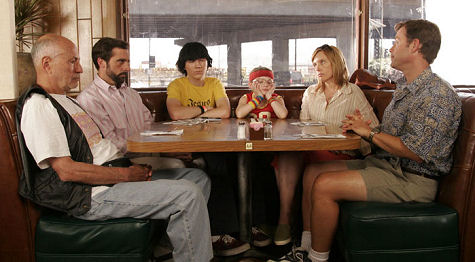
(l. to r.) Alan Arkin (as the family’s heroin-snorting grandpa), Carrel, Dano, Breslin, Collette, Kinnear

Sunshine is basically about family ties holding strong under ghastly and horrific circumstances.
It’s two days or so in the life of the can’t-catch-a-break Hoover clan — the vaguely dipshitty motivational speaker Richard (Gregg Kinnear), his sorely frustrated wife Sheryl (Toni Collette), Sheryl’s crushed, post-suicidal brother (Carell), a curmud- geonly, drug-taking grandpa (Alan Arkin), the silent, sulking Dwayne (Paul Dano), and 7 year-old cutie-pie Olive (Abigail Breslin).
The action is about going on a car trip from hell to take Olive to a Little Miss Sun- shine beauty pageant in Redondo Beach…and wouldn’t you just know the pageant itself would also be a nightmare? But this family has an improvised cure for that.
It’s not just that this all feels unexpectedly funny, but fresh and unforced. So much so that it’s easy to ignore a couple of scenes that don’t entirely work. It’s not quite as refined or soulful as Alexander Payne’s Sideways, but Sunshine has to be a hit — it can’t not be.

Bielinsky’s Spooker

Bielinsky’s Spooker

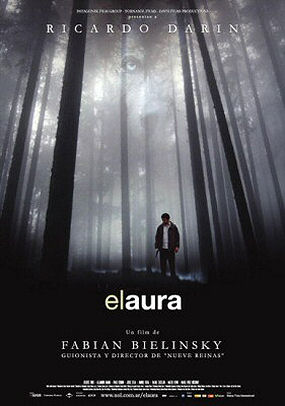
Having finally seen Fabian Bielinsky’s The Aura Saturday night, I understand why IFC Films picked it up and will open it in early September. Quiet, low-key and haunting in the manner of a half-awake dream, it’s a very unusual hybrid by the standards of American films — a heist film mixed with a psychological spooker.
Bielsinky’s screenplay was obviously influenced on some level by Michelangelo Antonioni’s The Passenger, which is about a journalist (Jack Nicholson) who abandons his life and identity in order to “become” a recently-deceased arms dealer whom he closely resembles.


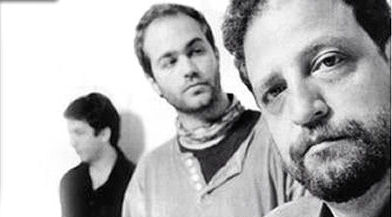
The late Fabian Bielinsky (r.), director of The Aura, in a 2000 publicity shot taken to promote Nine Queens

The Aura is about a Buenos Aires taxidermist named Espinoza (Ricardo Darin, star of Bielinsky’s Nine Queens) with an active fantasy life (he dreams of pulling off the perfect bank job) who accidentally kills a complete stranger named Dietrich during a hunting trip in the Patagonian forest.
Instead of simply reporting the shooting to the authorities, Espinoza decides to poke into Dietrich’s life and learns fairly quickly he was involved in a scheme to rob an armored truck — a job due to happen in two or three days’ time. A bit curiously, Espinoza slowly begins to introduce himself to Dietrich’s friends and co-conspira- tors as a confidante whom Dietrich has asked to take his place.
< ?php include ('/home/hollyw9/public_html/wired'); ?>
Suddenly immersed in a world of complex deceptions and lurking hair- trigger violence, Espinoza’s willingness to play this very strange game puts him in big danger, and it gets a little bit creepier with each lie he tells or is forced to cover up. On top of which Espinoza has periodic epileptic fits that send him into blackouts at the worst possible times.
The Aura is superbly acted, shot and scored — a big leap for Bielinski beyond the rote minimalism of his last hit, Nine Queens, which came out six years ago. The quietly creepy music is by Lucio Godoy, the superb color-desaturated photogra- phy is by Checco Varese, and it’s all been cut together in first-rate fashion by Alejandro Carrillo Penovi and Fernando Pardo.


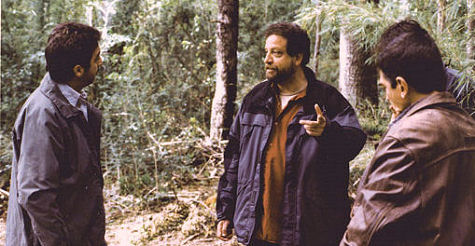
The Aura star Ricardo Darin, director Fabian Bielinsky during shooting in early ’05 in Argentina’s Paragonian forest.

Nothing was going to keep me from seeing The Aura at its final L.A. Film Festival showing. I’d been keen to see it all along, but Bielinsky’s death last Thursday in Sao Paolo upset me and made me resolve to go no matter what, if for nothing else than as a tribute to a director I respected and a guy I didn’t know very well at all, but who was always friendly and gracious to me when we communicated.
Before the film began an actress named Hebe Tabachnik, who is serving as the L.A. Film Festival’s Shorts Programmer and Latin American programming consultant, told the audience about Bielinsky’s sudden death.
Trying for a dignified tone while fighting back tears, Tabachnik described Bielin- sky’s career as an assistant director on several films in the late ’80s and ’90s before getting his big break in getting the chance to direct Nine Queens.
I asked Tabachnik after the screening if she knew what had happened to cause his death. 47 year-old men generally don’t just keel over and die without warning. She said she had no information, although it can probably be said that Bielinsky either had a heart condition that he genetically inherited, or he simply didn’t know his body or chose to ignore the warning signs or whatever.

Bielinsky’s Variety obituary said he “reportedly had had hypertension for some time.”
He was in Sao Paolo casting for an advertising project when a heart attack killed him.
The Aura received six Condors de Plata on Monday, 6.26, at the 54th Argentine Association of Film Journalists Awards ceremony in Buenos Aires. The thriller won for best film, director, original screenplay, sound, cinematography and lead actor (Darin).

Cheese Ball

Cheese Ball

Jeff Garlin’s I Want Someone to Eat Cheese With, which I caught Friday night at Westwood’s Crest Majestic, is the most entertaining and engaging audience- friendly film I’ve seen at the L.A. Film Festival over the past eight days. And it definitely has the makings of a theatrical hit if it’s shaped up and sold right.
It’s a small-scaled, funky-looking thing in a handheld 16mm vein (it could have been shot in the ’70s or ’80s…there’s nothing here-and-now digital in its technique or emotional approach), but it’s warm and engaging and pretty damn funny.


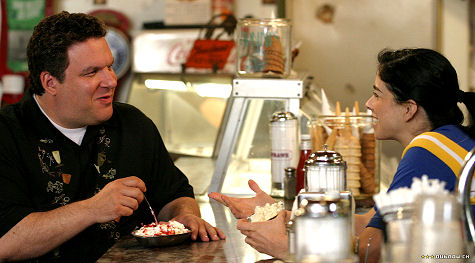
Star, director and writer Jeff Garlin (l.) and Sarah Silverman in I Want Someone to Eat Cheese With

Director-producer-writer Garlin — best known for his ongoing role as Larry David’s manager in HBO’s Curb Your Enthusiasm — and his fellow performers (Bonnie Hunt, Sarah Silverman and a team of Chicago-based actor pals) are all top-notch. And in an unassuming little-movie way with the emphasis on spirit and tone and quirky-hip humor, Cheese works.
I could feel the satisfaction levels in the house right away. The audience was totally grooving on it until the very last scene, but this is a fixable problem. The Weinstein Co. is in the process of acquiring, and if I know Harvey he’ll be pressing Garlin to re-cut or re-shoot the ending, which isn’t “bad” as much as vague.
< ?php include ('/home/hollyw9/public_html/wired'); ?>
If the finale is re-tooled in the right way, Cheese could catch on and then some. The word will get out that it’s kind of a Big Fat Greek Wedding for witty fat guys, only without the wedding or the slobbery cattle-yard relatives.
Garlin said last night he’s totally at peace with the ending and his heels are dug in, so maybe the film will go out as is. But even if it does critics and auds will still speak highly of it and it’ll do some decent business.


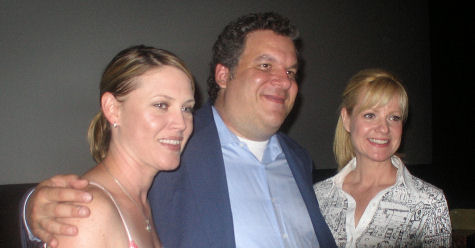
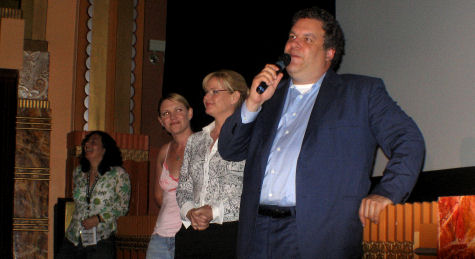
Cheese producer whose name I didn’t write down, Garlin and costar Bonnie Hunt during q & a at Crest Majestic theatre — Friday, 6.30, 8:50 pm.

Cheese is a sharply written (here and there genius-level) comedy-drama about a witty, likably humble Chicago comedian named James (Garlin) who lives with his mom but badly wants a soulmate girlfriend. Vaguely fortyish, James is saddled with a yen for slurping down junk food late at night (which costs him in the roman- tic department), and he’s pretty good at getting shot down or turned down or fired.
But as gloomy as James sometimes gets (and for good reason), he’s tenacious in a shuffling, good-natured, comme ci comme ca way, and you can’t help but feel for the guy and want him to succeed.
Garlin’s model, obviously, is Paddy Chayefsky’s Marty, which his film is a kind of tribute to. The Oscar-winning celluloid version of Chayefsky’s play, directed by Del- bert Mann and released in 1955, is brought up several times, and Garlin uses a theatrical staging of the play in Chicago as a plot point.
Cheese isn’t as sad or tear-jerky as Marty, and of course, being a Garlin thing, is coming from a wittier, schtickier place. Marty was about heartfelt pathos and the loneliness of a homely Brooklyn butcher (Ernest Borgnine). Garlin’s world view (and his film’s) is that of an always-candid, whipsmart, vaguely self-loathing Jewish comic…big difference.


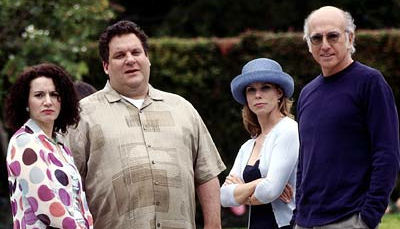
Curb crew (l. to r.): Susie Essman, Garlin, Cheryl Hines, Larry David

Hunt has what should be the lead female role — a neurotic elementary school teacher who’s a secret chubby-chaser, and who right away seems like James’ best romantic bet. But Hunt doesn’t make as big an impression as the always-brilliant Silverman does in a secondary role, that of an impulsive wackjob whom James has a fling with.
And that’s a problem. An extra scene or two with Hunt (a brilliant comedian who’s quite good in the scenes that she has) needs to be added toward the end, some- thing involving an emotional catharsis or confessional of some kind. Garlin knows what I mean — a James L. Brooks scene.
David Pasquesi is also underdeployed as Luca, James’ aloof and very logical- minded pal. Mina Kolb is quite good as James’ overbearing mom. Amy Sedaris has an amusing cameo as a therapist. A bunch of other Chicago actors whose faces I vaguely recognized (or so I told myself) are also very fine.
Garlin originally performed the material in a one-man show under the same title. He said during the q & a last night that Silverman’s character is based on a woman he once had a thing with, and who half-tortured him to death. Obviously his Second City improv skills (and also Hunt’s — they knew each other as nascent Chicago comedians) are the basis of the film’s tone and attitude, and good for that.


(r. to l.): Garlin, Hunt, mystery Cheese producer, L.A. Film Festival programmer Rachel Rosen

I hope the Weinstein Co. pushes I Want Someone to Eat Cheese With in the way it deserves, and that it connects with the public in some kind of vigorous way. And let’s hope Garlin keeps writing and acting and directing because he’s one very sharp dude.
I Want Someone to Eat Cheese With played at the Tribeca Film Festival two months ago, and here’s Garlin’s “director’s statement” that appeared in that festival’s online catelogue.
And here’s a N.Y. Times Magazine profile of Garlin by Alex Witchel that ran a few days ago.
Garlin’s previous credits include a supporting role in Daddy Day Care (which I will never see if I can help it), Full Frontal , Bounce and Austin Powers: The Spy Who Shagged Me. He serves as an exec producer on Curb Your Enthusiasm and has shot a pilot that no one will ever see unless he puts it up on YouTube.

The Big Empty

For a brief period in the early ’80s I was seriously flirting with an idea of launching a glossy culture magazine called Nothing. Of course, a series of snide, lighthearted riffs on what was then an emerging new current — a notion that glib irony and an increasing absence of sincerity or “meaning” in the arts had virused into a kind of existential fast-food that everyone was consuming — was doomed to fail. It was too uptown, too dry.


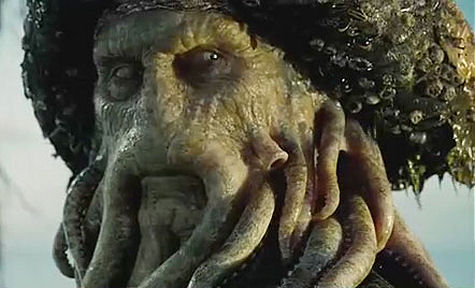
Bill Nighy as Davy Jones — the greatest movie villain to come along in years, and a landmark CG accompishment

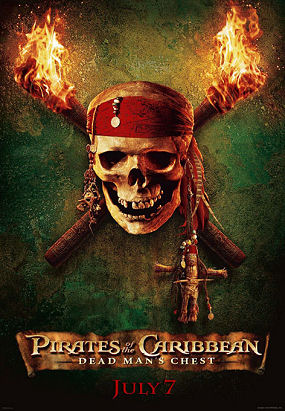
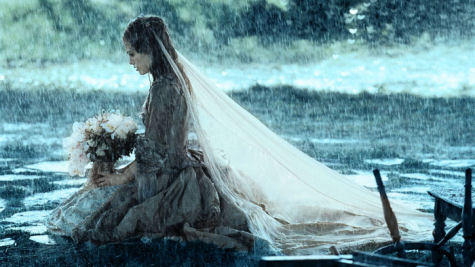
But if Nothing had succeeded and was still publishing today (and I were still the editor), Pirates of the Caribbean: Dead Man’s Chest — a profile of director Gore Verbinksi, probably — would be on the cover of the current issue.
Every scene, every shot, every frame of this 149-minute action blast and production-design extravaganza is a technical knockout. If your idea of great entertainment is measured primarily in terms of EED — extraordinary eyeball diversion — Pirates 2 is going to wow you. It’s going to fill you with good-time- movie delight.
I was over the moon about one particular element — Bill Nighy’s Davy Jones character, not only a villain extraordinaire but a masterful CG creation. Nothing I say in the rest of this review will slight this accomplishment in any way, shape or form.
But you need the right kind of hollowed-out attitude about movies to have a truly good time with Pirates 2. If you’re don’t, you may have some problems.
There is nothing, nothing, nothing going on inside this film. I can hear the Sons of Matthew McConaughey going “awww, screw him” right now. Only guys who are out of the post-Millenial loop would complain about a good-time jokey-ass pirate movie, they’re probably thinking. Lighten up and grow a sense of humor, dude. Life sucks if you can’t kick back and have fun.
But I get the humor. Pirates is very funny at times. It’s inventive and spunky every step of the way, and there’s the comfort of Johnny Depp’s jaded-smartass performance as Cpt. Jack Sparrow, and the pleasure of seeing Orlando Bloom and Keira Knightley hold their own and then some, and studying all those wonderfully choregraphed action sequences.


Johnny Depp as Cpt. Jack Sparrow

This is a superbly calibrated and perfectly-timed movie, and Darius Wolski’s photography is drop-dead luscious. There’s a shot of rain falling on a set of teacups in the very beginning that really made me smile.
But it’s almost creepy how everything that’s good about this film is entirely about the eyes. Nothing kicks in within. Not ever, not once.
Jerry Bruckheimer used to make sirloin-steak guy movies. This is a Vegas movie for the whole overweight popcorn-munching family, and it feels like a real shame. I never realized in the mid-to-late ’90s that The Rock, Con Air and Gone in 60 Seconds were manifestations of Bruckheimer’s golden era, but they sure seem that way now compared to Pirates.
I need to reiterate how absolutely delighted and mesmerized I was by Nighy’s Davy Jones, the slimiest, yuckiest squid-faced villain to ever rule over a motion picture. The whole world is going to feel this way — this is a world-class baddie for the ages — although it’s only Nighy’s voice and body (i.e., not his head) at work here. His petroleum jelly maggot-squid head and light-blue eyes are all CGI.

Nighy is the captain of the Flying Dutchman, a three-masted ship that dives like a submarine and mostly prowls around underwater, which accounts for the barnacles and slime covering everything and everyone on board. (So why is it called the Flying Dutchman?) Nighy deliver his lines with perfectly honed humor and wit. He should be nominated for a Best Supporting Actor Oscar…really.
The basic plot is twofold. Davy Jones believes that Sparrow owes him his soul, and he’s slimy and ferocious enough to insist upon this so Sparrow has to figure an escape. (Finding a key and a small wooden chest containing an organically throbbing object figure into this.) And the romantically entwined Will Turner (Bloom) and Elizabeth Swann (Knightley) have to deliver Sparrow’s compass to a frigid, bewigged British magistrate who will hang them if they don’t.
And for whatever reason, Verbinksi has decided to take two and half hours to tell one half of the story. (Pirates of the Caribbean 3 will be out in May ’07, and if it’s as long as this installment that two films will one day be a five-hour DVD.) The reason it’s so long is that Verbinksi is a Big Cheese these days and, like Peter Jackson, can do what he wants to do. And what he wants for this film is to digress and joke around and sometime slow things down for exposition’s sake.
The giant-squiddy Cracken monster, one of the joke-around elements, is just okay. Very fine CG, I mean…big tentacles!…but again, it’s strictly an EED thing. If that’s all you want from a film, fine.

Pirates 2 didn’t have to be this long, of course. Attitude romps should never run more than two hours. Verbinski and Bruckheimer know this — it’s a law — and they went ahead anyway.
I became very depressed last night when I looked at my watch, hoping to see I had about 30 or 40 minutes to go, and I realized there was a whole hour more. An hour! I had to go out to the lobby and walk around a couple of minutes to prepare for the coming ordeal.
The script should have been tighter, there didn’t have to be so many tangents and curlicues, and I swear to God I couldn’t understand any more than five or ten words spoken by a voodoo priestess character with black lips and inky-purple teeth (played by Naomie Harris). But I liked Stellan Skarsgaard as Bloom’s barnacled ghost-dad. He’s the only one trying to do anything semi-soulful in the whole film.
Pirates of the Caribbean: Dead Man’s Chest is the best-made serving of big-studio eye candy in a long time. The craft that went into it is truly top of the line. It looks great and buckles swash like a champ. But if you see this thing and use the word “joy” to describe the way it made you feel deep down, there is really and truly something wrong with you.

Ellroy’s De-Solve

Ellroy’s De-Solve

I should have asked hard-boiled crime writer James Ellroy (“L.A. Confidential,” “My Dark Places”) the obvious question during his L.A. Film Festival appearance on Monday night at the Italian Cultural Center — what is his view of alleged wiretapper and hard-guy Anthony Pellicano, and particularly Pellicano’s declaration that he’ll never rat out his clients?
Knowing Ellroy as I do (i.e., only slightly), he probably would have called Pellicano a punk and a poseur, but I won’t know for sure until the next time.


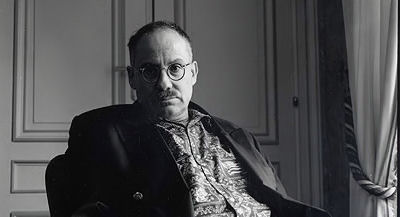
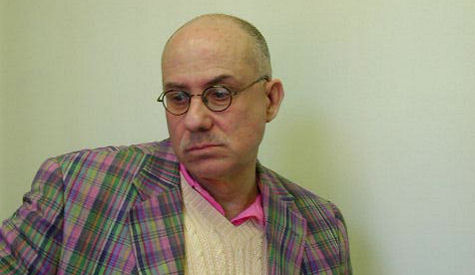
Crime-novel author James Ellroy, who’s shaved his moustache and lost a few pounds since the photo was taken five years ago.

The question I did ask was about the fictional plot of The Black Dahlia, Brian De Palma’s noir thriller based on Ellroy’s book of the same name. I was trying to get at the present-day interest among audiences in watching yet another fictional Dahlia tale on top of three or four cheapy TV movies plus Ulu Grosbard’s 1982 True Confessions**.
The Black Dahlia cow been milked too many damn times, and the teats are red and sore.
< ?php include ('/home/hollyw9/public_html/wired'); ?>
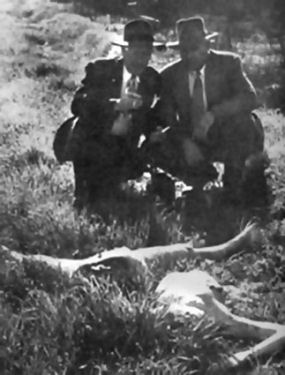
I’m especially convinced of this due to the fact that the “unsolved” murder of aspiring actress and troubled party girl Elizabeth Short has, to some people’s satisfaction (including my own), been solved.
Ellroy dismissed the “solve” as speculative on Monday night and he may be right, but read this 4.2.03 Washington Post article by William Booth about a book called “Black Dahlia Avenger” by former LAPD detective Steve Hodel, and go over all the disclosures and allegations and apparent facts.
When you’ve done that, convince me that Hodel’s father, a Los Angeles physician namd George Hodel, Jr., who ran a clinic treating venereal diseases (and who died in 1999 after leaving the U.S. and moving to Asia in 1950), doesn’t sound awfully damn guilty.
That’s right…Steve Hodel’s father.


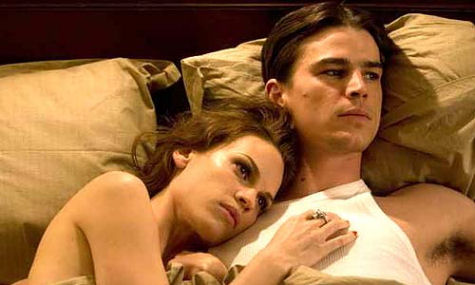
Black Dahlia costars Hilary Swank, Josh Hartnett

L.A. Times writer Larry Harnisch voiced another persuasive theory about a man he believes was the Black Dahlia killer (a surgeon named Walter Bayley) in Vikram Jayanti’s excellent 2001 doc James Ellroy’s Feast of Death. Read Harnisch’s site for the whole kit and kaboodle.
Ellroy wouldn’t discuss Bayley or Hodel on Monday night, I’m guessing, because notions of a solve would obviously drain the DePalma film of whatever allure it may have going in, and that would obviously lessen interest in people wanting to buy Ellroy’s fictional book about the case.
Another angle is the fact that Ellroy’s interest in cops, sex crimes and the seamy underbelly of Los Angeles stems in large part from the strangulation murder of his mother, Jean Ellroy, in 1958, when James was 10.
In the mid ’90s Ellroy published “My Dark Places,” a book about an unsuccessful attempt to solve her killing. The murderer was probably a guy she was seeing on some basis, but no final investigative score ever happened. I have an idea that because Ellroy doesn’t have closure on his mom’s death, he’s not comfortable with wrapping things up on Elizabeth Short.

Universal’s The Black Dahlia, which costars Josh Hartnett, Aaron Eckhardt, Scarlett Johansson, Mia Kershner and Hilary Swank, is slated for release on 9.15.
Ellroy said on Monday night that he’s watched hours of dailies from DePalma’s film and said he would be doing promotion for it and, like with L.A. Confidential, that he’s fairly happy with the end result.
His favorite element in The Black Dahlia, he said, is Josh Hartnett, who plays a haunted cop named Bucky Bleichert who, along with partner Lee Blanchard (Aaron Eckhart), is assigned to look into Short’s (Mia Kirshner) grisly murder. (Her nude body was found in two pieces, sliced at the waist, on south Norton Avenue.)
Ellroy said, “Hartnett reads lines that I wrote with near perfect inflection every time.”
Ellroy is living in Los Angeles now, and that’s good. (I tried offering a link to a video piece about him discussing his return home while dining at one of his favorite haunts, the Pacific Dining Car, but it’s dead.) And he’s a lot slimmer these days than he was four or five years ago, and full of energy and in jolly spirits.

It was lot of fun listening to Ellroy’s well-honed shpiel the other night, although he’s not much of a conversationalist. Zap2it’s Hanh Nguyen has written a pretty good rundown of the highlights. You just need to scroll down a bit.
** True Confessions isn’t out on DVD by the way. What’s up with that?

Superman Again

Superman Again

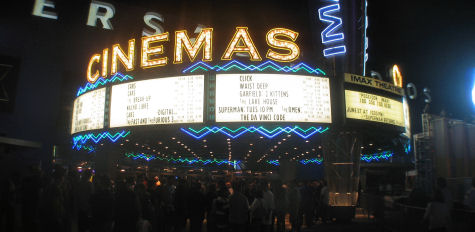
A whole lotta people were lined up at the Universal Studios 18-plex last night to get into three screenings of Superman Returns, the big draw being the IMAX 3D presentation at 10:30 pm. I saw the throngs as I came out of a Supie-3D 7 pm show, and I stopped and took a few blurry-ass photos. The after-effect was such that I forgot to set the camera to auto-focus.


Outside Universal Citywalk plex — Tuesday, 6.27.06, 9:42 pm

As I was doing this, however, I was indulging in my usual-usual — i.e. having second thoughts after a second viewing. And I’m now persuaded that Superman Returns should have been shorter. A really fine editor could go to work on it and (just spitballing) get it down to two hours and 15 minutes, say, or maybe a wee bit shorter with a thousand tiny cuts.
The spiritual current in this film is still, for me, wondrous and profound — Superman Returns is The Passion of the Christ for non-Christians. And the bring-it-home sequences — i.e., the ones involving disaster, rescue and redemption — are no less jaw-dropping, and each and every second of Brandon Routh tearing through the clouds and the heavens is spectacular. But the pace could be picked up…it really could. It didn’t seem labored when I saw it the first time, but last night it did here and there.
Not to the degree that it’s a major problem, but…well, put it this way. When the big-growing-Krypton-island sequence began, with those wretchedly ugly rock-spires starting to emerge through the waves, I started muttering to myself, somewhat fatigued, “All right…here we go again.” But not long after came the fantabulous 3D version of the scene in which Superman rescues Lois and family aboard Luthor’s sinking yacht, and everything was right again.

If only Singer had done what every good tree-trimmer does before finishing the job — if he had grimmed up and lashed himself with birch branches and said, “Okay, now comes the really hard part” and been a man’s man and gone back into the editing room and taken out the orange hand-snippers and started to shave little bits here and there…he could have delivered a film that would feel a little bit tighter and righter to guys like myself.
Spoiler alert…!!
Otherwise it’s a kind of gem, although to understand this you have to get that it’s primarily about the current within. Anyone saying they didn’t get enough of a sense of fun or frolic from this movie is missing that. Superman Returns isn’t “like” a church service — it is one.
Anyone bitching about Clark’s lack of loyalty and supportiveness for Lois (i.e., getting her pregnant and then disappearing for five years) and being a no-account absentee dad (which he is) doesn’t get what’s going on either. Did you ever hear any New Testament scholars dishing critiques about Yeshua’s not being more attentive to the ladies, or not getting married, or not being a more dutiful son to Mary?
I can sympathize with those complaining that Superman shouldn’t be able to carry that rocky land mass out into space because it’s laced with Kryptonite and therefore he shouldn’t have the strength, but I saw this as an act of will, devotion and self-sacrifice first and super-human strength and Kryptonite-vulnerablity second. Besides, the act obviously brings Superman to the brink of death…or perhaps to death itself.


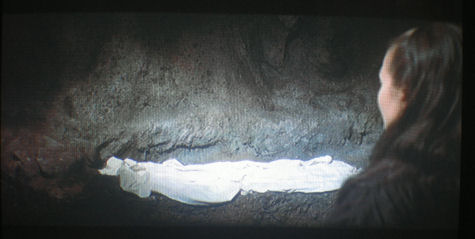
Mary Magdelene (Carmen Sevilla) discovering Christ’s empty bed in Nicholas Ray’s King of Kings

And I love, love, love the scene at the very end in which the nurse comes into the hospital room and finds only an empty bed and rumpled sheets.

Fashion Abrasion

Fashion Abrasion

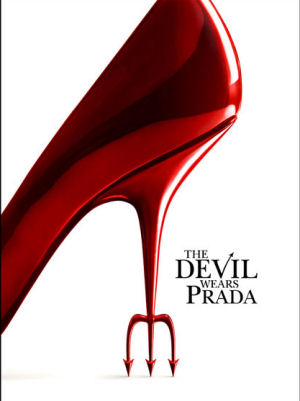
To the already-formed consensus on The Devil Wears Prada (20th Century Fox, 6.30), I have nothing new or startling to add.
Without Meryl Streep and Stanley Tucci’s performances, this very carefully measured girl movie set in the never-jangled world of a big-time fashion magazine — a tale of a young woman getting bruised, and then wising up and finding her way through a very tough racket — would be okay but only that. But with them — because of them — it’s savory as hell at times.


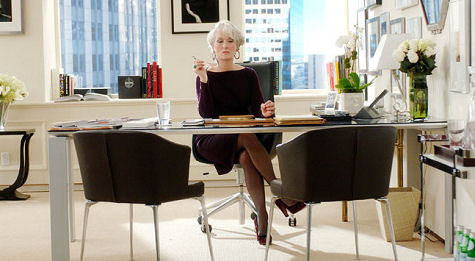
Anne Hathaway, Meryl Streep in David Frankel’s The Devil Wears Prada.

I don’t like chick flicks any more than the next guy, but this is a reasonably sharp and grown-up one with an above-average, big-city IQ.
It could be a little more wicked. I don’t know the fashion industry, but I’m sure it’s a lot darker, druggier, randier and more complex than the way it’s portrayed in The Devil Wears Prada. But this is a 20th Century Fox enterprise aimed at women with certain limitations (cultural, educational), and as such is above average.
< ?php include ('/home/hollyw9/public_html/wired'); ?>
Anne Hathaway’s performance as Andy Sachs, the main protagonst, is fine…but she’s been drawn with a soft pencil and it’s easy to give up on her — the character — early on because she feels too clueless and unparticular…too vaguely motivated as to why she’s working for Streep’s Miranda Priestly, the editor of a hugely successful fashion magazine called Runway.
One particular beef: Andy, we’re told, majored in journalism and edited a school paper, and yet, we’re told, she’s never heard of Priestley or Runway when she first interviews for the job. What would your opinion be of a real-life journalism major from a big school who’s never heard of Vogue or Anna Wintour?
I have some perspective on Adrien Grenier’s performance as Nate, the cute boyfriend whose purpose is to show us how Andy is relinquishing her everyday menschiness in order to perform her job. Nate, I can tell you, was a total drag in the Prada script that I read last year — too mopey, a guilt-tripper — but Grenier has given him extra flavorings and humor and made him more intriguing.
All this is secondary, of course, to Streep and Tucci, Streep and Tucci, Streep and Tucci…

In Lauren Weisberger’s best-seller of the same, Miranda Priestly was a shrieking banshee and a fit-thrower. (She’s based, accurately or not, on Wintour.) But Streep, very wisely, has toned the character down and, to a certain extent, humanized her.
I’ve been telling friends that Streep gives a performance very much like Al Pacino’s as Michael Corleone in The Godfather, Part II . Everything she says is quiet, muted, almost whispery…but there’s always something ferocious and vaguely malignant going on beneath the surface.
Miranda’s readiness to dismiss, berate or crush her underlings with the slightest facial gesture is a hoot. No one has ever made the words “that’s all” sound so resoundingly like a smart slap across the face. Streep’s final on-screen moment — I won’t describe it except to say it’s all about thoughts she’s having as she sits in the back seat of a chauffeured car — is hilarious.
And yet you can sense Miranda’s desperation and loneliness from time to time, and almost always her apartness. She loves her job and her power and won’t suffer fools, but you wouldn’t call her “happy.” (Or maybe you would.) Either way, this is an instant Oscar-contender performance, probably in the supporting category.
I don’t know many gay guys Tucci has played over the last five years, but he knows this turf and plays it like a champ every time, even when he doesn’t have much of a role, as in Prada. He’s playing Nigel, Streep’s right-hand man who’s also a caring friend of Andy’s, and he’s exactly right in every scene.

Emily Blunt gives a feisty, brittle performance as Emily, Miranda’s top assistant who’s so concerned with inner-office status that she’s always on the brink of nervous collapse. Thing is, I didn’t much like her. Always saying something bitchy or fuming, or acting hurt or shocked, or beset by a cold with sniffles and swollen red eyes. All reaction…nothing centered.
You can certainly detect the influence of director David Frankel’s having directed several episodes of Sex and the City and Entourage.
When I first saw Prada in a suburb north of Las Vegas, I was sitting in the midst of a group of women in their 30s and 40s. When it was over I could feel their reactions. They were okay with it, but the emotional impact wasn’t much. They weren’t lifted out of their seats. I don’t know if this means anything or not.
The weakness, I know, is with Andy and not Miranda or Nigel. It’s not a fixable problem at this stage, so either you roll with it or you don’t.