Open Letter to Polanski Haters

HE to Adele Haenel and the international #MeToo Community:

Last night I re-watched Roman Polanski‘s The Pianist, which I hadn’t seen for roughly 17 years. I watched it because I’d recently seen Polanski’s J’Accuse, and was reminded of what a brilliant artist he’s always been, especially when the spirit is upon him. Repulsion, Knife in The Water, Rosemary’s Baby, Chinatown, Tess, The Ghost Writer, Cul de Sac — uncomfortable as this may seem to some, there is unmistakable genius in the man. He also radiates (and you really have to be exceptionally stupid to miss this) basic compassion. You can always feel the pulse in a Polanski film.

You can’t watch The Pianist and not say to yourself, “The man who made this clearly knows the horror that Warsaw Jews experienced during the German occupation of the early to mid ’40s, and also knows about love, family and kindness.” I was also reminded that many of the same qualities — frankness, intelligence, scrupulous attention to detail, magnificent visual compositions — are abundant in J’Accuse.

The difference, of course, is that anyone can watch The Pianist, but no one in the U.S. and England can watch J’Accuse in a theatre, on a Bluray or even via streaming.

Because of you guys. Because you believe that Polanski’s rep must be permanently tarred and feathered and therefore J’Accuse, too, must be buried or otherwise scrubbed from existence. Because of reputedly credible accusations of Polanski having behaved badly and perhaps even criminally with certain younger women in the ’70s and ’80s. And because the distribution community is terrified of what you’ll say and do if one of their number would even consider streaming J’Accuse.

Here’s the thing — Polanski the man is not the same thing as Polanski the artist. His depiction of awful or ghastly things in his films (he’s never explored Pollyanic fantasy and escapism) has never conveyed a corrosion or poisoning of his own spirit. He understands what goes, how it all works, who the good guys are. This is quite evident in The Pianist and J’Accuse. But the latter is nonetheless going to be buried for a long time to come, or so I’m told.

To hear it from distributors, the #MeToo community has destroyed any possibility of J’Accuse being seen theatrically in this country, but is it really necessary to keep this truly magnificent and honorable film from being streamed? Prevented from simply being watched and contemplated privately, domestically?

You should understand that this is not a good look for #MeToo. If not now then certainly in the near future and for all time to come.

HE to Parisian distribution sales guy (sent Tuesday night): “How many millions in this pandemic would love to buy access to Roman Polanski‘s J’Accuse? All you have to do is allow streaming from France to the US. Please level with me. You guys aren’t interested in tapping the English-speaking U.S., British and Canadian streaming market because of fears of the French #MeToo community? You’re afraid of what Adele Haenel might say? Is that it? Please forgive me but this seems so wrong.”

Parisian distribution sales guy to HE (late Wednesday night): “To make it simple, no streaming company operating in the UK or US will risk putting Polanski’s J’Accuse on their service. It has nothing to do with the potential customers but rather with the association of the Polanski brand. A streamer takes fewer chances if he/she doesn’t offer a Polanski title than if he/she does. But times may change…”

Read more

Job Is Finished

It took around four hours to complete the Coral Gables transformation. The place now has a kind of Key West feeling. A three-day effort altogether — Saturday, Monday and today.

Height of Pandemic Fashion

I’d be lying if I said I’m not pleased with my new polka-dot face mask. Tatyana says it’s foolish because it’s not an N95-level mask; she says it’s for bank-robbing at best. Nonetheless it looks better than my white N95 masks (I have three or four) or the lightweight paper surgical masks I’ve been wearing for the last couple of weeks. Be honest — if you had a choice between a run-of-the-mill mask and this Bloomingdale’s variation, which would you wear as you walk your dog or hit the gas station or whatever?

Another “Nashville” Fracas

A couple of days ago I stood up like Davy Crockett against Larry Karaszewski and his motley band of Nashville worshippers on Facebook. I held my ground, swinging Ol’ Betsy as General Santa Anna’s troops stormed and besieged. It’s so bizarre that accomplished people who know what they’re talking about have remained Nashville fans. My initial “Okay, The Nashville Jig Is Up” piece ran on 12.14.13. Why didn’t Steven Gaydos jump into this when musketballs were flying and gunpowder was short?

“Peter, What Are You Doing?”

Comedy is a deadly serious business. We all understand that the best comedies are those that are played absolutely straight, and the worst are those that send signals to the audience that something is intended to be funny. Goofing off, self-pranking, going too broad, etc. It follows that actors must never laugh at anything the audience may or may not laugh at. Signalling that something is funny is called “breaking character” — a violation of the code.

It’s significant, therefore, that in this scene from Stanley Kubrick‘s Dr. Strangelove, perhaps the greatest straightfaced comedy ever made, a serious actor can be seen dropping the ball.

Peter Bull, as Russian Ambassador Alexi de Sadesky, is the violator. It happens at 1:26 or thereabouts. Peter Sellers‘ titular character repeatedly beats his rebellious Nazi arm and Bull, standing nearby with a group of U.S. military officers, can’t help himself — he starts to grin very slightly but then reverts back to sternface. It’s surprising that Kubrick didn’t call for a retake.

Coral Clark Gable

I’m sorry but I’ve spent the last six hours painting the living room. Which of course involved more than just painting. I had to remove paintings and photos from the wall, tape off door jams, floorboards and light sockets, spread the plastic covering over floors and furniture, paint the main portions with a roller and then brush-paint the tops, bottoms and corners, which takes forever to do correctly.

Never Trust The Artist

In a 3.18 AP interview with Jake Coyle, legendary director Brian DePalma was asked to name his peak career period.

You naturally assume he’ll say either (a) the late ’60s to mid ’70s or (b) the late ’70s to late ’80s. Nope — the sweetest career chapter was between the early to mid ’90s, he claims.

De Palma: “In my mid 50s [actually his early to mid 50s], doing Carlito’s Way and then Mission: Impossible. It doesn’t get much better than that. You have all the power and tools at your disposal. When you have the Hollywood system working for you, you can do some remarkable things.”

I’m sorry but DePalma is wrong. He was a truly exciting, must-watch director from the late ’60s to mid ’70s (Greetings, The Phantom of the Paradise, Sisters, Carrie), and an exasperating, occasionally intriguing director from the late ’70s to late ’80s (Dressed To Kill, Scarface, The Untouchables). His ’90s films certainly don’t match those of the previous decade, and his ’70s output, as noted, reigned supreme.

As I noted five years ago, De Palma is “one of the most committed and relentless enemies of logic of all time. For a great director he has an astonishing allegiance to nonsensical plotting and dialogue that would choke a horse. I tried to re-watch Blow Out last year — I couldn’t stand it, turned it off. The Fury drove me crazy when I first saw it, although I love the ending. I found much of Dressed To Kill bothersome when it first came out 35 years ago, and to be honest I haven’t watched it since.”

Reade Tosses Grenade

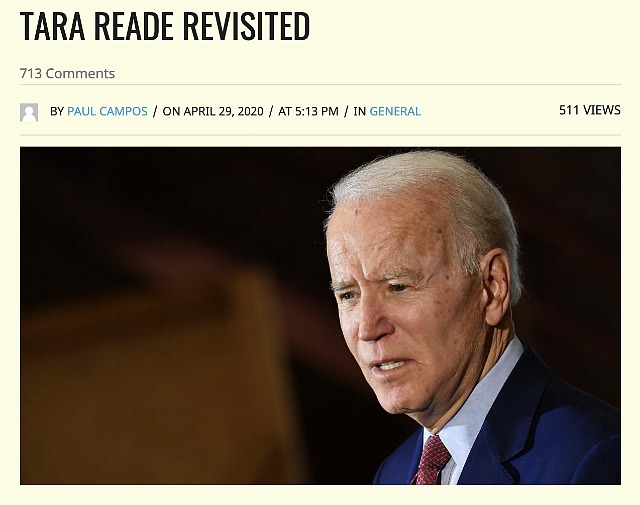
On one hand we have a temperamental sociopathic president mishandling the pandemic to a mind-boggling degree, and an upcoming presidential election in which the aging but decent-hearted Joe Biden may prevail, God willing. On the other hand we have former Biden aide Tara Reade claiming that Biden sexually assaulted her 27 years ago (“kissed her and penetrated her with his fingers without her consent”) and that he became annoyed and reacted with hostility when she rebuffed him.

If it happened, it happened. But why talk about it now? Long suppressed trauma needs closure and healing — we all understand this — but has Reade considered the possibility that what she may or may not have endured during the first year of the Clinton administration isn’t quite as important as Donald Trump being unseated next November? Biden may or may not be guilty but he hasn’t been similarly accused by anyone else, or not to my knowledge.

Reade was presumably in her early to mid 20s in ’93 and is now 50 or a bit older. She said yesterday she’s “a lifelong Democrat” who voted for Barack Obama twice as well as for Hillary Clinton. She didn’t come forward about Biden earlier because she had a young daughter at the time. But she’s out there with her story now, and in so doing giving the Trump campaign a weapon.

Again — who would decide that settling a score or attaining closure about an undoubtedly traumatic episode (if in fact it actually happened, and I’m not trying to dismiss or minimize anything or anyone if it did)…who would conclude that this is more important than the fate of an entire nation?

And by the way, what was that Russian thing she wrote a couple of years ago? **

Read more

Absolute Masterpiece

Last night I finally saw Roman Polanski’s “J’Accuse” (aka An Officer and a Spy). Yes, I watched it illegally, but we’ll never see it in this country because of the #MeToo Khmer Rouge prohibition of all things Polanski and so I figured, okay, just this one time. Actually I also watched Woody Allen‘s A Rainy Day in Manhattan illegally, and with the same justification.

In any event I watched it on the 65-incher in 1080p with English subtitles, and my God, the “holy shit, this is great” and “why can’t more films be this good?” current. The 86 year-old Polanski is undimmed…he seems to be as commanding and bull’s-eye as when he made Repulsion, Chinatown, Rosemary’s Baby, etc.

J’Accuse has been crafted with absolute surgical genius…a lucid and exacting and spot-on retelling of an infamous episode…a sublime atmospheric and textural recapturing of 1890s “belle epoque” Paris, and such a meticulous, hugely engrossing reconstruction of the Dreyfus affair…a tale told lucidly…a clue-by-clue, layer-by-layer thing.

You know what J’Accuse is? A bedtime comfort flick — comforting because it’s so damned good.

Stop me if you’ve heard this before, but it’s a tale of anti-Semitism and a rigged conviction for treason, an innocent man condemned to Devil’s Island, nationalist rightwing groupthink, suppression of the truth and the punishment of those who would bring the perversion to light.

Most of us know the basic bones, but Polanski’s film is absolutely riveting because of the detailed approach that he applies to each and every character, setting, line, costume, light source and choice of location. Adult-level subtlety to die for.

It’s my idea of a perfect film in every respect — Polanski and Robert Harris‘s brilliant screenplay, the ace-level production design by Jean Rabasse and art direction by Dominique Moisan, Pawel Edelman‘s naturally lighted cinematography, Alexandre Desplat‘s music…every single element is aces. Polanski concentrates on elements that 99% of today’s directors would run screaming from. The discovery portion of the film is all about ripped-up letters pasted back together, bureaucratic records, folders, etc.

Jean Dujardin’s lead performance as Georges Picqart, the intelligence officer who uncovered the frame-up, is easily his career-best. Ditto Louis Garrel as Dreyfus plus Emmanuelle Seigner, Mathieu Amalric, Melvil Poupaud, Eric Ruf, Laurent Stocker, etc. And with everyone under the constraints of the era, of having to hold themselves erect and behave in a stiffly correct manner.

I was especially taken having recently endured Justin Kurzel’s True History of the Kelly Gang (IFC Films, 4.24), which looks and feels like nothing more than a director re-inventing and re-stylizing the past in order to show off and look cool. I got through it but not without frustration.

J’Accuse is a textural, cerebral masterpiece, and yet one of the most affecting anti-racism films ever made. The sight of the Parisian nationalists and anti-Semites cheering on the lying military brass…the MAGA redhats of their day.

Read more

Passing of Stuart Gordon

The late Stuart Gordon had a rich and varied life, but he was mainly known for one thing and one thing only — his riotously funny horror-comedy Reanimator (’85), which I saw with five or six friends at Manhattan’s Rivoli (B’way and 49th) in late October 1985. We were all working at New Line Cinema at the time, my specialty being publicity and press kits. The Rivoli viewing, no lie, was one of the greatest theatrical experiences of my life — we laughed, howled, screamed, thigh-slapped, spilled our drinks and popcorn, laughed some more.

As it happened I soon after moved into a bungalow complex on Hightower Drive, and Reanimator star Jeffrey Combs was living right next door.

Reanimator was directed and coadapted by Gordon, the source being H.P. Lovecraft‘s “Herbert West: Reanimator“, a horror short story written in 1921. his partner Brian Yuzna produced it, and the coscreenwriters were Dennis Paoli and William J. Norris.

They all deserve an eternal pat on the back for coming up with the most insanely perverse oral sex scene in the history of motion pictures.

Gordon passed yesterday at the age of 72.

Read more

Woody’s Days in Capua

I’ve read a little less than half of Woody Allen‘s “Apropos of Nothing.” I’ve gotten as far as the launch of Play It Again, Sam, his 1969 stage comedy that costarred himself, Diane Keaton, Tony Roberts and Jerry Lacy. This was also when his romantic relationship with Keaton began.

I’m loving the book completely, but I have to say that the portions dealing with Allen’s fascinating if occasionally bewildering childhood and early adolescence in Brooklyn (roughly his first 15 or 16 years) make for richer reading than the portions that cover how his career began — first as a kid who submitted jokes to Manhattan newspaper columnists, then an in-house joke writer, then as a comedy contributor to The Colgate Hour and Caesar’s Hour, then his beginnings as a stand-up comic in the early ’60s, etc.

The “starting to make it happen” stories are fine, but the childhood stuff is full of wide-eyed wonder, fevered impressions, impossible dreams.

Allen’s description of his first look at 1942 Times Square, when he was seven years old and his father had taken him along on some errand, is truly thrilling. Ditto how he loved the way women looked and smelled and felt during brief hugs when he was knee-high to a grasshopper. Plus the absolute joy of watching old-school movies every Saturday afternoon with a five-years-older female cousin at his neighborhood theatre. A lot of this material was covered in Radio Days, of course, but the writing is tart and wise and a joy to sink into.

The childhood portion, in short, is like the first 35 or 40 minutes of Stanley Kubrick‘s Spartacus (i.e., the first 25%) inside the gladiator school in Capua — the story tension and the personal suspense element about when and how Kirk Douglas and his bros might break out. Apropos of Nothing is similarly about young Woody’s confinement inside his family’s small apartment and the middle-class neighborhood he explored as a kid, and always the hovering question of when and how he’s going to break free.