Push Comes To Shove

The first truly exciting film of the 2019 Cannes Film Festival screened this afternoon — Ladj Ly‘s Les Miserables. Set in the Parisian suburb of Montfermeil, a poor but tightly knit Muslim community, it offers a jolting contemporary echo of the cruelty, harassment and oppression that ignited Victor Hugo’s classic 1862 novel, this time rooted in police brutality and racial animus.

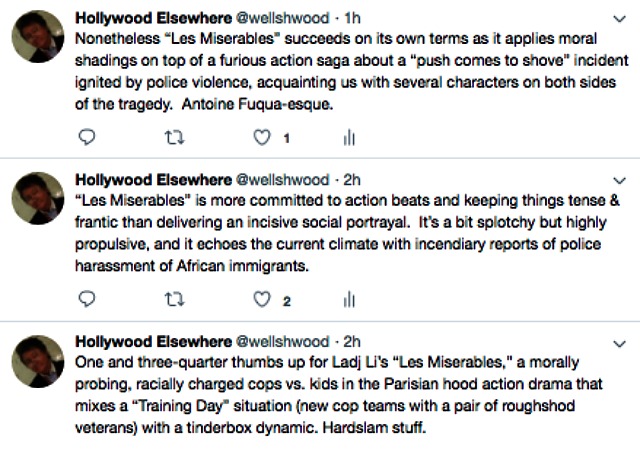
Start to finish Les Miserables is rough, riveting, incendiary — written by Giordano Gederlini and Alexis Manenti and brilliantly shot by Julien Poupard. It generally feels like a rough-and-tumble Antoine Fuqua film, using the basic dynamic of Training Day (but with three cops instead of two) plus a Little Do The Right Thing plus a dash of the anxious urban energy of William Freidkin‘s The French Connection.
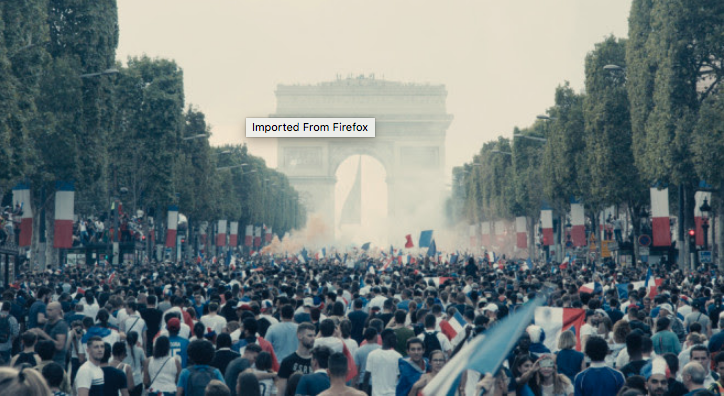
But it’s about more than just urban action beats. It’s a racially charged tragedy, injected with sharp social detail and several strong (if somewhat sketchy) characters on both sides of the tale. It’s a bit splotchy and slapdash at times, but is quite the ride.

Part policier and part social-canvas suspenser, Les Miserables is basically about conflicted cops (including one bad apple) under pressure vs. a crew of scrappy, rambunctious, vaguely criminal kids in the ‘hood. It takes the side of Montfermeil natives (Ly was raised there) but also portrays the cops in reasonably fair and humanistic terms.

Closing motto: “There are no such things as bad plants or bad men. There are only bad cultivators.”

The story is about a mischievous Muslim kid named Issa (Issa Perica) who gets himself into hot water by stealing a lion cub from a small local circus. The circus guys angrily threaten some Montfermeil community leaders (not the suit-wearing kind), and soon after the film’s three plainclothes protagonists — the racist and brutish Chris (Alexis Manenti), a casually brusque but decent-hearted Montfermeil native named Gwada (Djibril Zonga) and Stephane (Damien Bonnard), a new transfer with a curtly liberal, mildly compassionate approach to police work — are on the hunt.

They eventually chase down and capture Issa, but then comes the triggering incident: an agitated Gwada fires a flashbang (a non-lethal stun grenade) into the kid’s face. Luckily Issa recovers, but Chris and Gwada go into panic mode when they quickly realize that the incident has been captured by a drone-mounted video camera. Despite Stephane’s objections, the priority becomes finding and destroying the visual evidence.

Things get increasingly hairy and desperate, ultimately leading to a climax…okay, I’ve said enough.

I won’t reveal the finish but it reminded me of the last two or three minutes of Asghar Farhadi‘s A Separation. I for one found it satisfying.
Earlybirds Get The Worm

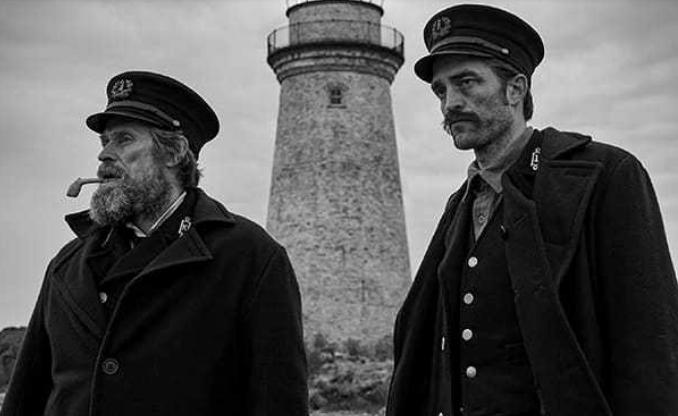
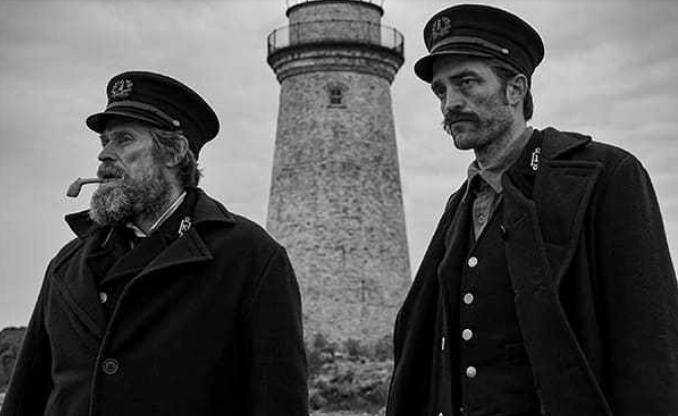
The news about Focus Features having bought international rights to Robert EggersThe Lighthouse, which will screen in the Directors’ Fortnight section on Sunday, obviously ups interest levels. Which means that getting into either of the two Lighthouse screenings (8:45 am and 8:30 pm) will require extra determination and stamina.

Elite press badges cut no ice at Directors Fortnight screenings. Everyone is on an equal footing, so you just have to line up outside the J.W. Marriott and hope you’ve arrived early enough. Gaspar Noe‘s Climax was the hottest Directors Fortnight attraction last year, and it took me two tries before I got in.

The Lighthouse solution, I’ve decided, will require a 6 am Sunday wake-up and arriving at the Marriott by 7 or 7:15 am. I recently urged an industry friend, who’s intrigued by The Lighthouse having been shot on 35mm black-and-white celluloid, to join me at that hour. I explained that the 8:45 am offers the only realistic shot because access to the 8:30 pm screening will be a huge time-eater. Awaking at dawn is simply a matter of will.

Passive Zombie Contemplation

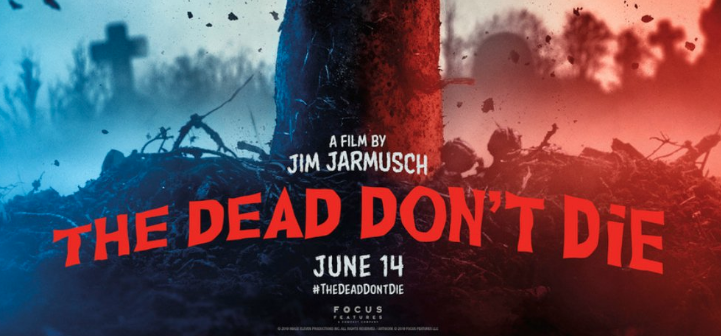
Dry, droll and deadpan are what you always get with Jim Jarmusch (and that’s fine with me), but The Dead Don’t Die, a small-town zombie comedy, is too slow, passive, resigned, lethargic and self-referential. It kind of works during the first half, but gradually spaces itself out.

Die‘s central problem is that it’s about watching a zombie apocalypse rather than somehow dealing with it.

Strange as this sounds, none of the characters actually try to survive. Well, they do but half-heartedly. It’s a hipster goof-off riff, but if you want to get serious and divine a social-political message, the film is basically saying “we’re going so wrong now and are more or less fucked at this point so why even fight it?”

Jarmusch occasionally flirts with the thematic thrust of George Romero‘s Dawn of the Dead (passive, brain-dead consumers are real-life zombies) and takes shots at the spreading Trump cancer, but he doesn’t really engage. Well, he does but in the manner of an aging, despairing, heavy-lidded type.

The Dead Don’t Die is baroquely amusing here and there, but the mood of laid-back nihilism and a general “submission to the plague” mentality is too persistent. Around the two-thirds mark the lack of any semblance of narrative energy starts to work against itself.

Horror fans are going to stay away in droves, Joe Popcorn is going to say “where’s the movie?” and Jarmusch devotees are going to feel under-nourished.

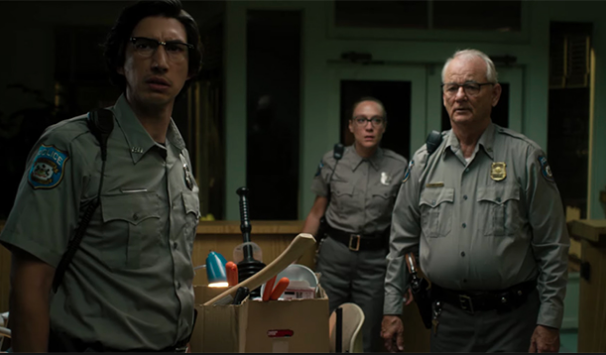
Bill Murray, Adam Driver and Chloe Sevigny play cops in an upper New York State town called Centerville, and all they really do is watch and comment, watch and comment, watch and comment.

Tilda Swinton plays the only truly cool character — an eccentric small-town samurai mortician.

Tom Waits plays a kind of Greek chorus character named Hermit Bob — a woods-dwelling hobo who provides despairing commentary now and then, especially toward the end. Steve Buscemi, RZA, Danny Glover and Caleb Landry Jones are typical Jarmusch-styled eccentrics (a snarly Trump fanatic with a dog named Rumsfeld, a wisdom-dispensing UPS delivery man, a kindly townie, and a gas-station owner with an encyclopedic knowledge of film and comic books, respectively).

I’m sorry to be panning. I’m a huge fan of Only Lovers Left Alive (which I only saw once but has gotten better and better the more I’ve thought about it) and Paterson. I had the feeling during tonight’s screening that Jarmusch wrote the script too quickly and hadn’t really thought things through. But the main problem is that his story and direction are just as lethargic as his characters.

Shatterankle

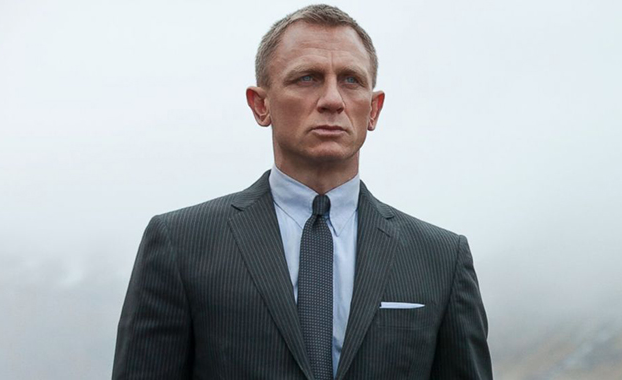
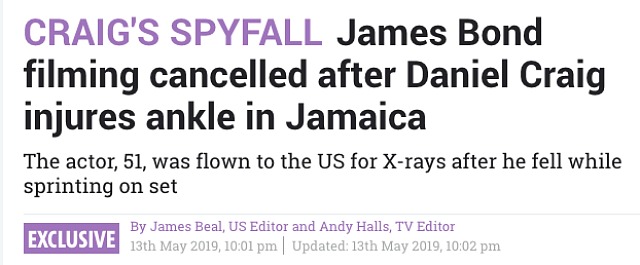
Daniel Craig pulled a Tom Cruise last week in Jamaica, injuring his ankle during a running scene and consequently throwing the shoot of Bond 25 (aka Shatterhand) out of whack.

What was your first thought after hearing of this? Right — you wondered how old Craig is (51) and if that might have been a slight factor. The answer is “it might well have been.” Craig is squarely middle-aged and not even within flirting distance of being “old”. But you do wither slightly at that age. Running, fighting and leaping-wise, the optimum window is between your late teens and mid to late 40s. After that an actor is probably better off playing “M” or “Q.”

Genes, luck and discipline are always key factors in shooting action scenes, but one or more of these probably failed Craig, who’s been injured three or four times before while Bonding. Biology, man. You can run but you can’t hide.

After the fall Craig “was in quite a lot of pain and was complaining about his ankle,” according to a source who spoke to The Independent‘s George Simpson. “As you’d expect he was also pretty angry that it had happened. He threw his suit jacket on the ground in sheer frustration.”

Craig: “Fuck, fuck, fuck, fuck, fuck! I’ve done this kind of action scene dozens of times before. What the hell happened?”

Sean Connery was 52 or so when he shot in last Bond film, Never Say Never Again (’83). Pierce Brosnan was the same age when he hung up his Bond spurs in ’05. Roger Moore was 57 or 58 when he did his final Bond, A View to a Kill (’85). They were all pushing it. They all tasted a bit of luck.

HE says the ideal Bond actor should be in his early 30s (the rugged-looking Connery was 32 when he made Dr. No) to late ’40s, depending on the breaks. After that it starts (I say “starts”) to become a game of roulette mixed with careful choreographic planning.

Read more

Usual Pre-Festival Revelry

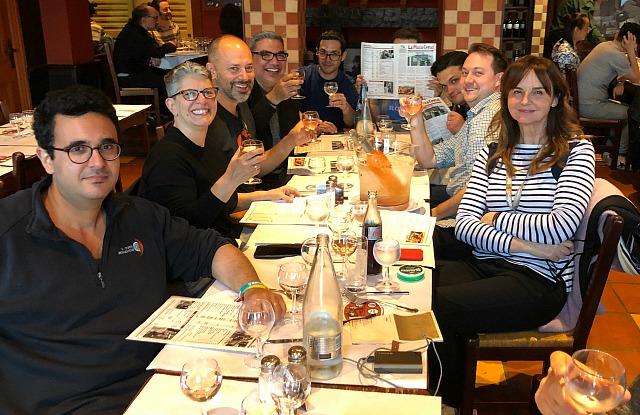
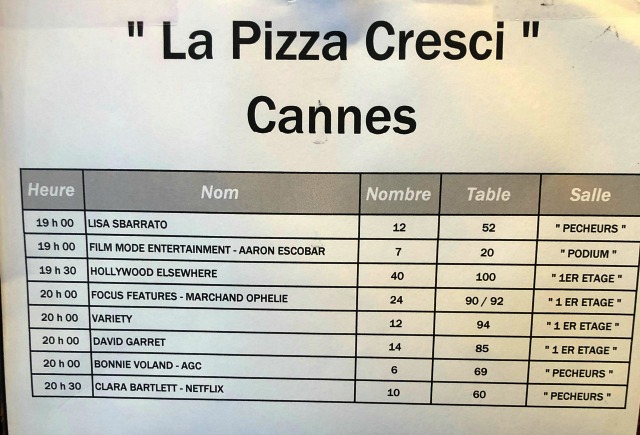
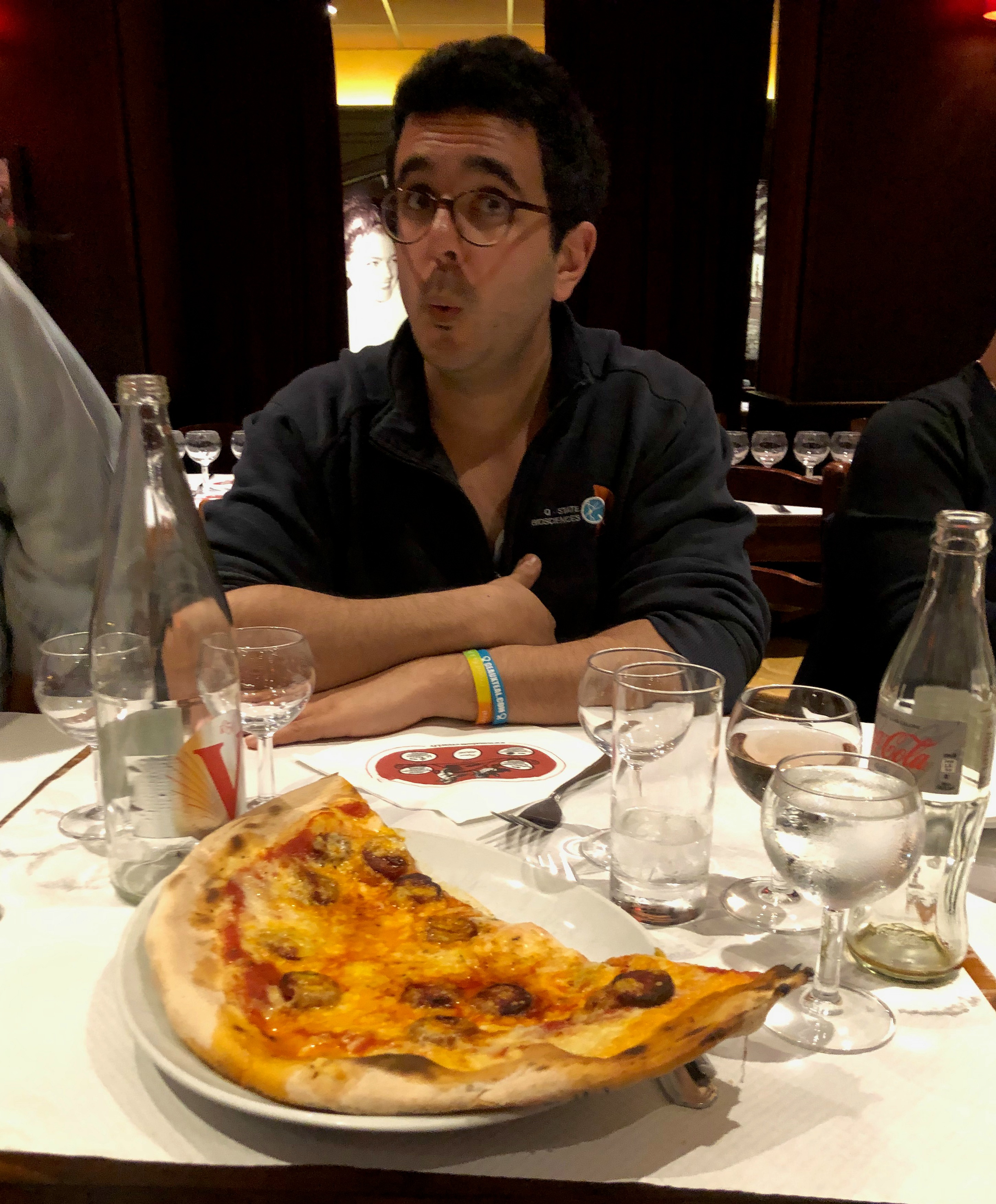
The La Pizza guys honored HE’s reservation, but they somehow got the idea that 40 guests were expected. “That was a mistake, possibly on my part,” I explained, half expecting to get my knuckles rapped. “I’d like to predict but people do what they want…I mean, the guests could be as few as 20 or 25.”

The waiters were counting on a much bigger bill and tip, you see, so they were a teeny bit miffed. I must have said “I’m sorry” three or four times, but the La Pizza guys were giving me side-eyes left and right.

I explained that Toronto Star critic Peter Howell was on deadline, a plane carrying Indiewire‘s Anne Thompson was late, N.Y. Times “Carpetbagger” Kyle Buchanan was downstairs and not into the upstairs crowd and Variety‘s Owen Gleiberman had opted to join his colleagues (including editor Claudia Elller) three or four tables down from ours. And Variety‘s Steven Gaydos was inexplicably MIA. And no sign of Deadline‘s Pete Hammond.

Plus there’s a kind of Hatfields-vs.-McCoys separatism between wokester critics and the not-so-woke, I told the waiters. It’s not the one-for-all, all-for-one crowd it used to be. A lot of prickly pears out there.

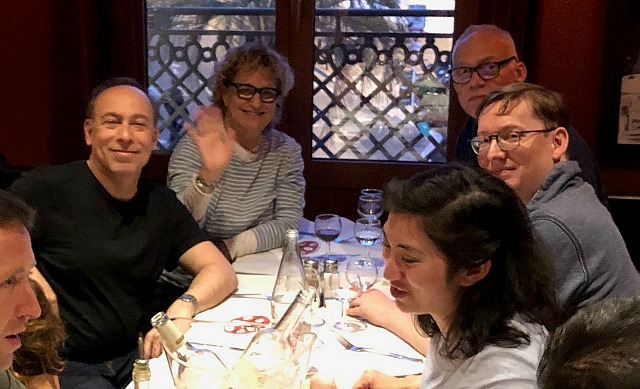
But things eventually worked out. Our banquet-sized table filled up, everyone ate and drank and the mood turned joyful and even boisterous. Raucous applause broke out when Thompson arrived; more cheers when Indiewire‘s David Ehrlich dropped by.

The bill ended up at 359 euros. Film at Lincoln Center exec director Lesli Klainberg generously picked up half the tab…that’s the American spirit!

Top group photo (l. to r.): Variety‘s Owen Gleiberman, Claudia Eller, Asian bureau chief Patrick Frater, Brent Lang. Fourth pic from the top (l. to r.): World of Reel‘s Jordan Ruimy, Film at Lincoln Center’s Lesli Klainberg, Miami Film Festival’s Carl Spence, Indiewire‘s Eric Kohn, Apple guy Matt Dentler, John Von Thaden from Magnolia Pictures and director (Show Me What You Got) & dp Svetlana Cvetko.

Read more

Remains Of The Day

HE’s Stockholm-to-Nice flight touched down at 9:30 pm, or a half-hour later than scheduled. Plus 25 minutes in front of the luggage carousel. I couldn’t locate the 15-euro bus, which usually takes 45 or 50 minutes. So I took Jordan Ruimy‘s advice and dragged my luggage down to the Gare de Nice-Saint-Augustin, which began operations in 1864. The hike took a little more than 15 minutes. Lots of twists and turns and fast-car-dodging, but I managed. The train ride was free — nary a conductor in sight.

Norwegian Dead Zone

My LAX-to-Stockholm flight was a typical 10-hour int’l flight, which is to say uncomfortable and interminable. A grim-up endurance test. Can you take it? Can you steel yourself and suffer through with grace and aplomb?

What made it especially bad was the absence of wi-fi. What airline doesn’t offer in-flight connectivity these days? Norwegian plans to join the club sometime next year, but for now Type-A passengers looking to file stories during a trans-oceanic flight are fucked.

It’s 4:52 pm, and I’m waiting to board the 6 pm Nice flight. And having gotten a grand total of 90 minutes of shut-eye, I’m starting to droop. I know this drill backwards and forwards. I’ll crash on the flight, and when I finally get to the Cannes apartment this evening I won’t be able to sleep.

Burgundy or Maroon

I know this is nuts. I know it’s irrational. I know there’s no reason the rest of the world thinks like this. I know this is just me and my private weirdness. But I have to add another item to my list of pet peeves, quirks, caprices, obsessions, superstitions and animal dislikes**.

So here it is: I hate people who wear maroon or burgundy-colored clothing — especially sweaters, sport jackets and scarves. Okay, I don’t “hate” people who wear maroon or burgundy, but I can’t fathom why anyone would want to wear such a horrid color and so the instant I see someone strolling around in a burgundy T-shirt or wearing maroon socks, I’ll mutter to myself, “The fuck is wrong with that guy?”

I’ll never “say” anything, mind. I keep it to myself or write about it, but I’ll never go up to some maroon-wearer and actually make a crack or something. I always keep that shit holstered.

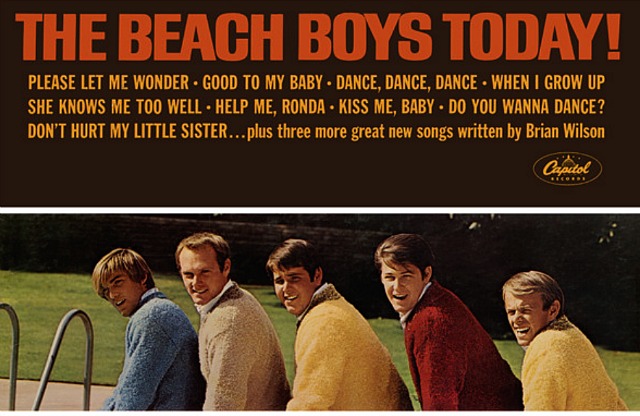
I’ve hated maroon sweaters ever since I first glanced at the cover of “The Beach Boys Today” and noticed that Brian Wilson (who was always kind of nerd when it came to apparel) was wearing one of these horrid things. I didn’t have to think about it. One look and I went “Jesus H. Christ.” From that moment I knew — I knew that maroon and burgundy were musts to avoid, and I didn’t know why or how or whatever. It was a gut call.

There are a lot of people with animal dislikes out there. Some people will just glance at you one time and say to themselves, “Okay, that’s it, I hate that guy.”

There are frothy-mouthed Twitter dogs who hate me today. They seethe and bark at the sound of my name. I don’t much like them either. But you know the difference between me and them? I keep it to myself, and I sure as hell don’t say “these guys should be hounded out of the business…don’t hire them or give them advertising!” I would never dream of tweeting something like that. No offense, but those who do this fall under the heading of “diseased scum.”

I can remember strolling into a mixed-company beer bar when I was in my early 20s, which is when I looked a bit feminine with my long hair and high cheekbones and slender features. And I just scanned the people sitting at the bar, and right away I spotted a guy who was giving me a look that said “oh, man, you’re fucking disgusting…I hate your ass….c’mon over and say something…I’ll punch your lights out,” etc.

This is how I feel about burgundy-maroon minus the physical threats.

I’m okay, however, with hand-crafted burgundy or cordovan lace-up shoes.

** People who take extra-long showers, people who shriek with laughter in bars and cafes, couples who obliviously block escalators or moving sidewalks, twenty- and thirtysomething Millennials who wear the same fucking outfit from coast to coast (baggy shorts, T-shirt, backward baseball caps, mandals or canvas slip-ons), the term “Portugese water dog,” people who can’t sing “Happy Birthday” on key, bar owners who won’t let me eat an innocent slice of pear cake as they’re stacking chairs and closing up shop, grandma types who would give my cowboy hat to the police, etc.

More Derry Horrors

27 years after the horrific events that took place in Derry, New Hampshire in 1989, the “Loser’s Club” — now in their late 30s — are back in the old town and looking to settle this nightmarish Pennywise shit (hauntings, spookings, self-reflections) once and for all.

Let me tell you something — if on the cusp of 40 you’re still seriously haunted or even psychologically imprisoned by your childhood traumas — if you’re seriously inhibited or impaired by bad shit that happened when you were nine or ten years old and you can’t seem to get past it, then you’ve got a serious problem on your hands. Most people get past their childhood shit, but here you are still frowning and fretting and grinding your teeth about it. The applicable terms are (a) arrested development and (b) pity party.

I for one don’t give a damn if you resolve your problems with Pennywise and the other bugaboos or not. You can all take a walk in a swamp

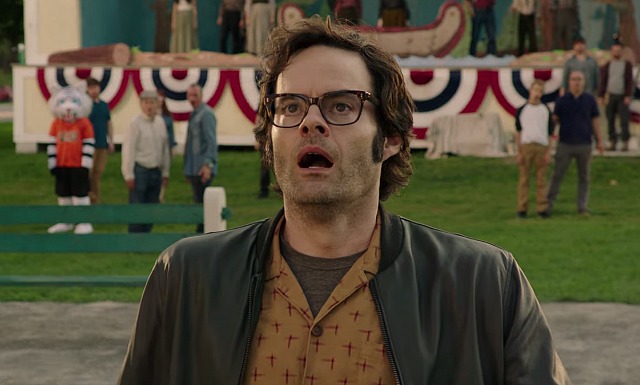
You didn’t have to be a megaplex moron to rave about the first It film, but it probably helped if you were. It (’17) was not a Hollywood Elsewhere film, and the same probably goes for the forthcoming sequel — It Chapter Two. The It films are for popcorn munchers — lowbrows who prefer their horror films to howl and jolt and gush blood and vomit in their laps.

And I love the fact that the there’s no colon or dash between It and Chapter Two on the poster — it’s like the filmmakers are shouting “hello, idiots…over here!”

Read more

On The Death of “Long Shot”

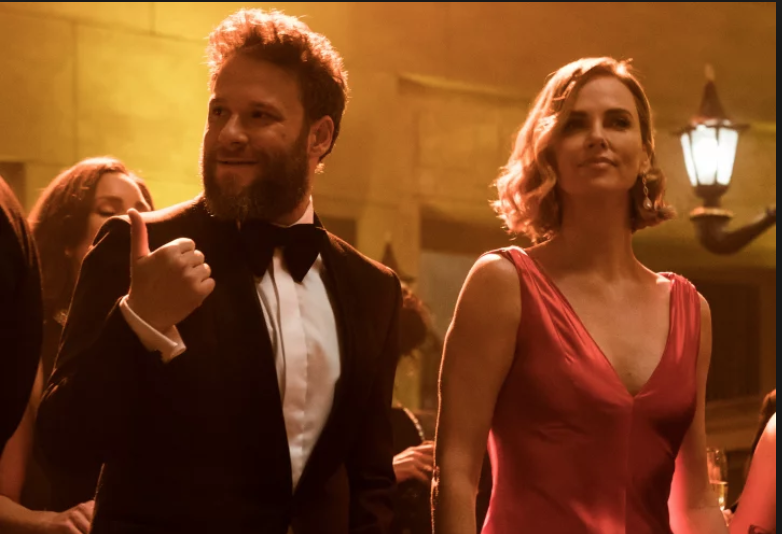
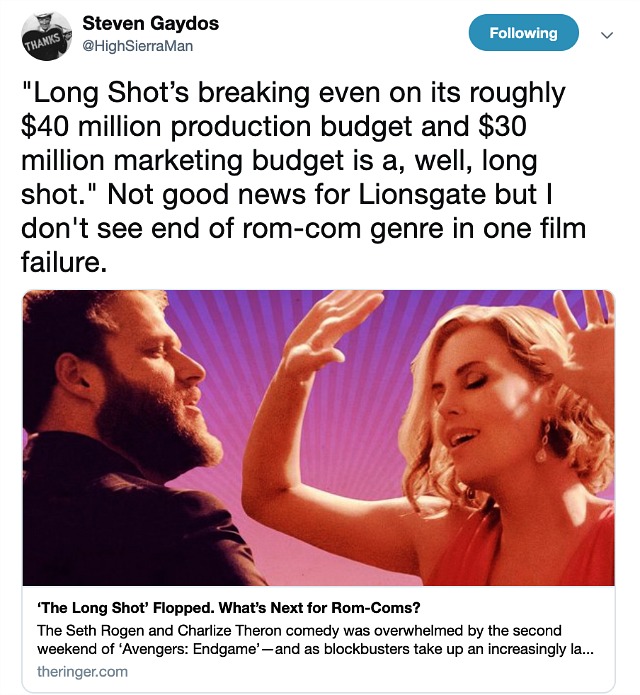
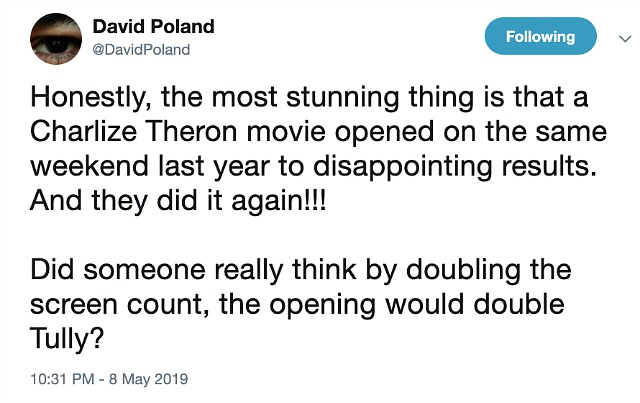
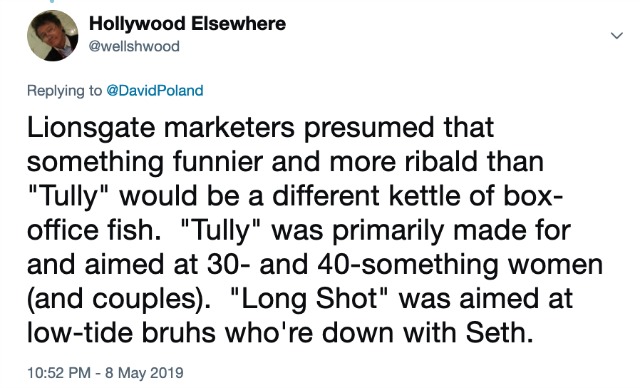
Jonathan Levine, Seth Rogen and Charlize Theron‘s Long Shot is a bust. After costing “roughy $40 million to make and another $30 million to market,” according to the N.Y. Times‘ Brooks Barnes, it made a lousy $10 million last weekend (it’s currently at $12 million) and will almost certainly suffer a 40%-or-higher diminishment during the next round (5.10 to 5.12).

The odds of tripling that opening weekend tally by the end of the run are not high. Face it — the movie was intermittently funny at best (I found it flat-out unfunny), the premise was absurd or at least distasteful (the toad-gazelle pairing of Rogen and Theron) and Joe and Jane Popcorn said “nope.”

No, wait — that’s not why it died. The handicappers are claiming that Long Shot sank beneath the waves because the competition from Avengers: Endgame was too fierce. So HE’s above-mentioned issues were incidental to its failure? I doubt it but you tell me.

Theory #1: Rogen is only 37 but he looks 49, and I’m wondering if the guy he’s been playing in film after film for the last 12 years (or since Knocked up) is starting to wear thin among his followers. I personally love the guy when he’s spouting impudent, sharp-edged dialogue, but his Long Shot character was a 16 year-old. Theory #2: It’s Charlize Theron‘s fault! The public accepts/respects her as a dramatic actress who takes chances, but is wary of watching her in a romcom mode. Theory #3: The movie blew chunks and the word got around. Theory #4 (see below): It’s Jon Feltheimer‘s fault!

Repeating For Clarity’s Sake

From “Joe Biden’s ‘Electability’ Argument Is How Democrats Lose Elections,” a 5.7 Vanity Fair piece by Peter Hamby:

“Since Vietnam, every time a Democrat has won the presidency, it’s because Democrats voted with their hearts in a primary and closed ranks around the candidate who inspired them, promising an obvious break from the past and an inspiring vision that blossomed in the general election. Jimmy Carter. Bill Clinton. Barack Obama. All were young outsiders who tethered their message to the culture of the time.

“When Democrats have picked nominees cautiously and strategically falling in line, the results have been devastating, as Michael Dukakis, Al Gore, John Kerry and Hillary Clinton made plain.

“It’s not a perfect rule: While Gore and Clinton didn’t quite electrify the country, they still won the popular vote. And George McGovern was a heart candidate who got slaughtered by Richard Nixon in 1972. But the McGovern wipeout is kind of what Biden and his loyalists are clinging to: the idea that this Trump moment, like the wrenching 60s, is so existential and high stakes that Democrats will overlook their usual instincts and do the sensible thing.

“Theatrical and Irish, Biden surely is hoping that he can be a vehicle for both passion and pragmatism. But if he wins the nomination next year, it will be because Democrats went with their heads, not their bleeding hearts.

Read more