Will There Be Two Versions of “The Irishman”?

Late this afternoon the legendary Martin Scorsese sat for a mostly French-language q & a today following a Director’s Fortnight screening of Mean Streets. The questions were almost entirely about the genesis and making of this 1973 classic. Scorsese recalled his Little Italy upbringing in the ’50s and early ’60s, and the crackling atmosphere of the 1973 Cannes Film Festival, where Mean Streets premiered and actually got booed by some.

The healthy-looking 75 year-old (who again was wearing violet socks) mentioned that the troubled bond between Harvey Keitel‘s Charley and Robert De Niro‘s Johnny Boy is based on the relationship between Scorsese’s dad and his nee’er-do-well younger brother. Scorsese also recalled the real-life influence of a man of the cloth, a kind of “street priest” who counselled him during his early-to-mid-teen years.

But all this fell by the wayside when Scorsese mentioned that his forthcoming The Irishman, a $180 million gangster flick funded mostly by Netflix, contains about “300 scenes.”

Right away I leaned forward and wondered if I’d just heard that. Because 300 scenes could translate into a helluva running time, perhaps as long as 450 minutes or 7 hours and 30 minutes. I asked Scorsese’s rep for a confirmation or clarification, but heard zip. Then an Associated Press story run by The New York Times reported the “300 scenes” quote, and I knew I hadn’t been hearing things.

In other words (and I’m just spitballing here) The Irishman could wind up as an expanded Netlix miniseries in addition to being shown as a shorter theatrical feature. Who knows? I know that a film with 300 scenes will definitely be a bear, length-wise. Too much of a bear for theatres, in fact, if Scorsese intends to use all or most of that footage.

The average scene used to last two minutes, give or take. But scenes today are shorter, or roughly a page and a half or 90 seconds per scene. By this standard a typical two-hour movie might contain 75 to 90 scenes. If the scenes last 90 seconds a film with 75 scenes would run 112 minutes; if the scenes number 90 the running time would be 135 minutes without credits.

Read more

Older, Beefier Bill & Ted

It was reported yesterday that 52 year-old Alex Winter and 53 year-old Keanu Reeves will costar in a third installment of the Bill & Ted franchise, titled Bill & Ted Face the Music. Bill & Ted’s Excellent Adventure began things in ’89; Bill & Ted’s Bogus Journey followed in ’91.

HE’s reaction is roughly the same as my thoughts about Dumb and Dumber To, which I explained in a 9.25.13 piece called “Long of Tooth“:

When Jim Carrey and Jeff Daniels costarred in the Farrelly Brothers’ Dumb and Dumber (’94) they were roughly 32 and 39 years old, respectively. Obviously not spring chickens but relatively buoyant, fresh-faced, elastic of bod. They’re currently costarring in the Farrelly’s Dumb and Dumber To, which I suspect will be funny and inventive (I was a fan of the Farrelly’s Three Stooges flick), but now we’re talking about a 51 year-old and a 58 year-old playing the same characters.

Dumbasses in their 30s vs. dumbasses in their 50s are different equations. You’re supposed to mellow down and gather a little wisdom out as you get older. You can fall into dumb-shit situations when you’re youngish but guys with creases on their faces are supposed to be craftier and less susceptible.

Read more

Irma la Meh

I saw on Twitter that in mid July Kino Lorber is bringing out a 4K remastered Bluray of Billy Wilder‘s Irma la Douce (’63). The disc will contain audio commentary by author and film historian Joseph McBride, with whom I maintain a correspondence.

So I wrote McBride the following: “What is there to say about the overlong, inauthentic Irma la Deuce? I like Andre Previn‘s musical score, but it moves so slowly and takes so long (147 minutes). Jack Lemmon‘s performance as Shirley MacLaine‘s policeman lover isn’t so much nervy or heart-touching as glumly dutiful. Lou Jacobi, as a local Pigalle bartender, is the only really good thing in it.”

McBride’s reply: “I’ve been working on a critical study of Wilder, following my critical study of his mentor Ernst Lubitsch, called “How Did Lubitsch Do It?” (Columbia University Press, 6.26). And so I was honored to be asked by Olive Films to talk about Wilder and Irma.

Irma represented an important stage in my own sexual liberation. I had to see it three times while I was a horny but guilt-ridden Catholic high school student and kept walking out before I could make it all the way to the end. So I thank Billy Wilder for helping free me from my religious scruples about sexuality.

“Ironically in that light, Irma is one of Wilder’s most romantic films, while also dealing with the seamy side of life, a paradoxical combination he often explored in his films both in Europe and the U.S. Irma shows him taking advantage of the new frankness allowed Hollywood filmmakers in 1963 and, as he often did, helping lead the charge. It deals openly with prostitution and mocks sexual hypocrisy, themes that pervade his body of work.”

I’d forgotten that Irma was Wilder’s most popular film. It cost $5 million to make, and brought in $25,246,588 — quite the sum in 1963 dollars.

Read more

“Attractive” Isn’t The Idea

Before last night’s screening of Asghar Farhadi‘s Everybody Knows, Salle Debussy journalists were more or less obliged to sit through live video of the red-carpet arrivals as well as opening remarks and tributes inside the Grand Lumiere. I was half-watching and half-texting while scrolling through Twitter. But Kristen Stewart‘s appearance struck me as comment-worthy.

I asked a youngish British journalist sitting to my right what she thought of Stewart’s radically cut, blonde-streaked hair, and she said “Oh…uhhm.” In other words she found it striking but didn’t want to share any impressions. I said, “The shorn sides and odd streaks and the smoky eye makeup…it’s just not very attractive.” Certainly not in a conventional hetero sense of that term, I meant, which is what Hollywood Elsewhere more or less goes by.

The journalist said, “Well, I don’t think ‘attractive’ is the idea.” What would the idea be then, I wondered? I actually was telling myself that the idea was to project an edgy sapphic thing, or some kind of statement against what most of us would call conventional foxy norms. But I didn’t want to discuss in detail that so I just said, “She doesn’t want to project an attractive appearance?” No response so I added, “You mean as a gay thing?”

That stopped the conversation in its tracks. British journo woman stared silently at the screen and I went back to Twitter.

Pre-Cannes Murmurs at La Pizza

The Cannes jury press conference happens today (Tuesday, 5.8) at 2:30 pm, but there’s nothing to see until Asghar Farhadi‘s Everybody Knows screens this evening. It screened last week for Parisian press, and the loose talk during last night’s La Pizza gathering was that it might be on the “meh” side. One journo said he’d heard it was similar to Farhadi’s About Elly, another said something about it being Farhadi’s Personal Shopper or — I’m reaching here — possibly in the vein of Almodovar’s Volver. The general feeling is one of slight apprehension rather than excitement.

One of the above said he can’t be specific, but that he understands that a major American film is probably going to get booed. Which is not a difficult achievement here, and is sometimes not that meaningful in the long run. (The journalists who booed Personal Shopper a couple of years ago look like idiots now.)

If the “going to get booed” thing is correct, the likeliest candidates would be David Robert Mitchell‘s Under The Silver Lake, which runs 139 minutes, or Spike Lee‘s BlacKkKlansman. They’ll debut roughly a week from now (Lee’s film on 5.14, the Mitchell the following day). The possible booing recipient could also be Ron Howard‘s Solo: A Star Wars Story.

The BlacKkKlansman rumor is that it’s a “buddy comedy,” but Lee did his best to shoot that notion down on Instagram [see above].

A friend who saw Under The Silver Lake some time ago: “Loved [Mitchell’s] Myth of the American Sleepover, and really like It Follows. I like some of Silver Lake” — presumed to be kind of an impressionistic cultural panorama of present-day hipster Los Angeles a la The Big Lebowski with a dash of Fellini Satyricon — “and I love Riley Keough, but Andrew Garfield is so flaccid and without any charisma or sexuality, and this movie really needs that. There are some great fun sequences and it certainly looks great, but all in all it just feels silly with a donut hole in the lead role.”

I’m making a point of catching Jim CummingsThunder Road, a father-daughter drama that was well received during South by Southwest 2018 and is screening on Saturday evening under the ACID Cannes program.

Read more

Cry of Harbor Seagulls

Having slept two and half hours on the train, I arrived in Cannes at 12:40 pm. Right away I didn’t care for the vaguely misty, milky-ish light, as if everyone was seeing everything through the eyes of Janusz Kaminski (i.e., HE’s second least favorite cinematographer after Bradford Young). My usual pink-wth-yellow-pastille badge is now dark gray with a rectangular pink-plus-yellow-dot strip, and it’s slightly smaller than before. The official carrying bag is cool — dark-denim colored and lightweight.

I went right back to the Old Town pad and slept again, bagging another two-plus hours. Now I’m unpacking and preparing to head over to La Pizza for the annual Cannes journalist soiree, which will start around 7:15 or so.

Asghar Farhadi‘s Everybody Knows, which may have problems, will be the first film out of the gate. The first press-access screening happens tomorrow night at the Salle Debussy at 7:15 pm, about 75 minutes before the 8:30 pm public screening inside the Grand Lumiere. Follow-up press-access screenings will happen daytime Wednesday. If you have a high-grade badge (white, pink with yellow pastille, pink) you’ll definitely get into the first-look press screenings, but the blue and yellow badgers may have to wait. It would so much simpler if the festival would just stick to the old system with a demand that embargos on reviews and tweets (i.e., concurrent with late afternoon or evening public screenings) be respected.

Read more

Idiotic Polanski Pitchforker

Sometime yesterday an Apartment-lover named Mason Daniel (aka “BuddyBoyBaxter”) claimed on Twitter that Roman Polanski conveyed his attitude about women in three films — “REPULSION: Woman protagonist is raped during night terrors — ROSEMARY’S BABY: Woman protagonist is raped by Satan to have his child — CHINATOWN: Woman is raped by her father and gives birth to incest child.”

Daniel’s conclusion: “Yeah, really easy to apply ‘separate art from the artist’ with Polanski.”

Soon after The Hollywood Reporter‘s Scott Feinberg called this an “interesting observation” as in “hmm, you might have a point there, Mason!”

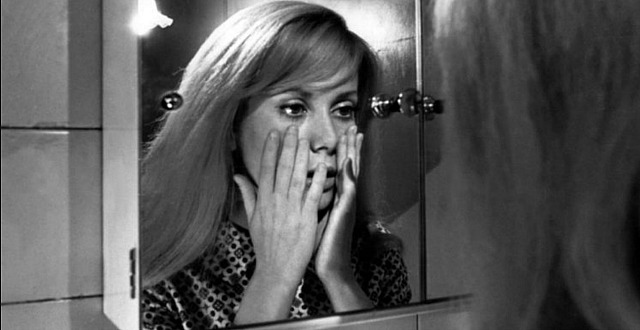
HE response: “Interesting” how, Scott? Because these scenes reveal Polanski’s mindset or something? Repulsion is a meticulous, carefully observed, very measured portrait of a young woman (Catherine Deneuve) descending into madness. First, the scene in question is an IMAGINED assault on Deneuve’s part. Second, what makes it stand out is Polanski’s decision to erase natural sound and use only the sound of a ticking alarm clock and the ringing of a bell. Film school lesson #1: It’s not what you show but how you show it that distinguishes pulp from art.

Plus: Rosemary’s Baby author Ira Levin created the sex-with-Satan scene, not Polanski. There couldn’t be any ducking away from this because the whole story hinges on this coupling. Plus: Chinatown screenwriter Robert Towne created the incest link between Evelyn and Hollis Mulwray, except, as Evelyn confesses to Jake Gittes, the sex wasn’t “rape” but consensual.

Conclusion: Mason Daniel is a moron.

Awakenings


Who sticks out in this wall poster? Obviously Brolin. Deadpool himself is presented as a secondary character.

Right outside Hollywood Elsewhere’s 2nd floor pad at 35 rue Andre Antoine.

Worst gelato flavors I’ve ever considered in my life.

Read more

A Cape Room?

For 40-plus years the Millennium Falcon was a souped-up “bucket of bolts” — a Kessel Run equivalent of a slightly grimy, seen-better-days 1965 Mustang that nonetheless had a powerful engine and could always jump into light speed if things got hairy.

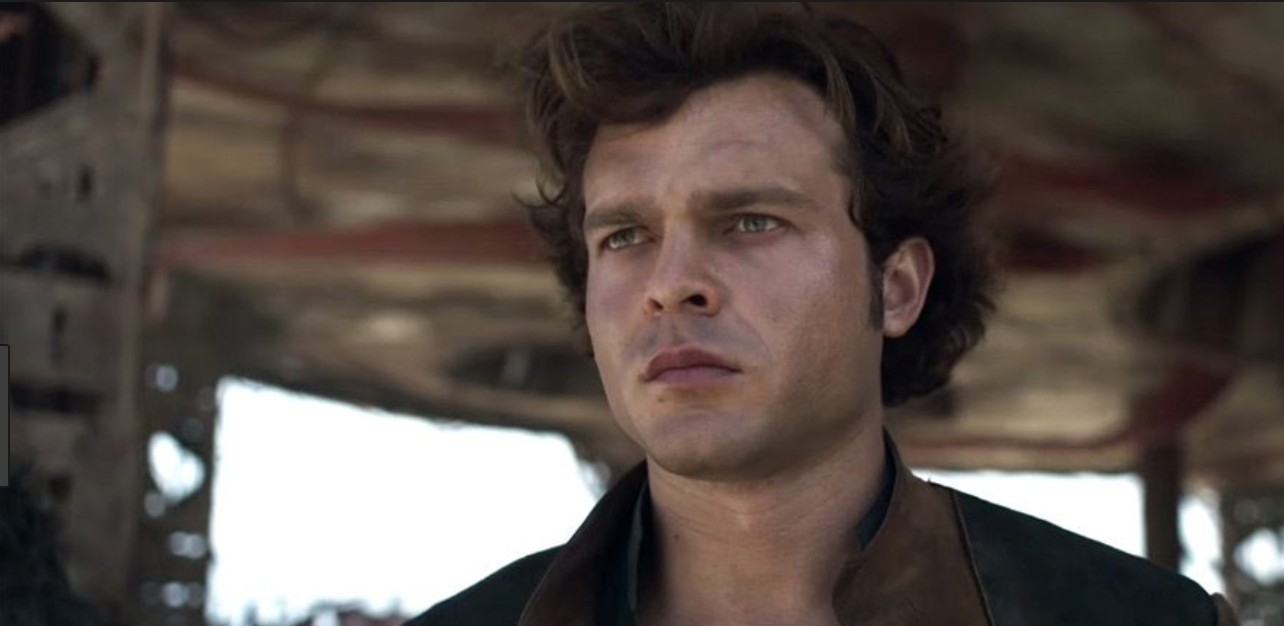
No longer. In Ron Howard‘s forthcoming Solo (Disney, 5.25) the Falcon is new, spiffy and packed with luxury perks. It even has a special Lando Calrissian “cape room”…arrghh! Like it’s been refurbished for Kanye West, Kim Kardashian and the kids.

On top of which Donald Glover pronounces the first syllable of Falcon like Hal Ashby or HAL 9000. Jesus Christ, Howard can’t even get his actors to say it correctly? Harrison Ford, Billy Dee Williams, Carrie Fisher, Mark Hamill and James Earl Jones pronounced that syllable the way Humphrey Bogart, Mary Astor, Peter Lorre and Sydney Greenstreet pronounced it — like the season, rhymes with “all.”

Black Klansman of ’66

Within the last 52 years, there have been two films called Black Klansman that don’t precisely deliver on what the title implies. First and foremost is Spike Lee‘s BlacKkKlansman (inserting the third “k” is arguably the most irritating film-marketing strategy of the 21st Century), which will debut at the soon-to-launch Cannes Film Festival. Second is a 1966 blaxploitation film called The Black Klansman, shot in the Bakersfield area during the 1965 Watts riots and directed by Ted V. Mikels.

As noted a month ago, Lee’s ’70s drama isn’t literally about a black guy joining the Klan but an undercover investigation of the Klan by the real-life Ron Stallworth (John David Washington) when he was the first black detective in the history of the Colorado Springs Police Department.

After initial correspondence with the Klan, Stallworth received a call in which he was asked if he wants to “join our cause.” According to an Amazon summary, “Ron answers the caller’s question that night with a yes, launching what is surely one of the most audacious, and incredible undercover investigations in history. Ron recruits his partner Chuck to play the ‘white’ Ron Stallworth. The “Chuck” character is apparently called “Flip,” and is played by Adam Driver.

This morning I found a reasonable-sounding review of the ’66 Black Klansman on a blog called Scared Shiftless in Shasta.

Key passage: “My expectation was that [The Black Klansman] would be something campy, poorly constructed and/or preachy. To my surprise, it was none of those things, but an earnest, serious treatment of what was clearly exploitation subject matter, but which never elicits any unintended humor. Even with the Victor/Victoria-like mind-melting idea of a white actor playing a black man who pretends to be white, it doesn’t offend or condescend.”

Wiki boilerplate: “Set during the Civil Rights Movement, the film tells the story of an African-American man, Jerry Ellworth (Richard Gilden, a white actor), who is an LA jazz musician with a white girlfriend. Meanwhile, in an Alabama diner, a young black man attempts to exercise his civil rights by sitting at a local diner. When the Ku Klux Klan learn of this, they firebomb a church, killing Jerry’s daughter. When he learns of this, Jerry moves to Alabama to infiltrate the group responsible for his daughter’s death. Jerry dons his disguise and becomes a member of the inner circle, befriending the local leader and his daughter, and soon exacts his revenge.”

The original title of The Black Klansman was I Crossed The Color Line.

Read more

Cultural Mainstay

These days the 3rd arrondisement (northern Marais, intersection of rue Bretagne and rue Saintonge) is Hollywood Elsewhere’s favorite Parisian hang zone, but 15 years ago Montmartre (excepting the ghastly tourist section adjacent to Sacre Coeur) was my ground zero. One of the cultural lures of that neighborhood was and still is Studio 28, the nearly century-old repertory cinema on rue Tholoze. George W. Bush was in office the last time I caught a film there, but I’m very glad it’s still viable and thriving and using digital projection, etc. Those eccentric wall lamps designed by Jean Cocteau, the covered courtyard cafe, the literal aroma, the history…it’s Montmartre’s Film Forum. Honestly? I wrote this because I love the below photo, and I didn’t want to post without editorial comment.

Connecticut Compromise

European culture and gourmet cuisine often go hand-in-hand. 11 years ago I happened upon a small family-owned osteria in Rome’s Trastevere district. I can still taste a smallish pasta dish I ordered, served at just the right temperature and bursting with the flavor of fresh tomatoes and odd spices. I also recall wandering around Portofino, a seaside Italian village not far from Cinque Terre, a few years earlier. A bit touristy, but with the usual historical aromas and architectural charms and a warm, wonderful sense of “so glad I’m here…life doesn’t get much better than this.”

I’m mentioning these experiences because last night a friend and I visited Portofino, a respected Italian restaurant in Wilton, Connecticut — the woodsy, whitebread, not-overwhelmingly-liberal town where I went to high school for a couple of years.

It looked inviting from the outside, but I was hit with a big fat “uh-oh” the instant I walked in — three large flatscreens in the bar area showing ESPN. A sports-bar vibe (a general Hollywood Elsewhere no-no) always means “watch it…this may be an okay restaurant, but it’s catering to Ordinary Joes so grim up for some agreeable but unexceptional food.” That’s what we got. Acceptable meh. But with a nice candlelit atmosphere (if you were facing away from the bar area).

This is what upper Fairfield County dining is often about — cushy comfort vibes but minus the sublime flavors, seasonings and sauces. For people willing to settle. Not unpleasant but you’re also thinking “this is not what great servings can and should be — inoffensive but substitute-level.”