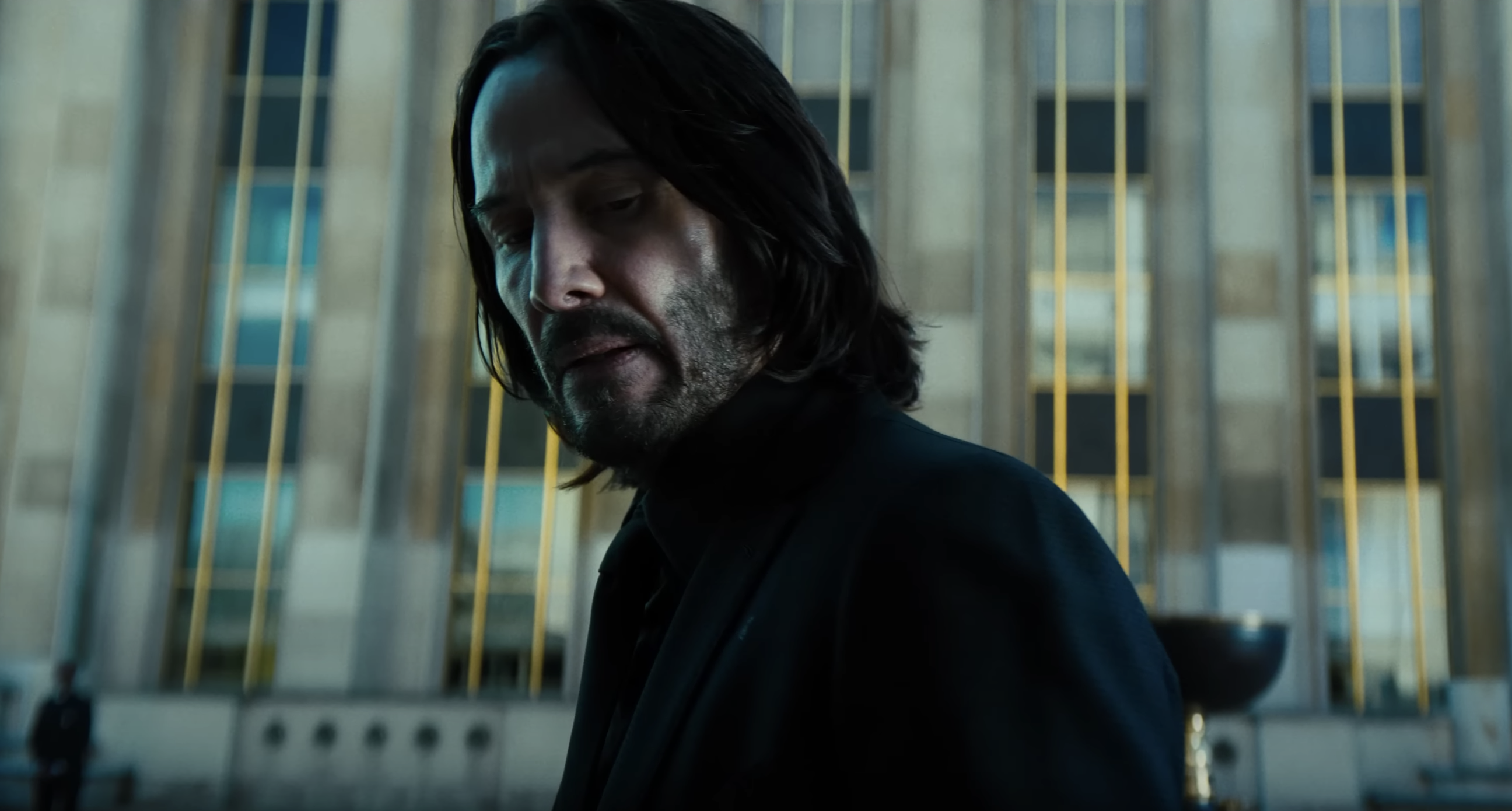
In yesterday’s pan of the revolting and deplorable John Wick: Chapter Four, I should have mentioned my grudging respect for an extended, uncut overhead shot of Keanu Reeves going from room to room and blasting bad guys at every turn with the camera constantly maintaining its God’s-eye viewpoint.
In a 3.25 interview with TheWrap‘s Scott Mendelson, dp DanLaustsen (totally unpronouncable) explains that the scene utilized a set built on one of the Studio Babelsberg sound stages.
Laustsen: “It’s one crane shot and one spider cam shot where we are starting on the stairs and flying around. We did in eight or ten takes. The light must be outside the set. We see the whole set. That’s the challenge when your shots are wide and the entire set is in view.”
John Wick 4’s god’s-eye gunfight has been called the “Hotline Miami” scene but I was surprised to see Chad name an even more obscure indie game as inspiration
HONG KONG MASSACRE is Hotline Miami x John Woo, and JW4 beautifully adopts its top-down look & gargantuan muzzle flashes pic.twitter.com/hGU3A47icE
The “rules” of high-powered action films over the last 20-plus years is that there are no rules. Life is worthless, death is immaterial, nothing matters, nothing sticks and everything’s everything, baby. You can globe-hop at will and stage big set pieces and start fires and blast everything to bits and nobody blinks an eye…explode at will, kill dozens or hundreds of guys, jump out of three-story buildings, get hit by speeding cars, get shot two or three or eighteen times yourself…it’s all a bullshit cartoon. There are no humans with recognizable characteristics…no behavior that makes a lick of sense.
This is the cold, cynical, sick-fuck, android travel-porn world of Chad Stahelski, a former stunt man and a soulless visual composer, and the godforsaken John Wick: Chapter Four, which I just suffered through for 169 minutes. And the theatre lobby is like fucking Disneyland…family fun for dads, kids, moms, little girls. It’s surreal, sickening.
I saw Wick 4 because I was feeling good about life and I needed to re-pollute my soul…because I needed an injection of green Stahelski poison coursing through my veins. And because I wanted to revel in the Paris portions of this insane, rancid, ugly-ass film, which take up the last…oh, 45 or 50 minutes. And because I wanted to cheer the death of Keanu Reeves‘ John Wick, and I don’t mean an action-film tentpole death that doesn’t really mean anything (like the “death” of 007 in No Time To Die, which ended with a credit crawl pledge that said “James Bond will return”) but a real, honest-to-God, stick-him-in-the-ground death that doesn’t allow for rebirths or reboots. Because I half-liked the first Wick but have hated the expanding insanity that followed.
That’s why I caught a 3 pm show on Saturday, 3.25. As to whether or not my expectations were satisfied…I can’t answer that.
Filming started in June 2021, initially in Berlin and Paris before moving on to Osaka and New York City. They wrapped in October of that year.
The varied Paris locations are grand and beautiful, and scene to scene it’s all handsomely lighted and designed and shot with appropriate pictorial panache. I sat there like an Egyptian sphinx. I had my phone on the whole time, and when the boredom became too much you’d better believe I checked my texts and did some research.
I was pleased and comforted that Stahelski covered all the diverse casting bases…a studly Anglo-Hawaiian lead (Reeves), three Asian actors (Donnie Yen, Hiroyuki Sanada, Rina Sawayama), a young Swedish evil guy (the ice-cold Bill Skarsgård, aka “Pennywise”), three black dudes (Shamier Anderson, Lance Reddick, Laurence Fishburne), an action star in a fat suit who says “you shot me in the ass!” (Scott Adkins), a Chilean guy (Marko Zaror) and an aging British smoothie (Ian McShane).
Wick 4 is the first action film I’ve seen in which the guns don’t appear to shoot actual bullets. They shoot “ding” bullets, which is to say bullets that aren’t as lethal or damaging as they usually are. I’m not saying they’re high-powered beebee pellets, but some guys need to be shot three and four times before they go down for the count. Either way Reeves doesn’t have to worry because he never gets shot until…I’d better not say.
Posted on HE 11 1/2 years ago: “In 1987 Lethal Weapon used a funny jumping-off-a-building gag. Ragged-edge cop Mel Gibson is sent to the top of a four-story building to talk an unstable guy out of making a suicide leap. Gibson winds up cuffing himself to the guy and jumping off the building, and they’re both falling to their deaths…not. They land on one of those huge inflated tent-sized bags…whomp!…that cops and firemen use to save people. All is well.
“Flash forward to another jumping-off-a-building scene in Brad Bird and Tom Cruise‘s Mission: impossible 4 — Ghost Protocol (’11), which I saw last night. An American operative is being chased over a rooftop by baddies in Budapest. He fires some rounds, kills a couple of guys, and then escapes by leaping off the building, continuing to shoot as he falls four or five stories to the pavement below. He’s saved, however, when he lands on a modest air mattress that’s about one-tenth the size of Lethal Weapon‘s tent-sized bag.
“Where did this miracle air mattress come from? We’re not told. In what physical realm does a guy leap backwards four stories onto an air mattress that’s a little bit larger than a king-sized bed and live? I’ll tell you what realm. The realm of Mission: Impossible 4 — Ghost Protocol and its brethren.
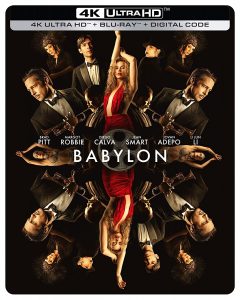
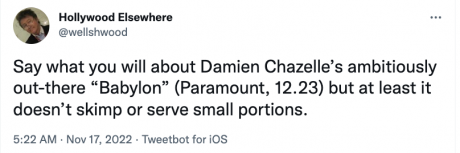
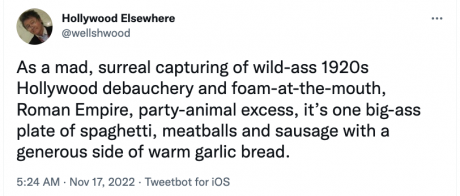
From Glenn Erickson’s longish review of the new 4K Bluray of Damien Chazelle‘s Babylon, which streets today: “Babylon lives up to the crazy reports that accompanied its theatrical release last December — it’s a spectacular Hollywood history movie that ignores Hollywood history in favor of exaggerated orgies and drug use, as if Kenneth Anger’s bad gossip were just the tip of the scandal iceberg.
“In entertainment terms it’s a 188-minute gross-out that wants to be shocking but is mainly unpleasant. Anachronistic profanity is non-stop, but the dealbreaker comes in the very first scene with an enormous, diarrhetic elephant whose bodily eliminations rival Noah’s Flood. Margot Robbie is a dynamo and Brad Pitt as charming as ever, but the movie overall is ideal only for the curious and the masochistic.
“Babylon, in short, is oppressively off-putting, and no deep thought is required to explain why it wasn’t a hit. Word of mouth likely did the job, as most audiences would find it unpleasant at best and at worst intolerable. Personal tastes vary, but I know nobody who would think the movie’s excesses are entertaining. If I were to take a date to this picture, within three minutes I’d be telling the person, ‘it’s perfectly okay if you want to walk out right now.’ Babylon may do much better on disc and streaming than it did in theaters — a lot of moviegoers out there are curious.”
…and generally made to endure a lot of stress and anguish and emotional difficulty as a child, there wouldn’t be a movie. So we know what this doc will be going in. Then again Shields is allegedly worth between $20 and $40 million as we speak, probably closer to the higher figure. So it all balances out.
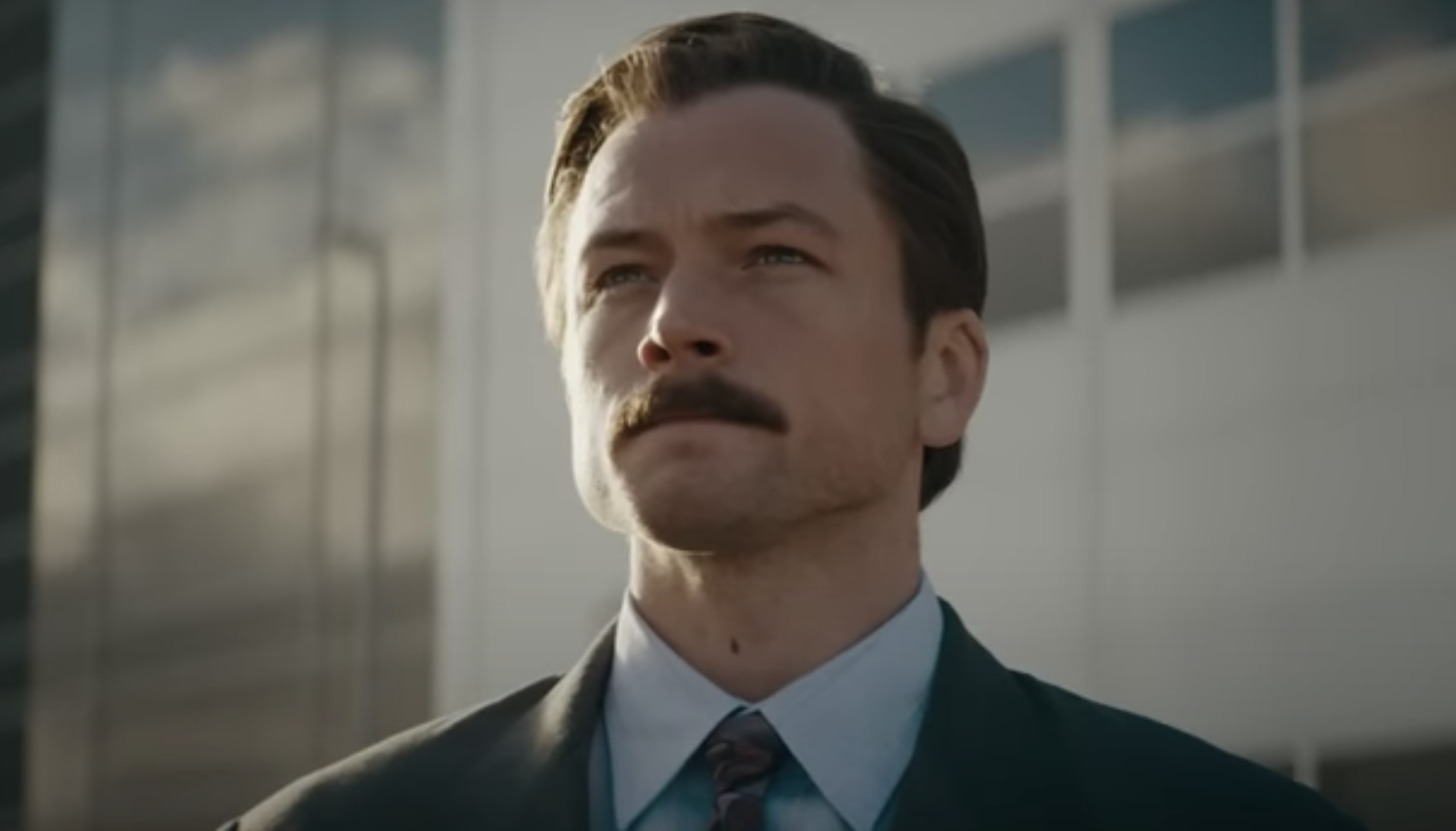
Kingsman: The Secret Service, Kingsman: The Golden Circle, Billionaire Boys Club, the absolutely vile Robin Hood and the slow-paced (except for the opening 40 minutes) Rocketman…I’ve never liked and have mostly hated films starring Taron Egerton. I’m therefore reluctant to see anything he’s starring in.
“Egerton stars as Henk Rogers, the founder of a company called Bullet-Proof Software, and a man who basically stumbled into the legacy of Tetris at a gaming convention in his new home country of Japan. He instantly realizes the potential of a game that had yet to make its way around the Iron Curtain to any part of the world other than Tokyo. And he wants a piece of it.
“Rogers narrates Tetris, a complicated film about a simple game. It’s just a rolling array of dropping blocks, but the details about market shares, legal rights, and Cold War politics drive this plot, not the game itself. Rogers is a low-level player in the gaming world, and getting the rights to something as Tetris will require navigating around power figures in both business and politics.
“It sounds like a lot, and yet it’s also not enough. All of this intrigue and negotiation gets Tetris to a remarkably repetitive and monotonous place that’s not helped by director Jon S. Baird’s glib tone, one that looks back on the ‘80s with a sort of goofy bemusement that feels disingenuous. The movie bounces back and forth between conference rooms and scary Russian alleys, but it never finds the right depth of character or deviation in either, choosing to enliven the dry material with an odd amount of condescension instead of actual tension. “Can you believe these crazy Russians?” is an odd tone to strike, especially with the current state of the world in 2023.
“The saddest thing about Tetris is that it’s easy to see why someone wanted to tell this story. The little guy never wins in Russia, and he usually goes to jail for even thinking he could play, but American business is built on narratives of Davids beating business Goliaths. Merging the two for a story in which an ambitious American had to use the tools of Capitalism to topple Communism sounds like an easy sell, and there’s probably a great documentary to be made on this subject. But breaking it out into a drama or thriller requires a different set of rules, and, despite Egerton’s best efforts, the team behind “Tetris” never figured out how to tell this story.”
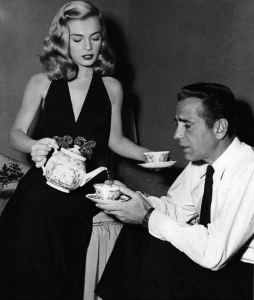
Dead Reckoning (’47), a noirish hriller in which Humphrey Bogart and Lizabeth Scott costarred, stinks. I caught it once and probably never will again. Scott, a femme fatale type with a smoky voice, never appeared in a really good film, not even during her mid to late ’40s heyday. You could argue that her most appealing performance was in Loving You (’57), and in that she was a second-banana to Elvis Presley.
All my adult life I’ve been in love with Joni Mitchell‘s “Free Man in Paris.” But what I’ve especially loved all those years has been based on a misunderstanding, and right now I feel sick about this.
I’ve always adored the notion of Mitchell referring to herself as “a free man in Paris” as she describes her life as being partly defined by people less powerful or wealthy than herself hitting on her for help….”in it for their own gain”, “calling me up for favors.” Isn’t that the way of the world pretty much? Struggling or less powerful folks asking for help from wealthy, powerful people they might happen to know, looking for gimmes and whatnot? And Mitchell’s delightful, whimsical gender substitution…only an X-factor creative woman would call herself a “free man”, I’ve told myself all these years…a brilliant leapfrog notion…make your own rules, go your own way.
This morning I suddenly realized, to my immense disappointment in Mitchell as a lyricist, that “Free Man in Paris” is about David Geffen, with whom she travelled to Paris back in ’73 or whenever it was. I had simply never read up about the song; it had never occured to me that the tune was about another person’s experience, and Geffen’s yet! Jesus, I’m crestfallen.
This is almost as bad as my realization a few years back that I had misunderstood a key lyric in Mitchell’s “Refuge of the Roads.” I had thought that a line in the first verse went “hard of humor and humility, he said will lighten up your heavy load”….”hard of humor” as in hard of hearing….genius!
In fact Mitchell’s actual lyrics read “and we laughed how our perfection / would always be denied / ‘heart and humor and humility’ / he said ‘will lighten up your heavy load’ / I left him then for the refuge of the roads.” I’m so bummed out I can barely think, much less write.
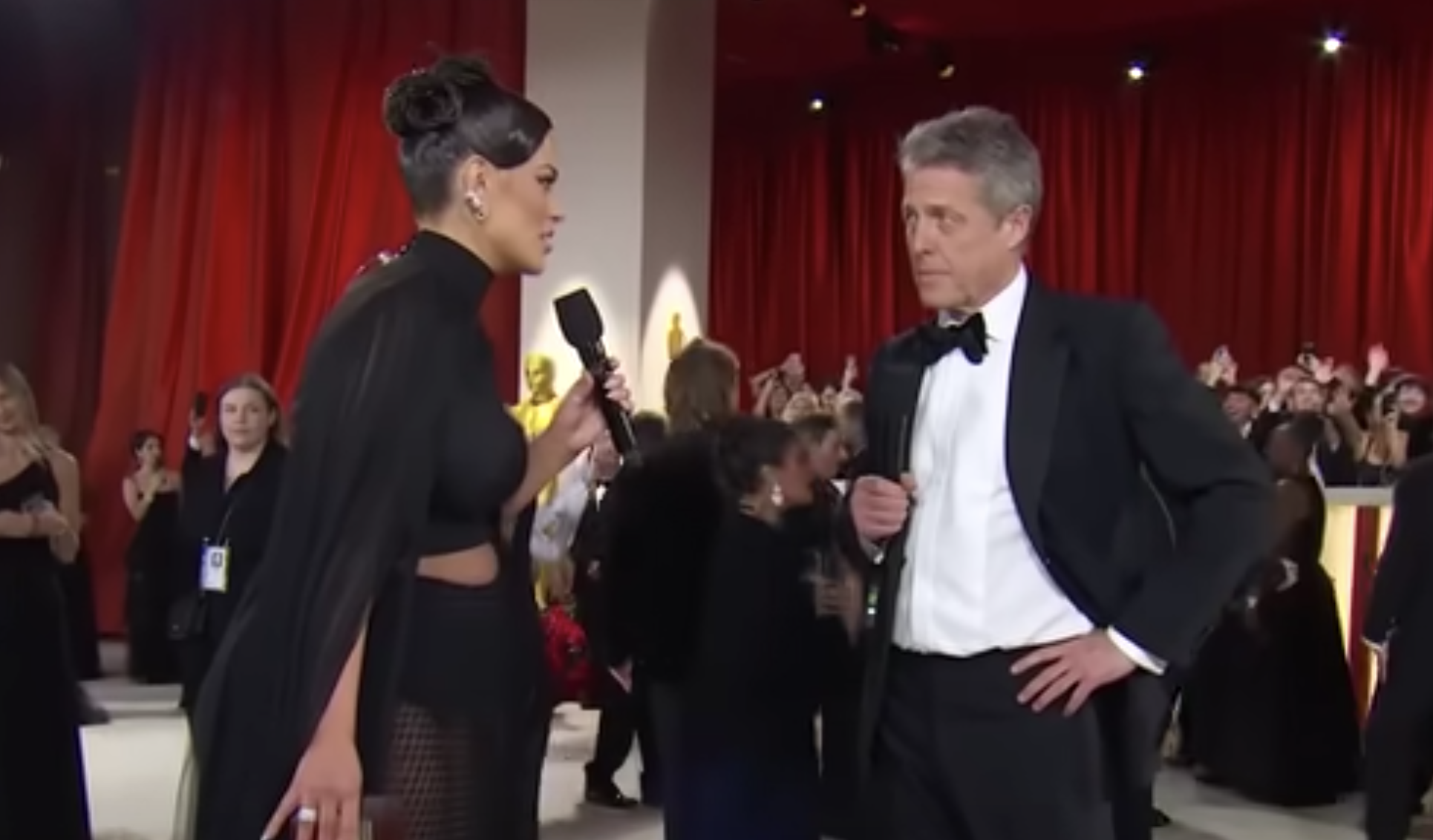
Dr. Todd Grande: “At a ceremony filled with many people who are insincere, hypocritical and obsequious, it was refreshing to see somebody with a sharp sense of humor and who was generally disgusted with grandiose and extravagant displays of wealth and power. Ashley Graham should thank Hugh Grant for the education [that he provided]. Graham’s reaction of feigning comprehension as well as her tedious questions actually supported Grant’s original characterization of the Academy Awards as ‘Vanity Fair.’ She ended proving his point, which should represent her only successful endeavor during that interview.
“Grant’s witty and annoyed behavior was a metaphorical slap that far exceeded the dramatic value provided by Will Smith….Hugh Grant accomplished more without using violence. He reminded people that sometimes small talk can be so small [that] it should not be tolerated.”
Apparent fact: When Hugh Grant said that Sunday night’s Oscar congregation was like “‘Vanity Fair‘”, Ashley Graham thought he was referring to Vanity Fair‘s website/magazine or the VF after-party. God help her, but the poor woman had apparently never heard of William Makepeace Thackeray.
Graham undoubtedly knows who Thackeray is now, of course, and will almost certainly never again be at a loss for words when the subject of his novel, “Vanity Fair”, comes up.
Grande again: “‘Vanity Fair’ expresses a desolate view of the human condition…the term is generally used to describe the frivolous behavior of wealthy people and condemns shallowness…Hugh Grant‘s comment was not meant as a compliment to the Oscars. [Grant’s] reference to a 19th Century English novel might have been a bit esoteric for a lighthearted, superficial, feel-good interview before an awards ceremony…[which leads to the question] why did Grant presume that Graham” — a superficial, under-educated Millennial know-nothing — “would be familiar with the reference to Thackeray’s novel? Unfortunately a general lack of interest in the arts is fairly common these days. Grant was somewhat rude, yes, but at the same time he was authentic.”
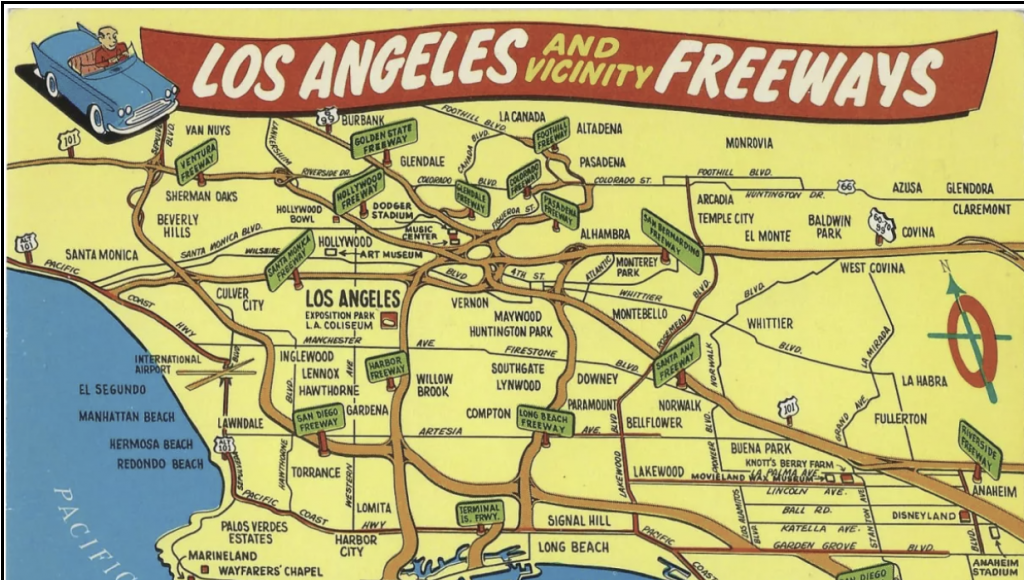
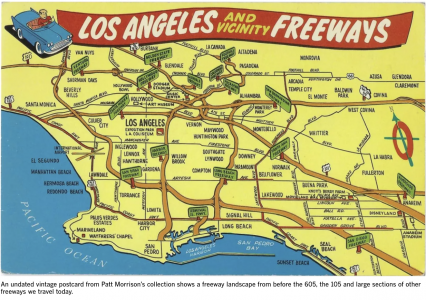
Yesterday (3.9) a Los Angeles Times story by Sammy Rothexplained how thoughtless white commuters and city planners of yore have casually worsened pollution of the air breathed by low-income communities of color.
Would it be be fair to use the term “intentional racist pollution of lower-income Los Angeles air“?
“Many residents of the county’s whiter, more affluent neighborhoods — who were often able to keep highways out of their own backyards — commute to work through lower-income Black and Latino neighborhoods bisected by the 10, 110 and 105 freeways and more,” the story explains.
And so residents of these neighborhoods — Baldwin Hills, Compton, Inglewood, Watts, South Gate, Paramount, Huntington Park — breathe shittier air. Because of cavalier white racist commuters who think only of themselves.
Speaking as a former resident of West Hollywood who would occasionally drive on freeways through the crappy areas of Los Angeles, I am completely ashamed of myself. I didn’t mean to cause residents of color to develop breathing problems, but that’s what I wound up doing. Because I was a deplorable white person with a car, although I mostly drove a rumblehog.
If this was a Woody Allen film made in the early ’70s, it would end with men dressed in white uniforms chasing Roth down the street with huge mosquito nets and forcing him into a straightjacket.
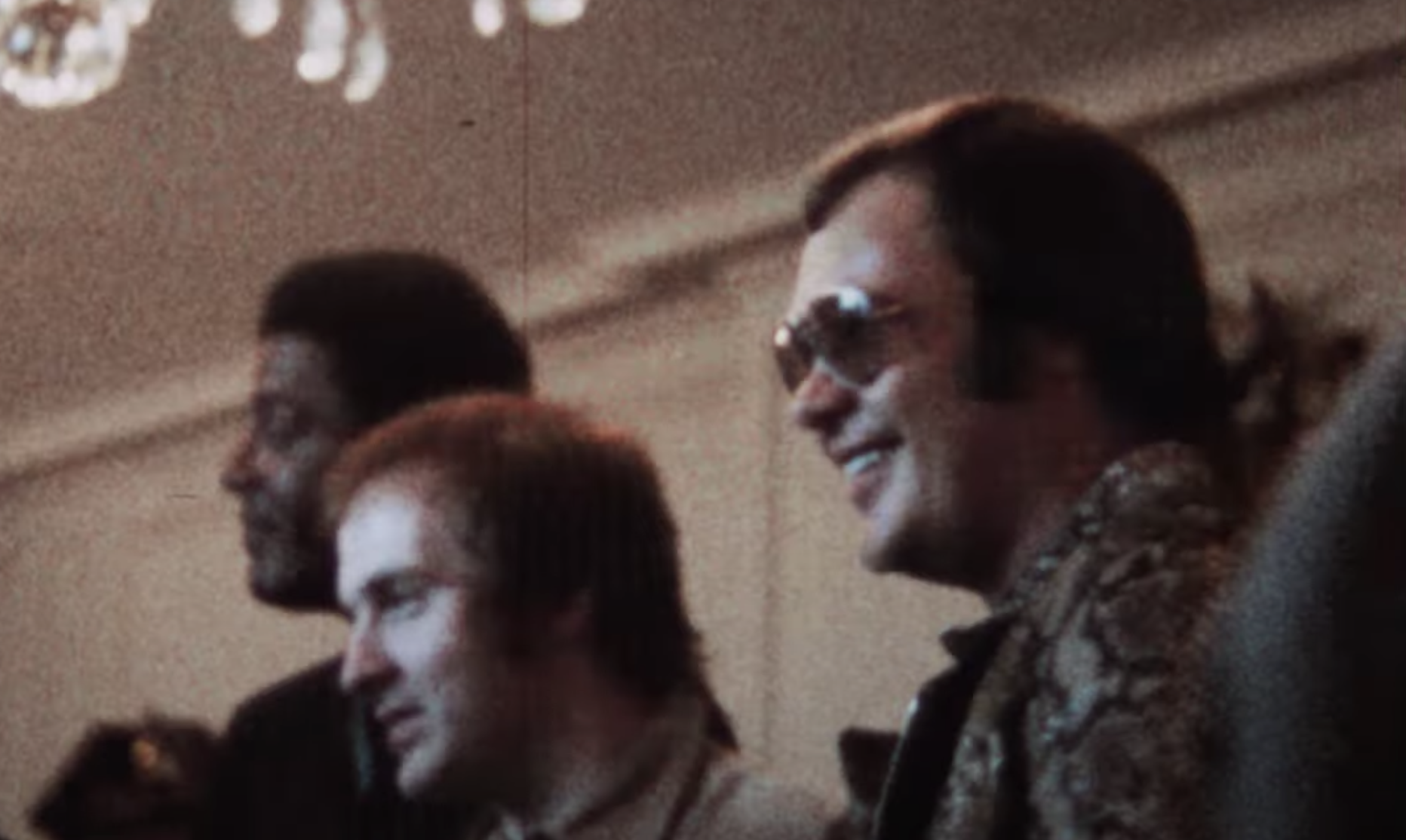
John Scheinfeld‘s What The Hell Happened to Blood, Sweat & Tears? (Abramorama, 3.24) is not a biography of the band, and basically has zip to do with Al Kooper‘s version of it (late ’67 to late ’68).
It’s about the David Clayton Thomas incarnation (’69 to ’71), I’m told, and more particularly about “a moment in time when BS&T found itself in the crosshairs of a polarized America, as divided then as it is now. It really is a political thriller with great music in it, not a music doc.”
Another description: A doc about how Blood, Sweat & Tears was pressured into sacrificing their cred with a sector of their audience that considered itself hip and anti-establishment.
Wiki: “In May/June ’70 the jazz-fusion band went on a United States Department of State-sponsored tour of Eastern Europe. Voluntary association with the U.S. government was highly unpopular with New Lefty-influenced fans at the time, and BS&T was criticized for this. It is now known that the State Department subtly pressured the group into the tour in exchange for a U.S. residency permit to Clayton-Thomas, who had a criminal record in Canada and had been deported from the U.S. after overstaying his visa.”
The Soviet bloc tour was compounded by BS&T accepting a lucrative gig at Caesars Palace on the Las Vegas Strip — another extremely uncool thing to do at the time.
There’s actually a section of the doc in which Kooper appears (including a rare piece of audio from back in the day), but he’d left the band more than two years before the events depicted in the film.
…for alluding to “online haters” of Everything Everywhere All At Once in a 3.10.22 N.Y. Times piece called “Why Everything Everywhere Will Probably Win Best Picture.” There is no online columnist in any country in the Engiish-speaking world who has spat and shrieked at this infuriating A24 release more than myself…I am half Diogenes and half Captain Ahab in this realm.
Friendo: “Douthat didn’t even touch the woke thing, which is the key to all of it. EEAAO is a perfect embodiment of the woke ideology in a movie. It’s basically about an older Chinese businesswoman grappling with an unhappy marriage, an IRS audit and gnawing discomfort about her chubby gay daughter.”
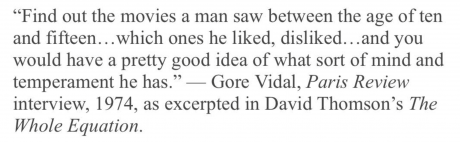
I’m pretty sure I posted this Gore Vidal quote before in hopes of sparking a discussion, but I can’t find the article.
Despite having been born in 1972, my preferred era of deep movie impressions happened between the late ’50s and mid ’60s. The films of 1962 and ’63, in particular, were key to my aesthetic development
49 worthy films from 1962: David Lean‘s Lawrence of Arabia, John Ford‘s The Man Who Shot Liberty Valance, Sam Peckinpah‘s Ride The High Country, Robert Aldrich‘s Whatever Happened to Baby Jane?, Bryan Forbes‘ The L-Shaped Room, Howard Hawks‘ Hatari, Francois Truffaut‘s Shoot The Piano Player, Francois Truffaut‘s Jules and Jim, Agnes Varda‘s Cleo From 5 to 7, Luis Bunuel‘s The Exterminating Angel (10)
Peter Ustinov‘s Billy Budd, the John Frankenheimer trio of Birdman of Alcatraz, The Manchurian Candidate and All Fall Down, J. Lee Thompson‘s Cape Fear, George Seaton‘s The Counterfeit Traitor, Frank Perry‘s David and Lisa, the Blake Edwards‘ duo of Experiment in Terror and Days of Wine and Roses, Pietro Germi‘s Divorce, Italian Style. (10)
Stanley Kubrick‘s Lolita, the great Kirk Douglas western Lonely are the Brave, John Schlesinger‘s A Kind of Loving, Roman Polanski‘s Knife in the Water (released in the U.S. in ’63), Alain Resnais‘ Last Year at Marienbad, Michelangelo Antonioni‘s L’eclisse, Sidney Lumet‘s version of Eugene O’Neil’sLong Day’s Journey into Night, Otto Preminger‘s Advise and Consent, Terence Young‘s Dr. No, John Huston‘s Freud. (10)