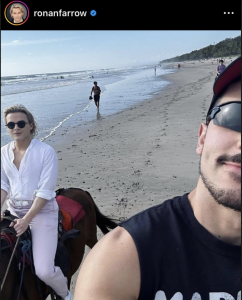
Obviously Ronan Farrow owns his own history, biology and style choices, but my very first thought upon seeing this vacation photo (seemingly taken on the beach in Baja California) is that he looks a lot like Tatiana. Tell me I’m wrong.
Tatianaagrees: “Haha, yes, there is something :-))”
I would never dispute that Andrew Dominik‘s Blonde isn’t a serious art film. It’s intensely dislikable but completely, paradoxically respectable. It can be accused of exaggerating the dark aspects in Norman Jean Baker‘s life, as Joyce Carol Oates’ 22 year-old source novel did, as well as inventing some out of whole cloth. But it was all of a piece — a pitch-black downer.
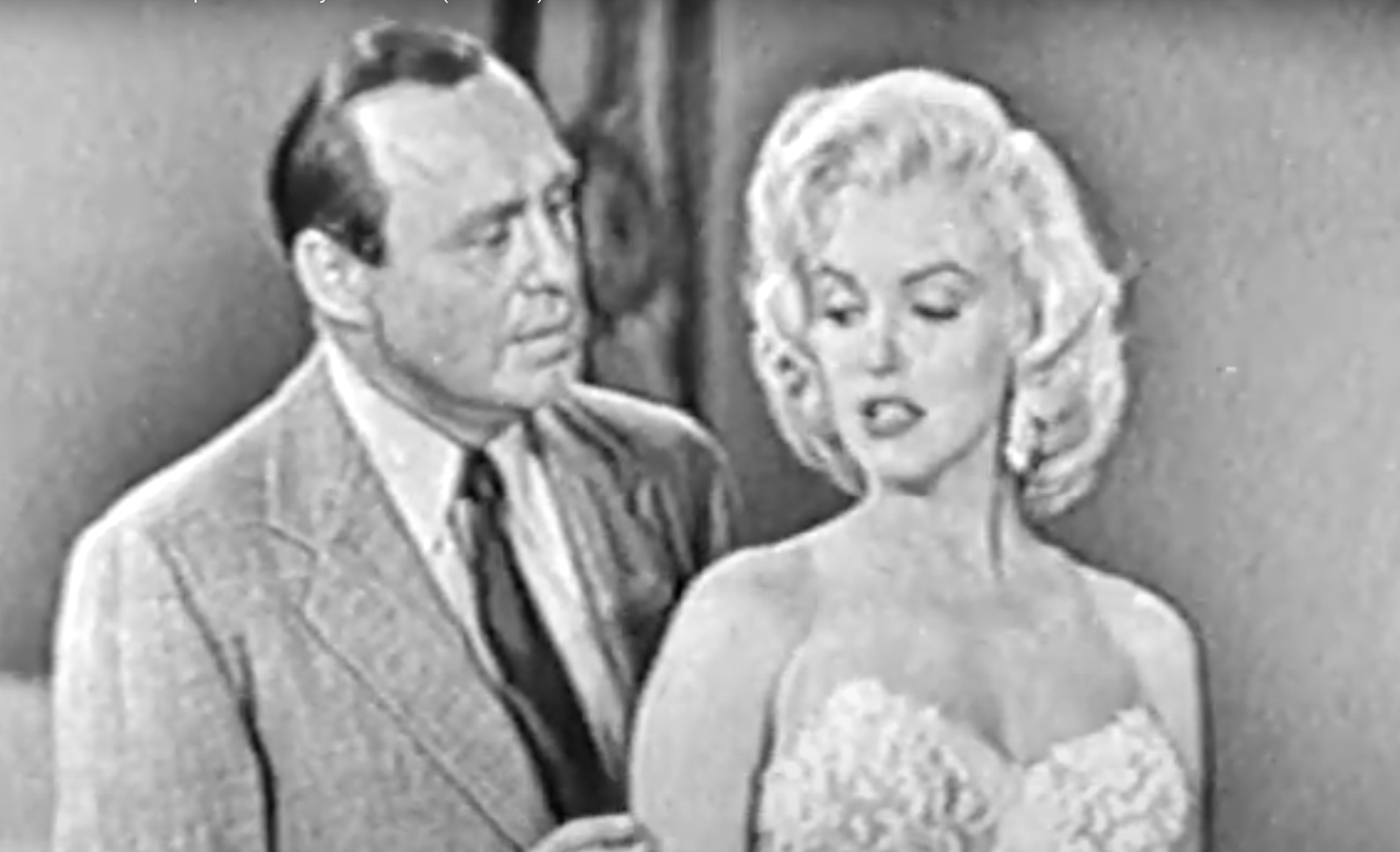
Will I ever watch Blonde again? I can say with absolute assurance that I will not. But I will gladly watch this clip of Marilyn Monroe‘s visit to The Jack Benny Show in September 1953. It sells the bullshit, of course, but she’s a total pleasure to watch and listen to. She wasn’t inwardly happy, of course, but she convinced the public otherwise. Look at her expression when the audience is loving her and laughing at the humor, etc. She was happy in a certain sense!
HE to Blonde spoiler whiners: This post discusses the August 1962 death of Marilyn Monroe, which is what Andrew Dominik‘s Blonde (Netflix streaming, 9.28.22) ends with.
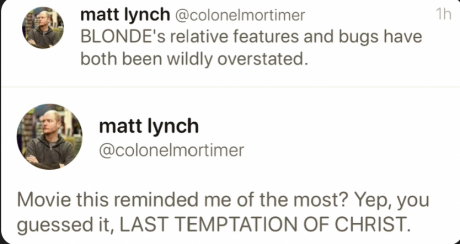
HE to friendo #1: “Yesterday I slogged my way through Andrew Dominik‘s Blonde, which I regard as artful torture porn. And then I happened upon a Matt Lynch tweet that analogized Blonde and a landmark 1988 film, and the instant I read it I said ‘yes!'”
“I’m thinking not just of the incessant dismissals and degradations and spiritual uncertainties, but the anguished and agonized relationship between the main protagonist and the elusive ‘father.’
“Just as Willem Dafoe sips a goblet of sacramental wine before submitting to his final fate, Norma Jean swallows alcohol and barbiturates before her final episode of passion at her Fifth Helena Drive abode (the delivery man, the fuzzy tiger, the shattering note). And like Dafoe’s Jesus, a spectral Marilyn smiles and separates from death, and greets the immortality that she still enjoys today a la Andrew Dominik.”
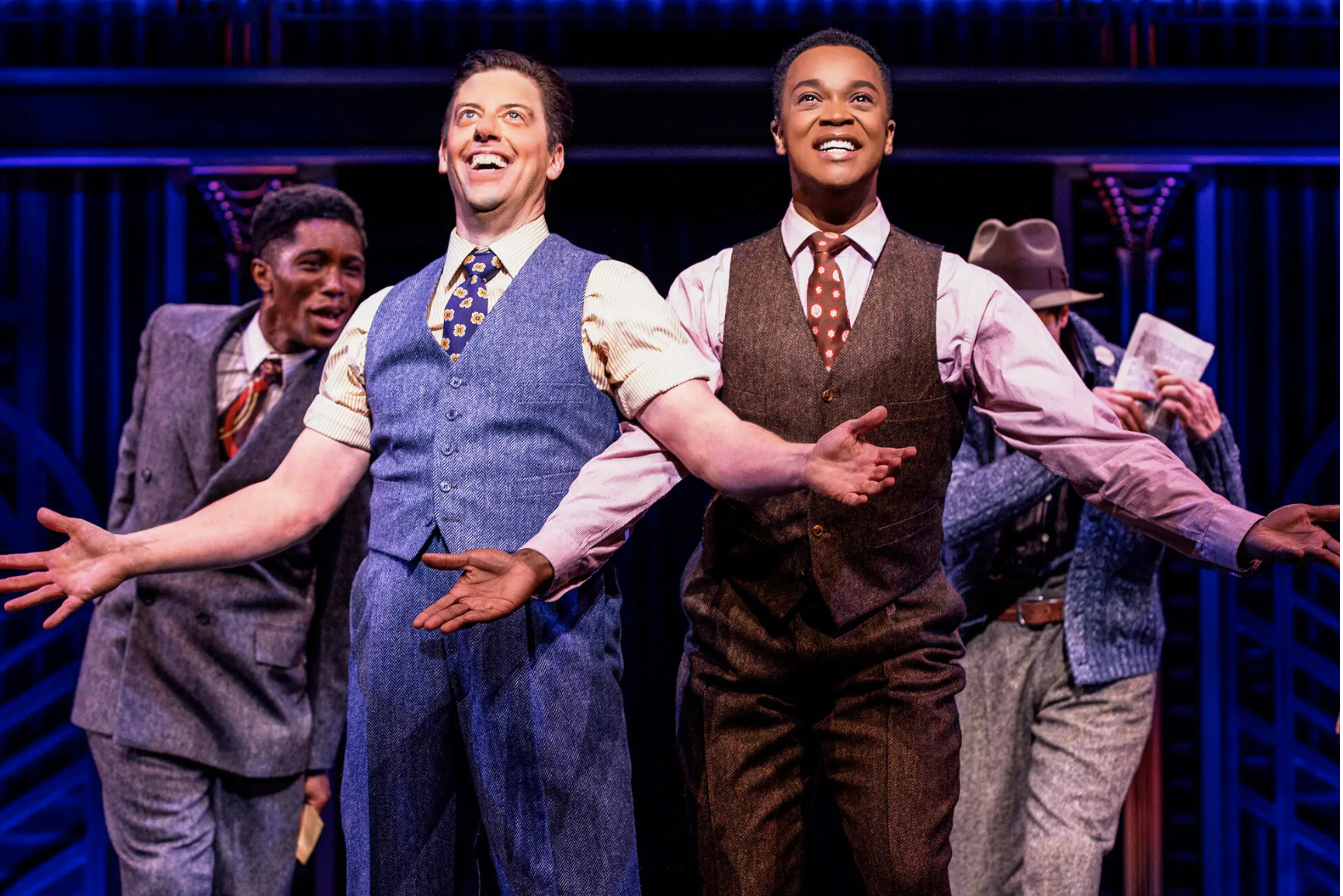
The show ignores the basic scheme of the Billy Wilder’s 1959 classic, making more than half the characters black with the Jerry/Daphne character (played by Jack Lemmon in the Wilder film) embracing transgenderism and yaddah yaddah. And the show buries the film’s final line — “nobody’s perfect.” Of course it does!
Directed by Casey Nicholaw and featuring Christian Borle (Joe/Josephine), J. Harrison Ghee (Jerry/Daphne), Adrianna Hicks as Sugar (called Sugar “Kane” Kowalczyk when she was played by Marilyn Monroe) and Kevin Del Aguila as an Latino Osgood, Some Like It Hot opened just under three weeks ago — 12.11.22.
HE reader Des McGrath: “The Jack Lemmon character has been rewritten to discover that he is a trans woman over the course of the story.
“The immortal final line? Gone. Instead of Osgood Fielding responding ‘Nobody’s perfect’, he tells Daphne ‘You’re perfect just the way you are’ (or something like that).
“And the Marilyn Monroe character is no longer a dumb blonde but a strong black woman, who sings about how as a child growing up in a small town in Georgia she liked to go to the movies, but ‘could only use the balcony. Like the movies, life could be that black and white.’
“So now she wants to break the color barrier in Hollywood.”
HE to McGrath: “Like the film, the show is set in 1929. Sugar wants to break Hollywood’s color barrier in nineteen-twenty-fucking-nine? The new Some Like It Hot, in short, is another exercise in presentism — transposing the woke sensibilities of today to the jazz age.”
If the kid (actor Philip Tanzini) had been, say, 12 or 13 or even 14, I might not feel altogether comfortable watching Demi Moore (19 at the time) give him a hot-mama kiss. But 15 is cool. Plus he was a showbiz kid. Plus he looked like a nerd — that doesn’t mean he wasn’t ready to slam ham at the drop of a hat.
Plus it was 1981 — the dawn of the tits ‘n’ zits era of movies (Losin’ It, All The Right Moves, Risky Business). Everybody knew the score, and the era of woke prudery was several decades off. Tanzini is now 56 years old and probably melting down over the memory.
I was 15 once, and my hormonal surges were like bodily volcanoes…Krakatoa, East of Java. I would’ve dropped to my knees, gotten out a hymn book and praised God if a hotsy-totsy 19 year-old actress had kissed me like that.
I was taking sneaky Saturday trips into Manhattan when I was 15, remember, and occasionally getting goosed by 40ish, creepy-looking gay guys on 42nd Street, and I more or less shrugged that shit off.
One day when I was 15 my mother told me to watch out for older women who might try to take advantage of me, and my only thought was “please…please, God…arrange for an older foxy woman to try to bring thoroughly immoral, anti-Christian sexual rapture into my life!”
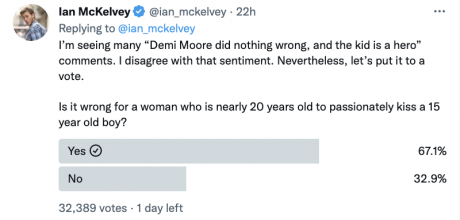
Needless to add, Hollywood Elsewhere stands with the 32.9% of Twitter responders who have no problem with this.
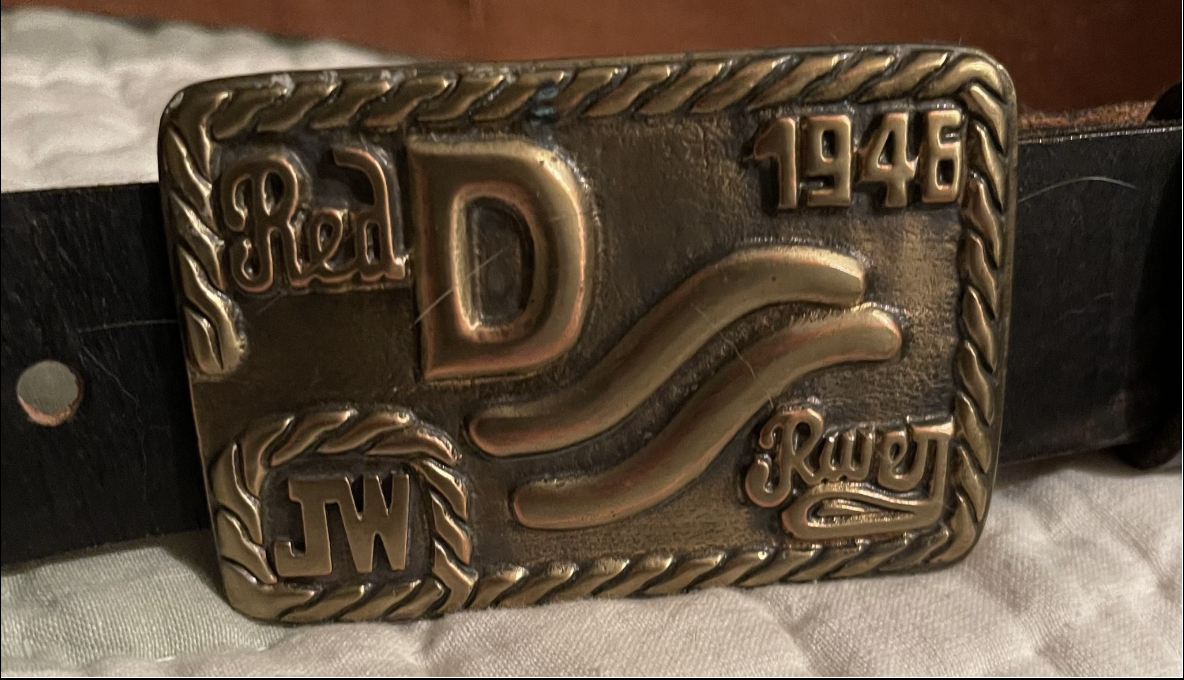
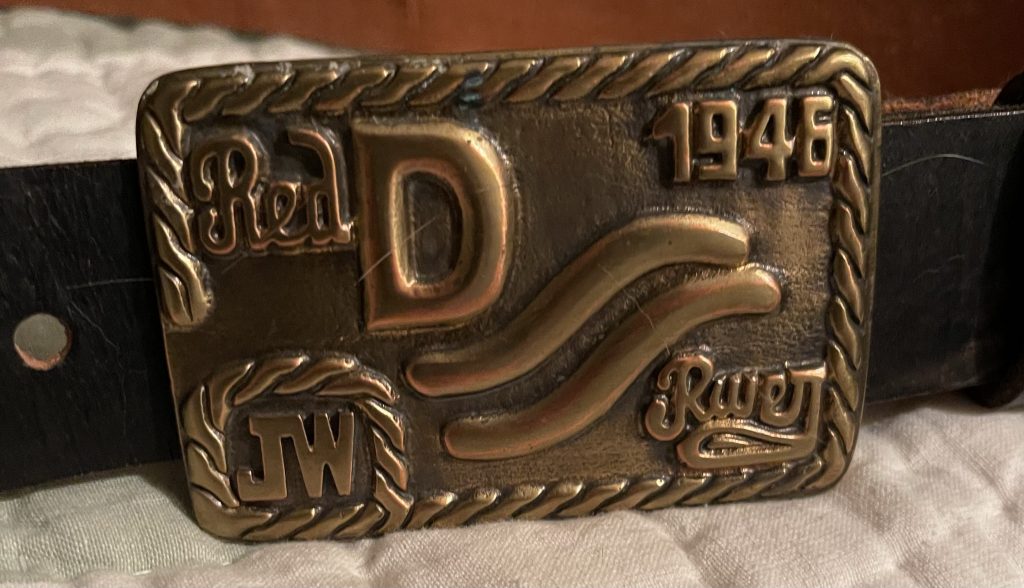
There’s something hugely joyful about reuniting with my mail-order John WayneRed Riverbrassbeltbuckle. The fact that I’m happy to once again have it in my possession means, of course, that I’m just as much of a racist swine as Wayne was during his lifespan, and has nothing to do with my loving the 1948Howard Hawkswestern (which, as the buckle points out, was actually shot in ‘46).
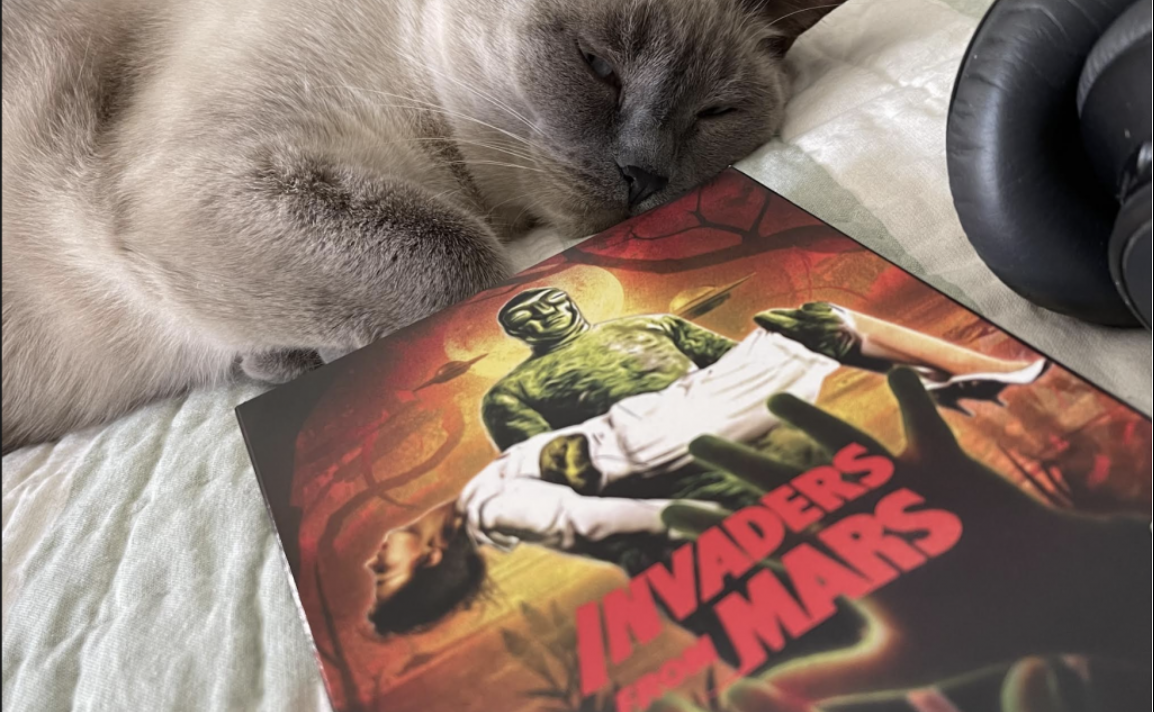
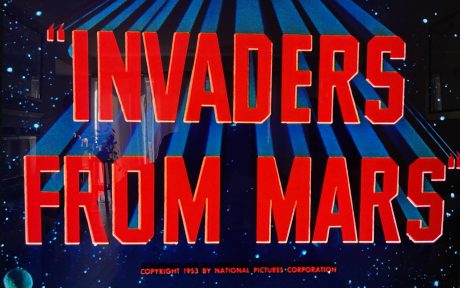
HE is reminding that the next big Bedford Marquee event is a special 4K screening of William Cameron Menzies‘ recently restored Invaders From Mars (’53). A special master class instruction from restorationist Scott MacQueen will also occur. It’ll happen three weeks hence on Sunday, 1.15.23 at 11 am.
How keen will local film buffs be about catching a sci-fi classic on a lazy Sunday morning? Understand this: This will be the only first-rate screening in a AAA first-rate theatre (which the BP definitely is) of an absolutely mint-condition restoration of perhaps the most influential Eisenhower-era space invader film ever made. This will almost certainly never happen again…trust me. Hot chocolate served in the indoor cafe. The more, the merrier!
Jeff Sneider is a whipsmart, fair-minded guy with that strange intestinal fortitude quality known to very few journos in this racket. Co-panelist Scott Mantz is also part of this fraternity, having showed his own form of courage a few months ago in that Hollywood Critics Association dust-up.
In the minds of woke hive-mind fanatics I am a “divisive” columnist, as Jeff notes, but I care deeply about films and the remnants of the film culture that used to prevail in this industry (i.e., more cinematic, less of an emphasis on political instruction), and at least I’m not some breezy, constantly smiling opportunist (those Noovies promos!) and zeitgeist cruiser like Perri Nemiroff, whose face freezes and whose eyes narrow into a skeptical squint when Sneider mentions me.
“Emotional” sometimes gets conflated with “divisive”. What I am, boiled down, is a devotional, storied (40 years and counting), richly seasoned, aspect ratio-attuned, well-travelled and still strongly relationshipped Film Catholic who’s (a) filing as passionately as always and loving the grind, (b) had a pretty great peak ride for nearly 30 years (early ‘90s to late teens) but (c) has also endured some fairly intense cash-flow trauma over the last three years due to woke fanaticism, hence Sneider’s use of the term “divisive.”
Excepting the sea-change event of embracing sobriety in March of ’12, I haven’t changed that much over the last 20 or 25 years. My film devotion has been steady and reverent since I got into this racket in the late ‘70s, and I still regard myself as a sensible center-left type, but there are some Robespierre loonies (especially those from the absolutist DEI brigade and the older-white-guy-hating #MeToo fringe vengeance squad) who began going over the waterfall in ‘18 and ‘19.
That mad fervor is starting to calm down as we speak. Will woke lunacy last as long as the rightwing Red Scare paranoia did in the ‘50s? Maybe but who knows? It’s very easy to just go along with the mob. Very few have spine or sand. Even I am doing whatever I can to groove along with the loonies — no point in getting into small slap fights that I can’t hope to win.
In sum I appreciate and admire Mr. Sneider’s fairness and his respect for my integrity. Yes, I sincerely meant it when I put Empire of Light at the top of my 2022 list. Ditto my other selections, 30 in all.
The piece has two titles — “The Final Campaign” online and, on the current New York cover, “Party of One.”
It’s a darkly amusing dig-down piece…fascinating content start to finish…one smirking, devastating paragraph after next. D-List MAGA types (including “Brick Man”) at the Mar a Lago announcement of Trump’s ’24 presidential campaign. Anonymous Trump adviser: “It’s not there. In this business, you can have it and have it so hot [but] it can go overnighty and it’s gone and you can’t get it back. I think we’re just seeing that it’s gone,. The magic is gone.”
The image of Trump basically being fat Elvis Presley during the tacky decline period of ’76 and ’77…this analogy will stick.
The Elvis observation is from 41-year-old Sam Nunberg, a Manhattan-based operator who was an on-and-off political advisor to Trump’s 2016 presidential campaign, and “was subpoenaed by a grand jury for testimony and documents relating to the Special Counsel’s Russia investigation.”
The spooky closing montage is the crowning crescendo of William Cameron Menzies‘ Invaders From Mars (’53). Without this sequence the film would amount to much less, certainly in terms of present-day esteem. The combination of that eerie choral music (composed by Mort Glickman, orchestrated by Raoul Kraushar) along with those trippy reverse-motion shots still get under your skin.
A huge round of applause to editor Arthur Roberts, and an extra round for Glickman — the choral music delivers the spook and the soul.
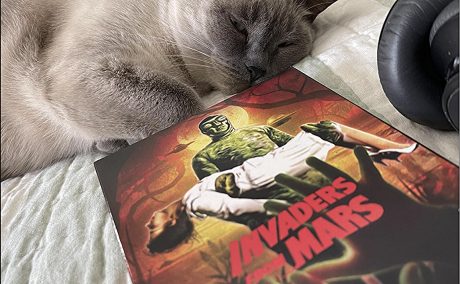
The new Ignite Bluray arrived just a couple of days ago, and on one of these video essays Glickman is given credit for the music by Invaders restoration master Scott MacQueen. Joe Dante and John Landis also deliver excellent commentary in the same essay.
Apologies for the crappy video capture — I should have shot it last night.
My God, Avatar2: TheWayofWater rerally romps and stomps like nothing I’ve seen in a long while, and the astonishing CG realism (which I couldn’t settle into at first — it took me 10 minutes to find my way into it) is quite the thing, and there’s no beating that last 50- or 60-minute aquatic pitched-battle, breaching-whale, pulse-rifle-burst, arrow-piercing “woo-woo!” destructathon.
A family that fiercely fights together loves all the more…ThePoseidon Adventure meets a return-to-Titanic sinkathon + TheAbyss drowning trauma + weeping death scene + the wildest, craziest, most vigorously sustained battle lollapalooza ever…worth the price and then some…pays off like a motherfucker.
James Cameron is a drop-dead brilliant action director…let no one ever challenge that statement.
And I’m now determined to practice my Navi cat howl-Māori battle cry.
But so much of Avatar2 is padded all to hell & is too fucking long, man…it could’ve easily, EASILY been 45 minutes shorter. The narrative pretty much stops in the middle section and becomes a bloated, ultra-costly real-estate video + a tricks-of-under-the-sea survival instructional + Club Med acqua-blue travelogue for glorious Pandora Shores.
The tech is marvelous and bracinglyreal & every last dollar seems to be on the screen. But there’s something oddly oppressive and even un-entertaining at times about being vigorously assaulted & smothered by so much CG dough…truckloads & truckloads of cash spent by the ultimate wizardly maestro of wildly expensive holy shit superfuck blockbusters. The film is a titanic grand-slam CG toy factory spendathon…whew!
I like the “family is a fortress” theme but my God, I was exhausted when it ended. I’m not altogether sure I want to see it a second time. Variety’s Owen Gleiberman was right when he called it thin. Pic seems to take as much as it gives.