Having missed the Sundance ’15 debut of Robert Egger‘s The Witch, I didn’t see it until a year later. Boy, was I won over! For me, the film’s critical praise and box-office success ($40 million gross vs. $4 million budget) crystalized my understanding that elevated horror had become a thing — a respectable sub-genre as well as an assurance that not all horror films needed to be aimed at primitives.
A year earlier Jennifer Kent‘s The Babadook had defined the 21st Century template; in 2018 Kent’s The Nightingale and Ari Aster‘s Hereditary fortified things, followed in 2019 by Aster’s Midsommar.
I have this idea that elevated horror was launched by the German expressionists (Robert Wiene‘s The Cabinet of Dr. Caligari, F. W. Murnau‘s Nosferatu) in the early 20s. Was Val Lewton‘s Cat People the first American-made flick to suggest creeps rather than show them? The prize for the best E.H. flick of the ’60s was split between Jack Clayton‘s The Innocents (’61) and Robert Wise‘s The Haunting (’63). The most explosively popular E.H. of all time, of course, was William Friedkin‘s The Exorcist (’73).
Anyway, last night I re-watched The Witch, and this time with subtitles. From my original review: “I’m very much looking forward to the subtitle option when the Bluray comes out. Ralph Ineson, blessed with one of those magnificent deep voices with a timbre that can peel wallpaper, was the only one I fully understood on a line-for-line basis. To my ears everyone else spoke 17th-Century dithah-moundah-maaaysee-whatsah.”
Now that I’ve “read” Eggers’ script, so to speak, my respect for The Witch‘s period-authentic language is greater.
More review excerpts: “This little creeper (which was projected last night at a 1.66:1 aspect ratio!) is set on an isolated farm in 17th Century New England, when the lore of witches and sorcery was at an all-time high. I was seriously impressed by the historical authenticity and the complete submission to the superstitious mythology of evil in the early 1600s and the panicky mindset of those God-fearing Puritans who completely bought the notion that demonic evil was absolutely manifest and waiting in the thicket.
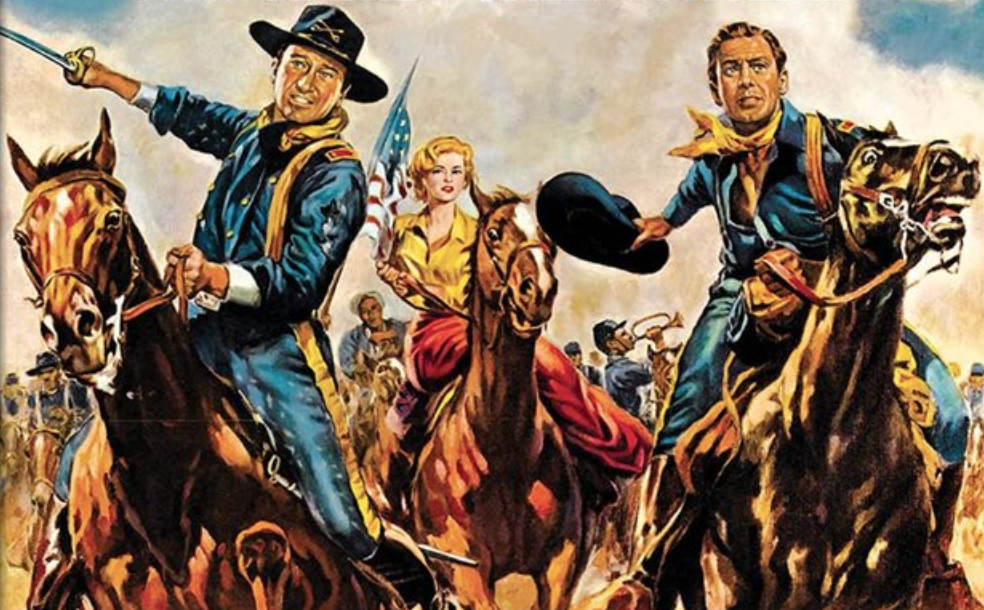
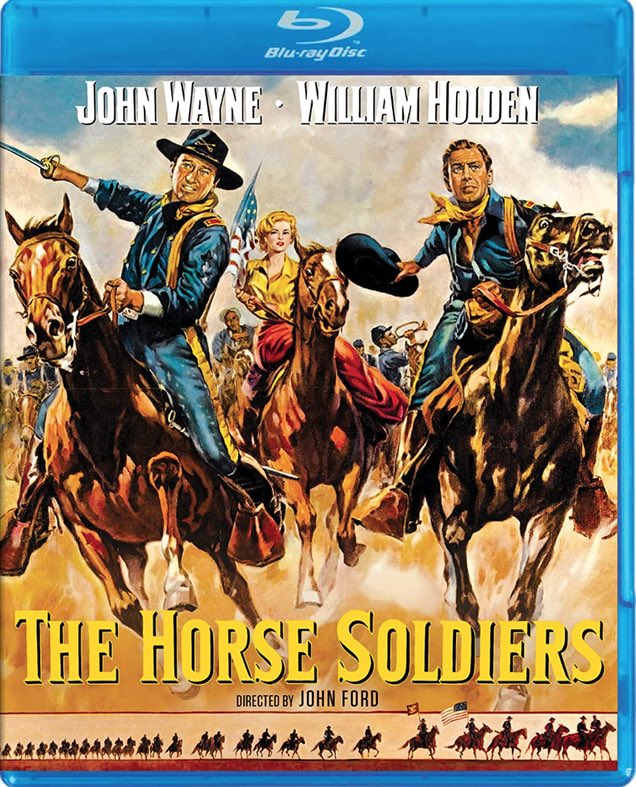
I’ve had it up to here with the standard narrative about The Horse Soldiers being one of John Ford‘s lesser efforts. I know this sounds like heresy, but it may be my favorite post-1945 Ford film. I know that She Wore A Yellow Ribbon and The Searchers and The Man Who Shot Liberty Valance are widely regarded as more substantial and therefore “better”, but I don’t like watching them as much as The Horse Soldiers, and anyone who doesn’t like that can shove it.
A Civil War drama based on Grierson’s Raid of 1863, The Horse Soldiers is steady, solid, midrange Ford — well-produced and well-acted with good character arcs and flavorful Southern atmosphere. Plus it gets extra bonus points for being set in the South (green trees, green grass, plantations, swamps, bridges, rivers) and not in godforsaken Monument Valley.
Handsomely shot by William H. Clothier in a 1.66 aspect ratio, its very easy to watch — every time I pop it in I feel comfortable and relaxed. Partly because it has a minimum of Ford-bullshit distractions. My only real problem is a scene in which rebel troops are heard signing a marching tune exactly like the Mitch Miller singers. I also don’t like a scene in which a furious John Wayne throws down eight or nine shots of whiskey in a row — enough to make an elephant pass out.
There’s a scene in which a boys’ military academy is asked to attack Wayne’s Union regiment — a scene in which a mother drags her 10-year-old son, Johnny, out of a line of marching troops, only to lose him when Johny climbs out of his second-floor bedroom window to rejoin his fellows. It reminds me of that moment when Claudette Colbert collapses in a grassy field as she watches Henry Fonda marching off to fight the French in Drums Along The Mohawk.
I also love that moment in Newton Station in which Wayne senses something wrong when costar William Holden, playing an antagonistic doctor-surgeon, tells him that perhaps a too easily captured Confederate colonel (Carleton Young), an old buddy, isn’t the submissive, easily captured type — “He’s West Point, tough as nails…the man I knew could lose both arms and still try to kick you to death.”
In a perfect world, how much should it cost to make a film out of Don DeLillo‘s “White Noise“, a nearly 40-year-old satire of academia (or, in the present context, deranged wokesters) and a general meditation about the inevitability of death?
We’re talking, of course, about the Noah Baumbach film (directed and written by) that was shot last summer and fall in various Ohio college towns (including Oberlin), funded by Netflix and starring Adam Driver as perturbed Hitler Studies professor Jack Gladney and Greta Gerwig as his neurotic wife Babette. It costars Raffey Cassidy, Alessandro Nivola, André Benjamin, Jodie Turner-Smith and Don Cheadle.
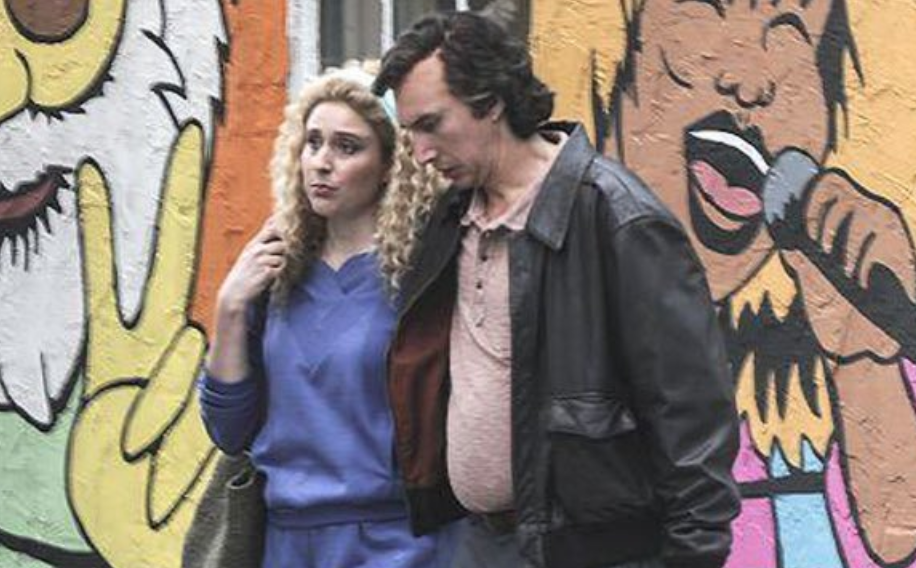
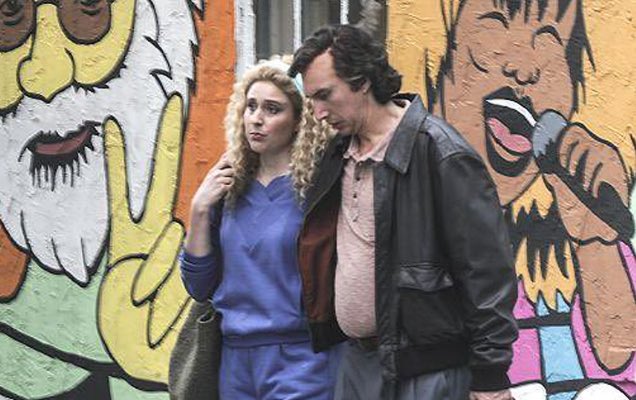
If I was to spitball the budget, I would guess (especially given the tendency of Netflix films to cost more than anyone might expect) something in the range of $40 million plus, maybe a touch higher. But it appears as if White Noise might be an ’80s period piece**. I’m basing this on a set photo of Gerwig wearing big ’80s hair. Shooting period (clothes, cars, signage) is always costly.
If you know anything about Baumbach’s films and more particularly his writing and shooting style, White Noise most likely will be medium close-ups of dialogue, dialogue, dialogue and more dialogue. White Noise‘s big visual element is a depiction of a big train accident that spreads toxic waste all over the place; there’s also a car accident scene involving a lake or pond in which the car sinks. But it mainly sounds like a boilerplate Baumbach talkathon.
The latter figure comes from a film-set worker named “Saul Atreides” (a Jewish nom de plume inspired by Paul Atreides). This calls for a serious trade-reporter inquiry, because as the above headline states, “Noah Baumbach” and “$100 million budget” are a serious contradiction in terms.
On top of which Driver has been made up to look late 40ish or early 50ish, and to this end Baumbach has given him a prominent pot belly. Is it prosthetic or did Driver do a “Robert DeNiro as Jake LaMotta” by going to Italy and tanking up on pasta?
Ruimy: “How does a budget on a smallish, intimate drama, set on a Midwestern college campus, balloon to $100 million plus?! This is madness. I liked Marriage Story and Kicking & Screaming, but this isn’t a guy with a big enough name or following to justify that kind of spending. It’s no wonder Netflix is cutting back now — they’ve been spending like drunken sailors for about a decade now.”
HE’s all-time favorite Baumbach film is still Greenberg (’10), but I wouldn’t like it as much if it had cost $100 million.
Paul Kolas: “It was a fool’s errand to even attempt to make a movie out of White Noise. It may be a brilliant novel, but an apt metaphor would be Ahab chasing the White Whale, and if this turns out to be Baumbach’s Heaven’s Gate, l can just see critics calling it Noah’s Flood.
“I want this to be a great movie, do I ever, but this news is most distressing. Notice that Netflix is not promoting it, or Blonde, and focusing on more commercial audience-friendly films like The Gray Man and Knives Out 2. And look at the way they are already promoting the living daylights out of Maestro, which you know will be their biggest Oscar bait movie to date, and we’ll most likely have to wait until October-November-December of next year to see it. I don’t know what the budget is on Maestro, but I seriously doubt it’s anywhere near $140 + million. No wonder Netflix is in a panic.”
** If White Noise is, in fact, an ’80s period thang, we can obviously scratch the “deranged campus wokester” angle.
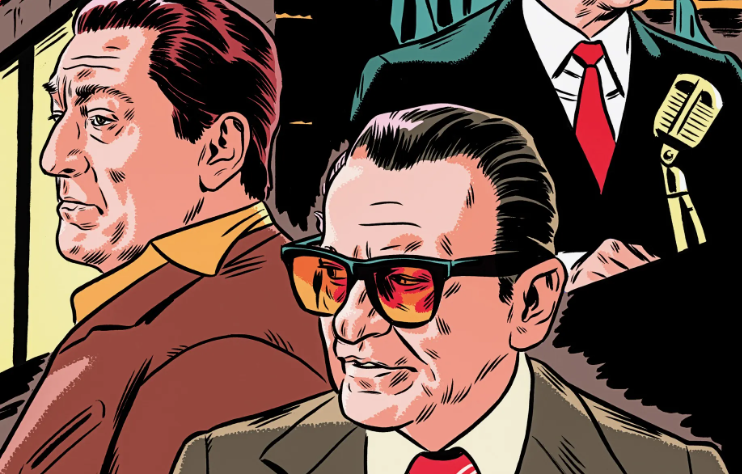
In a 6.122 THR article by Borys Kit, Martin Scorsese‘s The Irishman is described as “an expensivevanityproject.” The statement is Kit’s own, and I’m sorry but it’s bullshit.
The Irishman is easily one of the greatest films of the 21st Century, and the last 30 or 40 minutes delivers perhaps the most devastating passage about grief, regret and facing the end of one’s life in the history of movies.
For the 47th time, “Wild Strawberries with handguns.”
Parasite is a toy movie…a toy movie about class conflict, made by a serious, super-crafty cineaste and blah blah. Don’t crank me up again about the drunken con-artist family letting the fired maid into the house, etc. History will not be kind.
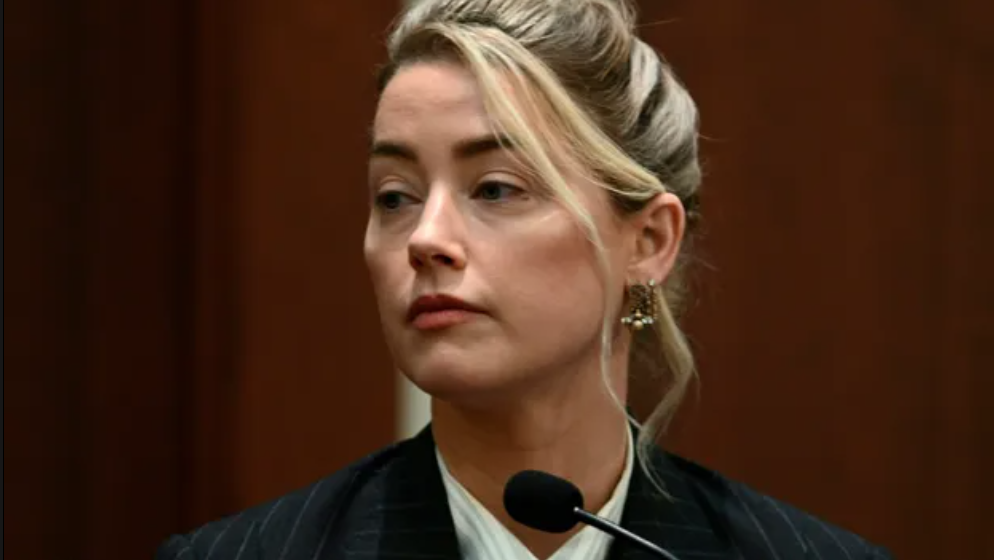
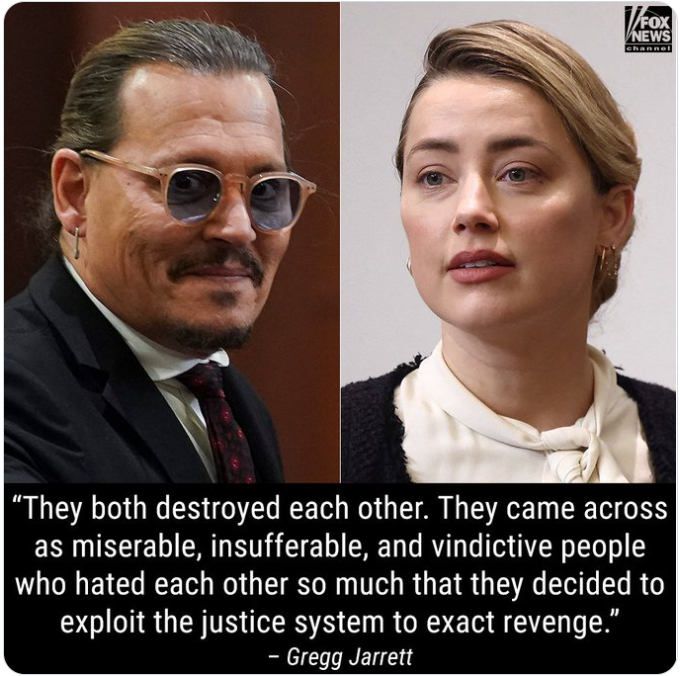
If there’s a general consensus about the Depp-Heard verdict, it’s probably something like “it’s finally over…let it go…whatever the truth of it, Depp seemed more honest than Heard plus he’s certainly more likable…it’s gone on long enough…let it go.”
“One might have thought — or, at least, I might have thought — that we’d be in a more enlightened place by now. And yet despite the public reckonings of #MeToo and the recent reexaminations of pop culture figures — Britney Spears, Pamela Anderson, Janet Jackson and others — there is precious little introspection over the widespread hatred of Ms. Heard.
“This trial seems to have exposed some of the rhetorical weaknesses of #MeToo. ‘Believe women’ for example — a phrase that was meant to underscore how rare it is for a woman to lie about her own abuse — had somehow morphed into ‘believe all women,’ which left no room for the outlier. That has apparently become, as the comedian Chris Rock put it this week, ‘Believe all women…except Amber Heard.’
“The intent of that early slogan was, in part, to encourage the public to treat women who speak up with basic dignity and respect, however messy and imperfect they or their stories may be. Yet none of that seems to have trickled down here.”
Still in Toronto due to a pair of Air Canada flight cancellations yesterday (one due to a sick pilot, the other due to New York weather)…you don’t want to know. Not to mention Justin Trudeau‘s infuriating insistence upon masking. I left Paris yesterday morning at 8 am. By the time I arrive tonight I’ll have been travelling for roughly 42 hours.
Except for the wounding, bandaging and eventual healing of a pigeon, next to nothing happens of any serious consequence in Kelly Reichart’s Showing Up, which I reviewed a few days ago in Cannes. And yet despite the absence of a compelling story, it’s reasonably engaging…okay, mildly diverting.
But is it also about significant invisible things…undercurrents that signify what’s actually going on in not just the characters’ lives but perhaps even our own? That’s the key question, and honestly? I can’t say that I felt much of this.
What are the most highly regarded films in which relatively little transpires plot-wise but which signal that somethingisgoingon, and in some cases more than a little something?
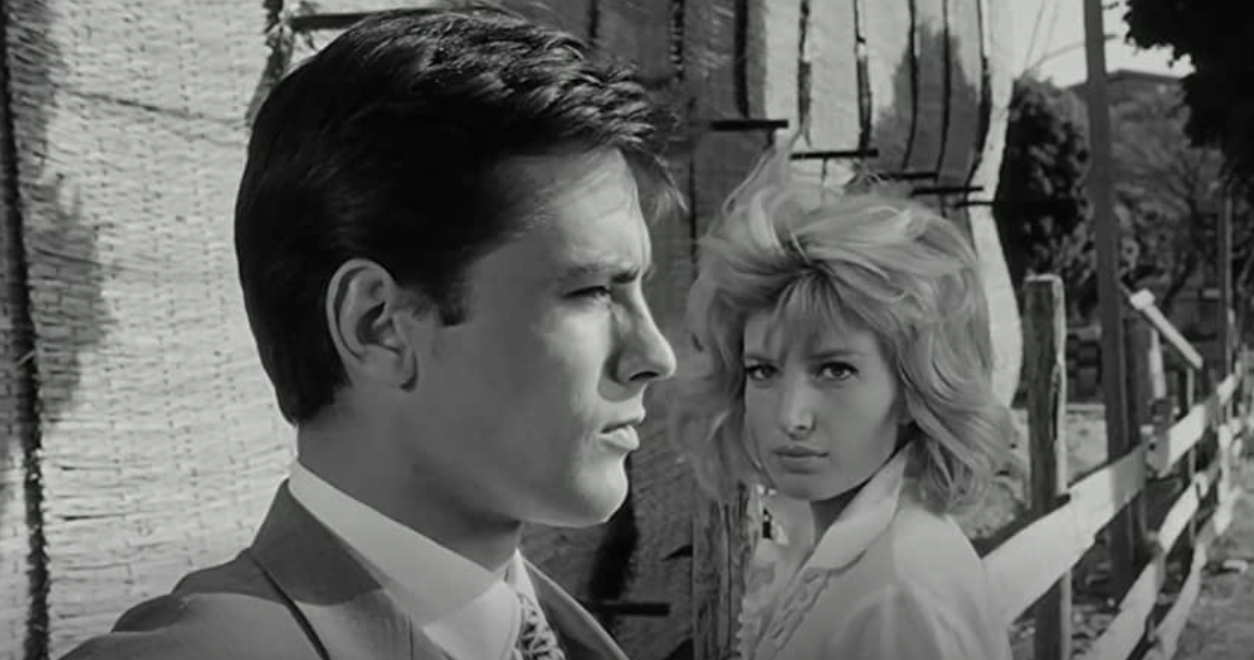
Certainly the five Antonioni classics of the ‘60s (L’Avventura, L’eclisse, La Notte, RedDesert, Blow–Up). Sofia Coppola’s Somewhere. Chris Petit’s RadioOn. I’m already running dry. Which others?
PostedinJuly2021: Most of us are attuned only to life’s tangibles — food, shelter, warmth, money, clothing, pets, guns, cars, shoes, homes, furniture, trees, hills, mountains, oceans, swimming pools, sailboats. Things we can see, touch, smell, eat, wear and dive into.
But others, fortunately, are also mindful and in some cases stirred or motivated by invisible things — thoughts, feelings, spirits, ghosts, dreams, intuitions, morality, melancholy, premonitions, memories.
Any filmmaker can focus on the tangibles. Most of them do, in fact. Movies that are strictly about tangibles are “mulch” movies, a term that I defined earlier this month. Mulch is the source of our shared Hollywood ennui…the muck at the bottom of the dried-up lake…the disease that keeps on infecting…the gas that fills the room.
Except for a smattering of elite, award-season stand-alones (or festival movies) and select forthcoming streamers like HBO’s Scenes From A Marriage (Bergman remake), Hollywoodmakesalmostnothingbutmulchthesedays. The streaming + re-emerging feature realm is flooded with mulch…empty, inane, meaningless, spirit-less, jizz-whiz “content” crapola that nobody wants to see or cares about, but they’re made anyway because the zone-outs and knuckle-draggers need stuff to watch.
But only serious directors are able to convey or dramatize the presence of invisible things. The finest films are actually concerned with a mixture of tangible things, which is natural and inevitable in any corner of life, but are driven by the invisibles.
And the best of the best almost never articulate in so many words what the invisible currents or particles are about. They hint at them or nudge audiences into considering or meditating upon their presence, but they never say “these are the things that really matter.” The great films always say “you figure it out…you put it together.”
The more a film is focused upon or at least mindful of the invisibles, the richer and more accomplished it is. And the more moving, of course.
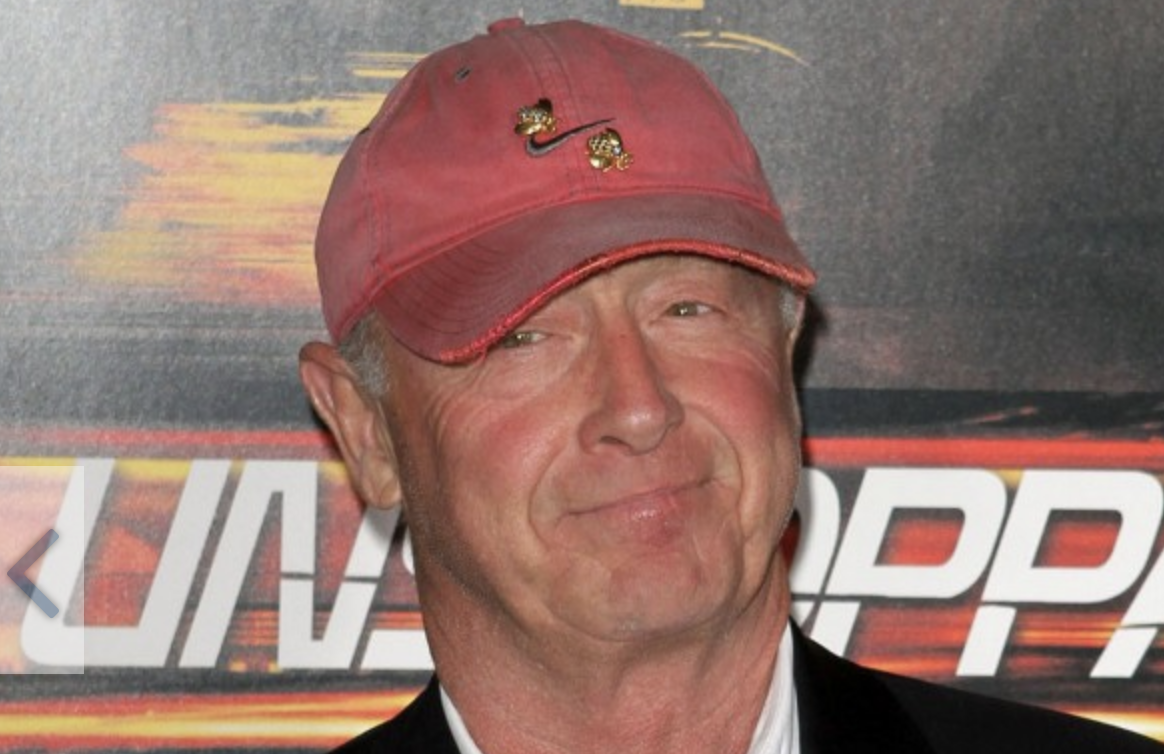
“Original Top Gun helmer Tony Scott was to have directed Top Gun: Maverick. Tony had a signed contract with Paramount and was developing the screenplay. But ten years ago this August, Tony jumped off a San Pedro bridge to his death. I am not certain of the whys behind the suicide**, only that it is always a sad event when someone checks out early. It’s especially sad when it is someone as sunny, bull-headed, and easy-to-laugh as Tony. He silently battledcancerfor40years but kept it quiet. There was no sign of it in the coroner’s report or any other underlying health issues. His brother, Ridley, called his suicide ‘inexplicable.’
“I first met Tony on the screen. He was a lad of 15 years. He starred in his older brother’s first experimental film. It was shot with a Bolex in Hartelpool England. The movie was called Boy & Bicycle — 45 minutes of Ridley Scott doing fancy camera moves while Tony rode around. It was not as powerful as Truffaut’s first film which also tackled the subject matter of bicycles, but it showed the daring and power of the film language that Ridley would later command in movies from Alien to Blade Runner to Gladiator.
“Tony had a sweet demeanor in that short movie. While he was 8 years older than I, I always treated him like a younger brother. What does that mean? I was kind but firm with him because he could be prone toward mischief and disobedience even while smiling and hugging you.
“In the flesh, I first met Tony in an interview with Ned Tanen, the head of the studio, at Ned’s house in [Santa Monica] on Channel Road. The meeting was to determine if Tony should direct Top Gun. During the high-tension meeting, Tony fell asleep. In mid-sentence. While explaining his vision in Ned’s favorite chair.
“35 Hollywood directors had turned down TopGun. The producers, Don Simpson and Jerry Bruckheimer, were anxious to keep the project alive. But NO ONE wanted to get near it. Don and Jerry had a monster hit with Flashdance. BUT when first viewed, Flashdance was a hot mess. After the preview, the theatre was empty. The audience had walked out. It was that bad. Flashdance went through 35 arduous previews until it morphed into an audience-pleasing juggernaut success. Paramount was infamous for previewing until the movie was the best it could be.
“After the meeting with Scott, Tanen turned to me and said ‘well, what do you want to do?’
“Then came the most important prompt of my life. I learned so much through that prompt. Ned said, ‘Listen, I hate this fuckin’ project. I hate these fuckin’ looney-tune producers. Everyone in town hates the script. But I believe in you. If you want to make a fuckin’ movie with this Brit who falls asleep in the middle of a job interview, then be my fucking guest. You make the decision, right or wrong. And when this fucking movie comes out, you’re going to wear it, for better or worse. You get it? Do you understand me?’
“I took up the gauntlet. To be fair, Scott was jet-lagged. He had gotten off a plane from London and was rushed to Ned’s house for the meeting. I felt bad for my younger brother.
“That night, I booked a projection room on the Paramount lot, ordered some take-out, and watched Tony’s last movie, The Hunger, about lesbian vampires. It was beautiful to look at, and it was godawful. Commercial storytelling demands that a director put the energy of the narrative in the right place. It was a bunch of pretty images and nothing more.
“In The Hunger, Tony was so focused on closeups of high heels and red-painted mouths and endless fluttering curtains, I never had a clue where I was in the story. He never established the geography of the narrative. There were no masters. No exits and entrances of people into rooms. Where the heck were we?
“After a sleepless night, I asked to have breakfast with Tony and his manager, Bill Unger. I explained to Tony that we would hire him to direct Top Gun under two conditions: 1) adhere to the budget of $13.5 million and 2) in every scene, shoot a master up front as protection. ‘We have to know where we are, Tony. You are a brilliant shooter but we have to know where we are. If we are shooting a bar scene, we need to see the bar to establish the scene. That goes for every scene, whether it be an air hanger or a classroom. ‘I promise, mate,’ he said as he smiled and hugged me.
“I went back to Tanen and told him we had found our man. I explained why we were hiring him, what the simple strategy of obtaining master shots in each scene. I told Ned that I had gone over the financials and believed with some certainty, with Tom Cruise’s star power, we could reach at least break-even if the picture did $50 million in U.S. box office. With that box office, we should do at least 3 million units in home video.”
Tanen: ‘Listen to you,’ he laughed. ‘You’ll have my job in 3 years.’
“’I appreciate the responsibility and for your belief in me,’ I said. ‘No one has ever believed in me like that.’
“’Get outta here,’ he said but he was choked up. Three years later, I took over his job. He was tired of it. Ned helped me believe in myself. I never worked so effing hard to make Tony work as the director in all my life.
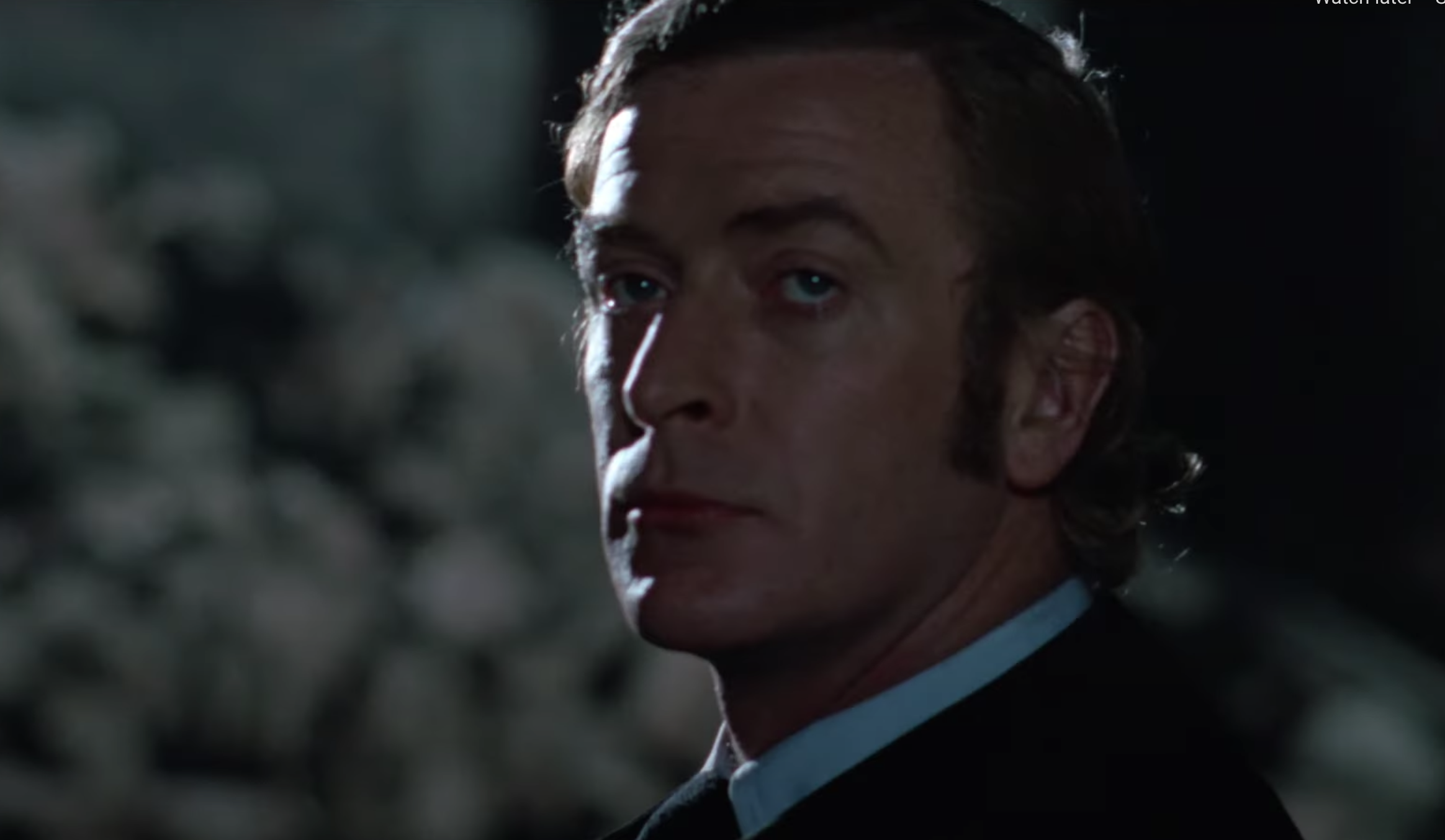
HE-posted on 8.23.15: One noteworthy thing about Michael Caine‘s icy performance in Get Carter is that he always looks stern, steady and focused. He never blinks an eye.
And yet by his own admission Caine was half in the bag while filming this Mike Hodges gangster flick. During the ’60s and early ’70s Caine was smoking at least 80 cigarettes and “drinking two to three bottles of vodka” a day, he’s said.
Caine reportedly quit cigarettes “following a stern lecture from Tony Curtis at a party in 1971,” and has credited his wife Shakira, whom he married in ’73, for steering him away from vodka.
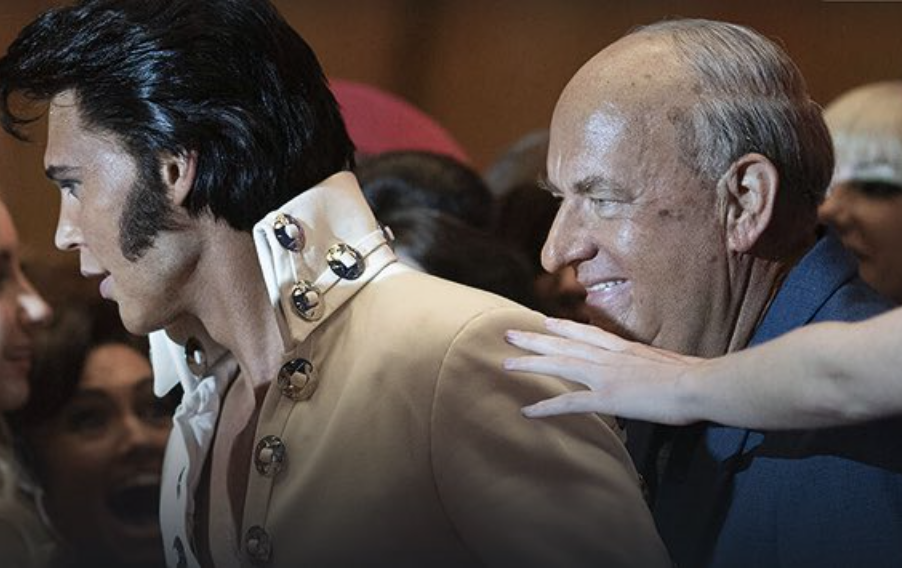
I’m not up on makeup techniques. I don’t know the functional differences between foam latex, gelatin, silicone and gypsum cement. But I’m moderately impressed by the Elvis transformation of Tom Hanks into Colonel Tom Parker, at least as it appears in the below photo.
A guy who’s seen Baz Luhrmann‘s film says that Hanks’ bulky, big-nosed Tom didn’t strike him as wow-level, but sometimes this stuff is in the eye of the beholder. The ears might belong to Hanks or not — I can’t tell. Otherwise I’m impressed by the thinning gray hair, the spray-tan complexion and especially the schnozz.
I understand, by the way, that while the film doesn’t transform Austin Butler into classic “fat Elvis” proportions (which reportedly manifested during the last couple of years, sometime between ’75 and the singer’s death on 8.16.77), Vegas-jump-suit Butler does appear slightly bulkier, or so it seemed to this observer.
Parker died in January 1997, or nearly 20 years after Elvis ascended.
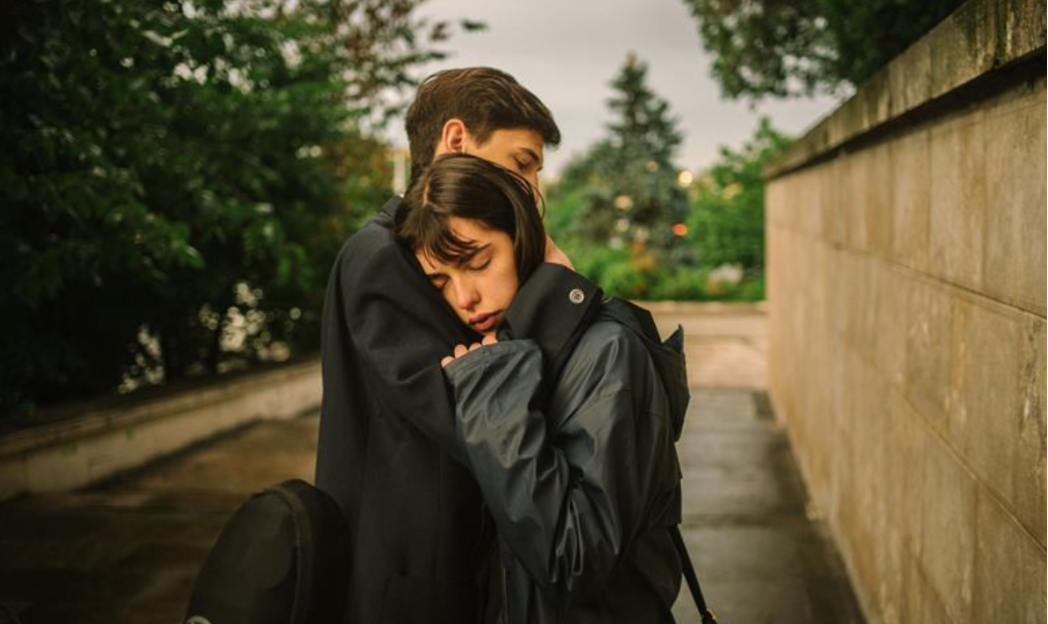
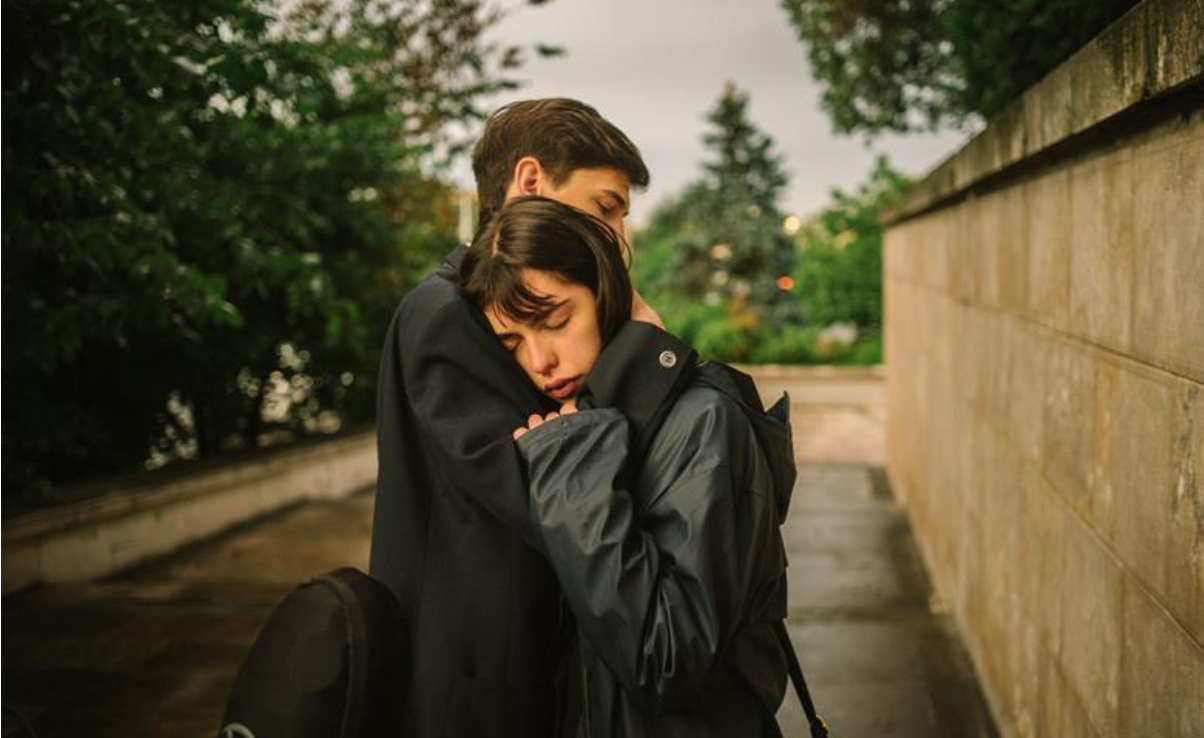
Metronom, the debut effort by Romanian director-writer Alexandru Belc, is a spot-on, nearly perfect political drama about a pair of Bucharest-residing lovers in their late teens (played by Mara Bugarin and Serban Lazarovici) whose relationship is tragically perverted by Romania’s secret police.
It’s not a Cannes competition entry but part of the Un Certain Regard line-up, but if it were a competition film it would be a top Palme d’Or contender, at least in my book.
Set in October 1972, Metronom doesn’t particularly resonate with our present catalogue of political horrors, but serves as a time-capsule reminder of the beastly oppression of the Nicolae Ceaușescu regime, which ran Romania from early March of 1965 until Ceaucescu’s overthrow and execution on 12.22.89.
The story is principally told in personal, emotional and intimate terms, and is focused on the ins and outs of the relationship between Ana (Bugarin) and Sorin (Lazarovici). The inciting incident scene, which doesn’t happen until roughly the 45-minute mark, is a party in which they and their high-school-age friends listen to a Radio Free Europe broadcast by rebel DJ Cornel Chiriac (1941-1975).
Chiriac’s shortwave radio show, “Metronom,” delivered uncensored news from the non-Communist west along with contemporary rock music, and thus was feared and, as much as possible, suppressed by the Securitate.
As the party kids listen they decide to write a “thank you” letter to Chiriac for providing an anti-Commie view of the world, both topically and musically. Such an act, of course, was regarded by the bad guys as subversive and criminal, and so before you know it (and I mean while the party is still going on) the goons bust in, arrest the kids and take them down to headquarters to sign confessions about the letter.
Did someone rat them out?
That’s all I’m going to say about the plot, but what happens certainly has a significant effect upon Ana and Sorin’s relationship. Let’s just say that the last 55 minutes of this 102-minute film are quite chilling. This mood is complemented by Tudor Vladimir Panduru’s shooting style, which follows the standard Romanian-cinema aesthetic — plain, unfussy, longish takes.
I’ll admit that Metronom tried my patience here and there. Some shots seem to last too long. Bugarin’s performance is hard to read at times,. During the party scene there’s an announcement by Chiriac that rock superstar Jim Morrison has died in Paris, which is a problem given that the Doors frontman passed on 7.3.71, or roughly 15 months before the party scene in question. And near the end there’s a post-interrogation scene between Ana and her best friend Roxana (Mara Vicol) that doesn’t quite stick the landing.
But otherwise Metronom is quite riveting — an emotionally relatable story of state terror that sticks to your ribs.