Sinead O’Connor’s Beautiful Scream

During her ascendant, hot-rocket period (’85 to ’92), Sinead O’Connor was one of the greatest rockers ever — a ballsy poet, provocateur, wailer, screecher, torch carrier…a woman with a voice that mixed exquisite style and control with primal pain. She was / is magnificent. I still listen to The Lion and the Cobra and I Do Not Want What I Haven’t Got, and I still love “Madinka”, “Jerusalem”, “Troy” and “Nothing Compares 2 U”…all of it, the primal energy, the shifting pitch of her voice, the Irish punk banshee thing…wow.

It doesn’t matter that this happened 30 to 35 years ago, and that O’Connor has lived a convulsive, ebb-and-flow life ever since…one torrential spew or tussle or throw-down after another…or that she now performs in Muslim robes (having converted two or three years ago)…what matters is that from age 19 through 26, or for roughly eight years, O’Connor was a blazing art-rocker of the first order and an unstoppable historic force…like Bob Dylan was between ’61 and the motorcycle accident + Blonde on Blonde crescendo of ’66.

Kathryn Ferguson’s Nothing Compares, a 96-minute doc that I saw late yesterday afternoon, is mainly about O’Connor’s rise, peak and fall over that eight-year period. (The last 30 years are acknowledged but mainly in the credit crawl.) Sinead’s climactic crisis, of course, was that infamous mass rejection that followed her defiant “tearing up the Pope photo” performance on a 10.3.92 airing of Saturday Night Live, which then was followed by the booing she received at a Dylan 30th Anniversary tribute concert in Madison Square Garden about two weeks later.

She never recovered the magic mojo.

Ferguson’s doc says three important things. One, Sinead’s fiery temperament came from a horribly abusive childhood, principally due to her monstrous mother (who died in a car crash in ’86), and as a musician she radiated such a bruised, scarred and beat-to-hell psychology that…well, blame her awful mom and her shitty dad also. Two, her peak period was magnificent, and if nothing else the doc will remind you of this. Three, Sinead was right about the Pope, or rather the institutional abuse of children at the hands of pedophile priests, and so she was way ahead of her time. (The Boston Globe‘s Spotlight team made a huge splash with their ’02 report about the Catholic church hiding the criminal misdeeds of priests abusing Boston-area children, and of course Tom McCarthy‘s Spotlight came along in ’15.)

O’Connor has soldiered on and kept plugging for the last 30 years, and obviously there’s an intrepid aspect and bravery in that, and yet Ferguson ignores the blow-by-blow — the lurching, shifting, sporadic turbulence that has marked O’Connor’s life ever since (not including the devastating suicide of her son Shane earlier this month, which happened well after the film had wrapped).

Side observation #1: The 55-year-old O’Connor doesn’t appear in the doc as an on-camera talking head, although she narrates a good portion of it. I have to say that the deep, guttural sound of her present-day voice — honestly? — sounds like a dude’s. Booze, cigarettes, whatever…the speaking voice she had in interviews from the late ’80s and early ’90s is gone.

Side observation #2: The Prince estate refused to allow Ferguson to use “Nothing Compares 2 U”, as the song was authored by Prince and owned by the estate. What a dick move! A low-budget doc that pays devotional tribute to O’Connor and the Prince estate refuses to allow her most famous recording to be heard? Jesus…this has to be one of the lowest scumbag moves in rock-music history.

Side observation #3: Who were those assholes who booed O’Connor at a Dylan concert, of all things? Her manner of conveyance was overly blunt, agreed, and she probably should have toned it down, but c’mon, her Pope protest was about protecting children from abuse and pain and thousands of Dylan fans fucking booed her?

Read more

“King Richard” Is Different, You Bet

Click here to jump past HE Sink-In

Reinaldo Marcus Green and Zach Baylin‘s King Richard has been in the award-season swirl of things since 11.19.21, but the buzz began at the Telluride Film Festival on 9.2.21. And since that debut I’ve been among those who’ve said “this is it!…the big Will Smith moment!…his best performance ever!” and so on.

I wasn’t wrong to jump on this horse, hoopla- and column-subject-wise, but within the last couple of weeks I’ve been giving King Richard a re-think, and I’ve realized that it’s bigger — more — than just an historic Will Smith triumph. It’s a genuinely great film about a family, and that doesn’t mean (let’s be clear about this!) a “family film.” King Richard is way beyond that realm.

This realization didn’t hit me at first. For ever since I turned 15 or 16, I’ve disliked the idea of movies made for or even about families. For decades the notion of films made by the old-time Disney factory — movies that felt a bit sappy and wholesome and formulaic — made me uncomfortable. (Except, that is, for the Jeffrey Katzenberg-led animated films of the ‘90s, which were exciting and joyful.) But otherwise family-friendly films were something to avoid. For me at least.

And yet King Richard is arguably the most thrilling (and I mean spiritually) film about the struggles of an ambitious family of the 21st Century. And not in the usual sort of way. It’s not so much about emotions and hugs and serendipity and God’s good fortune, but teamwork, discipline, self-respect and tenacity.

It’s also one of the smartest, most complex and most character-driven sports films ever crafted, and the credit for that goes to Green, who just buckles down, cuts out the superfluous b.s. and tells this hard-fought success story with the drill-sergeant discipline of…well, Richard Williams.

Story-wise, King Richard is clean and crafty and radiates authority, and credit for that aspect can also be shared by screenwriter Zach Baylin. The result is a genre-defying “family film” because it’s not aimed at the usual suspects. It’s aimed, really, at movie lovers and filmmakers who can appreciate what first-rate craft and storytelling are really about

What emerges are three movies in one. It’s a tennis-boot-camp-run-by-a-tough-dad family film. A strong-mom family film, due to the knockout performance by Aunjanue Ellis. And a family saga that plays like one of the greatest, down-in-the-trenches competitive tennis films ever made.

Seriously — name a film about the world of professional tennis — the tennis “racket”, if you will — that feels more real or recognizable or satisfying in a socially attuned, business-is-business way. And name a family-oriented film about strength and waking up early and working hard and thinking right…name another such film that behaves less like the usual product.

The Williams sisters — Venus (Saniyya Sidney) and Serena (Demi Singleton) — are sunny and mellow and well-behaved and glorious on the courts, and their mom, Oracene “Brandy” Price (Ellis) is a model of domestic steel and maternal resolve.

And the film is about rigor and devotion and absolutely no relaxing or kicking back. It’s about “if you fail to plan, you plan to fail.” It’s about “only the strong and gifted who get up early and go to bed at a reasonable hour succeed.”

So it’s not just a Will Smith film (although it is) — it’s a Reinaldo Marcus Green film, an Aunjanue Ellis film, a proud Black family film, a no-slacking-off film, a “show me the money” film, a Saniyya Sidney and Demi Singleton film, a Tony Goldywn and Jon Bernthal and Dylan McDermott film. In short, a team effort about the very tough discipline of filmmaking as well as tennis.

It’s finally a film about faith and belief and the kind of persistence that must not and cannot quit.


One of Greatest Musical Scores & Theme Songs

…for a film that’s reasonably decent and excitingly composed and a nice atmospheric New Orleans spooker, but which feels at times a teeny bit too lurid and sexualized for comfort, to the point of almost feeling like an exploitation film….almost.

That would be Giorgio Moroder‘s Cat People score and especially David Bowie‘s Cat People song vs. Paul Schrader’s 1982 erotic thriller, which I watched last night on Amazon.

I hadn’t seen Schrader’s remake in many years, and it’s really not that bad for the most part. But the music is what really seizes you. My very first viewing of Cat People was in a smallish Manhattan screening room, and the sound was so weak and faint (due to mixing or volume?) you could barely hear the percussion under Bowie’s singing. The sound in this music video is perfect.

The boyish Nastassja Kinski (now 61) with the taut muscular bod and oddly shaped lips and funny European feet, and those sex scenes with the late John Heard…I don’t know what to say except that schtupping and eroticism were weighing very heavily on Schrader’s mind back then. (He was having it off with Kinski at the time.) I was also thinking a lot about eroticism and whatnot at the time, but who cared? I was just a critic in the third or fourth row.

Schrader, by the way, is back in New Orleans as we speak, shooting The Master Gardener with Joel Edgerton.

Name other extraordinary scores that were composed for reasonably decent films, and wound up being the most affecting or exciting or profound element. I’ll name three that outshone the films they were meant to enhance — Miklos Rosza‘s scores for Ben-Hur, King of Kings and El Cid.

Attending With Trepidation

I haven’t seen Frank Perry’s Play It As It Lays (‘72), easily one of the greatest Hollywood-is-hell films of all time and certainly one of the finest jaded, glum-minded ‘70s dramas about affluent perversity…I haven’t seen it projected on a big screen for at least 15 years. (It played at the American Cinematheque’s Hollywood flagship theatre…uhm, sometime around ‘06 or ‘07.). I’ll be catching the 1.28 showing at the Los Feliz Cinematheque, but I’m extremely worried that the 35mm print will be faded (i.e., “pink”) or damaged all to hell. This movie is now a half-century old. If this happens I’m going to be very, very upset.

Read more

Dishonest Topography

Few things throw me out of a film more than bad backdrops or wrong-looking topography. A location has to more or less look the part or forget it.

I’ve no problem with the Philippine jungle standing in for Vietnam in Apocalypse Now, or Spain’s Almeria section subbing for the Old Southwest in those Sergio Leone westerns, or David Lean building a temporary set at Spain’s Playa del Algarrobico as a stand-in for World War I-era Aqaba. The locations seemed right plus I didn’t know any better so no worries. But if I do know better, watch out.

The “Florida” setting of the Seminole Ritz hotel in Some Like It Hot, for example, is impossible. Southern Florida is flat as a pancake, and yet we can see the hills of San Diego’s Point Loma in the distance during the “Cary Grant in a sailor hat meets Sugar” beach scene.

I hated it when Robert DeNiro, John Cazale, John Savage and those other factory-mill goons went hunting in rural Pennsylvania, and they wound up near the rocky peaks of Mount Baker in the state of Washington. I immediately checked out of that awful film when I saw those effing mountains.

One of the worst all-time offenders is Franklin Schaffner‘s Planet of the Apes. Charlton Heston‘s rocket ship crash lands in what might be Arizona’s Lake Powell or maybe somewhere in the Mexican Sonoran desert. And then we’re at the Fox ranch in Malibu Canyon, and then we journey to the high-cliff California coast and suddenly we’re in what remains of New York City…adjacent to Zuma State Beach at Point Dume.

As Evelyn Mulwray‘s Japanese gardener says about her salt-water pond and how it affects nearby plants, “Velly velly bad.”

And yet I don’t go out of my way to be a hard-ass. If a film is set in Oklahoma, the scenery only has to resemble Oklahoma. Which is why Fred Zinneman‘s Oklahoma! (’55), which was actually shot in the green-grass sections of Arizona, passes muster.

Cracked-Voice Emotion + Existential Gloom

16 months hence Errol Morris and Robert McNamara‘s The Fog of War will be officially 20 years old, and I’m wondering what our wonderful cancel culture fanatics would say about it today. “This film coddles a war criminal!…normalizes and rationalizes mass murder!,” etc.

I still regard The Fog of War as one of the most emotional docs I’ve ever seen. Phillip Glass‘s techno score is one of the most haunting ever created for a non-narrative feature.

Even in its meticulous recountings of wartime strategies and mistakes that led to mass killings on an almost unimaginable scale, The Fog of War is fraught with feeling…with ache and nostalgia and puddles of regret and candid admissions that cut like knives.

The combination of Robert McNamara stating that while working for Col. Curtis LeMay during World War II he was “part of a mechanism” that fire-bombed and murdered 100,000 Tokyo citizens, and his story of the B-29 captain who was furious that the 5000-foot bombing altitude led to the death of his wing-man, and in recounting LeMay’s response McNamara starts to choke up. 100,000 Tokyo citizens burned to death across 15 square miles, and McNamara weeps about a single Air Force guy who caught a bullet.

If that doesn’t get you emotionally, I don’t know what would. Alternately startling, numbing, unnerving…I’ve never forgotten it.

In early ’04 The Fog of War won the Best Feature Doc Oscar.

Read more

Say Hello to Obama’s Son

Rep. Ritchie Torres (D-NY) is only three months older than Jett (born in March ’88), and as I watched him talk last night on Real Time with Bill Maher a voice was telling me that Torres is future Presidential material. Well-spoken, sensibly liberal, intelligent, very good-looking, LGBTQ, a moderate temperament.

I know next to nothing about the guy, but my gut is saying he could be Obama 2.

Torres will be old enough to run next year — he turns 35 in March ’23. If Biden’s numbers are too deep in the toilet bowl to make a successful ’24 campaign seem feasible, somebody else will have to run against Trump, and nobody wants Kamala Harris as the heir apparent. Because she’ll lose. But Torres could run and win. Seriously. The oldest President in history succeeded by the youngest…it has a ring!

African-American voters who were too homophobic to give Pete Buttigieg a chance might think twice when it comes to Torres. Do I hear support for a Torres-Buttigieg ticket? If elected they could tap Barack as a top White House honcho — a senior adviser-in-chief & permanent West Wing honcho.

The only thing that bothered me last night was when Torres said he’d never heard of Steven Spielberg‘s West Side Story. A gay guy who’s never heard of a new film version of one of the biggest stage musicals of all time?

Dreamland

What is this strange urgent compulsion that some people have to keep Kristen Stewart in contention for the Best Actress Oscar, at least in their own minds? Whatever the root of it, Variety Oscar handicapper Clayton Davis seems to be singing from the same hymn book as Variety film critic Owen Gleiberman (i.e., “she might pull through because now she’s an underdog…go, Kristen…we’re rooting for you!”).

Stamford Theatregoers

Two days ago I mentioned that my very first viewing of The Godfather, Part II happened on 12.20.74 (opening day outside of NYC). It was a matinee showing inside an unheated theatre “somewhere north of downtown Stamford,” I wrote. A few hours later director Rod Lurie explained that the venue was probably the Ridgeway Theatre (52 6th Street, Stamford, CT 06905). It was part of the Ridgeway Mall. It turns out that the Greenwich-residing Lurie went to see Francis Coppola‘s Oscar-winning sequel to The Godfather later that very same day. He was 12 at the time**. The Ridgeway had opened in 1951, and closed its doors in 2001. An LA Fitness spa now occupies the same turf.

Read more

“Batman of Arabia”

The running time of Matt ReevesThe Batman is 175 minutes. I for one am disappointed. I want a Reeves-Batman flick that will run no less than 200 minutes (3 hrs., 20 mins.). I also want an overture, intermission, entr’acte and exit music. Seriously — if you’re gonna go big and weighty, shoot for the moon.

Jordan Ruimy: “Supposedly heavily inspired by Fincher’s Zodiac.”

Worst Bluray I’ve Ever Bought

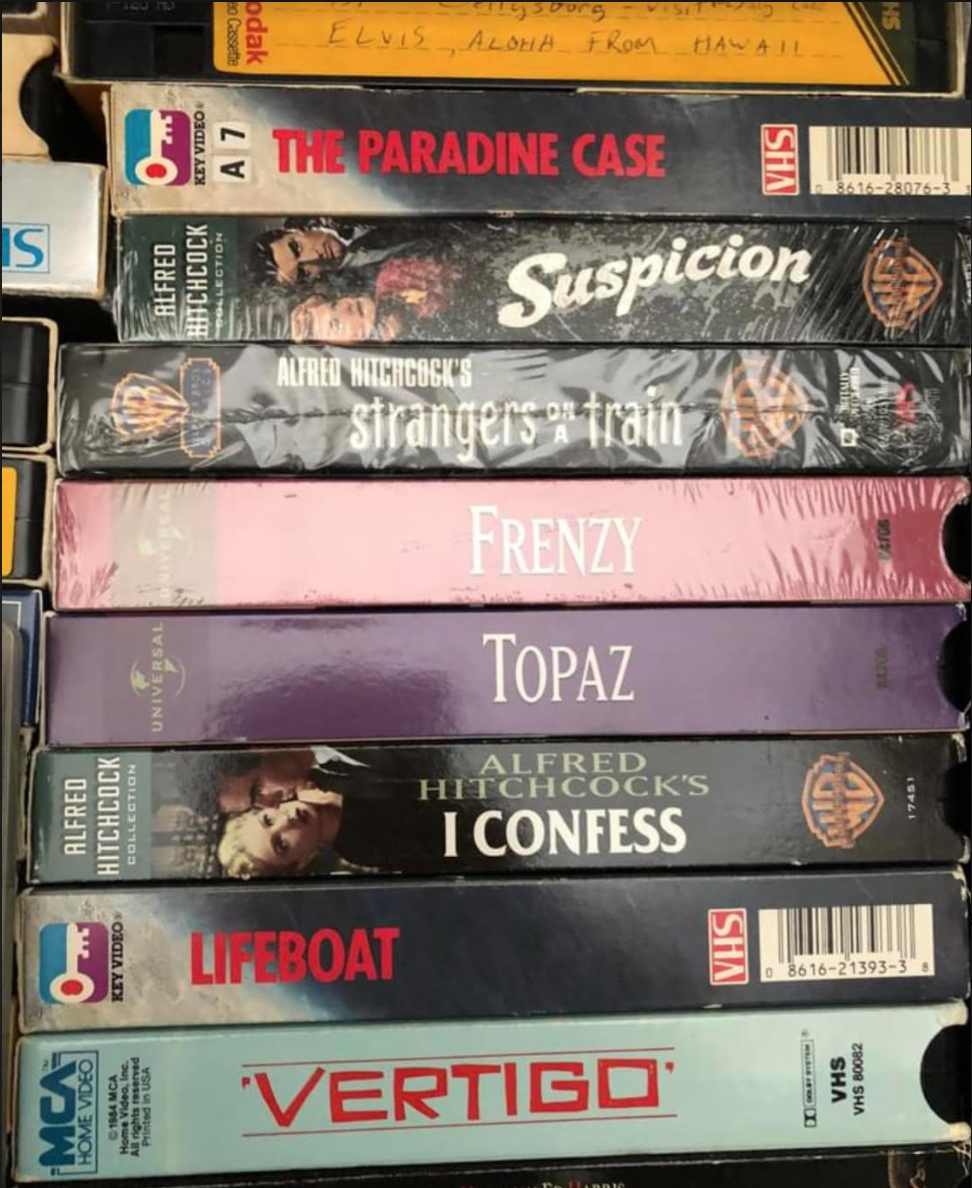
I’ve never felt so completely burned by a Bluray as I was last week when Kino Lorber’s The Paradine Case arrived. Large sections of it are speckled to death. I’m not talking about a Criterion-style swampy mosquito grainstorm, but a baffling suggestion of micro-sized digital sleet — a literal attack upon the film by billions of icy snowstorm specks.

I couldn’t believe what I was seeing. Kino Lorber is a highly respected outfit, and I’ve been delighted with scores of their Bluray releases over the years. It just doesn’t figure that they would release a classic 1940s film looking as badly as this. (And a Hitchcock yet!) I toughed it out until the end, but what a ripoff.

Affleck’s Peak Moment

Imagine that I’m Ben Affleck, and that I’m doing an interview with some obsequious junket journalist, and that the journalist has just asked which performance I’m most proud of…which single performance has, by my standards, hit the mark in a more incisive and commanding way than any other before or since?

I would say without hesitation that my finest performance is the young, go-getter, fortunate-son, guilt-stricken attorney in Roger Michel‘s Changing Lanes (’02).

The Paramount release was filmed 20 years ago, when I was roughly 29.

My “alcoholic basketball coach in San Pedro” performance in The Way Back is my second favorite in terms of all-around pride, subtle technique and emotional revelation, followed by my “husband under suspicion of murder” performance in Gone Girl. My fourth-place would be my action-commando turn in J.C. Chandor‘s Triple Frontier.

I would refuse to answer a follow-up question about which performances I’m most ashamed of, if any. I have a few failures under my belt, sure, but I wouldn’t discuss them with some mealy-mouthed junket whore.

My favorite non-performative performance was on Real Time with Bill Maher, way back in 2014.

Read more