Arson is a ghastly crime, of course — menacing, malicious. And it’s good to hear that last night’s burning of the Fox Christmas tree resulted in no harm to any fire fighters or passersby. The 49 year-old arsonist, a Brooklyn resident, was arrested soon after the tree ignited. The initial presumption, of course, was that the tree was torched as a political statement by a Fox hater. There are flammable Christmas decorations all over midtown Manhattan, but the arsonist chose the Fox tree. Do the math.
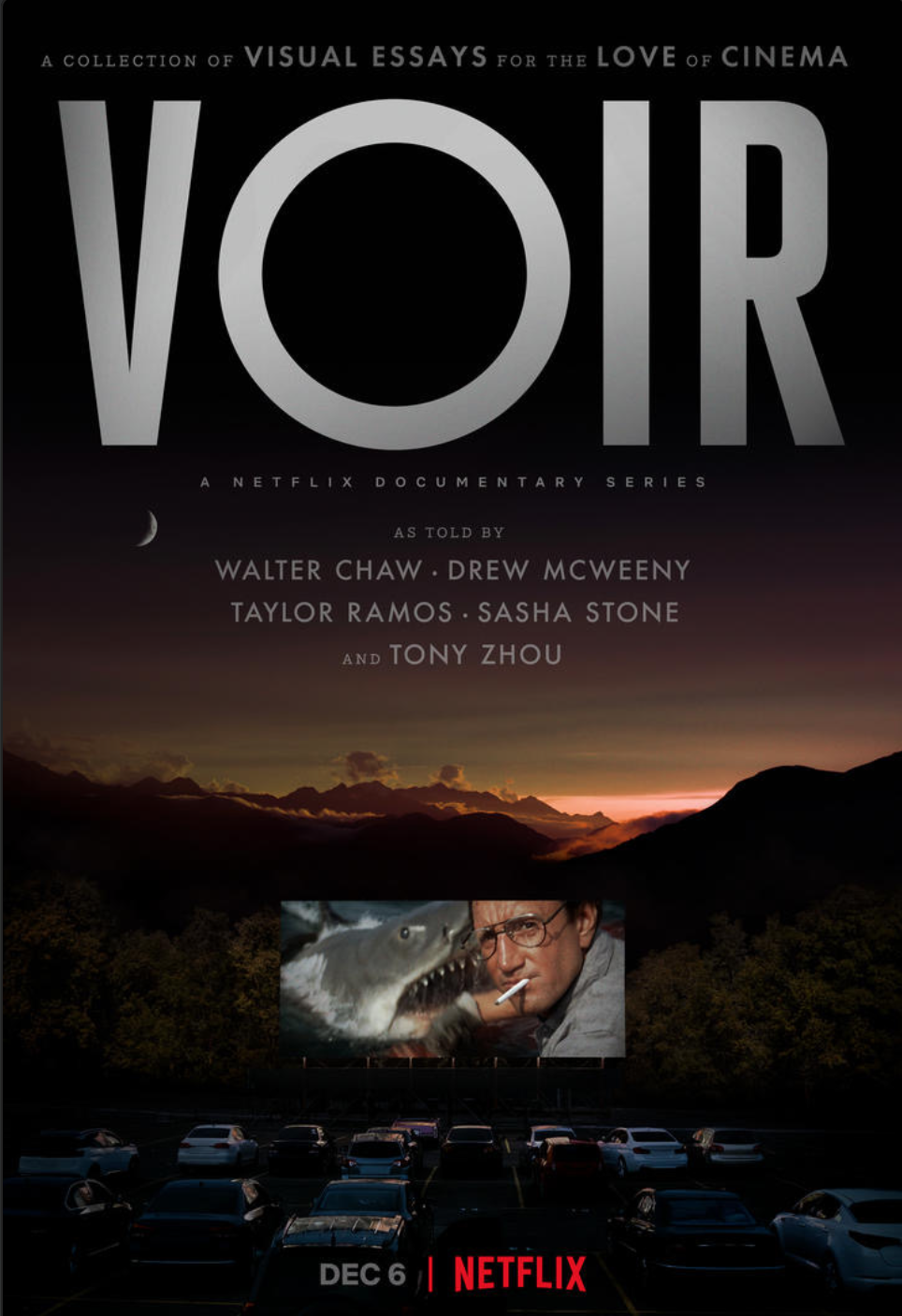
David Fincher and David Prior‘s Voir (Netflix, currently streaming) is a collection of six essays about film worship. I’ve watched four and they’re all finely wrought, but I have to spit something out. Despite my long friendship with Sasha Stone I can’t not say what I know to be true, which is that her autobiographical piece — “Summer of the Shark” — is the most eloquent and well-produced of the lot.
It’s the only one that reaches out and says “this, once upon a time, was me” plus “this was all of us back in the fanciful, doobie-toke Gerald Ford era, and what an impressionable time it was.” It’s about what’s gone forever and will never come back, but in another sense about what’s lasted forever.
“Shark”‘ tells a modest but fascinating little saga about young Sasha (played as a ten-year-old by Eva Wilde, and as a 17 year-old by Shannon Hayes) and her sister Lisa sinking into the captivating vortex of Steven Spielberg‘s Jaws, and how that film lit a certain fascination and devotion in both of them, and in Sasha especially.
The essay paints a swoony, sun-dappled portrait of hippie-ish Topanga Canyon and San Fernando Valley teen culture in the ’70s…detailed, lulling and just as time-trippy as Licorice Pizza in this respect…and tells how Sasha and her sister came to worship the refuge and sanctum of movies in that era (partly for the Spielberg and Star Wars-ian coolness, partly to escape from the turmoil of their mom’s bad boyfriends), etc.
Prior (whose involvement was more hands-on than Fincher’s) does a killer job of blending Jaws beach footage with recreations of Sasha’s own beach time — he and dp Martim Vian even mimic that famous zoom in-track back shot of Roy Scheider.
All in all, “Summer of the Shark” is a great little short (only around 12 minutes…longer?). I’m very proud of Sasha for having written from her heart and narrated it just so and worked so hard for so long on this thing, and (with Fincher and Prior’s expert assistance) having given it just the right touch and spin.
Walter Chaw‘s “Profane and Profound”, a delicious take on Walter Hill‘s 48 HRS., and Drew McWeeny‘s “But I Don’t Like Him”, about unlikeable protagonists, are very fine essays also.
I didn’t care for Taylor Ramos and Tony Zhou‘s “The Ethics of Revenge”, a piece about Park Chan-wook‘s Lady Vengeance (’05) — it struck me as cold and creepy. And I haven’t watched “Film vs. Television,” although I hear it’s admirable.
Friendo: “Watching Voir….your pal Sasha’s episode was good…looks like they spent some money on that one recreating the ’70s. Then again Fincher doesn’t do anything cheap.”
Previously: “Some of our greatest cinema challenges us to really confront our own hearts in the safety of that darkened theatre. That’s part of the purpose of filmmaking.” — quote from Voir trailer.
2021 Reality Check: Movies stopped challenging or even slipping into the hearts of filmgoers with any regularity a long time ago. The only current movies that even flirt with this aesthetic are West Side Story, King Richard, Cyrano, Pig, A Hero and one or two others. Voir is therefore a nostalgia flick to a certain extent.
The dual purpose of 90% to 95% of movies is to (a) repeat and reenforce woke narratives and (b) enhance corporate revenue.
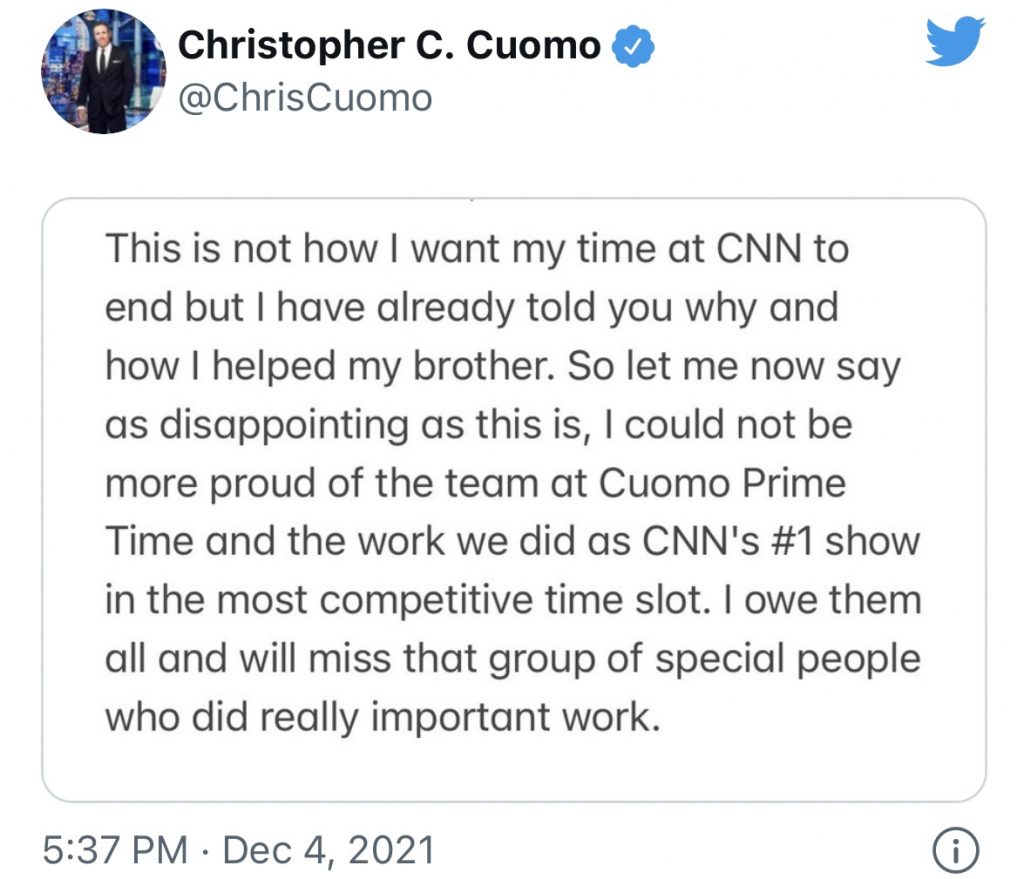
Ex-CNN headliner Chris Cuomo crossed ethical lines by helping his brother, ex-New York governor Andrew Cuomo, to dispute, challenge or circumvent the latter’s accusers in the realm of alleged sexual harassment. A very stupid decision, in short, to choose brotherly love over journalistic integrity. And now it’s time to paythepiper. So what should Cuomo do next?
If you have three reliable sources providing the same or corresponding information, you’re almost certainly on solid footing with your story. Then again if you’re writing about the private voting process for the 2021 New York Film Critics Circle awards, your story is automatically suspect because there’s an ironclad, “if you talk you die” rule among NYFCC members not to discuss the voting.
So in the matter of Jordan Ruimy’s World of Reel story about this subject, it apparently became obligatory among certain NYFCC members (Jason Bailey, Sam Adams, Allison Wilmore, Kate Erbland) to try and discredit the story and trash Ruimy, etc. Full court press.
My limited understanding is that Ruimy’s story is either (a) highly accurate as far as his sources relayed or (b) a mostly accurate summary of what happened, regardless of who said what and who disagreed and/or disputed.
TheSopranos began 22 years ago; today I finally laid eyes on the actual abode of Tony, Carmela, Meadow and A.J. And then we hit Holsten’s, the death diner. Jett decided that Satriale’s (located north of Newark) is too far — his car, his rules.
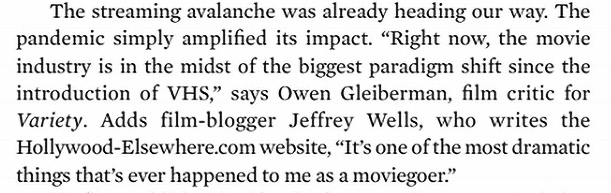
Seasoned critic, scholar and documentarian Marshall Fine has written an assured and comprehensive take on the streaming takeover of (nearly) all things Hollywood. It’s in a forthcoming issue of Cigar Aficionado (i.e., Brian Cox on the cover). I have two or three quotes in it; Cinetic Media’s John Sloss, Variety‘s Owen Gleiberman, Christian Science Monitor critic and LAFCA member Peter Rainer, and five or six others also chime in.
…was more of a 75% vs. 25% split reaction, but it was tweeted last night in earnest. The gladhanders who love almost everything have their place and function, but their raves about Steven Spielberg‘s just-premiered, sure-to-be-Oscar-nominated urban musical don’t mean much. At the risk of sounding puffed up, Rod Lurie is right — a single, emotional, very respectful thumbs-up from someone like myself (there are others who share my mixed view of Spielberg’s career arc) is worth 15 or 20 jump-up-and-down raves from a community of junket prostitutes. It means something in the same way that an HE pan of a boilerplate Marvel or D.C. film is meaningless.
21 years ago I sat down with Tony Curtis at the Beverly Glen shopping center, just south of Mulholland Drive. I waved to him above the heads of several customers sitting outside a popular, packed delicatessen. Curtis waved me over and led me to the inside of a less-crowded Starbucks — fewer people, fewer stares.
When he ordered coffee for both of us, the woman at the counter insisted on a freebie. “Really?” he said to her. “Well, thank you so much!”
We talked about everything — politics, drug-dependency (Curtis had difficulties in this area during the ’80s), Burt Lancaster, old Hollywood, his website (tonycurtis.com, a venue for selling his paintings), women, new technologies, etc.
At midpoint I handed Curtis a list of his 120 films and asked him to check those he’s genuinely proud of. He checked a total of 18. He checked Sweet Smell of Success (naturally) but not The Vikings. Some Like It Hot (of course!) but not The Outsider. He checked Houdini. Every film he made after Spartacus in 1960 up until 1968’s The Boston Strangler, he didn’t check. He checked his role as a pair of mafiosos — Louis ‘Lepke’ Buchalter in 1975’s Lepke and Sam Giancana in the 1986 TV movie Mafia Princess.
Among his notable TV guest appearances, Curtis checked only one — the voice role of ‘Stony Curtis’ in a 1965 episode of The Flintstones.
Dwayne’s answer would have to be “well, if you’re asking me that in the same way you asked Tony Curtis the same question, my answer would have to be zip. Because I’m not genuinely proud of any of my films. I’m glad a lot of them were popular and made money, and I’m certainly glad that I’ve become a hugely successful brand and all. But I’m not a Tony Curtis-level actor, and I never will be.”
Imagine my sitting down with Chris Pratt under similar circumstances. Imagine my handing him a list of the 14 or 15 films he’s starred or played a strong co-lead in over the last, say, 10 years, and asking him to check those he’s genuinely “proud of”.
Pratt’s answer would have to be “well, if you’re asking me that in the same spirit that you asked Tony Curtis and Dwayne Johnson, my answer would have to be that among the films I’ve starred in, I am genuinely proud of nothing. I’m ‘proud’ a lot of my films made money, and I’m certainly glad that I’ve become a hugely successful, bulky-bod, conservative-minded actor with big money and big homes.
“I’m genuinely proud of three films that I played a supporting role in between 2011 and 2013 — Bennett Miller‘s Moneyball, Kathy Bigelow‘s Zero Dark Thirty and Spike Jonze‘s Her — but that’s another subject. The bottom line is that as a movie star I make commercial fast-food movies and that’s all. If I’m the star, you know it’s going to be a throw-away, more or less. You know it, I know it. I’m really sorry I did Passengers, which everyone hated, but the money was good so I took it and ran like a thief.
Posted on 7.9.08: HE commenter Burmashave: “Anybody ever think about James Dean playing Jesus if he’d lived, and how fucking crazy that would have been?”
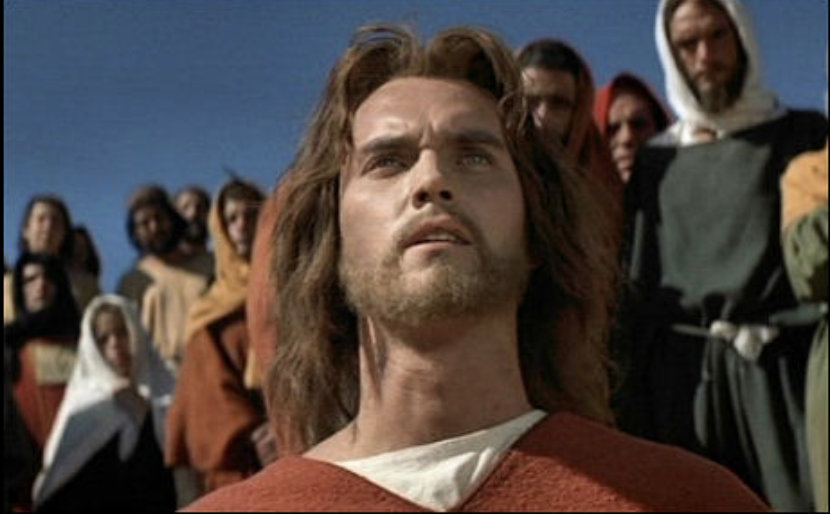
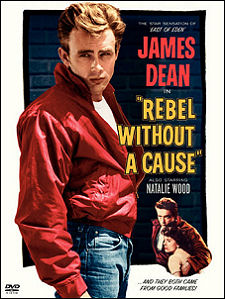
There’s a distinct similarity factor between Rebel Without a Cause‘s James Dean and King of Kings‘ Jeffrey Hunter. Both films were directed by Nicholas Ray, of course, so in a sartorial fashion Ray did sorta kinda cast Dean in his Bible movie. He did this by having Hunter wear a facsimile of the iconic red jacket and white T-shirt get-up that Dean wore in Rebel.
Variety critic Todd McCarthy reminded me this morning, in fact, that “Ray dressed Hunter in a robe of exactly the same shade of red as Dean’s Rebel jacket.”
The idea of Christ wearing a red robe had already been established in The Robe and Demetrius and the Gladiators, but think for a moment about the ludicrousness of a dirt-poor Jesus of Nazareth wearing a red cloak with a perfect white T-shirt garment underneath. It’s as if they had Gap and Banana Republic shops in old Jerusalem, and Jesus and his disciples occasionally shopped there.
What if J.C. had hired a fashion consultant? “As you know, Nazarene, plain red works fine on every occasion, but — stop me if I’m overstepping — you need to present an extra stylistic distinction, something that says ‘this guy is special’ and not just some, whatever, shepherd or olive farmer or whatever, if you follow my drift. That’s why a white undergarment is such a good idea. And it comes with white briefs in case, perish the thought, you’re ever crucified, because the Roman guards will let you keep the briefs on. Or at least, they have with my other customers.”
“Everything you say about King of Kings is right,” McCarthy wrote about my 7.8 posting, “but to me the most compelling aspect of the film it how political it is. The first whole section of the picture details the political situation in Judea at the time with almost documentary-like attention, and the script’s great and provocative gesture is to present Jesus and Harry Guardino‘s Barabbas as parallel revolutionaries — Jesus of a religious stripe and Barabbas as a political outlaw, which makes the ending ironic.
“In defining the major Jesus films of the ’60s-70s period, it’s fair to say that Stevens’ The Greatest Story Ever Told is the Protestant version, Zeffirelli’s Jesus of Nazareth is the Catholic version, Pasolini’s The Gospel According to St. Matthew is the Marxist version and King of Kings is the Zionist version.
“Of course Hunter is physically far too fair (and note the shaved armpits at the crucifixion), but he still manages to achieve a poignant purity as things move along. The score is one of Rozsa’s very greatest and crucial to covering over various narrative lurches and shortcomings. And, by the way, there are no known 70mm prints, so you can’t blame the Cinematheque for not delivering one.””
I’m trying not to sound all performance-arty about the sad, sudden passing of former movie critic and film festival get-around guy James Rocchi, who was 53. Felled by a heart attack. He wasn’t a “friend” but I certainly liked and admired him during the Rocchi peak years (late aughts to mid teens), and he seemed to enjoy or at least tolerate my routine for the most part. (He often addressed me as “Doctor Wells.”). I’m running around Manhattan as we speak but I’m very, very sorry for James’ loss, and ours. He was a total gentleman, and he always dressed impeccably.
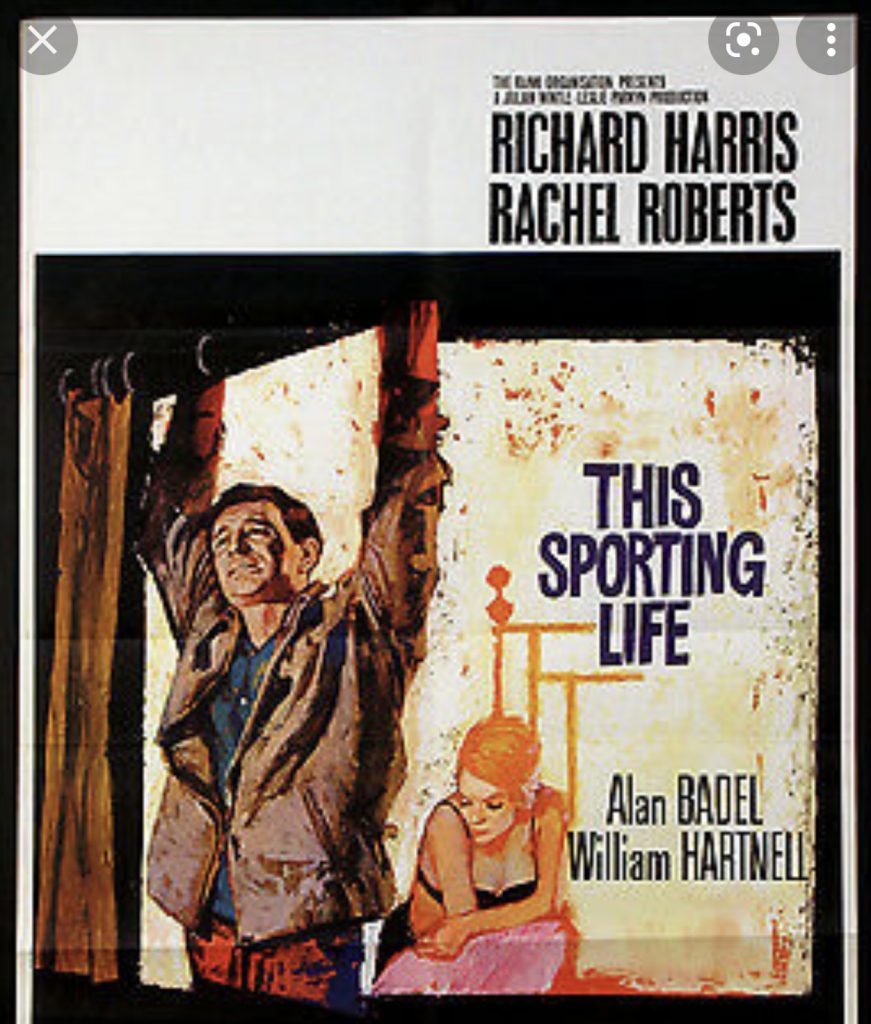
I’ve been watching Lindsay Anderson’s ThisSportingLife (‘63) off and on for 20+ years, or since the dawn of the DVD/Bluray era. Easily my all-time favorite “throwing up in the kitchen sink” drama, and certainly one of Richard Harris and Rachel Roberts’ greatest roles.
Denys Coop’s black-and-white cinematography is heavenly, and yet I’ve never gotten hold of an HD-streaming or Bluray version.
The kitchen sink genre was otherwise known as England’s “free cinema” movement. Most know this, but perhaps not all.