
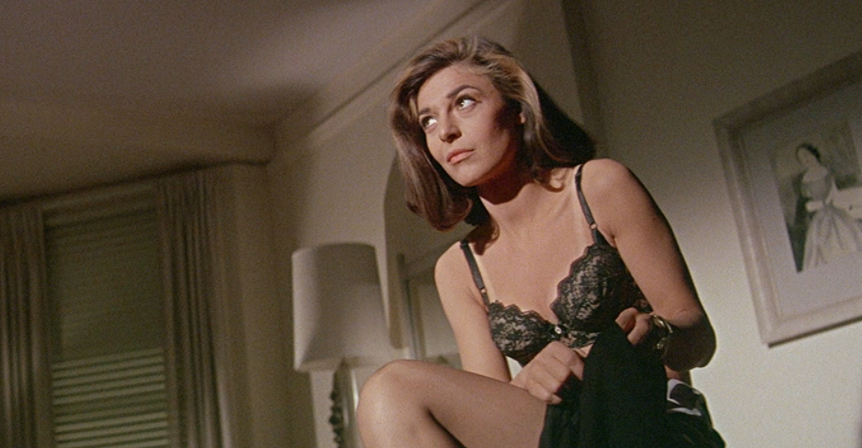
I visit and re-visit Mark Harris‘s “Mike Nichols: A Life.” It’s obviously been thoroughly researched and Harris has always been a smooth and engaging writer (and I love the chapter on the making of Who’s Afraid of Virginia Wolff) but for whatever reason I can only digest a modest portion at a time. And then I nod off or get distracted and wander away and forget about Harris-Nichols, and then, a week or a month later, I’ll start reading again. And always late at night.
I’m now reading the Graduate chapter, and a year-old exchange between Joe Leydon and myself is coming to mind.
Leydon: “Something else about The Graduate and not unlike The Sterile Cuckoo, which followed two years later. It appears timeless because it’s not at all reflective of its time. You’d never know from looking at these films (both of which I love, and both of which I saw back in the day) that the Vietnam War was going on.”
HE response: “The Graduate actually was reflective of its time as far as your vaguely stifling upper-middle-class norms were concerned. Anti-Vietnam War and anti-Dow Chemical napalm fervor (‘Dow shall not kill’) was hot on university campuses but not in your cushy suburbs. I can tell you that in Wilton, Connecticut — that leafy, well-tended, exurban hamlet that I felt half-oppressed and half-drugged by — the anti-Vietnam War thing only caught on in the aftermath of all the ’68 convulsions (MLK and RFK killings, LBJ folding his tent, Chicago Democratic Convention riots) and beyond.
“In ’66 and ‘67, the middle-class miasma was mainly about singing Beatles songs at parties and getting high and zoning out…an odd blend of vague resignation and regimentation and cruising around for nocturnal adventure. Whiffs of sexual secretions and Brooks Brothers shirts that smelled like pot (although scoring was very hard unless you were “in” with certain folkies and/or hung out with certain people in Westport) and and the sounds of Buffalo Springfield and Revolver and Sgt. Pepper. In short, the Vietnam War didn’t really begin to intrude upon this strata of American culture (Brentwood and Beverly Hills being somewhat similar to Wilton) until the Tet Offensive and then Johnson’s announcement that he wouldn’t be running again, etc.
“So Nichols and Graduate screenwriter Buck Henry did, in fact, capture the way things were for the Benjamin Braddocks and Elaine Robinsons in ’66 and ’67.”
About Catch-22: “Nichols admits during the Catch-22 DVD commentary with Steven Soderbergh that the film suffers from a lack of undercurrent. It’s all upfront, all stated plainly and rather broadly. The things that always stick to your ribs in the matter of noteworthy films are the after-aromas, ‘the things that are not said‘ but are clearly there. One of the very few sections of the film that deliver this happens in the last 25% or 30%, during the heavily shadowed scenes in Rome.”
Pete Miesel: “I would agree. Far too much of Catch-22 relies on TELLING us how insane it all is as opposed to showing and intimating until, as you correctly point out, the sequence in Rome.”