Feminist Holmes Fantasy for Girls

Let me guess…it turns out that 14 year-old Enola Holmes (Millie Bobby Brown) isn’t just a chip off the old block but in some ways smarter than her significantly older brothers Sherlock (Henry Cavill) and Mycroft (Sam Claflin).

It would appear that Enola Holmes (Netflix, 9.23) is a blending of Barry Levinson‘s Young Sherlock Holmes (’85) and Guy Ritchie‘s Sherlock Holmes (’09) but through a 21st Century female prism, and with the usual injections of arch attitude and ironic popcorn fantasy.

Based on Nancy Springer‘s Enola Holmes Mysteries, and directed by Harry Bradbeer (Fleabag, Killing Eve). Costarring Helena Bonham Carter, Fiona Shaw, Adeel Akhtar, Frances de la Tour, Louis Partridge and Susie Wokoma.

“She Sells Sea Shells By The Seashore”

I posted my first Ammonite riff (“Here We Go Again“) on 2.19.20….pre-COVID masks.

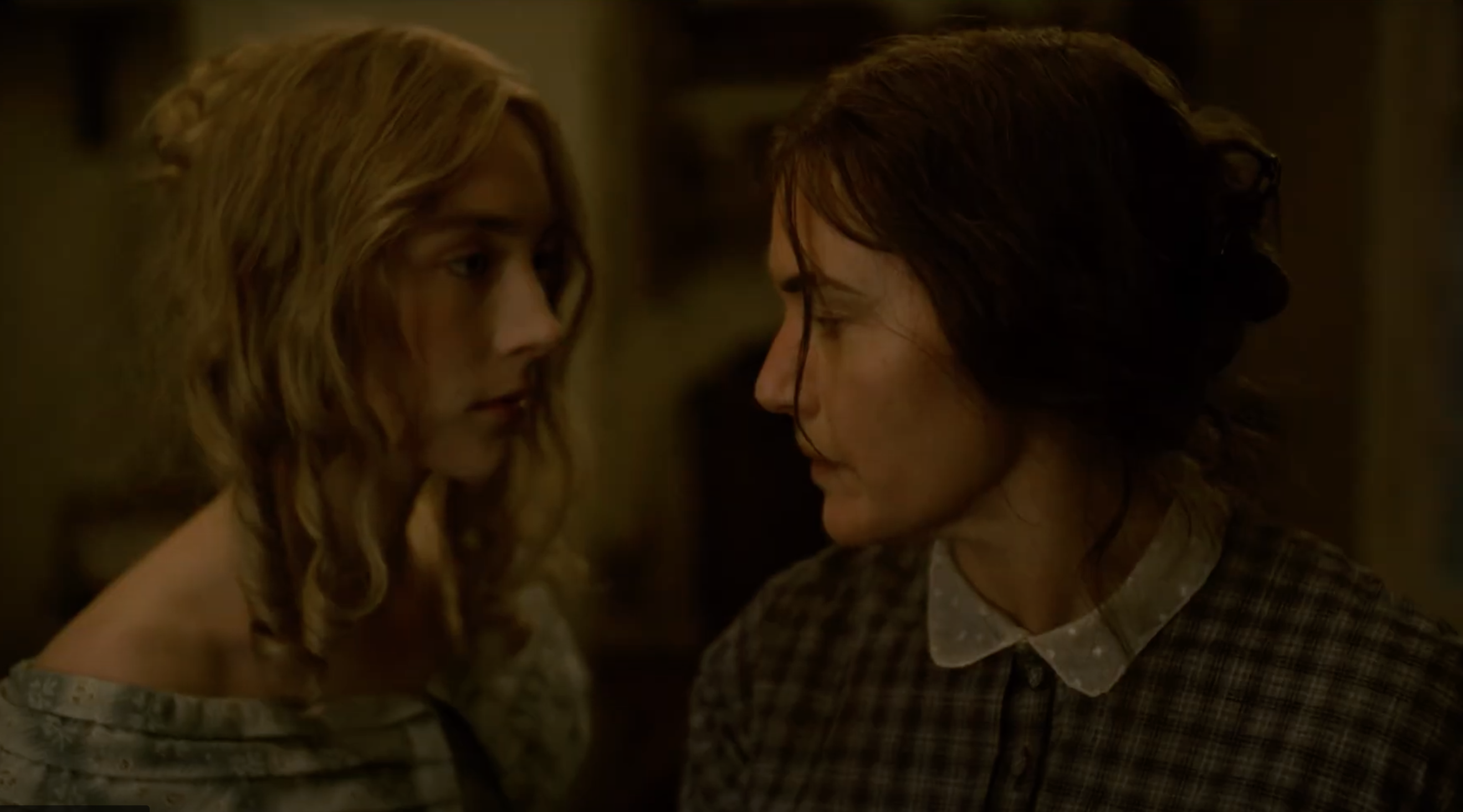
Observation #1: A close relation of Celine Sciamma‘s Portrait of a Lady on Fire, once again set near a beachy coastline in the distant past (Dorset in the 1840s), and once again about a lesbian love affair between tightly-corseted, socially restricted women who wear their hair in buns.

Observation #2: A bit of a May-December romance with 43 year-old Winslet (now 44) as the real-life fossil-searcher and paleontologist Mary Anning, who was born in 1799 and died in 1847. 26 year-old Saoirse Ronan (25 during filming) plays geologist Charlotte Murchison, whose husband, Roderick Impey Murchison, paid Anning to take care of her for a brief period.

Except the 1840s romance that allegedly occured wasn’t a May-December thing. Murchison was actually 11 years older than Anning, having been born on April 18, 1788. She was therefore in her early 50s and not, as the film has it, in her mid 20s. Furthermore Roderick Murchison wasn’t, as the film indicates, some kind of patronizing sexist twit who regarded his wife as a fragile emotional invalid who needed looking after. The Murchisons were actually partners in their geological studies; they travelled all over Europe together.

Charlotte Murchison lived to age 80; poor Mary Anning passed from breast cancer at age 47 or 48.

Ammonites are the extinct relatives of sea creatures that lived during the Jurassic and Cretaceous eras.

Ammonite will play at the Toronto Film Festival (so to speak) on 9.11.20.

Art of Electoral Cheating

Liz Garbus and Lisa CortesAll In: The Fight for Democracy, a 102-minute Amazon Prime doc about voter suppression and how it affected the 2018 Georgia gubernatorial race between Democrat Stacey Abrams and Republican Brian Kemp, will debut on 9.18.20.

16 days earlier the Garbus-Cortes doc will have a special world premiere screening at the West Wind Solano Twin Drive-In (1611 Solano Way) in Concord. The event is co-sponsored by Mill Valley Film Festival honcho Mark Fishkin and Telluride Film Festival exec director Julie Huntsinger.

Team Hollywood Elsewhere would be delighted to attend but we’ll be in Arizona…sorry.

In November 2018 Democratic gubernatorial Stacey Abrams lost to Republican gubernatorial candidate (and ardent Trump supporter) Brian Kemp, by a margin of roughly 54,000 votes — 1,978,408 for Kemp vs. 1,923,685 for Abrams. It is widely agreed that Kemp, Georgia’s Secretary of State since 2010, had basically cheated his way to victory by way of voter suppression.

On a single day in late July 2017 Kemp had removed 560,000 Georgians from the voter rolls — voters who’d been flagged because they’d skipped one too many elections. Abrams would later call the purge the “use-it-or-lose-it scheme.”

On 8.11.18, the New York Times posted an article by Carol Anderson titled “Brian Kemp, Enemy of Democracy“, which explored Kemp’s unscrupulous voter suppression efforts. “Hackable polling machines, voter roll purges, refusing to register voters until after an election, the use of investigations to intimidate groups registering minorities to vote — Mr. Kemp knows it all,” Anderson wrote.

Good vs. Less Good Gunfire

The best kind of movie gunfire is almost more felt than heard. Half sonic blast, half rib-punch. One of the best sounding handguns I’ve ever heard in an action film was fired by Tom Cruise in that back-alley scene in Collateral when he blew away two thieves (starting at 1:12 on the clip below). The sound was extra-effective because my first viewing was at the Arclight, and those cranked-up woofer speakers…man!

I’ve noted two or three times that the guh-BACH-ohwl gunshots in John SturgesThe Magnificent Seven represent the other end of the spectrum, as they’re totally without that special rumble-roar. Marlon Brando’s gunshots in a saloon shoot-out in One Eyed Jacks represent a slight improvement. But the cannon-like gunshots in George StevensShane (’53) are still the best in my book. When Alan Ladd shoots the hell out of a little white rock on the Starrett property and later when he plugs Jack Palance and Emile Meyer in the big finale.

In a perfect world the rights owners of The Magnificent Seven would pay for a Shane-like redesign of the gunshots. The improvement would be wonderful.

Can’t Be Repeated Enough

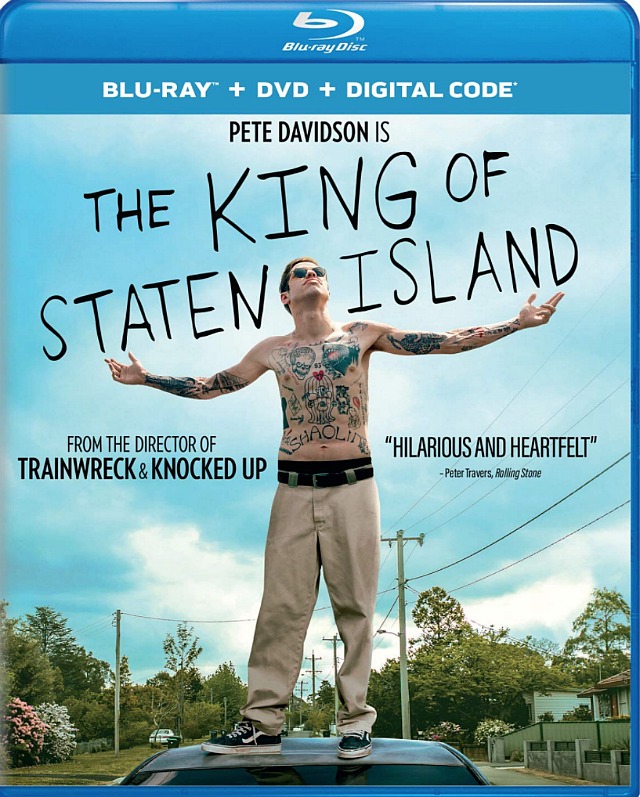
HE comment posted on 8.25.20, sometime around 6:30 am: “How telling that Jimmy Porter feels the urge to rub in the fact that The King of Staten Island didn’t fully connect with people who wanted and expected a semblance of the usual usual. KOSI reps an exotic realm in more ways than one, acknowledged, but it walks and talks in a completely honest and straightforward way. It has the courage to be funny on its own terms. You have to ‘let it in’ and accept Judd Apatow and Pete Davidson’s idea (revelation?) that Staten Island really is, from a certain perspective, this strange, half-forsaken, outback culture (part blue-collar, part stoner, in some ways hermetic) that even New Jerseyans look down upon. For a sizable sector (i.e., the Jimmy Porters of the world) KOSI was a zone apart and an attitude too far. I almost felt that way at first, but then it winnowed its way in.”

From “The Staten Island Funnies,” posted on 6.8.20: You know you’re in good hands when a film you’ve clicked with seems to be more on-point the second time. Last week I got an even better kick out of The King of Staten Island and enjoyed the performances all the more, not to mention the exotic atmosphere and how it all fits together in a reasonably neat and satisfying way. And without a single ounce of fat.

For my money The King of Staten Island is easily as good as Judd Apatow‘s Funny People (although a bit more despairing and downmarket) and at times as emotionally poignant as Trainwreck but braver, in a sense.

It’s significant that the film doesn’t hop on the ferry and visit lower Manhattan until the very last scene. Because the KOSI version of Staten Island is really a zone apart — thousands of miles from Brooklyn and Manhattan. Scott’s stoner bros (including “fat Kanye”) are so low-rent and devolved they pretty much border on the vegetative.

But I admired the commitment to this realm. The comedy hasn’t been sitcommed or punched up, or at least not in the usual ways. It feels real and grounded, and yet, per standard practice when it comes to Apatow’s brand, carefully honed and sculpted as far as the unrefined voices of the various characters are concerned. I loved that the film doesn’t feel slick or overly “presented”.

Read more

Current Screenplay Roster

Hollywood Elsewhere is on the hunt for PDFs of the following screenplays. I’m sure there are many, many others that I should be seeking out. Boldface obviously signifies special interest:

12 O’Clock Boys by Barry Jenkins and Sherman Payne
24/7 by Sarah Rothschild
Analog by Ryan J. Condal
Annette by Ron Mael, Russell Mael
Appetite by J.T. Petty
A Quiet Place 2 by John Krasinski
Barb and Star Go to Vista Del Mar by Kristen Wiig and Annie Mumolo
Cherry by Jessica Goldberg
Cinderella by Kay Cannon

Del & Charna by Rich Talarico and Alex Fendrich
Don’t Look Up by Adam Mckay
Dream Horse by Neil McKay
Emancipation by William N. Collage
The Empty Man by David Prior
Escape Room 2 by Will Honley
Everybody’s Talking About Jamie by Dan Gillespie and Tom Macrae
Everything Everywhere All At Once by Dan Kwan, Daniel Scheinert
Faster Higher Further by Charles Randolph’

The Force by David Mamet
The French Dispatch by Wes Anderson
The Fugitive by Brian Tucker
Ghostbusters Afterlife by Jason Reitman and Gil Kenan
Girl Named Sue by Lisa Cole and Mark Monroe
Godzilla vs Kong by Max Borenstein
Halloween Kills by David Gordon Green and Danny McBride
The Harder They Fall by Samuel and Boaz Yakin
Happiest Season by Clea Duvall, Mary Holland
The Hitman’s Wife’s Bodyguard by Tom O’Connor
Honest Thief by Steve Allrich, Mark Williams
A House in the Sky by Sara Corbett

Read more

Once Admired

A couple of months ago I glanced at but never read a New Yorker piece, authored by Paul Elie, called “How Racist Was Flannery O’Connor?“. Until a friend shared the below tweet this morning I didn’t realize that O’Connor has been posthumously terminated. She died in 1965 at age 39. I’ve visited her childhood home in Savannah a couple of times. Her racist views were hateful, of course, but there was more to her than just that failing. A moot point now. She’s being aggressively forgotten as we speak. If a person is willing to buy her portrait only to burn it…

Here’s an 8.17 Quillette piece — “Flannery O’Connor and the Ideological War on Literature” by Charlotte Allen — that offers a less condemning assessment.

Son of Respecting a Dead Guy

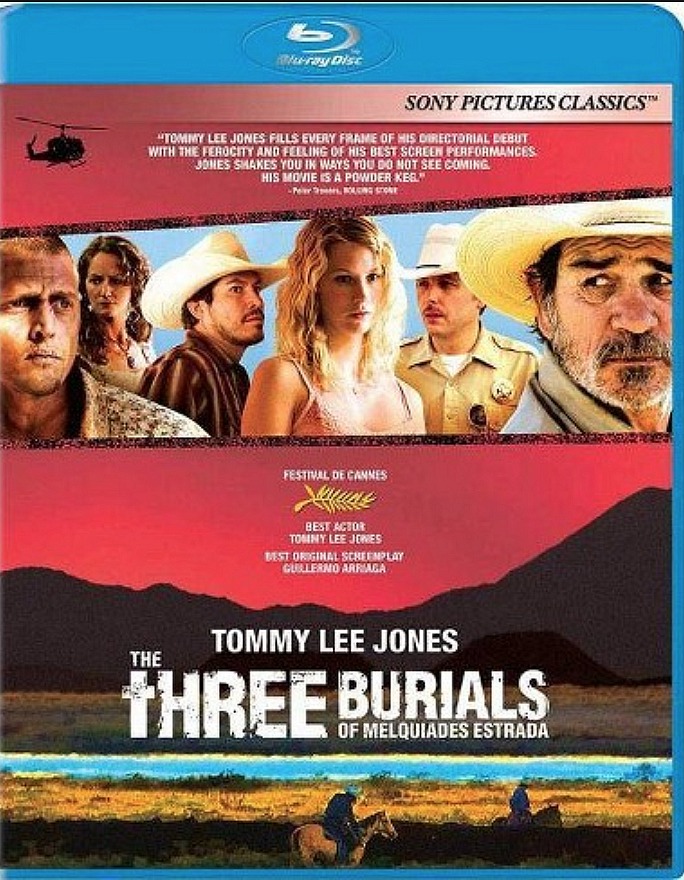
15 and 1/4 years ago I caught Tommy Lee JonesThe Three Burials of Melquiades Estrada in Cannes. I was an instant admirer. Directed by and starring Jones and based on a script by Guillermo Arriaga, it’s a tautly absorbing, well-crafted morality (i.e., anti-racism) tale. I decided this morning that re-watching it might be a good idea. It’s now on my Amazon watchlist.

Here are some impressions about the film and a press session that the producers staged in the hills above Cannes. Filed on 5.19.05, the piece was called “Respecting a Dead Guy.”

“I’ve pledged not to wade into The Three Burials of Melquiades Estrada until later this evening, but it’s fair to repeat what other journos are saying, which is that it’s highly respectable. Some (like the Toronto Sun‘s Bruce Kirkland) expressed surprise at how smartly composed and compassionate and thematically rich it is. Surprised because you never know what to expect from a first-time-out director. It could have been indulgent or precious or half-baked.

“It’s also fair to report that I attended an American Pavilion interview late Wednesday afternoon between Jones and Roger Ebert. Ebert made it clear he’d had a positive reaction to the film. He also asked if anyone in the audience had seen it, and when I raised my hand he asked me what I thought and I offered a thumbs-up gesture.


The Three Burials of Melquiades Estrada producer Michael Fitzgerald (left), director-producer-star Tommy Lee Jones (center) and Toronto Sun critic-reporter Bruce Kirkland at Thursday’s press gathering at a wonderfully picturesque and soul-soothing villa in the hills above Cannes — 5.19.05, 12:35 pm.

View of Cannes and the Med from EuropaCorp-rented villa.

The Three Burials of Melquiades Estrada is a modern-day tale set in western Texas and northern Chihuahua, Mexico. It deals with a ranch foreman (Jones), a border patrolman (Barry Pepper) and an illegal immigrant named Melquiades Estrada who works for Jones. The second half is a horseback-journey film about redemption and seeing through prejudices and embedded attitudes.

“It’s a film with a great deal of compassion and soul and a generally humanistic view of things. If you want your literary influences, check out Flannery O’Connor’s work and William Faulkner’s ‘As I Lay Dying.’

“In the press kit, Arriaga says he wanted “to make a study in social contrast between the land that’s south of the Rio Grande river and the land that’s north of it. About what ironies, injustices, glory, beauty and redemption you can find in this area that has its own character…something that cannot be imposed, something that has grown and evolved…something that cannot be controlled.”

“Just before 11 am today myself and a few other journos (Kirkland, Stephen Schaefer, Desson Thomson, Harlan Jacobson, Shari Roman, etc.) were driven in a minivan from the Gray d’Albion hotel near the Croisette into the hills above Cannes, and eventually (the driver got lost) to a beautiful hilltop villa.

“The purpose was to allow for a brief schmooze with Jones, Arriaga, Pepper, young co-star January Jones and producer Michael Fitzgerald (whose other ventures include Colour Me Kubrick and Sean Penn’s The Pledge).

Pepper said that Jones “has a very deep passion for strong visual composition and the poetry of words.” He read some passages from his on-set journal, and on one page he described Jones as “a Southern badass with a ruthless work ethic and a heart the size of the Copper Canyon.”

“He mentioned two things that Jones told him before shooting a couple of scenes — ‘Keep it stupid simple’ and ‘don’t do somethin’, just stand there.’

Read more

“Was It The White Pants?”

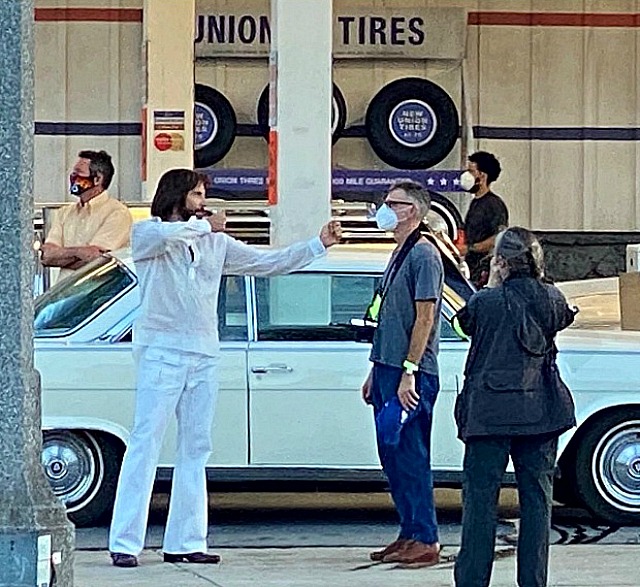
Paul Thomas Anderson‘s untitled ’70s-era drama is rolling as we speak. Set primarily in PTA’s beloved San Fernando Valley, it’s apparently an ensemble piece that partly focuses on a teenaged actor. Or something like that. Bradley Cooper looks a bit frightening with a period-appropriate beard, Prince Valiant hair and a necklace that certainly demands your attention.

Flawed-Human Bathwater

Deadline‘s Peter Bart reported today that Roman Polanski, 87, is “resolutely pursuing [an] appeal” about the Motion Picture Academy’s 2018 decision to expel him from Academy membership.

Polanski feels he was denied due process, but of course “due process” had nothing to do with it — he was ousted because wokesters and #MeToo-ers have blacklisted him, plain and simple. Not just over the 43 year-old Samantha Geimer case but other reports about sexual misconduct, also dating back to the ’70s and ’80s.

The Academy appeal is headed for Los Angeles Superior Court tomorrow (Tuesday, 8.25).

HE response: I have seen Polanski’s An Officer and a Spy (aka J’Accuse) twice online. It’s an immaculate period piece and an indisputably brilliant film in pretty much every respect, not to mention a highly persuasive argument against mob-driven injustice and ant-Semitism — easily the finest film I’ve seen so far this year. A mature way of processing this dichotomy would be to say there are two entities to consider — Polanski the flawed human being (and who isn’t?) vs. Polanski the artist. A mature conclusion would be that it is rash and unwise to throw the artist baby out with the flawed-human bathwater.

On 4.2.20 I posted an essay called “Open Letter to Polanski Haters.”

Consider also a 6.21.12 N.Y. Times article called “Good Art, Bad People“, written by Charles McGrath.