

What kind of a staunchly retarded hillbilly nihilist jackass asswipe do you have to be to still be a Trump supporter? What did Biden say recently about 10% to 15% of people in this country being “bad”? Sounds low.
The Staten Island Funnies
How about spending two hours and 16 minutes with a smart-assed, perpetually stoned flatliner from arguably the most low-rent culture on the Eastern seaboard and certainly the scuzziest borough of New York City, a place so low on the cultural totem pole than even New Jerseyans look down upon it? And at the same time a well-crafted film with heart and honesty and a relatable personality? And which ends…well, hopefully?
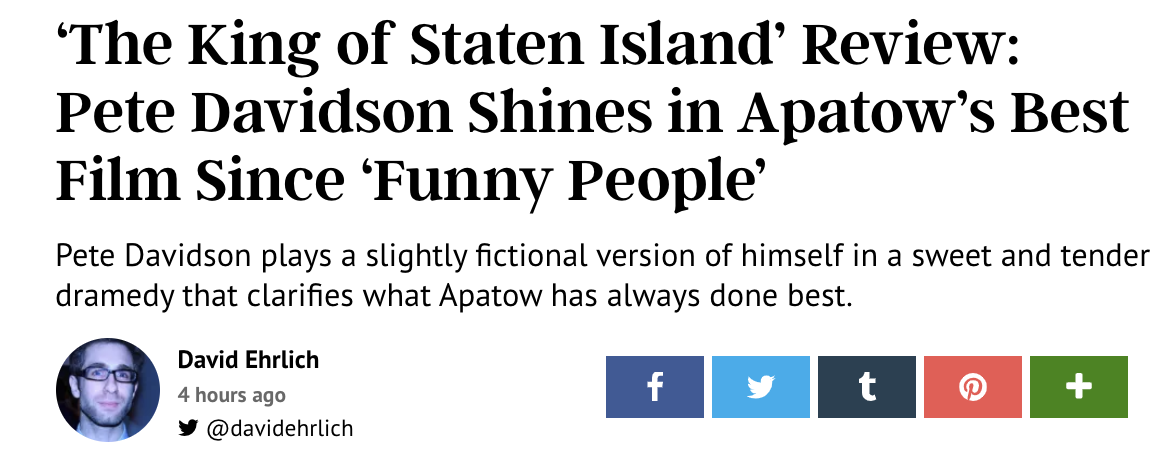
You can give the side-eye to Judd Apatow and Pete Davidson‘s The King of Staten Island all you want. You can say it’s too oddball fringe-y, too lower-depths, too submerged on its own weed planet and too caught up in nihilism and arrested development to connect with Joe and Jane Popcorn.
Which I strongly disagree with. Because it’s funny and plain-spoken (if a bit dismaying at times) and it doesn’t back off from an unusual milieu and mentality, and certainly from Pete Davidson‘s “Scott”, a layabout for the ages.
KOSI made me smile and guffaw and even laugh out loud several times (highly unusual for an LQTM-er). And I believed every word of it…every line, emotion, situation, character. It’s peddling sardonic humor that doesn’t feel schticky, although I guess it is. The tone is low-key raw, kinda nervy, certainly unpretentious and 90% bullshit-free.
Okay, it softens up during the final passage, but I welcomed this with open arms. Because a film about wall-to-wall, start-to-finish nihilism would be too much. And the length (136 minutes) doesn’t feel longish but completely necessary and natural.
And it fills out Davidson’s comic persona to the extent that he’s suddenly a completely compelling big-screen presence and (am I allowed to say this?) a movie star. And I loved the supporting turns by Bel Powley (whom I’d never really warmed to before), Bill Burr (whom I admire but have never found screamingly funny as a stand-op), Marisa Tomei and the always authentic Steve Buscemi.
It’s a shame this Universal release is going straight-to-streaming this Friday (6.12), as I’d love to watch it a third time at the Arclight with a couple of hundred know-it-alls and generally, you know, groove with the room.
The script (co-penned by Apatow, Davidson and Dave Sirus) is….what, 75% inspired by Davidson’s own life? Same Staten Island upbringing, same deceased fireman dad (killed in a local apartment fire rather than inside the World Trade Center on 9/11, which actually happened when Pete was 7), same living-with-mom (Marisa Tomei) and getting-ripped-with-loser-friends lifestyle. Quippy and weird and oddly endearing.
The difference is that it imagines how things might have turned out if Davidson hadn’t begun to try stand-up comedy in his mid teens and had stayed in an aimless funk into his mid 20s.
Aside from an unlikely dream of becoming a tattoo artist and an idiotic plan to open a combination tattoo parlor and restaurant, Scott is living a kind of “whatever” lifestyle, smoking weed and poking at this or that pretention, generally hanging back as time flies by and even flirting with stupid suicide, as dramatized in the opening scene.
KOSI reminded me at times of the Last Exit to Brooklyn milieu and the boozy despairing blokes in the British “kitchen sink” dramas of the late ’50s and early ’60s.
Scott is in a friends-with-benefits relationship with longtime friend Kelsey (Powley). His disapproving sister Claire (Maude Apatow) is about to leave for college. And his three bonged-out friends are on the verge of becoming petty felons.
And then mom begins dating a divorced, bald-headed fireman with a rangy moustache (Burr) and Scott is like “what?” And the film becomes a story about an emotionally stalled quipster-stoner trying to break up their relationship. But eventually (and thank God) there’s a way out of that.
“The Smell of Excuses”
I’m still of the view that ex-N.Y. Times op-ed editor James Bennet‘s statement about not having read the Tom Cotton “send in the troops” piece is suspicious, at the very least.
I was kicked around last night for saying this, but it just doesn’t smell right. The mob can pretend that Bennet is gone because he was simply a careless editor in this instance, but my gut says no. And I certainly don’t believe the piece wasn’t checked and assessed by deputy editor James Dao and probably others.
Here’s how Bennet explained things on June 4th. And here’s that 6.2 Morning Consult poll saying that 58% of the American public supported Cotton’s view about stopping looters. The Khmer Rouge didn’t want to acknowledge this viewpoint, much less see it supported in a Times op-ed.
The bottom line, I suspect, is Times wokester outrage over the Cotton piece was such that someone had to lose their job, someone had to take the hit.
From The Guardian‘s Kenan Malik, posted on 6.7 (yesterday), in a piece titled “Publish and Debate, NYT, But Don’t Be In Denial“: “The claims that op-ed editor James Bennet had not read the piece before publication, or that there was insufficient fact-checking, have the smell of excuses for a climbdown after the fact.
“Like many liberal newspapers, the NYT has responded to the rise of a more polarized politics by hiring conservative columnists, such as Bret Stephens. The problem, though, is not a lack of conservative voices. It’s the failure to create a wider culture of debate and engagement and an entrenchment of the ‘you can’t say that’ ethos. That’s an issue not just in liberal circles. And not just at the New York Times.”
Journo pally: “There is no way Cotton’s piece wasn’t read. Carefully. They knew what they had.
“And if Bennet didn’t read it before publication then who did? There is no way Cotton’s piece wasn’t read. Carefully. The Times calls everyone. They fact-check everything as a rule. I’ve been in stories in the Times [and] I get calls from fact checkers.
“The revised explanation is an excuse to quell the angry mob. Some are happy with this excuse but it isn’t why Bennet resigned.
“The Times-Bennet-Cotton thing is also part of a recent [wokester] pattern — Hachette/Woody Allen, Chris Matthews, Philadelphia Inquirer fallout (“Buildings Matter”), etc.
“Bennet’s statement that he didn’t read the piece suggests that if he had he would have made a different decision. But no matter how you slice this episode it comes back bullshit. From the official, recently revised Times perspective. Either they are not publishing it because they think it puts black lives at risk or they are being pressured because others think same.
“The fact is, no one told the story of those 58% of Americans who were scared and wanted to be protected by the military if need be. No one on the left wanted that to be true. But it was true.”
The Byrds’ “200 Feet High”
In ole Mexico ultralight rides cost $25 or $50, depending on how much time you spend in the air. Tatiana did the $50; I did the $25. First time for both of us.
Oddball Hardball
N.Y. Times staffers representing the BLM chapter of the wokester Khmer Rouge have apparently forced the resignation of poor James Bennet, the Times editorial page editor who approved the publishing of Tom Cotton‘s controversial “Send In The Troops” op-ed, which basically said U.S. troops should be used to stop looters.
BLM supporters were outraged (i.e., “Tom Cotton’s Fascist Op-Ed” by Michelle Goldberg), believing that such a move might endanger the lives of Times employees of color. This led to an intense backlash against the article, and then Bennet himself.
Bennet initially defended his decision as an expression of the op-ed section’s policy of offering a forum for occasionally non-liberal viewpoints. But the wokesters wouldn’t have it. Bennet and exec editor Dean Bacquet soon wimped out, saying that the column shouldn’t have run in the first place because it didn’t meet Times standards blah blah. Wokester standards, they meant.
Update: Bennet has stated that he didn’t read the Cotton piece before it ran. Of all the op-eds he forgot to read this is the one he dropped the ball on? THIS ONE? I find this flabbergasting, too absurd to be true, ice cream cone smashed into forehead, etc.
Back to article: Are wokester progressives turning into fascists? Have they decided that intolerance is the only way to go henceforth?
It would appear that op-ed-wise (and perhaps in other ways), the N.Y. Times is no longer a sensibly liberal, fair-minded, free-speech paper of record, certainly when it comes to issues and opinions that reflect upon people of color and particularly the forces that seem to be either vaguely or unmistakably against humanist social goals, or are vaguely or unmistakably in league with white supremacists and/or separatists, namely Trump Nation and many organs of local law enforcement.
Nobody sensible is arguing against wokester ideals and beliefs (particularly rooting out systemic racism in the nation’s police departments), but who isn’t horrified by cancel-culture fanatics muscling their way into power at the N.Y. Times with the idea of (dare I say it?) rooting out anyone else who might think like James Bennet? And thereby turning the Times into a force for our-way-or-the-highway absolutism?
What is the difference between the BLM Khmer Rouge suppressing op-ed pieces and scorning ideas that are viewed as subversive of or opposed to wokester ideals and…I don’t want to say it because it’ll sound wrong. But we’re basically witnessing the assertion of lefty progressive fascism.
Back to Mexico
I had to return to Tijuana’s Baja Oral Center on Monday to finish up some crown work, so we decided to stay a couple of days at the beachside, reasonably priced Poco Cielo hotel.
It’s about 50 minutes down the coast — just south of Puerto Nuevo, a half-hour north of Enseneda. Loving it all again, especially the fact that everyone down here is relatively relaxed on the pandemic stuff.
We felt badly about leaving Anya, our three-year-old Siamese female, for 48 hours, so we took her along. She didn’t freak out too badly on the way down — she was actually calm and cool for the most part — but she found the exotic air of Mexico alarming. She hugged me (and I her) like a frightened two-year-old child when we first entered the hotel room. She’s fine now. All cats hate travel.
But at least Anya can now say to herself, “I have now seen more than a small pocket of West Hollywood and have settled into a much more colorful realm than some swank hotel in Santa Barbara…I have seen a bit of the world, you bet!”




This part of Mexico is a 3G realm, I’m afraid, although the wifi inside the hotel restaurant is fine.

Forced To Shell Out $111.82
Just before Christmas of 2016 I purchased a UHD 4K streaming version of Lawrence of Arabia, which had been released almost a year earlier. I was deeply impressed or, as I wrote on 12.20.16, “really, seriously stunned by the micro-detail.”
I knew it wasn’t real-deal 4K because of digital compressing, and that it actually represented an image density that was somewhere between 2K and 3K.
And yet “for the first time in my life, I was noticing textures in Freddie Young‘s 70mm cinematography (wood grain, extra-tiny sand pebbles, wardrobe threads, even the subtle composition of fine cement in the opening credits sequence) that I’d literally never seen before, not with this degree of crispness and clarity, and that’s saying something.”
On June 16th fans of David Lean’s 1962 Oscar-winner will be able to own a 4K version, even though it’ll cost them $111.82 because it’s part of a box-set package deal that includes Mr. Smith Goes to Washington, Dr. Strangelove, Gandhi, A League of Their Own and Jerry Maguire.

This morning I asked restoration guru Robert Harris, who guided the original 1988 restoration (and who worked closely with Lean for weeks on end) and was involved on all levels with the newbie, how the 4K disc version compares with the streaming version.
“Far better,” Harris replied. “The streaming version is, of necessity, highly compressed. The 4k UHD is spread over 2 triple-layer discs. No comparison. Gandhi and A League Of Their Own are also magnificent. They look like film. But Aurens…other-worldly.”
The 4K UHD Lawrence, he said, is “the equivalent of 750-800 pounds of 70mm film on 13 reels, captured to a couple of discs that probably weigh about an ounce.”
A portion of Harris’s Home Theatre Forum review:
“The new 4K release of Lawrence of Arabia has seemingly reached home video nirvana.
“Everything that one might wish for is here. The film has been split across two discs, for maximum data throughput. Dolby Atmos has been added for a bit of height, which works nicely. Color, black levels, shadow detail and general densities all work nicely. Grain structure is superb. Image stability is perfect.
“For those unaccustomed to the film, be aware that it’s four hours long, has no women with speaking roles, spends hours watching men cross deserts on camels, and has no musical numbers.
“It’s all about this slightly looney Brit who seems to enjoy pain, and takes pleasure in burning himself with matches.
“It was originally released in December of 1962 at 232 minutes inclusive of music. In January, twenty minutes was removed, making certain sequences a bit incoherent, and in 1970, supposedly only for American TV, it was shorn of another fifteen minutes, leading to a wonderful article in the New York Times, entitled ‘Look What They’ve Done to Lawrence of Arabia Now.’
“Most people seemed to enjoy the 202-minute cut (212 with music), until a slightly looney American became involved and put back most of the pieces that had been cut, finally ending up with a Director’s Cut at 227 minutes with music.
“Those elements were digitized in 2012 by Columbia’s Grover Crisp, leading to what we have today.”
Except from Bluray.com review: “To be perfectly frank, the entirety of the Columbia Classics collection is worth buying for the UHD Lawrence alone. One can almost consider the other five films bonuses. This one looks that good. It’s breathtaking, and it’s impossible to imagine even the most stringent videophile not smiling the whole way through.
“The Atmos soundtrack is first-rate, too. There is one new, brief extra but the carryover content is perfectly fine in support. What a gem of a film and of a UHD. Of course, Lawrence of Arabia‘s UHD disc earns my highest recommendation.”
Cause and Effect
“How could we possibly, in a brief stretch, have gone from the euphoria of our first black president to the desolation of racial strife ripping apart the country?” — from Maureen Dowd‘s 1.6.20 N.Y. Times column, “Bonfire of Trump’s Vanity.”
Answer: Easy. In an election year that saw serious groundswell enthusiasm for renegade change-agent Bernie Sanders and an even stronger surge for wildcard con man Donald Trump from racially resentful bumblefucks, the mainstream Democratic machine nominated Hillary Clinton, whose negatives were sky high from start to finish. That‘s how.
What, Me Chemicals?
"Pepper spray is not a chemical irritant. It's not chemical" — AG Barr uses painstaking distinctions to defend the use of force against protesters near the White House last Monday pic.twitter.com/CQbtqLwfIk
— Aaron Rupar (@atrupar) June 7, 2020
Bleachy, Over-Exposed Monochrome
Somebody was smart enough to put subtitles on this trailer for Brian Welsh‘s Beats. Let’s hope the film itself has this feature, as I could barely understand what’s being said even with subtitles. Based upon a play by Kieran Hurley, this Steven Soderbergh-endorsed period pic (’94) appears to have ample juice. Illegal raves, smile buttons, etc. And the young lead characters are straight…dare to be different!
Does anyone remember Chris Petit‘s Radio On (’79)? Subdued, cultish, zone-out black and white photography. Barely audible when I saw it at the Bleecker Street Cinema.
Richard Benjamin’s “My Shittiest Year”
Lewis Beale on Facebook: “I’ve been asking people who have lived through both 1968 and 2020: Which was worse? Your thoughts, please.
HE response: “2020 is far, FAR worse. 1968 was tragic (MLK, RFK) and turbulent, but highly passionate and even exuberant and thrilling in patches. 2020 has mostly been a concentration camp. Where is the exuberance apart for the esprit de corps in the BLM marches? I take it all back if Biden wins .