Fair Reference

Essentially repeating a post from three days ago: HE agrees that Trump calling COVID-19 the “Chinese virus” doesn’t help anyone or anything. CDC officials are correct in saying that this kind of terminology “stigmatizes residents” of China, etc. 

But it’s also fair to note that with the exception of H1N1 and maybe one or two others, nearly all viruses over the last few decades have been routinely identified by their geographical origin.

There’s no denying that COVID-19 is widely believed to have originated in a “wet” wildlife market in Wuhan, and specifically from bats or snakes. Trump has earned his racist credentials over and over, but if he’d used the term “Wuhan virus” he wouldn’t have been wrong.

Was it stigmatizing to acknowledge that the Ebola virus partly originated in Yambuku (Democratic Republic of the Congo), “a village near the Ebola River from which the disease takes its name”? Or to acknowledge that the Zika virus came “from the Ziika Forest of Uganda, where the virus was first isolated in 1947”? Or to say that the West Nile virus “was discovered in Uganda in 1937″?

Was there an anti-white-person motive when Lyme disease “was diagnosed as a separate condition for the first time in 1975 in Old Lyme, Connecticut”? Have CDC officials ever said that the term “stigmatizes” residents of that Connecticut town? Just asking.

We’re All Named Sue

Joseph McBride, posted yesterday on Facebook: “Some God-fearing woman said today that in this crisis we should take comfort that God means good for us. I asked her the age-old question of why then [does] He lets bad things happen to good people if he is supposed to be all-powerful. I am awaiting a response.”

Answer: I don’t believe in the concept of a sentient, all-knowing, all-powerful God any more than I believe in Santa Claus, but I’ll go there for the sake of your question. God allows bad things to happen to good people — hell, to all people of whatever stripe — because living through horror, pain and frogs falling from the skies builds character. Obviously not everyone emerges from horrid times in a better place and we all know how dysfunction often breeds more of the same, but the basic idea from God’s vantage point, which has always been that of an absentee landlord, is that terror, agony and adversity are ultimately good for the soul.

As Aeschylus and Bobby Kennedy put it, “Even in our sleep pain, which cannot forget, falls drop by drop upon the heart, until, in our own despair. against our will, comes wisdom through the awful grace of God.”

If you insist on defining God as some kind of sentient being with an interest or awareness of what humans go through on a daily basis, God is basically defaulting to the same rationale offered by Johnny Cash‘s absentee father, the “dirty mangey dog” who “kicked like a mule and bit like a crocodile”, about why he named his son Sue.

In short, God allows all kinds of brutality and anguish to define human existence in order to make us wiser and stronger. God to Cash: “So I gave you that pain and said goodbye…I knew you’d have to get tough or die.”

That said, and just to repeat: There is no “God” in any kind of moral or compassionate sense. The universe is obviously bound together by a certain unified energy and intelligent design, but human-behavior-wise it’s a total crapshoot.

Finality

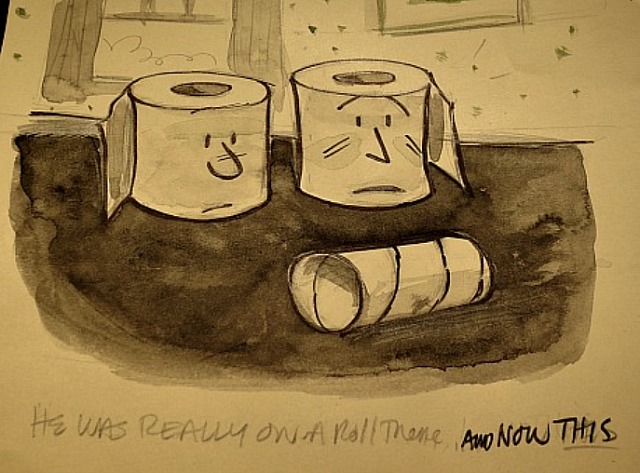
Last night my son Dylan was on a South Austin toilet-paper hunt. He came up dry in three or four places, but while visiting the fifth store a shipment was just being unloaded. To his credit he only bought 12 rolls. The current consumer instinct is to grab all you can, given the hoarding and whatnot. But Dylan stood fast. He doesn’t want to compound the problem.

Be Not Proud“, posted 7 and 1/2 years ago: “This is a rough by Connecticut-based longtime pally Chance Browne (“Hi & Lois”). For those who can’t read the opening: ‘He was really on a roll there…'”

“Probably Gay”

Until five minutes ago I’d never seen this mildly risque Australian underwear ad, which first aired in ’94. Could/would never be imagined, much less produced, in today’s realm. Nervy, catchy, good-humored.

There was a respected European-produced TV commercial for men’s underwear (made with fabric that’s allegedly great to touch) but I can’t find it online. The hook was that the fabric was so pleasurable to touch that it makes straight guys behave in a kind of “gay” way, so to speak. Funny bit.

Day-and-Date Streaming Dam Is About to Crack

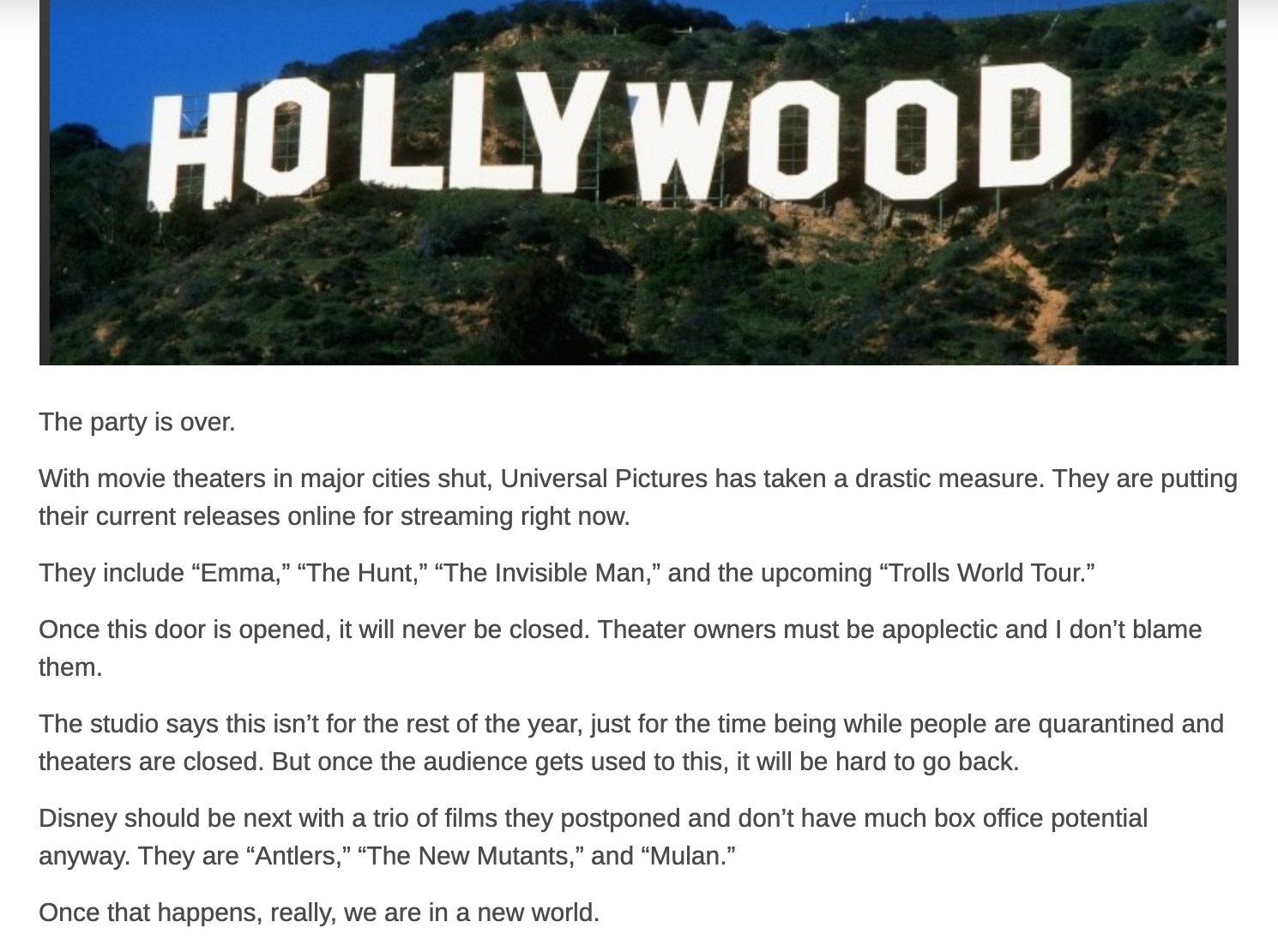
Universal Pictures has announced that at least one about-to-open film will be made available on same day as the global theatrical release date, and that three recently released films will also be available to stream.

Excerpt from release: “Beginning with DreamWorks Animation’s Trolls World Tour (opening 4.10 in the U.S.) the company will also make movies that are currently in theatrical release available on-demand starting as early as Friday, March 20. Titles from Universal and its specialty label Focus Features, including The Hunt, The Invisible Man and Emma, will be available on a wide variety of the most popular on-demand services for a 48-hour rental period at a suggested retail price of $19.99 in the U.S. and the price equivalent in international markets.”

Other distributors are sure to follow, right?

Question #1: Once the coronavirus panic has passed and things begin to stabilize, will Universal and other distribs pull back on this streaming strategy or will they keep it in place? Question #2: How would you feel about this tectonic shift if you worked for the exhibition industry?

Roger Friedman’s Showbiz411 column:

This Again?

Didn’t we just do the whole Wayne Williams thing with season #2 of Mindhunter?

It’s a fact that Williams (now 61) is (a) serving life imprisonment for the 1981 killings of two adult men in Atlanta, and (b) is believed by police to be responsible for at least 23 of the 30 Atlanta murders of 1979–1981, aka the Atlanta Child Murders. Although Williams was never tried for killing kids and has long maintained his innocence, there have been no similar killings of young black men since he came under suspicion in May 1981.

And yet Atlanta’s Missing and Murdered: The Lost Children, a forthcoming HB0 documentary, seems to suggest that because Williams was never charged, much less convicted, for any of the 23 for lack of hard evidence, that his guilt is an open question and that others might have been responsible. Yeah, maybe, but how come the child murders stopped after May ’81?

Documentary quotes: (1) “‘We found the killer, and that’s it’, but that really wasn’t it“; (2) “People saying this has to be the Klan or some crazy cop, but nobody really knew anything”; (3) “They didn’t follow those leads…[instead] they chose one [suspect]”; (4) “Elected officials did not want this [murder investigation] to go on” and so they decided to pin the killings on Williams and be done with it.

No Man Is An Island

Between my frequent hand and face washings, surgical gloves, N95 face masks, baby wipe packets, brawny constitution and a general uptick in antiseptic cleaning maintenance all around, I’m not concerned about flying back to Los Angeles tomorrow evening. Well, somewhat concerned but not, you know, “worried”.

What kind of blighted environment awaits? What a difference since I left a week ago. No movies, no restaurants except for take-out, no hanging in Starbucks, no nothing except for hiking and beach-sitting. Plus lines outside of gun stores and the possibility of martial law. Eventually we’ll be northern Italy, partly if not largely because of under-40s, operating under an impression that they’re bulletproof, ignoring the whole thing and party-ing like there’s no tomorrow.

Read more

Beardo Breaks News To Kaminski

INT. Steven Spielberg‘s post-production office on West Side Story. Spielberg is at his desk, reading a hardbound edition of Dostoyevski’s “The Brothers Karamazov.” A rap-rap on the door. Spielberg looks up — it’s his longtime visual collaborator and West Side Story dp Janusz Kaminski.

Kaminski: Steven?
Spielberg: Janoo!
Kaminski: You good? The assembly looks great!
Spielberg: (gestures) Siddown.
Kaminski: Somethin’ up?
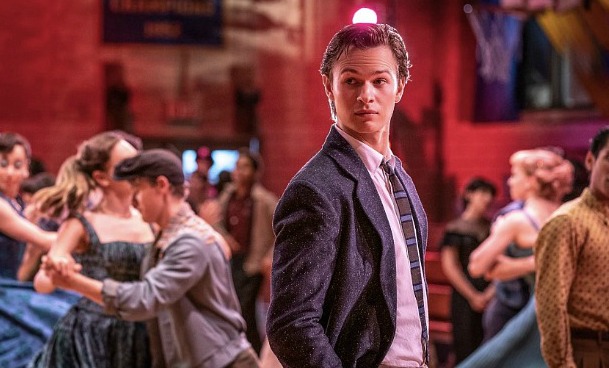
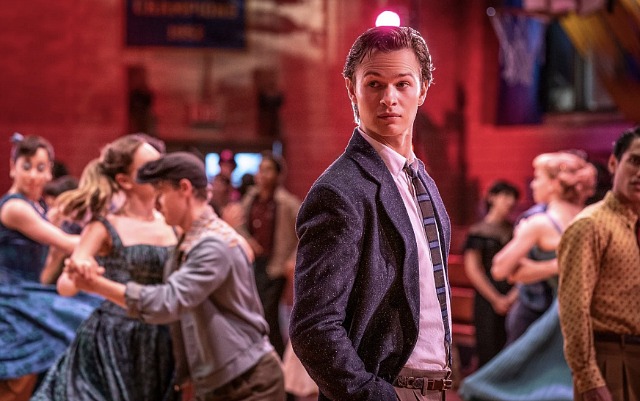
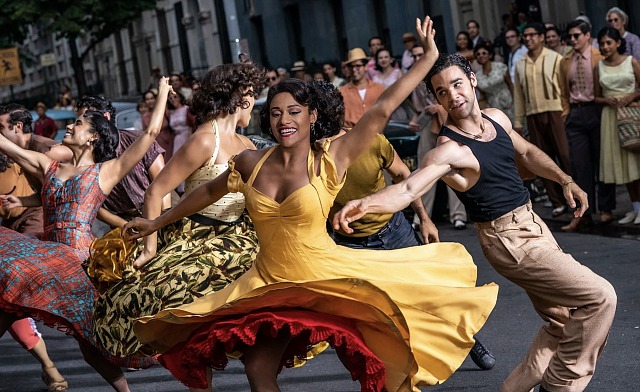
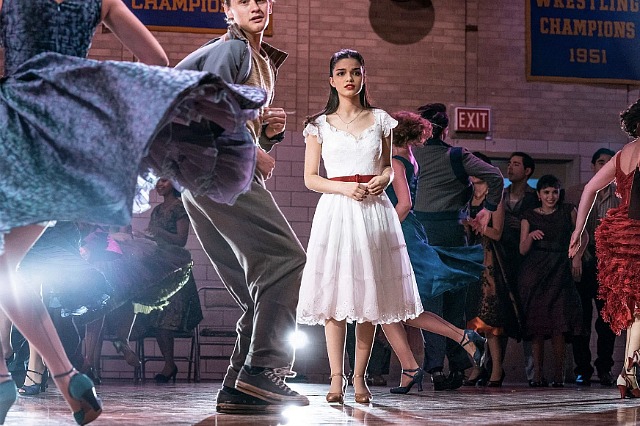
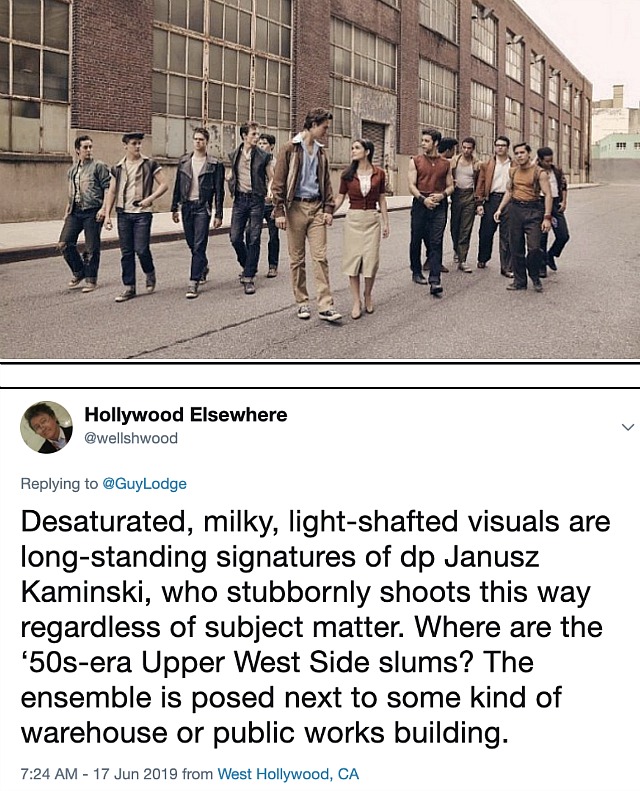
Spielberg: (exhales) I’ve changed my mind about West Side Story looking like a standard Kaminski…desaturated milky colors, shafts of light through windows, all that crap.
Kaminski: No!
Spielberg: Sorry, bruh, but not this time. I want vivid, real-world, life-like colors. I want the dance scene where Tony and Maria meet to have the same red colors that Robert Wise and Daniel Fapp went with.

Kaminski: But we almost always shoot with my faded palette! You agreed to stick with it.
Spielberg: I’ve changed my mind.
Kaminski: But we released an image last summer that had my grayish-beige scheme! You approved it!
Spielberg: It was just a photo. It’s not binding.
Kaminski: Wow.
Spielberg: I’m the director, Janoo.
Kaminski: I feel betrayed.
Spielberg: Adapt or die.
Kaminski: What about the Vanity Fair piece with the new photos? They’re grayish milky. I approved them.
Spielberg: I scrapped them. The Vanity Fair photos reflect the new approach.
Kaminski: Have you at least told Anthony Breznican about this?
Spielberg: I’m not making a big deal about it. Breznican doesn’t write for American Cinematographer. He probably won’t even notice the difference.

Read more