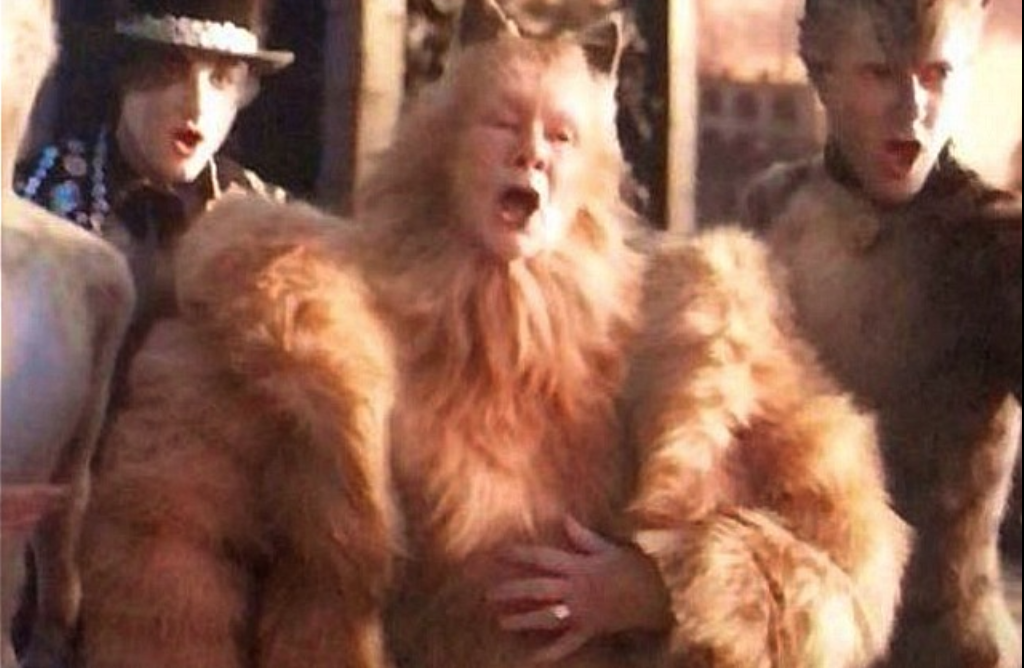
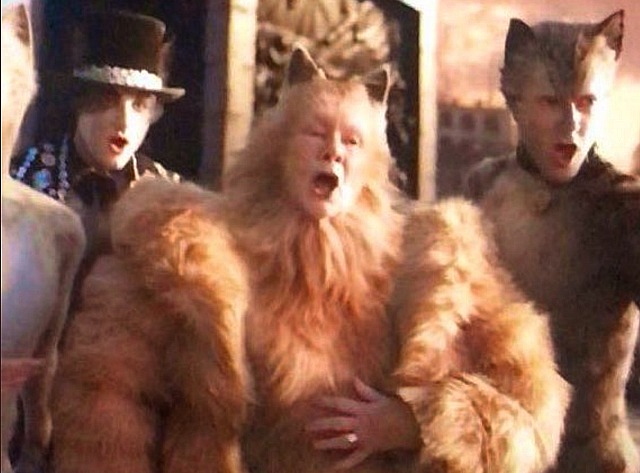
Judi Dench’s “The Hand”

Director Tom Hooper hadn’t fully finished Cats when it was time to duplicate prints, so he completed the job a few days later. And now Universal is sending out DCPs and satellite feeds of the corrected version (i.e., one in which Judi Dench has cat paws instead of human hands) to theatres.

“An unheard-of move for a finished film already in release,” THR‘s Pamela McClintock derisively snorted. But if you were in Hooper’s shoes wouldn’t you do the same?

I stayed awake throughout last week’s all-media screening of Cats, and I didn’t notice Dench’s naked hand, much less her wedding ring. Or maybe I noticed it and shrugged it off. (HE in 12th row at Chinese plex: “Dench has a human hand…aahh, whatevs.”)

Many films haven’t really been finished (at least in the minds of their directors) until after their commercial opening. Steven Spielberg‘s Close Encounters of the Third Kind, Oliver Stone‘s Alexander, etc.

Enveloping Holiday Blahs

The Christmas downshift began two days ago, and won’t end until Thursday, January 3rd, or 12 days from now. The twitter conversation is certainly slowing to a crawl. I wish I was in Manhattan now because at least I’d have that rumbling energy to draw upon. I always love roaming around in the days before Christmas, particularly in the stores and during walks around town in the late afternoon and especially at night. But the post-Christmas doldrums, a seven-day period that will begin on Thursday, 12.26, and end seven days later are hell. Okay, not “hell” but it always feels glorious when they’re over. The one thing that made me smile yesterday? The below black-and-white N.Y. Times pic of an angry Donald Trump.

Read more

The Day The ’70s Died

I’m trying to recall my first viewing of A New Hope, back when it was called Star Wars and nobody knew any better. I was a Westport, Connecticut lad at the time, and I’m fairly sure I attended a Manhattan showing right after the opening on 5.25.77, probably at Loew’s Astor Plaza.

Seeing a film like Star Wars in some dinky Fairfield County venue was unthinkable. Only the finest big-city venues had truly tip-top projection and sound back then. Dolby stereo sound had only been introduced a couple of years previously, the first-out-of-the-gate test case being Robert Altman‘s Nashville.

You can immediately feel the grip and the pull from these clips. There’s something vital going on, and the great Alec Guinness lent a veneer of class. I liked Star Wars but within its genre arena; in my eyes it wasn’t its own thing but a winking homage to Flash Gordon-style space adventures.

Two or three weeks later I saw William Friedkin‘s Sorcerer, and immediately told my friends “this is it…easily the best film of the year!” Maybe it was, but the infantilization of mainstream cinema had taken hold, and films like Sorcerer no longer had the mojo. Little did I know at the time…

Read more

Before Driver’s “Being Alive”

The look of contempt that Poe Dameron gives Kylo Ren at the 33-second mark is perfect. His eyes say three things: (1) “Is this cowboy-hatted dude…whatever he thinks he’s doing is lame”; (2) “Did he used to sing with the Jordinaires?”; (3) “And he’s recording with us?” I laughed at Oscar Isaac‘s disdain when I first saw Inside Llewyn Davis six and a half years ago, and I bought it all over again when I re-watched it last night. A 100% genuine moment, one human being to another. I’m sorry but it sank in more deeply than any single moment in The Rise of Skywalker. Plus the instrumentation sounds extra-great with headphones, especially with the stand-up bass.

Nine films were nominated for 2013 Best Picture Oscar, and Inside Llewyn Davis wasn’t one of them? Seriously? The Best Picture winner, 12 Years A Slave, is a masterpiece, but who re-watches the other eight nominees and to what extent?

I will never, ever watch Gravity again. (Sandra Bullock going “aagghh!” in a haunted house, and space is the ghost.) Nor will I ever watch David O. Russell‘s American Hustle again. (But I’ll watch Silver Linings Playbook any day of the week and twice on Sundays.) Captain Phillips was over-rated. Dallas Buyers Club is a good film — I’d watch it again. Spike Jonze‘s Her is also special, but I haven’t re-viewed. The best thing about Alexander Payne‘s Nebraska was that song, “Their Pie.” Dernsy screwed himself out of an Oscar by insisting that his grouchy old cuss was a Best Actor thang. Inside Llewyn Davis should have been nominated instead of Philomena. Martin Scorsese‘s The Wolf of Wall Street is the 2013 Best Picture nominee that people will be re-watching 50 years hence.

Calm Down About Murphy, Jost

Eddie Murphy‘s young, lithe and slender “Mr. Robinson” was hilarious in the early ’80s. But last night’s rebooted version? It’s funny when a 20something wise-ass skips on the rent but less so when an older, paunchy guy does the same thing. Not to mention stealing 72-inch flatscreens from his white-ass neighbors. The “toasting our loving family at Christmas” skit was the best. Buckwheat was funny; Gumby was noteworthy for the following ad-lib: “I’m the one that made that Eddie Murphy a star. He was just a regular coon boy until I saw him.”

Second complaint: The amiable Colin Jost, 37, is a valued SNL comedy writer in addition to his “Weekend Update” anchorship. He’s also moderately good looking, is engaged to Scarlett Johansson, and bunked with Pete Buttigieg at Harvard. But he’s the blandest SNL news reader ever. A confident “Weekend Update” personality just says it — clever is clever whether it gets a huge laugh or not. But Jost always seems to wait for audience approval, and then glows with contentment when he gets it. Plus his undercut (aka “Hitler youth”) is unflattering. Some of Jost’s forebears had the requisite impudence — Chevy Chase, Dan Aykroyd, Jane Curtin, Bill Murray, Norm Macdonald, Seth Myers, etc. Yes, I know — Uproxx’s Steven Hyden posted a riff along these lines last April (“Why Does Everyone (Still) Hate SNL’s Colin Jost?“).

Read more

Fear Flasher

…and the horror horn. Snapped at a party in Cannes in, like, ‘05 or thereabouts. The whole idea of warning viewers of Chamber of Horrors that something heavy was about to happen was, of course, on the face of it, absurd for obvious reasons. 98% of the readership has neither heard of nor cares about this dumb film. Nor should they.

Gender Instinct

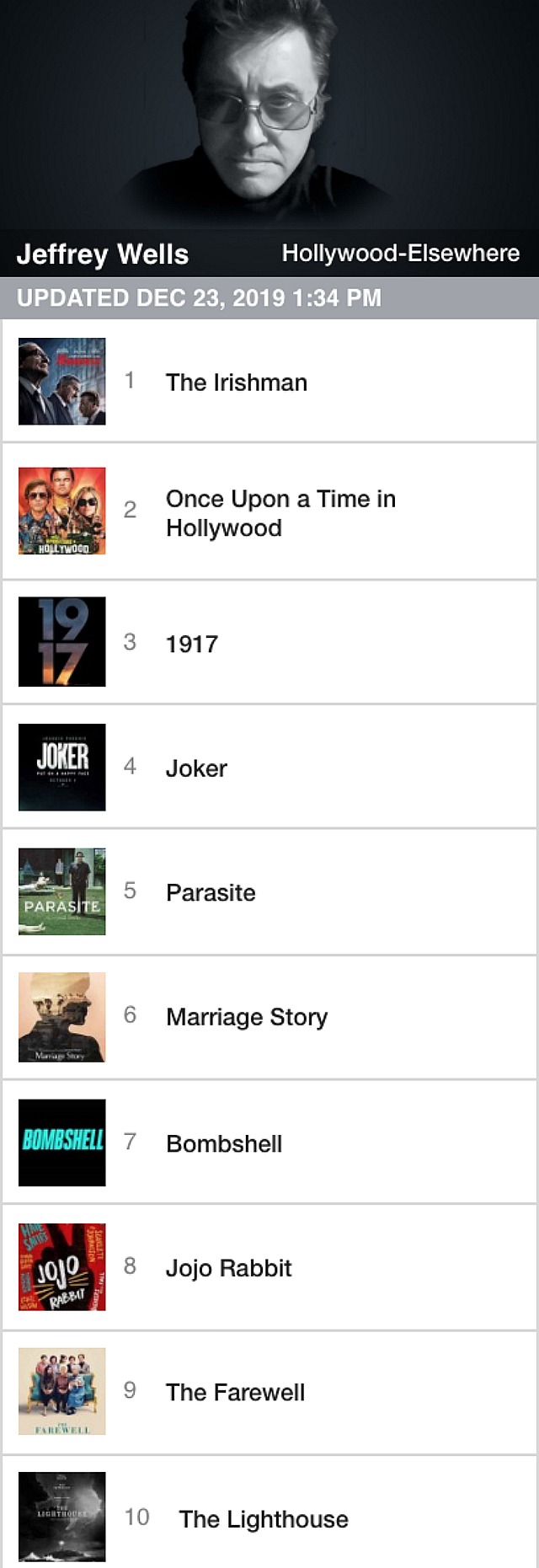
What would you call Janet Maslin‘s observation that straight guys aren’t exactly pining to see Little Women? I would describe it as somewhere between unsurprising and “no shit, Sherlock.” It was obvious from the get-go that Greta Gerwig’s adaptation was aimed at women of whatever age bracket. When Tatyana saw it she said, “This is not a movie for everyone…only certain people.” (Or words to that effect.) I would never tell a friend not to see Little Women (it’s a smart, well-composed, grade-A effort), but there’s no way to make a case for it being even close to the best of the year. HE’s current list starts with The Irishman, 1917, The Lighthouse, Les Miserables, Joker, Bombshell, etc.

Universal Sneak-Around

I’ve told this story two or three times, but sometime in the late winter or early spring of ’83 I flew from New York to Los Angeles for a job interview, and during the visit I went out to Universal studios to poke around. I wound up climbing a chain-link fence and walking onto a sound stage where, lo and behold, Scarface was being shot. The huge set contained a portion of Tony Montana‘s Miami mansion — the upstairs office, the red-carpeted foyer and staircase, a portion of the white-painted exterior with royal palm trees outside.

Hanging on a wall near the base of the staircase was a fairly large (at least six or seven feet tall) oil portrait of Al Pacino‘s Tony and Michelle Pfeiffer‘s Elvira Hancock. I’m no authority on oil portraits, but it looked like an absolutely first-rate effort. Someone had taken the time to make it look like a serious artist (one who knew from color and shadow and subtle gradations) had worked on it. In the film the painting is seen for maybe 1.5 seconds, if that.

I’ve long wondered what happened to this grand portrait. Did Brian DePalma or [the late] producer Marty Bregman make off with it? Online you can buy cheap knockoff versions with bullet holes, but the real thing was quite impressive.


The real-deal, full-size portrait presented a somewhat darker image that the one you see here.

Read more

Aspect Ratio Wrongo

Gina McIntyre has penned a 12.21 L.A. Times piece called “For Filmmakers This season, It’s Hip To Be Square — At Least On The Screen.” The primary focus is on Robert Eggers‘ black-and-white The Lighthouse (Amazon, currently streaming), which Eggers shot “using an aspect ratio dating [back] to the days of silent movies.”

Which is true. 1.19:1 was used during the transitional period when the film industry was converting to sound, or roughly from 1926 to 1932. Pally who knows everything: “It’s from the very early sound era with the soundtrack on the left, before Academy added the printed-in-frame lines to create 1.37.”

The problem is that McIntyre declares that the square-ish format “is known in cinematography circles as 1.3:1 or 4:3.” Sorry but that’s wrong. The Lighthouse aspect ratio, as A24 informed me and as I reported on 7.30, “is actually 1.19:1” — an aspect ratio introduced in 1926. Call it 1.2:1 if you want to simplify, but 4×3 (or 1.33 or 1.37) is definitely incorrect. Variety‘s Jazz Tanquay confirmed the 1.19 aspect ratio on 11.18.19.

Heavy Finale

Spoiler alluded to: I’m not an Apple TV subscriber, and I haven’t been watching the last few episodes of The Morning Show after streaming the first three episodes via a special press link. But episode #10, the first season finale, aired last night, and a certain principal character (and in particular a victim of sexual assault by Steve Carell‘s Mitch Kessler character, who is more or less based upon Matt Lauer) turned up dead.

The cause of death isn’t murder and it isn’t necessarily a suicide (or so says the actor playing the deceased), but the tragedy certainly brings the full weight of #MeToo reflection down upon viewers. Or so I’ve been reading. Who saw it and what’s your reaction?

Undiluted Greatness

The night before last (12.19) a special 20th anniversary screening of Michael Mann‘s The Insider happened at the DGA Theater in Los Angeles. This followed an identical event that happened at the Museum of Modern Art on 11.1. Usually such screenings serve as a promotional bounce for a forthcoming remastered Bluray (like a 4K version), but I’m not aware of any such plan for The Insider. A standard 1080p Bluray, the yield of “a new digital restoration”, was released by Touchstone Video on 2.19.13.

Most Mann-ophiles will insist that Heat is his grandest film, but I honestly find The Insider a better effort in nearly every regard — more exacting, complex, subtle, layered, intelligent. And certainly more real world. And without any annoying Waingro problems. No downtown LA shoot-out and no legendary Pacino-DeNiro conversation at Kate Mantilini’s, but The Insider is all adults, all hotels and corporate offices, all the time.

And with so many great Pacino moments (and not just the usual howling rants)! Not to mention one of the greatest Christopher Plummer performances of all time. Not to mention the absolute highlight of Bruce McGill‘s film career — “Wipe that smirk off your face!”

F.X. Feeney: “I’d admired Manhunter, Last of the Mohicans and Heat as individual films — but it was watching Mann penetrate the contemporary world of corporate authority, in which matters of life and death are decided over desks and behind closed doors, that the living totality and cumulative value of his filmography became unmistakable, and a source of abiding amazement.”

Two decades later I remain astonished by how Touchstone marketing failed to convey the simple fact that The Insider isn’t about the evils of tobacco, but about the glory (and the enormous difficulty) of good journalism vs. the evils of corporatism, and specifically about CBS corporate diluting a major 1995 60 Minutes story about big tobacco whistleblower Jeffrey Wigand.

Read more

Dogged Whistleblowers

Lewis Beale has tapped out a 12.20 L.A Times piece about whistleblower films, particularly Todd HaynesDark Waters and Scott Z. BurnsThe Report.

Beale’s boilerplate definition: “A single person or small, seemingly powerless groups fighting against great odds to uncover the truth about governmental or corporate malfeasance. Some are classic whistleblowers, who report on wrongdoings within their own organizations; others are just concerned citizens who see wrongdoing and take up the fight against it.”

Beale mentions a few storied whistleblower dramas — Mr. Smith Goes to Washington, Serpico, Erin Brockovich, The Insider — but omits any mention of Steven Soderbergh‘s wiggy and eccentric The Informant! (which Burns wrote) and James Vanderbilt‘s Truth, a whistleblower saga that blew up and went south, resulting in everyone washing their hands of it.

HE to Beale: And not a single mention of the Trump-Ukraine whistleblower saga, and the movie that will eventually but surely come of that down the road?

You saw The Report, I take it. Talk about an oppressively smug procedural, brandishing an ethical merit badge on its chest. I for one found Annette Bening‘s Dianne Feinstein…well, they got the wig right. No nation should embrace, much less be proud of, torturing its enemies, but the anti-torture lefties were the ones who attacked Kathryn Bigelow‘s Zero Dark Thirty, which is somewhere between 17 and 18 times better than The Report. A measure of irony there.

I was 100% down with Dark Waters until the end, when we’re told that the chemical corporates (Dupont) are going to dispute each and every individual case. They’re going to spend the plaintiffs to death. Then Dupont and the plaintiffs agree on an overall settlement for what seems like a formidable amount, but when you break it down…did the plaintiffs really feel restored with all the death and disease they had to cope with?

I’m sorry but Dark Waters doesn’t seem to end right. It feels overly mitigated. It left me feeling vaguely deflated and downish. I respected and admired, but it doesn’t do the movie-movie-thing very well. The attention to specifics is engrossing and even stirring, and the acting is aces up and down. It’s not that I was looking for an artificial sugar-high ending, but the finale that Haynes and producer/star Mark Ruffalo went with doesn’t feel like the one you wanted to see.