Ebiri vs. Canby on Hopper’s “Last Movie”

I’ve never seen Dennis Hooper‘s The Last Movie, which has been commonly regarded for decades as a legendary artistic embarassment and financial catastrophe, not to mention the film that killed Hopper’s directing career for over a decade. And yet it’s playing for a week at the Metrograph, starting tomorrow. And I’m asking myself “how many opportunities am I likely to have in the coming years to see this infamous creation in an allegedly restored condition on a first-rate theatre screen?” The answer may be “never again,” and so I’m tempted to catch a late afternoon show.

This is partly due to a near-breathless Village Voice review by Bilge Ebiri, titled “Dennis Hopper’s The Last Movie Is as Essential as Cinema Gets.” He calls it “one of the great lost films of the ’70s,” a statement that deftly sidesteps whether or not it’s any good.
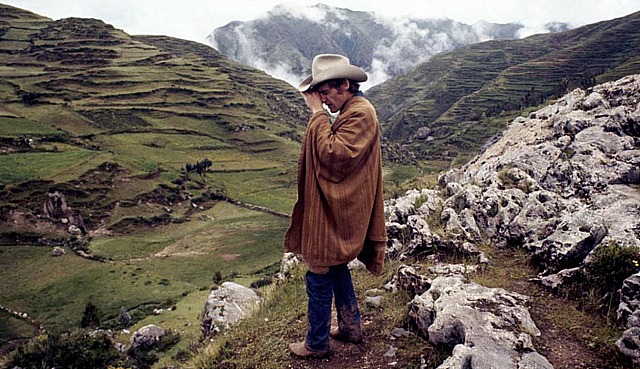

Dennis Hopper in The Last Movie.

He also says that The Last Movie “benefits from multiple viewings the way 2001: A Space Odyssey or Eraserhead or The New World do; you catch through-lines and details you’d missed earlier, while also developing new mini-fascinations and obsessions. It’s the rare film that seems both clearer and completely different with each viewing. The representational fissures of cinema — the tension between the real and the imaginary, between imitation and inspiration — have been woven into its very fabric.”

Toward the end of the review Ebiri calls The Last Movie Hopper’s “greatest ruin and his greatest triumph,” and says that it leads the viewer to “ask whether anyone but Hopper, the veteran character actor who became an unlikely counterculture figure after Easy Rider, could have made this film. And could The Last Movie have had any other fate than to [send Hopper] off to wander the winds of infamy, a man become a myth, and a myth become a man?”

See what I mean? Ebiri’s prose quickens the pulse. How bad could The Last Movie be? It has to be worth at least one viewing, right?

Then I came upon a sentence that gave me pause: “There is an excellent documentary about this chaotic, destructive period in Hopper’s life, called American Dreamer, which is also a lost classic.” Uhm, no…wrong. I saw American Dreamer back in 2010 and here’s a portion of my review, which I titled “American Boob“: “I was stunned by the doc’s shapeless sloppiness, and amused and repelled by its portrait of Hopper as a bearded, drug-fried horndog on the verge of destroying his directing career with the abomination that was The Last Movie.

Read more

First Peek at Barry Jenkins’ Latest

Based on the 1974 James Baldwin novel and set in early ’70s Harlem, If Beale Street Could Talk (Annapurna, 11.30) is about how a young African-American couple deals with a false accusation in 1970s Harlem.

The main protagonists are Tish (Kiki Layne), a 19 year-old, and Fonny (Stephan James), a 22 year-old sculptor, and their extended family. Fonny is unjustly accused of raping a Puerto Rican woman, Victoria Rogers (Emily Rios), and is sent to prison. Soon after Tish discovers she’s pregnant. She, her family and her lawyer struggle to find evidence that will free Fonny before the baby is born.

Pic was directed and adapted by Barry Jenkins (Moonlight). The costars includes Regina King (as Tish’s mom) Colman Domingo, Dave Franco, Ed Skrein, Finn Wittrock, Diego Luna, Pedro Pascal and Emily Rios. No Venice or Telluride screenings; Toronto only.

A guy who’s heard from a guy who saw Beale Street says it’s “art-housey…very theatrical and in line with Fences. Feels mostly like Barry adapting a book that was very personal to him. Even smaller than Moonlight and told in overlapping voiceovers, saturated cinematography and lots of montage. Stephan James is said to be the best in show and very charming. The fact that this film deals with sexual assault in an inconclusive manner may turn out to be an issue in this, the #MeToo era.”

Here’s a Blackfilm report from Wilson Morales.

Family-Level Adventure

Imagine being complacent enough to actually consider buying tickets to see Jaume Collet-Serra‘s Jungle Cruise when it opens on 10.11.19. Imagine being that pliant, that willing. The Disney pic has been shooting in Hawaii since late May.

Dwayne Johnson mentions the example of The African Queen, which was released 67 years ago, and the Charlie Allnut and Rose Sayer characters (played by Humphrey Bogart and Katharine Hepburn) that Johnson and Emily Blunt‘s characters (Frank and Lily) are presumably based upon.

What percentage of the potential Jungle Cruise audience has even heard of The African Queen, much less seen it? What percentage of this percentage would care one way or the other? The culture that knows and cares about classic 20th Century cinema is fading fast.

Boilerplate: “Frank, a boat captain, takes his sister and her brother on a mission into a jungle to find a tree believed to possess healing powers. All the while, the trio must fight against dangerous wild animals and a competing German expedition.”

Read more

Bless Me, Father, For I Have Sinned

While reading through the Elia Kazan Facebook thread that I mentioned yesterday, I came upon a story about a chat between director Joseph L. Mankiewicz and Marlon Brando on the set of Julius Caesar. It was April of 1952, and news about Kazan having named names in front of HUAC was just getting around. (Not “fresh” names though — Kazan confirmed names that the committee already had.) Brando was aghast, devastated. “What will I say when I see him again?” he asked Mankiewicz. “I truly loved that man, but look what he’s done.” Mankiewicz said something to the effect of “don’t judge or shun him…open your heart and give him a hug…he’s the same man you knew before, and I’m sure he had his reasons.”

In his autobiography A Life, Kazan wrote “I don’t hold people’s faults against them [and] I ask their tolerance for mine.” In the winter of late 1953 and early ’54, or roughly 20 months after Kazan’s testimony, he and Brando joined forces on On The Waterfront, which came to be regarded in some quarters as Kazan’s explanation for the occasional righteousness of testifying against former friend and colleagues. Brando was around when Kazan has given his honorary Oscar in 1999, but he never said a word for or against. They never worked together again after Waterfront.


(l. to r.) Elia Kazan, Marlon Brando, Julie Harris, James Dead on the set of East of Eden, sometime in mid to late 1954.

Read more

Grimly Surreal Telemarketing Oakland Penal Colony

I finally saw Boots Riley‘s Sorry To Bother You yesterday afternoon. I agree with the admirers — it’s a piece of wildly-out-there satire that warrants everyone’s attention and respect. I laughed from time to time and admired the Brittania Hospital-meets-Idiocracy surrealism, but I just didn’t care for the Oakland prison colony vibe (especially after sitting through the tedious, Oakland-based Blindspotting). As much as I got off on Riley’s edge and flamboyance and inventive sidestepping of the usual-usual, I didn’t want to “live” in this film. And that’s a key thing.

I was saying to myself, “Yup…a clever, smart living-in-the-21st-Century-horror flick with a trippy sense of style…thumbs up.” But at the same time it’s basically a film about pervasive tyranny — about economic desperation and miserable 30somethings surrounded by a system that’s trying to turn them into drones and slaves. Yes, there’s a rebellion aspect but the tone is nonetheless dominated by the oppressors. I was feeling uncomfortable less than ten minutes in, and actually doubly so as I knew that if I wrote anything even half-negative that Glenn Kenny would accuse me of being a Grand Wizard.

And yet at the same time I wanted to escape. I’m sorry but I did. Sorry To Bother You made me feel like Steve McQueen in Papillon. It made me feel like a shrieking man-horse, writhing on the floor. I loved Lakeith Stanfield‘s deadpan performance and laughed every time he spoke in his pee-pee “white voice” (actually David Cross‘s), but I liked the presence of Jermaine Fowler more…sorry. Tessa Thompson is obviously fetching (especially since she announced that she’s having an affair with Janelle Monae) but lacks range. Armie Hammer was brought in to satirize his white Winklevoss master-of-the-universe vibe…whatever.

Can I get out of this? I “liked” and “admired” Sorry To Bother You — it’s definitely a film with an attitude of its own and a lot of tricks up its sleeve, and I completely agree that it’ll win all kinds of indie-centric awards early next year. But I’ll never watch it again because on a certain level I felt as if Riley and his cast were more into taking than giving. I nodded glumly at the vision being presented, but I felt as if some essential liquid enzyme was draining out of me as I sat there in my Village East auditorium. I’d rather jump off a 300-foot rocky cliff than become a telemarketer, and this film made me feel as if I was literally stuck doing that.

I had roughly the same reaction to Sorry To Bother You as I did to Steven Soderbergh’s Unsane, which I half liked. The difference is that Sorry is a lot funnier and crazier.

Read more

Kazan Trip

There was a lot of passionate talk on Facebook yesterday about Elia Kazan. It was partly inspired by a 35 year-old Jonathan Rosenbaum piece about Kazan that he re-posted a day or two ago. So much feeling, so many different currents and moods and conflicts…it was as if Kazan were still alive and kicking.

It all gradually led to a rewinding and a re-visiting of the most emotional journey into Kazan and his films that I’ve ever known — Martin Scorsese and Kent JonesA Letter To Elia (’10).

A Letter to Elia is a delicate and beautiful little poem,” I wrote that year. “It’s a personal tribute to a director who made four films — On The Waterfront, East of Eden, Wild River and America America — that went right into Scorsese’s young bloodstream and swirled around inside for decades after. Scorcese came to regard Kazan as a father figure, he says in the doc. And after watching you understand why.

Letter is a deeply touching film because it’s so close to the emotional bone. The sections that take you through the extra-affecting portions of Waterfront and Eden got me and held me like a great sermon. It’s like a church service, this film. It’s pure religion.

Read more

Nolan’s Piss-Yellow “2001” Hitting IMAX Screens

For years I’ve been hoping to see Stanley Kubrick‘s 2001: A Space Odyssey projected in genuine IMAX. It was announced today that serious large-format presentations will finally happen on 8.24, or just over three weeks hence. The Hollywood Reporter‘s Pamela McLintock reports that four IMAX theatres (in Burbank, Manhattan, San Francisco and Toronto) will project the 1968 classic on what I presume will be titanic IMAX-sized screens.

The downside is that Chris Nolan‘s teal and yellow-tinted version, by any fundamental visual standard a vandalizing of Kubrick’s original 70mm presentation of the film (as this comparison reel makes clear), is the version that will be shown. McLintock reports that a “4K restoration” (i.e., Nolan’s version converted for an upcoming 4K Bluray) will be screened at “350 other IMAX locations,” many if not most of which will be fake IMAX screens.

You want irony? A video posted at the bottom of McLintock’s THR story, titled “2001: A Space Odyssey Anniversary / A Look Back”, shows scenes from the film that haven’t been Nolan-ized (i.e., aren’t tinted teal or piss-yellow).

Read more

Hardy Submits To Fantasy Realm

Remember the good old days (i.e., five years ago) when Tom Hardy‘s middle name wasn’t “paycheck” and he’d just blown everyone away with his quiet, less-is-more, totally-solo performance as a building contractor in Locke? Remember his performances in Warrior, The Revenant, Dunkirk, Legend, Tinker Tailor Soldier Spy and The Drop? Those were the days. Beware of director Ruben Fleischer, whom I loved after Zombieland (’09) but regretfully walked away from after Gangster Squad. Venom pops on 10.5.

Who’s Playing Ailes?

Variety and Deadline have reported that three name-brand actresses will costar in Fair and Balanced, an Annapurna drama about the downfall of Fox News honcho Roger Ailes over sexual harassment charges.

Nicole Kidman will play former Fox News anchor Gretchen Carlson, Charlize Theron will portray former Fox News headliner Megyn Kelly, and Margot Robbie will play “a fictional Fox News associate producer named Kayla Pospisil.” Question: How do you pronounce Pospisil? A tongue-twister any way you slice it.

My first choice to play Blubbergut Ailes was Russell Crowe, but he’s taken by that other project. Who then?

Jay Roach will direct. The script is by Charles Randolph (The Big Short). In anyone has a PDF, please send it along. Boilerplate: “The film will tell the story of the ensemble of women who took on the toxic male culture of Fox News and helped depose its chief architect.”

John Sununu Did It

The entire issue of the next N.Y. Times Sunday Magazine (8.5) is devoted to the steadily losing war against climate change. Written by Nathaniel Rich and titled “Losing Earth: The Decade We Almost Stopped Climate Change,” the central thesis is that civilization could have arrested climate change if responsible meaures had been taken during the mid to late ’80s, or more precisely during the George H.W. Bush administration.

Alas, former New Hampshire governor John Sununu, Bush’s chief of staff, successfully argued against such measures, and so the opportunity was lost. Have tens of thousands aided and abetted, including President Trump? Of course, but Sununu stands alone — the satanic ogre who did more than any other single person in a position of power to block constructive measures against climate change during a key period, and who set forces in motion that will essentially doom millions to untold meteorological horrors.

From a 2.6.90 N.Y. Times story titled “Bush Asks Cautious Response To Threat of Global Warming“: “President Bush called today for a cautious response to the threat of global warming, pleasing those in his Administration who want a deliberate policy but disappointing many environmentalists.

“In a speech to an international environmental group, the President called for global action but warned against policies that would interfere with economic growth and the free market.

“Administration officials said the speech struck a middle ground between conflicting positions among Mr. Bush’s aides. His chief of staff, John H. Sununu, wanted to emphasize scientific uncertainties about global warming and to warn of economic dangers in rushing to act. Several agency heads, including William K. Reilly, Administrator of the Environmental Protection Agency, pressed for a stronger message of America’s commitment to action.”

Sununu quote #1: “The global warming crisis is just the latest surrogate for an over-arching agenda of anti-growth and anti-development. This agenda grew and gathered support in the years following World War II.” Sununu quote #2: “Nature will eventually do what nature has always done. It will respond in a self-stabilizing manner over the long term with moderate variability over multi-decade periods and with occasional significant variability over the short term.”‘

Asked on PBS to summarize the conclusion of his lengthy N.Y. Times report, Rich said that “the simple political answer, a very narrow answer, which is that [in] the first George Bush administration…chief of staff John Sununu was an engineer [and] was very skeptical about the science of global warning, and he suspected that it would be used by a cabal of folks who wanted to suppress growth and economic advancement, and he managed to win an internal fight in that White House against action.”

Read more