Fan Investment & Ownership

A 7.5 Indiewire article by Zack Sharf reports that Guardians of the Galaxy director James Gunn has offered stern words to a certain sector of Star Wars fanatics. Gunn was affected by a 7.3 Wrap article in which Ahmed Best, the actor who played Jar-Jar Binks in The Phantom Menace, confessed that the Jar-Jar hate was so intense 20 years ago that he actually contemplated killing himself. Some fans apparently replied that George Lucas was the guilty party and not Best, as Lucas was Jar-Jar’s creator.

Gunn’s reply: “Star Wars may be important to you, but it doesn’t belong to you. If your self-esteem depends on how good you think the current Star Wars is, or if your childhood is ruined because you don’t like something in a movie, GO TO THERAPY.”

HE to Gunn: There are very few critics or columnists who feel less in league with Star Wars loonies than myself, but if you want to be fair about it two truths need to be acknowledged.

One, fanboy fervor cuts both ways. The sputtering anger that fed haters of The Last Jedi or The Phantom Menace came from the same emotional gas tank that has propelled the reputations of other fanboy flicks and made them into super-hits. Fanboy ardor can obviously turn toxic, for sure, but it’s slightly hypocritical for filmmakers to deplore fan-bile on one hand while winking at fanboy worship and profiting handsomely when the reviews are good and the winds are favoring.

And two, fans who’ve responded to certain films with crazy intensity arguably own the film as much as the filmmakers, and perhaps even more so. When The Big Lebowski was surprise-screened at Sundance in January of ’98, it was nothing more or less than an offbeat Coen brothers entry — a deadpan stoner comedy that some critics liked and others not so much. But the crazy fans of Joel and Ethan’s eccentric paen turned it into a cult phenomenon. That special popularity is owned by them, not the Coens. Ditto the fanatical love of the first two Star Wars films, A New Hope and The Empire Strikes Back, between ’77 and ’80, and how all of that flipped into rage when the prequels came along 20 years later.

Last Jedi haters probably could benefit from a little couch therapy, but Hollywood types never allude to fan psychology when the money is pouring in.
Beware Of These Words

If you’re speaking to senior-level Apple tech support person (as I am right now about an iPhone problem), you’re probably wasting your time if the technician says “I’m very sorry that you’re having this problem.” I’ve been dealing with these guys for over a decade now, and no one who’s sagely and confidently solved a problem has ever apologized for anything. Problem solvers assess and fix, period. But there’s always a first time, right? Open your heart and wait for divine providence. Then comes the second death-knell chant: “I’m just trying to help you, sir…I’m just trying to work with you.” Those are guillotine words. If you hear them you need to gently thank the tech for his/her assistance, wish him/her a good day, and start all over again.

The problem, in a nutshell, is that yesterday I misplaced my iPhone 6 Plus while visiting the Beverly Center. I reported the loss to the security and guest services guys …nothing. I went home and used the “Find My iPhone” app on my Macbook Pro…no signal. By all indications someone put it in their pocket, went home and tried to hack it. I know because I was forced to buy a new phone (8 Plus with 256K memory), and while retrieving my apps, photos and contact info from the cloud (no problems on that end) the 8 Plus software subjected me to a two-factor authentication process, which means providing not just my Apple password but a six-digit code that Apple has sent to “your other iPhone.” Huh? The bottom line is that the Apple network now believes that my current phone number ends in “14,” which it never has. The phone number ending in “14,” I suspect, was submitted by the thief in the process of hacking the iPhone 6 Plus and installing a new SIM card. The long and the short is that I’m currently unable to double-authenticate my identity, at least as far as the iPhone 8 Plus’s software is concerned.

One of the senior-level Apple support reps told me that the only way she could make the problem go away was for me to erase my longstanding Apple ID and password and create new ones. “But I’ve had that Apple ID for years and years,” I said. “I’ve bought all kinds of songs and albums with them, and if I switch out all kinds of problems will result. Why should I abandon my Apple ID because a thief has tried to hack my phone and give it a new number?” She said she had to recommend this because she couldn’t fully authenticate my identity over the phone. “But there’s a ton of information I could supply…historical background stuff, bank account #s, purchasing history,” I said. “Why can’t you verify by asking these questions?” She said her protocol didn’t allow for this. I said thanks anyway, etc. A second senior-level tech support guy pretty much said the same thing.

My next move will be to consult with a nearby Apple store “genius bar” person.

Opening Night Reminder

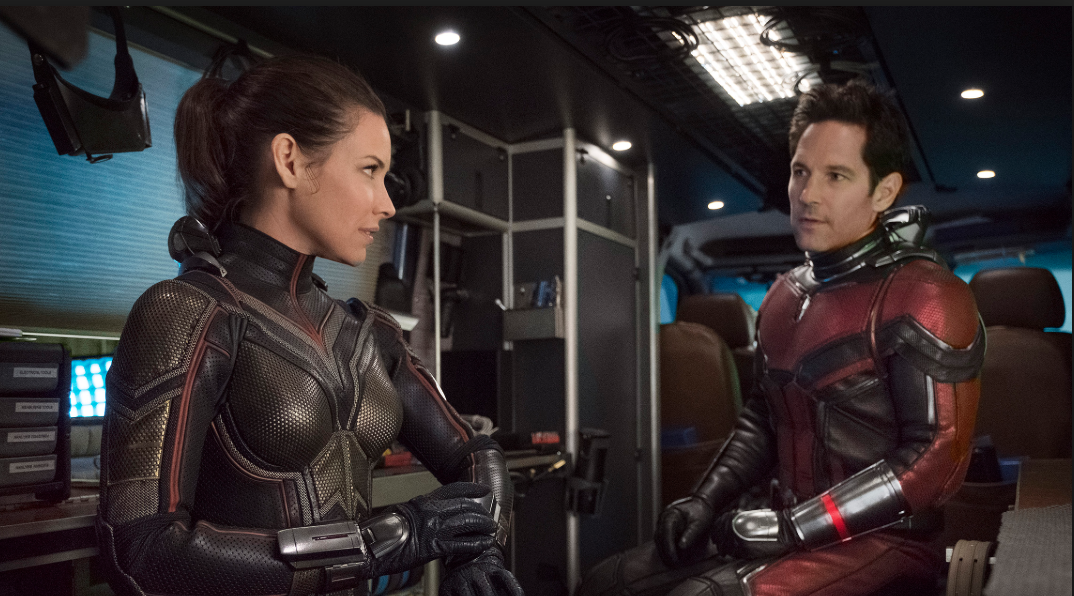
Posted on 6.27: Peyton Reed‘s Ant-Man and the Wasp (Disney, 7.6) isn’t a problem unless you’re determined to complain about it not being as good as the original Ant-Man (’15). Which it’s not.

It nonetheless has good, occasionally amusing work by Paul Rudd, Evangeline Lilly (Hope van Dyne / Wasp), Michael Douglas, Michael Pena, Walton Goggins (fated to play pain-in-the-ass, low-rent villains for the rest of his life), Bobby Cannavale, Judy Greer, Hannah John-Kamen (Ghost), Abby Ryder Fortson (Rudd and Greer’s daughter Cassie), Randall Park, Michelle Pfeiffer (Janet van Dyne — rescued in Act Three from the sub-atomic, micro-quantum realm or whatever you want to call it), Laurence Fishburne (punching the clock), etc.

Ant-Man and the Wasp is fleet, funny, disciplined, carefully honed, occasionally dazzling, light-hearted, pleasingly absurd…112 minutes worth of cool cruisin’. And those 112 minutes feel like 80 or 85, by the way. There are no significant downshiftings or speed bumps, or none that bothered me.

Please don’t let any other sourpusss types stop you from seeing it, but I’m telling you straight and true that Ant-Man and the Wasp is not quite as affecting, highly charged and/or sink-in good as I wanted it be. You may feel the same way when you see it, but you’ll probably survive.

Why should anyone care if Ant-Man and the Wasp registers as a slight letdown that’s nonetheless entertaining? There are bigger fish to fry and meditate upon. See it or don’t see it. But don’t weep for the Marvel and Disney empires — they’re fine. On top of which the Rotten Tomatoes whores have given it a 96% approval rating.

The dopey subversive humor in Reed’s three-year-old original felt fresher, for one thing. And the story was more emotionally affecting as far as Paul Rudd‘s Scott Lang was concerned. He was in a fairly dark and despairing place as it began — ex-con, low-rent loser, not much of a role model for his daughter — so morphing into Ant-Man by way of Michael Douglas‘s (i.e., Hank Pym’s) brilliance and reluctant largesse really meant something.

Read more

Hip-Hop Phase…Fog, I Mean

Now this — this! — is truly great television. A performance that felt like something else. Nine years and change. I was living in New York at the time, and I don’t think I was even watching as it happened. Letterman to Phoenix: “Joaquin, I’m sorry you couldn’t be here tonight. We’ll certainly keep you in our rolodex.” Phoenix looks like his 2009 self in Garth Davis‘s Mary Magdelene, which got caught in the Weinstein collapse and may or may not open in this country.

18 months later (9.22.10):

Uhm…I Already Knew This?

Six days ago a video clip surfaced of Stanley Kubrick explaining the ending of 2001: A Space Odyssey.

The footage was recorded 38 years ago by filmmaker Jun’ichi Yaoi. It was part of a documentary about paranormal experiences, blah blah. Yaoi’s doc was never released but a VHS of the raw footage was reportedly sold two years ago on eBay. Somebody evidently decided to upload the video to YouTube. Why did they wait two years? Why didn’t they upload it immediately? Or why didn’t they wait until 2001‘s 60th anniversary in 2028? Or the 70th in 2038? Who cares?

The Great Stanley K., in his own words: “I’ve tried to avoid doing this ever since the picture came out. When you just say the ideas they sound foolish, whereas if they’re dramatized one feels it. But I’ll try.

“The idea was supposed to be that [Keir Dullea‘s Dave Bowman] is taken in by god-like entities, creatures of pure energy and intelligence with no shape or form. They put him in what I suppose you could describe as a human zoo to study him, and his whole life passes from that point on in that room. And he has no sense of time. It just seems to happen as it does in the film.

“They choose this room, which is a very inaccurate replica of French architecture….deliberately so, inaccurate…because one was suggesting that they had some idea of something that he might think was pretty, but weren’t quite sure. Just as we’re not quite sure what do in zoos with animals to try to give them what we think is their natural environment.

Read more

Scandal-Ridden EPA Honcho Goes Down

Scott Pruitt, the most malignant Environmental Protection Agency chief ever, has resigned. EPA deputy Andrew Wheeler, almost certainly another anti-environmentalist, will take over in the interim. Pruitt impressed many in the media as the dirtiest, swampiest cabinet chief in government history, his actions having reportedly inspired 14 separate investigations. (Here’s a list of 13.) Pruitt, 50, had been very popular among conservatives for his absolute indifference to the health of the planet, but his ethical scandals were overwhelming.

From N.Y. Times: “Pruitt began the largest regulatory rollback in the EPA’s history, undoing, delaying or blocking several Obama-era environmental rules…among them was a suite of historic regulations aimed at mitigating global warming pollution from the United States’ vehicles and power plants.”

Sad Loss of a Good Guy

Midwestern liberal-progressive TV personality and talk-show host Ed Schultz, who hosted The Ed Show on MSNBC from 2009 to ’15 and who’d recently hosted a daily news show on RT America, has died at age 64. “Natural causes,” the report says. What exactly is “natural” about succumbing to an eternal black void at age 64?

Ed began as a North Dakota sports guy on radio, and then became a conservative talkshow host on North Dakota’s WDAY. He gradually evolved into the progressive camp in the mid to late ’90s. The Ed Schulz Show (radio) ran from ’04 until ’14.

Ed was quite the MSNBC host during the Obama years. I was a regular follower. He left MSNBC in ’15, largely due to political censorship from management.

Since being with RT America Schulz had told one and all that MSNBC’s Phil Griffin initially (and to some extent persistently) suppressed coverage of Bernie Sanders’ presidential campaign, and in one particular instance Schulz’s attempt to cover Sanders’ official announcement of his presidential campaign in Burlington, Vermont, on 5.27.15. This happened, Schulz believed, because Griffin and NBC news president Andy Lack were in the tank for Hillary Clinton, et. al. Here’s Schulz’s oral account of what happened when he tried to cover Sanders’ announcement. Seriously…listen.

45 days after this incident happened, Schulz left MSNBC.

Read more

“Great Escape” Leisure Village

John Sturges The Great Escape (’63) was shot on sound stages near Munich, and to some extent in a Bavarian town named Fussen. The real-deal Stalag Luft III, the P.O.W. camp from which P.O.W.s actually escaped in March 1944, was located 100 miles southeast of Berlin, in what is now the Polish town of Żagan.

In the comment thread that followed yesterday’s Great Escape post (“Independence Day Doldrums”), a discussion arose about the logistics of the escape, which led me to riff about the whys and wherefores of the escape itself.

The Great Escape P.O.W. camp was built in what looks like a 15-acre area not far from the Munich sound stages. It consisted of 16 P.O.W. barracks, which could theoretically hold 50 guys each or 800 total. The actual Stalag Luft III was spread over 60 acres and housed 11,000 POWs.

I noted yesterday that Sturges’ P.O.W. camp had the atmosphere of a leisurely, not-hugely-unpleasant work camp, and that the German guards were like testy high-school teachers (who’s been throwing spitballs?) and that the inmates conveyed military decorum while being casually impudent, or the attitude that TV audiences would later associate with Hogan’s Heroes.

The actual Stalag Luft III was not a hell hole. A bit grim but certainly tolerable. The men were adequately fed and housed. Bunks, blankets, pillows. Holiday dinners were served. The atmosphere was almost collegial, to go by the Wiki page. POWs organized theatrical shows and published two weekly newsletters. Mail and parcels from loved ones arrived. All kinds of recreational fitness options (including weights, fencing and table tennis) were available. The camp even had a small swimming pool.

As noted, the escape happened in the late stages of WWII (i.e., March 1944). Any sage assessment of how the war was going told you the Germans were doomed. The coming Eisenhower invasion, the disastrous Russian front, constant Allied bombing. Albert Speer wrote that events turned against the Germans in ’42, and that he knew they were sunk soon after. A 9.8.09 Guardian article by Richard J. Evans (“Why Hitler’s Grand Plan Collapsed”) asserts that “ordinary Germans knew by the end of 1943 that the war was lost.”

Read more

Thomson Back To Billson

Critic David Thomson has responded to Anne Billson’s Guardian response to his 6.21 London Review of Books essay about Alfred Hitchcock‘s Vertigo.

Thomson questioned whether Hitchcock’s 1958 masterpiece is an acceptable fit in the #MeToo era. He said that given Hitchcock’s creepy attitudes toward women on-screen (and his behavior toward Tippi Hedren in the early ’60s) he doubts Vertigo will be #1 again when Sight & Sound critics vote in 2022.

Billson replied that Hitchcock “created many strong and perceptive female characters,” as I summarized yesterday, “and that many of his male characters are weak and vacillating.

“For a so-called misogynist, his films feature a lot of intrepid heroines,” Billson writes. “Even when the women are nominally just love interests, they are unusually plucky and quick-witted.”

The subhead of Billson’s piece: “While some critics see the film, released 60 years ago, as proof of Hitchcock’s sexist creepiness, a closer look reveals that strong women and weak men were often at the heart of his work.”

Thomson replied today as follows: “I enjoyed Anne Billson’s article and I agree with a lot of it. But I find it hard to see [Kim Novak‘s] Judy Barton in Vertigo as a ‘strong’ character.

“After all, she has come to San Francisco to survive. She is not quite young any more and there are hints of failure along her way. So she gives herself to a fanciful and very cruel plot. She is being hired (and paid surely) to destroy two people — Madeleine Elster and Scotty Ferguson. There seems every likelihood that she has become Elster’s mistress in that process.

“In other words, she is a tool, being manipulated, and giving up her self. So when she starts to fall for Scotty, she cannot admit it. And after that, dumped by Gavin, she lingers in San Francisco, as if to wait for Scotty to notice her, as Judy. But then she has to be Madeleine again. With further disaster, including her death.

“It’s hard to think of a clearer case of victimhood. or a film so in love with romantic tragedy.”

Nothingburger

I felt a slight surge of excitement when I first heard that a woman was climbing up the Statue of Liberty. How can anyone scale a smooth copper statue that doesn’t have any footholds to speak of? Then, of course, the headline turned out to be bullshit. Seven or eight people with Rise and Resist had unfurled an anti-ICE banner at the bottom of the statue, and were then arrested. Then a single woman wearing bright pink shoes climbed up to the base of the statue, and the news media went crazy. Except it was nothing.

Rise and Resist organizer Martin Joseph Quinn told CNN that the woman in question “climbed without our knowledge…it was not part of our action…we are deeply concerned for her safety.” Deeply concerned about what? A woman sitting and chatting with the cops who had climbed up to the same area on a ladder. And yet Liberty Island was evacuated, and at least a couple of news networks treated the incident as a possible act of terrorism.

Read more

Independence Day Blahs

Here’s a two-year-old Great Escape piece that I have a special affection for. I’m posting it because there’s a vague association between this 1963 John Sturges classic and the 4th of July holiday.

I loved The Great Escape as a teenager and 20something but not lately. Lately it feels too smug and self-satisfied, too much jaunty humor. It’s almost played on a Hogan’s Heroes level. Cast to audience: “We may be portraying POWS but we’re a bunch of cool-attitude 30something actors and we can pretty much do anything we want within reason. (Including making our own potato vodka and throwing a 4th of July party.) It’s like high school, this prison. The German guards and officers are hugely irritated geometry and math teachers. ”Who’s throwing spitballs? Apparently some people in this room want detention!”

The only bad thing that happens during the entire camp portion (or about 65% to 70% of the film) is when one of the three tunnels is discovered by the Germans. That’s it! No other mishaps or mistakes except for the shooting of Angus Lennie‘s Archibald Ives, except in my book that’s a good thing. Because I hate his Brigadoon Scottish accent.

In no particular order…

(1) The German camp commanders are far too lenient with the prisoners, who after all have been put into this super-camp because they’re all disobedient bad apples with a high likelihood of trying to escape.

(2) Why oh why don’t the Germans simply post two guards inside each of the barracks so as to spot any possible digging going on?

(3) I despise Richard Attenborough‘s “Big X” character, such that I always feel a slight pang of pleasure when he gets machine-gunned to death near the end (not that the other 49 other prisoners being killed isn’t a tragedy, but at least Attenborough has been shut up for good).

(4) That scene when McQueen and Ives explain to their superiors how they intend to dig their way out under the fence like moles is completely absurd and not even vaguely funny, and McQueen’s delivery of his dialogue is straight out of The Honeymoon Machine.

Read more