Toadies

From N.Y. Times editorial, posted Saturday, 5.26: “The owners of the National Football League have concluded, with President Trump, that true patriotism is not about bravely standing up for democratic principle but about standing up, period.

“Rather than show a little backbone themselves and support the right of athletes to protest peacefully, the league capitulated to a president who relishes demonizing black athletes. The owners voted Wednesday to fine teams whose players do not stand for the national anthem while they are on the field.
“Let us hope that in keeping with the league’s pinched view of patriotism, the players choose to honor the letter but not the spirit of this insulting ban. It might be amusing, for example, to see the owners tied in knots by players who choose to abide by the injunction to ‘stand and show respect’ — while holding black-gloved fists in the air. Or who choose to stand — while holding signs protesting police brutality.

“We look forward to many more meetings of fatootsed gazillionaires conducting many more votes on petty rules to ban creative new forms of player protest.”
Read more

Slut Brigade

Variety‘s Steven Gaydos has tweeted a point he made in a 2.26.18 Guardian article titled “Ripe For A Kicking: Hollywood’s Love-Hate Relationship with Rotten Tomatoes. The thrust is that critics have become more and more whore-ish over the last 10 or 15 years.

“Critics have trained themselves to [pretend to] take seriously movies that they don’t take seriously because the danger is not having a job and not being ‘relevant’, being aged out of the discussion.

“The numbers bear out this trend. The median Tomatometer score for movies grossing more than $2 million was 51% during the 2000s and 53% during the 2010s. In 2017, though, the year of crashes such as Baywatch and Pirates of the Caribbean 5, the median was 71%. Either critics are enjoying movies more or movies are better than ever.”

Uhm, movies are not better than ever, or weren’t the last time I cheoked.

Sturgeon’s law doesn’t quite apply to the movie realm. 70% of films tend to be underwhelming, weak, bad, formulaic, dispiriting or numbing. 15% tend to be fair, decent, pretty good, passable. 10% are usually good to very good, and less than 5% are brilliant or epic or genius-level. This is how it usually shakes out, year in and year out. One out of four.

Anyone giving thumbs-up reviews to more than 40% or 50% of releases is being overly generous, and I myself am being generous in using this term.

Franchise Fatigue! “Solo” Is Falling!

Wall Street Journal reporter Ben Fritz has tweeted that Disney-Lucasfilm is confirming that Solo: A Star Wars Story is looking at a four-day Memorial Day weekend haul of $105 to $115 million, which translates into a three-day-weekend tally of under $100 million. The studio’s previous four-day estimate was in the range of $130 to $150 million. Solo is playing in 4,380 domestic situations. First-day (i.e., Friday) grosses are around $32 million, including Thursday night’s $14.1 million.

The last Star Wars flick, The Last Jedi, opened five months ago. It brought in a first-weekend haul of $220 million in North America for a grand domestic total of $620 million and $1.3 billion worldwide.

Bring It, “Sicario” Brahs

From my 6.19.15 Sicario review: “The tale, such as it is, is told from the perspective of Emily Blunt‘s FBI field agent, who, being a 21st Century woman, is in touch with her emotions. She is therefore constantly stunned and devastated by the unrelenting carnage of the Mexican drug trade, blah blah.

“You know what I’d like to see just once? A female FBI agent who isn’t in touch with her emotions, or at least one who tones it down when it comes to showing them. Too much to ask for, right?

“One of Blunt’s battle-hardened colleagues, a senior veteran with a semi-casual ‘whatever works, bring it on’ attitude, is played by the ever-reliable Josh Brolin. My favorite character by far was Benicio del Toro’s Alejandro, a shadowy Mexican operative with burning eyes and his own kind of existential attitude about things. Benicio the sly serpent…the shaman with the drooping eyelids…the slurring, purring, south-of-the-border vibe guy.”

Crisis Publicist Paul Bloch Ascends

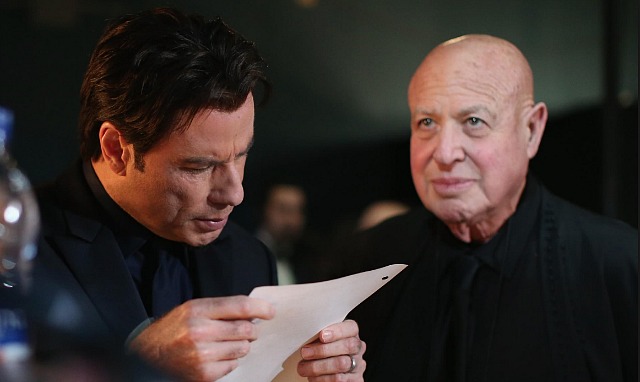
Paul Bloch, the well-liked Rogers & Cowan publicist with a easygoing manner and an endless repertoire of sweaters and watches, passed this morning at age 78. He was the lanky bald finesse guy whom big-name stars always hired when they got into trouble or needed something smoothed over or the press kept at arm’s length — Tom Cruise, Eddie Murphy, John Travolta, Michael Keaton, Sylvester Stallone, Bruce Willis, Lisa Marie Presley, Nick Nolte, et. al. Back in the day Bloch also repped Sharon Stone, Kevin Costner, Anthony Hopkins, Farrah Fawcett, Barry Gibb and Diana Ross. Big brand name, nice guy, mellow presence. Born in 1940, Bloch started in the Rogers & Cowan mailroom in 1962. Hugs and condolences to friends, clients and family.


Paul Bloch (r.) with client John Travolta, sometime in the mid to late ’90s.

Meh Shelley Drama Highlights New Brad Pitt

A friend who saw Haifaa al-Mansour‘s Mary Shelley (IFC Films, opening today in one theatre in Santa Monica) says the standout is 25 year-old Douglas Booth, who plays Percy Bysshe Shelley. I don’t even remember him from Darren Aronofsky‘s Noah (’14) or Lone Scherfig‘s The Riot Club (’14), and sitting through the Wachowski brothers Jupiter Ascending, in which Booth also costarred, made me too miserable to notice anyone or anything. I just wanted to die.

IFC’s West Coast p.r. rep didn’t even invite me to see Mary Shelley. He/she probably calculated that I’d trash it but it got trashed anyway by everyone else. It only has a lousy 33% RT rating.

At age 16, the actual Mary Shelley (Elle Fanning) began a physical relationship with the already married Percy Bysshe Shelley. Together with Mary’s stepsister Claire Clairmont (Bel Powley, whom Booth is seeing in real life), Mary and Shelley left for France and travelled through Europe. Claire began sleeping with Shelley, and then started sleeping with Lord Byron, who dumped her. Mary became pregnant thrice by Shelley, but two of the babies died. Shelley’s wife committed suicide, after which he and Mary got married.

At age 18 Mary wrote “Frankenstein”, which was allegedly some kind of metaphorical saga about her life. Shelley was Dr. Henry Frankenstein — she was the unloved, spat-upon, misunderstood monster.

Avoidance Syndrome

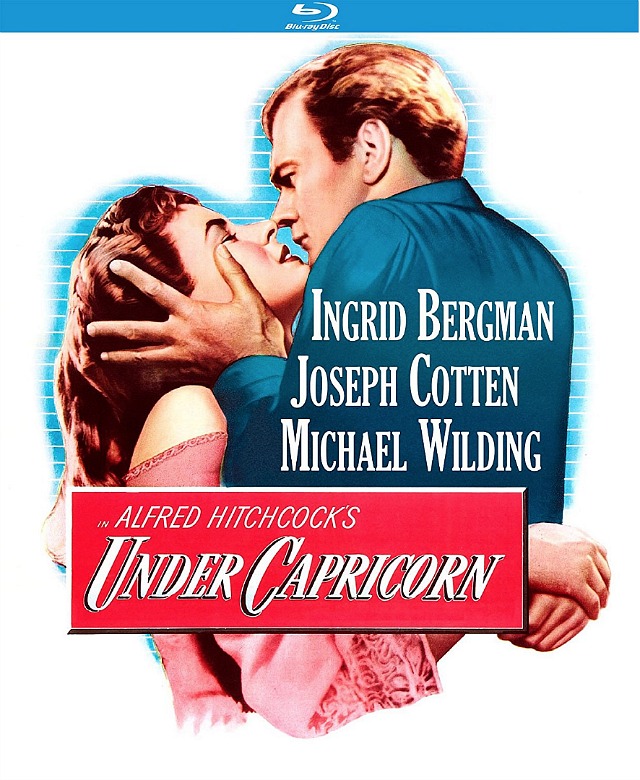
Although I’ve been an Alfred Hitchcock fan since childhood, I’ve avoided seeing Under Capricorn (’50), an early 19th Century drama set in Australia, all my life. Despite knowing there are always elements in a Hitchcock film that are worth seeing. Despite the legendary Jack Cardiff (Black Narcissus, The African Queen) having shot it in Technicolor, and despite Hitchcock having reportedly used ten-minute-long takes. Despite the stellar cast — Ingrid Bergman, Joseph Cotten, Michael Wilding, et. al. The forthcoming Kino Lorber Bluray (out on 6.19) is a 4K restoration, and I still won’t touch it. Because Hitch himself never hesitated to call it one of his worst films. Plus it was a box-office stinker — cost $3 million, made $1.5 million.

Too Fuddy-Duddy For Proverbial Sack

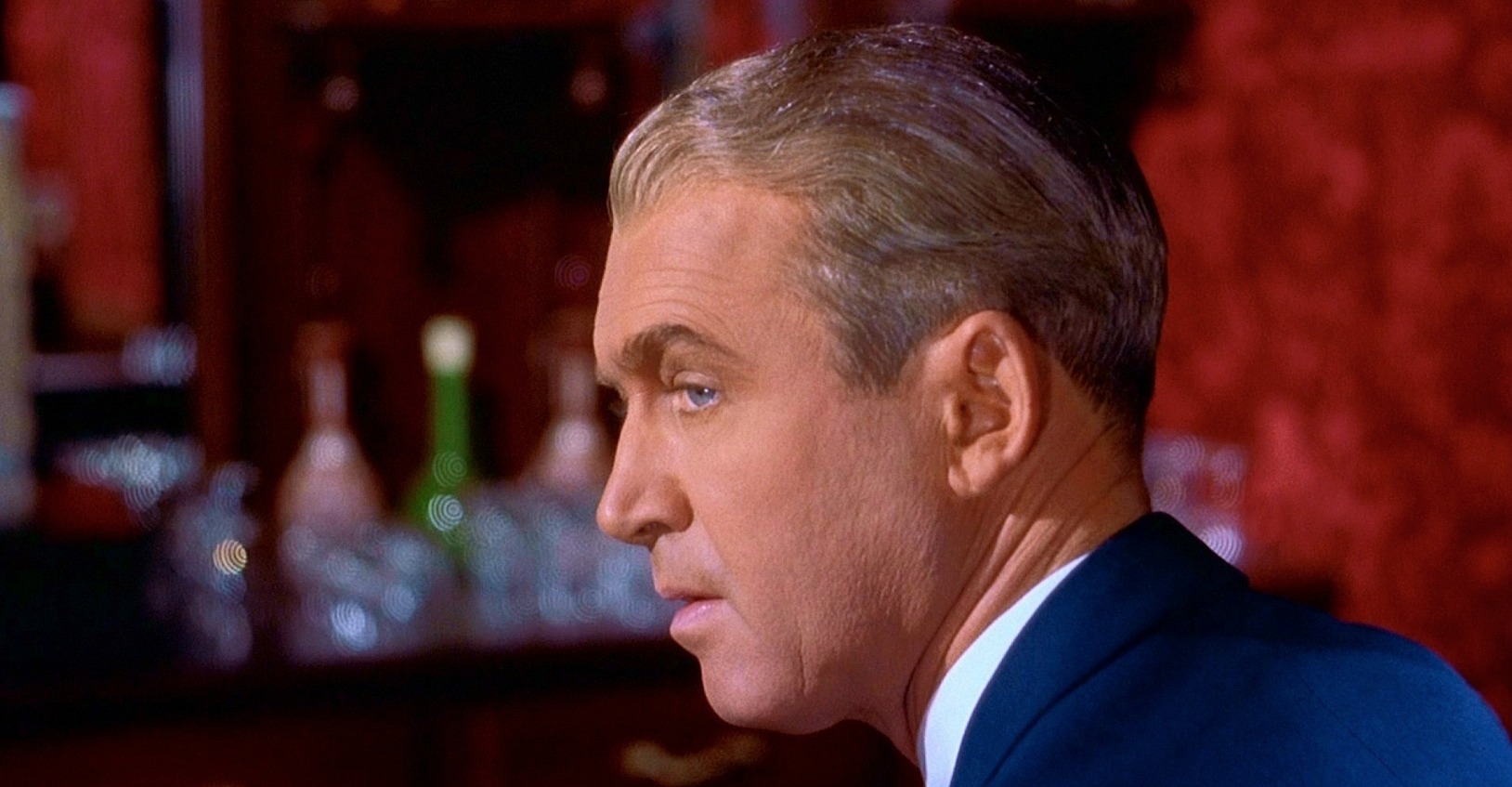
Several online forums have repeated an Alfred Hitchcock assertion, possibly sourced from his 1962 interview with Francois Truffaut, that one reason Vertigo was a financial failure was because the 49-year-old Jimmy Stewart looked “too old” to be the lover of Kim Novak, who was 25 during filming. (Vertigo was shot between September and December 1957.)

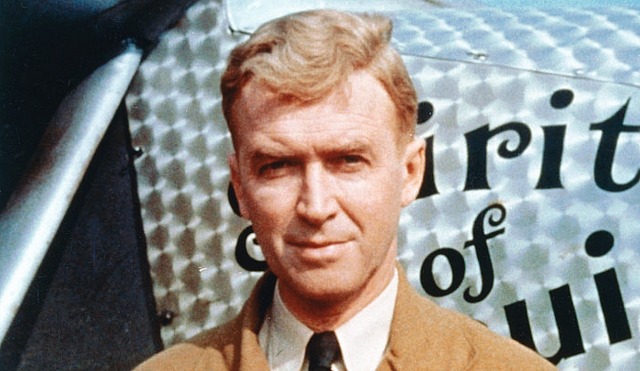
Stewart’s John Ferguson does in fact seem too rigid and stodgy for Novak, not just because of his mostly gray hair but a generally stuffy conservative bearing. (That awful brown suit, for example.) But Hitch could have easily made Stewart appear younger by giving him fair, blonde-tinted hair with a slightly longer, less conservative cut. Only a year earlier Stewart had worn a blonde, almost bushy wig in The Spirit of St. Louis when he played the 25 year-old Charles Lindbergh.

There was nothing loose or sensual or sexually upfront about Stewart in Vertigo. Nothing. He looked and behaved like a Republican governor of a midwestern state, or an Air Force colonel or a corporate real-estate broker. One glance at Novak and you could imagine her nude under satin sheets, but it’s impossible, really, to think of Stewart’s character in even a partial state of undress, much less buck naked and doing the deed. It feels creepy to even describe this, and I’m fully aware that in his youth Stewart was quite the randy fellow.


James Stewart in Alfred Hitchcock’s Vertigo (released in May 1958).

Stewart as Charles Lindbergh in Billy Wilder’s The Spirit of St. Louis (released in April 1957).

Read more

Cuffed, Pled, Bailed

Harvey Weinstein surrendered to the cops this morning, and was subsequently arrested “on rape, criminal sex act and other charges from encounters with two women.” Seven months have passed since the Weinstein allegations broke in the N.Y. Times and The New Yorker. The reports immediately transformed Harvey into toast and launched the #MeToo and #TimesUp movements. His attorney’s claim that Weinstein “didn’t invent the casting couch in Hollywood” is true, but hardly a defense. He’ll almost certainly do time.

Read more

“Solo”: The Floor Is Open

For the third time: Solo is basically a numbing formula exercise that never really sings or revs or lifts off the pad with a levitational force of its own. Everyone (Ron Howard, Alden Ehrenreich, the audience) is going through the motions because Disney is determined to monetize the Star Wars franchise as much as possible, including (God help us) hiring James Mangold to make a Boba Fett movie. Yeah, okay — Ehrenreich does a relatively decent job of pretending to be a youngish, much shorter Han, and if you want to go along with this second-tier charade, be my guest. I felt hugely bored and irritated during the first hour, which is all about adrenalizing the ADD crowd with the usual distractions. Nor was I taken with throwing in the crucial card game (the one in which Han won the Millennium Falcon from Lando) at the very end, almost as an afterthought. But don’t let me stop you. If you’re determined to be an easy lay, you’ll find a way to convey enthusiasm.

And your opinion is…?

Ron Howard’s Proudest Five

Solo: A Star Wars Story, which begins screening tonight, is not among Ron Howard‘s finest efforts. It’s rotely, routinely proficient — that’s the best you can say. But I will alway respect Howard, if nothing else a reliable craftsman, for having made what I regard as his five finest films, and in this order:

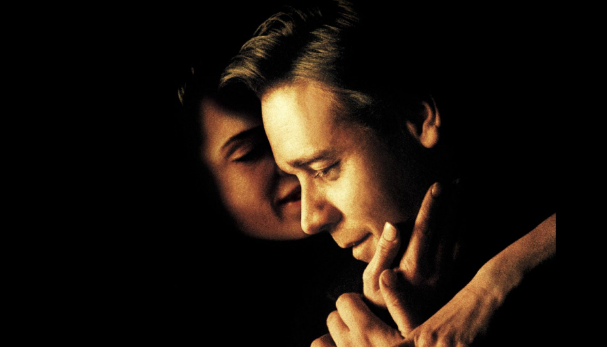
1. A Beautiful Mind (’01), which is well-acted (loved Russell Crowe‘s oddball John Nash) and emotionally satisfying (the pens scene) with a magnificent James Horner score; 2. Apollo 13 (’95) — a decently written, completely satisfying situational thriller within a bureaucratic framework; 3. The Paper (’94) — a big-time journalism movie that finessed several plot threads and delivered first-rate performances, and was reasonably engaging for the most part — a not-great but entirely decent effort; 4. Cinderella Man (’05) — a totally solid ’30s boxing drama (David Poland called it “Fistbiscuit“) with excellent performances from Russell Crowe and Paul Giamatti; and 5. Parenthood (’89) — a well finessed, nicely-written, emotionally centered yuppie family drama with an excellent Steve Martin performance.

How many of the above would I be interested in re-watching? All except Cinderella Man.

Pretty good, not bad, mezzo-mezzo or somewhat minor Howard: Frost/Nixon (’03), Splash (’84), Cocoon (’85), Night Shift (’82), Gung Ho (’86), The Dilemma (’11), Rush (’13).

Meh, not-so-good, irritating Howard: Far and Away, Willow, The Missing, The Da Vinci Code, In the Heart of the Sea, How the Grinch Stole Christmas, Ransom, Backdraft.

Didn’t see ’em, probably never will: Angels & Demons, Inferno, EDtv.