Schlumpy Ballgame

While promoting Bombshell: The Hedy Lamarr Story yesterday, Susan Sarandon explained the Hollywood casting basics. “In my business it’s all about your sexual currency,” she said. “People hire women they want to be with and men they want to be, and anyone who falls in between is a character actor.”

What Sarandon didn’t acknowledge (and this is not new for HE regulars) is that sexual currency standards have significantly changed over the last decade or so, and that the principal change-agent in this shifting landscape has been Judd Apatow. Producers and directors will always “hire women they want to be with,” but the guys they want to be used to be traditional or at least semi-traditional leading-man types, and now (and roughly since Apatow’s The 40 Year-Old Virgin) they’re not.

Here’s how I put it on 8.15.14: “Guys who got the girl used to look like guys who got the girl. And girls who attracted a lot of guys used to look like girls who attracted a lot of guys. But no longer. By today’s standards any homely, marginal, bearded or overfed guy or girl can hook up with good-looking types and nobody bats an eyelash.

“Blubbery Seth Rogen getting lucky with and impregnating Katherine Heigl in Knocked Up…uh-huh. Rogen married to and boinking Rose Byrne every which way in Neighbors…if you say so. Mark Duplass making sensitive-guy moves on Melissa McCarthy in Tammy…really? The bulky, nearly bald Steve Zissis connecting with Amanda Peet on HBO’s Togetherness…right. Anne Hathaway being sufficiently taken with Rafe Spall to move in with him in One Day…remarkable. The obviously desirable Anna Kendrick and Keira Knightley finding dweeby twee-male Mark Webber attractive and beddable in Lynn Shelton‘s Laggies and Joe Swanberg‘s Happy Christmas…huh?”

“In short, Apatow’s rules of attraction have been sinking in for years and we’re all buying it.
Read more

Grainstorm Horror?

Nothing makes my blood run colder than to read the words “much richer grain textures” in a DVD Beaver Bluray review. But that’s what it says in Gary W. Tooze‘s assessment of Criterion’s forthcoming Bluray (4.17) of Leo McCarey‘s The Awful Truth.

That’s pretty damn close to Tooze’s assessment of Criterion’s His Girl Friday Bluray (“it has more, and consistent, grain”), and I’ve learned through hard experience what this actually means. Tooze also reports that the Awful Truth Bluray “looks wonderfully film-like“…good God.


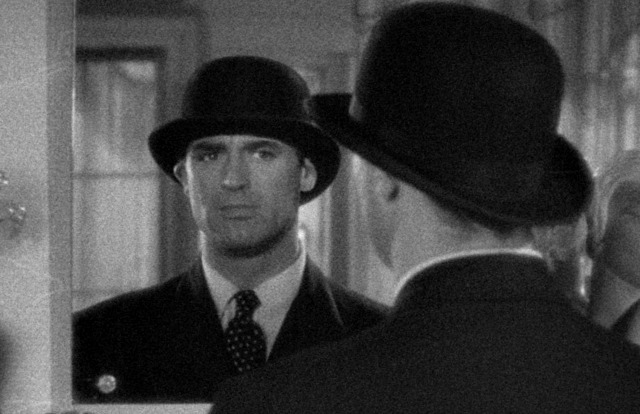
CU of DVD Beaver frame capture of Criterion’s Awful Truth Bluray, streeting on 4.17.18

I bought Criterion’s His Girl Friday Bluray and discovered that it’s “completely smothered in digital grain mosquitos,” as I said in a 1.13.17 review. “I kept thinking to myself ‘poor Ralph Bellamy, playing that poor dope from Albany and having to sit there and suffer as those billions of mosquitoes crawl all over his head and neck and hair, not to mention Cary Grant and Rosalind Russell and all the rest besieged by the same swarm.”

This plus the DVD Beaver screen captures of the Awful Truth disc show that this 1937 screwball classic has been grainstormed to a fare-thee-well.

I’ve said it 10,000 times, but I don’t like heavy grain. No one does except for grain monks (i.e., perverse aficionados) like Tooze. Call me a plebian but I prefer my older black-and-white films to be tastefully DNR’ed — I want them to look as sharp, clean, unfiltered and un-muddied as possible, and that means no swarms of Egyptian mosquitoes covering each and every frame.


Ditto.

Now Would Be Perfect

Right now (i.e., the post-Oscar season blahs) would be a great time for A24 to release Paul Schrader‘s First Reformed, which everyone went nuts for six months ago. March, April and May films have always lacked nutritional value; it would be wonderful to settle into Schrader’s best film in years right now. Alas, First Reformed won’t open until 6.22.

From my 9.1.17 review: “First Reformed, a spare, Bresson-like, thoroughly gripping piece about despair, environmental ruin, moral absolutism and sexual-emotional redemption, is completely rational and meditative and yet half crazy. But in a good way.

“On top of which it’s been shot in a 1.66:1 aspect ratio, which itself is cause for modest celebration.

“I can’t over-emphasize how amazing it feels to watch a fully felt, disciplined, wellordered film by a brilliant guy who had seemingly lost his way or gone into eclipse, only to be startled when he leaps out from behind the curtain and says ‘Hah…I never left!’

First Reformed is so Schraderian, so moralistic in almost a Travis Bickle kind of way, so tortured and yet fully engrossing. Everyone has been calling it Taxi Driver meets Diary of a Country Priest with a little Hardcore and Rolling Thunder thrown in.

“Set in upstate New York, it’s Reverent Toller (Ethan Hawke), an ex-military chaplain turned small-town minister, who gradually succumbs to the idea — don’t laugh or recoil — of moral absolutism by way of becoming a suicide bomber.

Read more

Fat Man and Rocket Man

One reason that North Korean dictator Kim Jong-un is okay with meeting President Donald Trump next May, I suspect, is that they’re peas in a pod — a pair of overweight, cult-of-personality authoritarians who have reflexively turned to bluster when challenged — and that a certain form of blowhard-to-blowhard, asshole-to-asshole, takes-one-to-know-one communication will probably kick in.

That’s probably the instinctual motive on both sides, come to think of it.

What may result is another matter. There’s ample cause for skepticism. A 3.9 N.Y. Times analysis piece by Max Fischer (“7 Big Things to Understand About Trump’s Talks With North Korea”) covers most of the bases.

Korea-watcher Jeffrey Lewis c/o Middlebury Institute of International Studies: “Kim is not inviting Trump so that he can surrender North Korea’s weapons. He’s inviting Trump to demonstrate that his investment in nuclear and missile capabilities has forced the United States to treat him as an equal.”

From a 3.9 Economist piece, “The Pros and Cons of a Summit Between Donald Trump and Kim Jong Un”:

“Skeptics are also right to fear that Mr Trump — a man who boasts about his television ratings, and who is bored by briefings and scornful of foreign alliances — could end up being played like a gold-plated violin.

“There is nothing new about a North Korean despot proposing a meeting with an American president, or expressing warm words about denuclearization in return for security guarantees, by which the Kim regime usually means the withdrawal of American troops from the Korean peninsula and the breaking of treaty alliances with South Korea and Japan.”

Read more

Avoidance Instinct

I wouldn’t see Nash Edgerton‘s Gringo with a knife at my back, no offense, and I’m starting to think I might be better off not seeing Ava DuVernay‘s A Wrinkle in Time. This adaptation of Madeleine L’Engle’s Y.A. fable smelled like trouble months ago. I’ve written that I “missed” my only chance to attend a Wrinkle screening last week, but the truth is that I was terrified of submitting to it and so I decided (with some domestic pressure) to attend J.J. Abrams‘ Oscar Wilde party instead. No regrets.

King of Drain

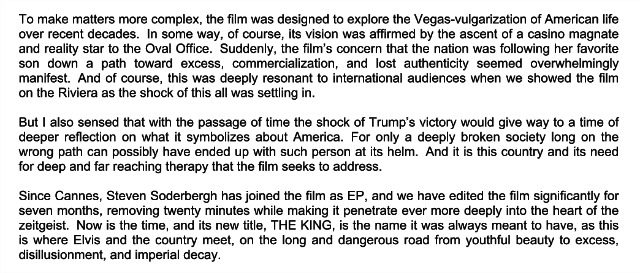
The night before last I caught the “Sundance cut” of Eugene Jarecki‘s The King, which is 20 minutes shorter than the version that played last May in Cannes as Promised Land. It’s much more than just an Elvis doc. I was pretty close to knocked out — touched and shaken to the depths of whatever — and I’ll eat my black Kenneth Cole desert boots if it doesn’t become a Best Feature Documentary nominee next January. It’s that good, that bell-ringy, that profound.

Oscilloscope will open it sometime in June.

The country used to be Elvis when he was sexy and slender and now it’s all fat and Donald Trumpy. Or Elvis was eaten by the spirit of Trump or something like that.

The message partly overlaps with that George Carlin rant: “This country was nice when we stole it…looked pretty good, pristine, paradise. Have you seen it lately? Have you taken a good look lately? It’s fucking embarassing. Only a nation of unenlightened half-wits could have taken this beautiful place and turned it into what it is today…a shopping mall, a big fucking shopping mall.”


13 year-old country blues singer Emi Sunshine, who takes a ride in Elvis’s silver Rolls Royce and sings some tunes in Jarecki’s doc, and Mr. Jarecki himself — Tuesday, 3.6, following screening at UTA.

The King is a sad portrait of the way this country used to be and what it no longer is, and how the American experience has turned sour and cynical and corporate, and how our collective journey of the last 60 or 65 years mirrors that of the surly sad sack known as Elvis Presley.

The metaphor of Elvis-as-America and vice versa…a young white guy who became the king of rock ‘n’ roll in the mid ’50s with a blend of jumpy black blues and rockabilly but who never marched or spoke out for civil rights, and how he began to sell out and downswirl as the ’60s began and sank into the straightjacket of Las Vegas and drug addiction by the early ’70s, and ended up dead on a bathroom floor in August ’77. And here we are right now on the bathroom floor with Trump, because our unenlightened half-wit journey is all about despair and opioids and pushing back against the multiculturals, etc.

The King ends with one of the greatest cultural-political montages I’ve seen in a long time, a portrait of America’s ruined soulscape as we listen to fat Elvis sing “Unchained Melody” from a Vegas showroom…for this sequence alone it’ll be Oscar-nominated.

Read more

John Hughes’ Howl

John Hughes and Nick Castle‘s Dennis The Menace (’93) wasn’t much but the bathroom-torture scene [below] was laugh-out-loud when I saw it at an all-media screening, and it just made me laugh again. The key moment comes at 2:01, when Walter Matthau‘s Mr. Wilson drinks the reconstituted mouthwash, and then, at 2:37, squeezes the spiked nasal spray into his nostrils. And he howls and dunks his head, etc.

The brilliant stroke comes a split second later with a wide shot of Wilson’s home, and you hear him howl again as a neighborhood dog does the same. Right at that instant the movie is saying to the audience, “We don’t care about this cranky old man in his new striped pajamas…all we want to do is fuck with this guy and make fun of his pain…listen to him!” Somehow the cruelty of this attitude, obviously embraced by Hughes and Castle, translates into funny.

Read more

On A Day of Celebration

2018 is delivering a cinematic boost to the legend of Supreme Court Justice Ruth Bader Ginsburg, first with Betsy West and Julie Cohen‘s RBG (Magnolia, 5.4) and then Mimi Leder‘s On The Basis of Sex (Focus Features, fall), a biographical drama about Ginsburg (Felicity Jones) and judicial career and her late husband Martin Ginsburg (Armie Hammer).

“Witch. Monster. Evil-doer. Zombie. In RBG, a survey of Supreme Court Justice Ruth Bader Ginsburg’s impact on American law, documentary co-directors Julie Cohen and Betsy West open with a montage of insults endured by the 84-year-old judge.

“Audiences for this peppy portrait will dissent. To young fans who’ve slapped Ginsburg’s face on T-shirts, coffee mugs and a million memes, she’s a hero, icon, and rebel, the queen of the judicial branch better known for Kate McKinnon’s Saturday Night Live impersonation than her hard-fought feminist victories.

Read more

Murmur Of The Heart

I happened to listen to the Russian National Anthem a couple of times during the recent Winter Olympics, and for whatever reason I found myself kind of melting into it. It got me, and got me again. Very full-hearted and whatnot. Obviously I’m influenced by being married to a passionate Russian, but only, I think, in the sense of being willing to really listen to it. Which I wasn’t before, largely due to the usual circumspect attitudes about crazy, vodka-drinking Russians blah blah. Plus I like the melody and the lyrics more than Francis Scott Key‘s “The Star Spangled Banner,” which is basically about perseverance during an arduous military battle and is hard to sing besides. Listening to the Russian anthem is like being hugged.

Read more

Amusing Stalin Falls Short of Hah-Hah Funny

I’ve been missing screenings of Armando Ianucci‘s The Death of Stalin (IFC Films, 3.9) for the last six months, but I finally saw it last night. I’ve no argument with the critics who are doing handstands and cartwheels except for the fact that it’s more LQTM funny than the laugh-out-loud kind. There’s nothing wrong with LQTM humor, which I’ve also described as no-laugh funny — you just have to get past the idea of expecting to go “hah-hah, ho-ho, hee-hee” because that never happens.

Iannucci’s script is about top-tier, real-life Communist scumbags (Nikita Khrushchev, Georgy Malenkov, Lavrentiy Beria, Georgy Zhukov, Vyacheslav Molotov, Svetlana Stalina) scrambling for position and power in the wake of Joseph Stalin‘s death in March 1953. It’s based on Fabien Nury and Thierry Robin‘s graphic novel “The Death Of Stalin.”

Last August I wrote “who cares what a demimonde of paranoid Russian assholes were up to 64 years ago, stabbing each other in the back and shooting innocent suspects and whatnot?” Now that I’ve seen this 107-minute film, the answer is “you can’t care…you can’t care about anyone.” But you don’t hate anyone either because of the comic attitude or…you know, that sprinkled pixie-dust feeling that all would-be comedies have.

The idea is to generate humor in the midst of political terror and random bullets in the head, and I have to say that the two elements don’t mix all that well. At best, The Death of Stalin is occasionally heh-heh funny. But I’m being sincere in insisting how smart and fleet this thing is. All the way through I was telling myself “I like this” and “this is fast and crafty as shit” so not laughing didn’t bother me very much. Well, I guess I would have had a bit more fun if it was “hah-hah” funny but I understand the concept of comedies that are only supposed to make you smirk and chortle, if that.

I have to say two other things that may not sound like recommendations, but they’re not huge problems. One, The Death of Stalin doesn’t really find its comic footing in the beginning. I was saying to myself “Jesus, this isn’t even LQTM” but that’s only for the first…oh, eight or ten minutes. And two, it doesn’t really have what you might call a climax or a third-act crescendo. The Death of Stalin lasts 107 minutes, but when it came to an abrupt end I said to myself “wait…they’re ending it with the brutal execution of Beria and the ascension of Khrushchev and….that’s it?”

Read more

Rap Their Knuckles

I should have mentioned this yesterday, but the decision by Oscar telecast producers Mike DeLuca and Jennifer Todd to omit Oscar-winner Dorothy Malone from the death reel was a stunner. Malone was iconic in the ’50s and ’60s — what were they thinking? Even if she hadn’t won a Best Supporting Actress Oscar for her performance as a sexual compulsive in Douglas Sirk‘s Written on the Wind (’57), Malone’s book-store scene with Humphrey Bogart in The Big Sleep (’46) would have more than sufficed.

These plus her performances in Sirk’s The Tarnished Angels (’57), Andrew Stone‘s The Last Voyage, Robert Aldrich‘s The Last Sunset (’61) and her Constance MacKenzie character on ABC’s Peyton Place series from ’64 to ’69….c’mon.

Why are some Hollywood luminaries included in the death reel and others ignored? The process seems haphazard and arbitrary.

Deluca and Todd could have made up this year for excluding Bill Paxton (who passed on 2.25.17) in last year’s death reel, but naahhh.

They also blew off Powers Boothe, Adam West, Glen Campbell, Robert Guillaume, David Cassidy, Fats Domino (although they included Chuck Berry), Hugh Hefner and Jim Nabors.

They included Jeanne Moreau but without a dialogue clip or brief image montage. On both sides of the Atlantic Moreau was a thriving legend in the ’50s, ’60s and early ’70s. Orson Welles (yeah, I know…who?) once called her “the greatest actress in the world,” and her sepia-toned image appeared for less than two effing seconds?

Read more

Bloody, Bothered and Necessary

My first profoundly negative response to the physical and spiritual being known as Joaquin Phoenix happened three and a half years ago, during a New York Film Festival screening of Paul Thomas Anderson‘s Inherent Vice (’14). I decided right away that his (or more precisely author ThomasPynchon‘s) Larry “Doc” Sportello, a mutton-chopped, sandal-wearing private detective, was mostly a lazy collection of slumbering mannerisms — slurry speech, lackadaisical manner, etc.

Then came Phoenix’s pot-bellied New England professor in Woody Allen‘s Irrational Man (’15) and again I said to myself, “I don’t like this guy…this is another Phoenix-playing-Phoenix performance…do I really have to hang with him?”

And then in Garth Davis‘s Mary Magdelene, Pheonix played the first graybeard, seen-better-days Jesus in motion picture history — a Nazarene who looks at least 47 or 48 years old, or roughly 15 years older than the Real McCoy was when he died on Calvary — and again I went “Oh, Jesus effing Christ…here we go again.”

So it really means something when I say that Phoenix’s sullen, barely verbal performance as a graybeard dadbod in Lynne Ramsay‘s You Were Never Really Here (Amazon, 4.6) didn’t bother me that much. Because the film is so good.

You Were Never Really Here wasn’t just the strongest film I saw in Park City — half narrative, half fever-dream — but the first intensely distinctive, high-style art film to open in 2018.

Read more