

Missing this wasn’t my intention. I tried like hell. Schedule another screening between now and next Friday and I’m there.
Old Guy vs. Hipster Tuxedo Pants
Prior to last night’s screening of Chris Nolan’s “unrestored” 2001: A Space Odyssey, Nolan was joined on the stage of the Salle Debussy by costar Keir Dullea, longtime Kubrick producer Jan Harlan and Cannes Film Festival topper Thierry Fremaux. The below photo is of (l. to r.) the tuxedo pants of Dullea, Harlan, Katharina Kubrick and finally Fremaux’s. Notice how Fremaux’s slimly tailored tuxedo pants are the only ones that look hip, and how Dullea and Harlan’s are baggy and blowsy with the cuffs bunched at the cuff — the way tuxedo pants were styled 20 years ago and before. I myself wouldn’t be caught dead in tuxedo pants that look like Dullea’s and Harlan’s, but that’s me. Some people don’t care about this stuff, but you have to care.

Lee’s “Klansman” Busts Trump Like A Bitch

Spike Lee‘s BlacKkKlansman (Focus Features, 8.19) isn’t a great film, but it’s his strongest since Inside Man (’06) and before that The 25th Hour (’01), and easily his most impassioned, hard-hitting film about the racial state of things in the U.S. of A. since Malcom X (’92).
You can feel the fire and rage in Lee’s veins in more than a few scenes, and especially during the last five minutes when Lee recalls the venality of 2017’s “Unite the Right” really in Charlottesville, which ended with the death of protestor Heather Meyer, and reminds that Donald Trump showed who and what he is with his non-judgmental assessment of the KKK-minded demonstrators. Lee paints Trump with the racist brush that he completely deserves, and it makes for a seriously pumped-up finale.

But that doesn’t change the fact that BlacKkKlansman is basically a police undercover caper film, based on Ron Stallworth’s 2014 novel (“Black Klansman: Race, Hate, and the Undercover Investigation of a Lifetime”).
Nor the fact that tonally it sometimes feels like Starsky and Hutch or even to some extent like John Badham‘s Stakeout, especially as it involves the main cop protagonist falling in love with a girl (in this case an Afro’ed black activist played by Laura Harrier) who shouldn’t know what he’s up to, but whom he eventually confesses to. In this sense John David Washington‘s Stallworth is Richard Dreyfuss in the Badham film, and Adam Driver (as partner Flip Zimmerman) is Emilio Estevez.
At times the film also reminds you of some Clarence Williams III scenes from The Mod Squad.
Set in 1972, pic isn’t literally about Stallworth joining the Ku Klux Klan but a stealthy undercover investigation of the Klan, initiated when he was the first black detective in the history of the Colorado Springs Police Department.
After initial correspondence with the Klan, Stallworth received a call in which he was asked if he wants to “join our cause.” Stallworth answered affirmatively, and in so doing launched an audacious, fraught-with-peril inquiry.
SPOILER-ISH BUT NOT REALLY: Right away you’re telling yourself, “Yes, I know this actually happened and that Lee is using the facts in Stallworth’s book, but it made no sense for Fallworth to be heavily involved in this operation.” And it just feels crazy as you’re watching one crazy incident after another.
Holy Innocent
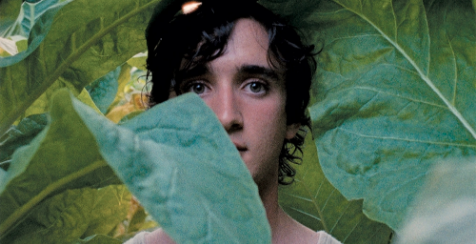
Alice Rohrwacher‘s Happy as Lazzaro, which I saw this morning at the Salle Du Soixantieme, may win the Cannes Film Festival’s Palme d’Or next weekend. It’ll almost certainly win something big as it’s quite the spiritual film, and it delivers the kind of humanist current that can lift all boats.
In this stand-up-for-women moment on the Cote d’Azur, the deciding factor, I suspect, may simply be one of gender. I’m not saying Happy as Lazzaro is a woman’s film — the spiritual current is universal and gender-less — but it’s very much a “heart” film, and I’m sensing that this plus a “let’s give the big prize to a woman director if we can” factor will penetrate.
Set sometime in the late ’80s, Rohrwacher’s third film is about a late-teen or twentysomething farmworker named Lazzaro (Adriano Tardiolo), who at first resembles a cross between a pure-of-heart innocent or, if you want to brusque about it, a seemingly charmed simpleton. But that impression changes as the film develops, especially during the second half.
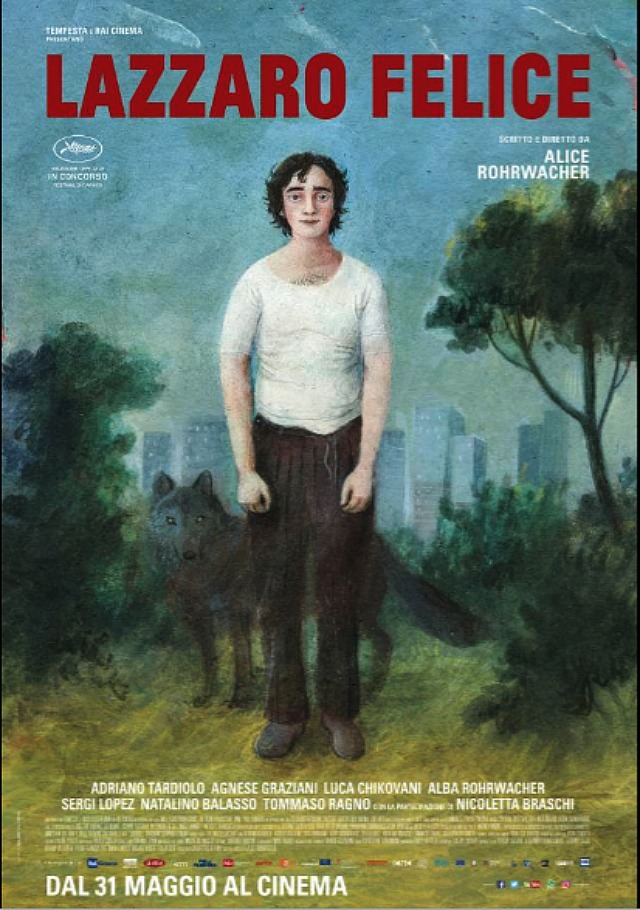
While Happy as Lazarro takes place in two distinctly different realms, they share a tone of exploitive cruelty and a look at the harsh plight of the hurting poor — a rural and almost medieval tobacco farm in central Italy in the first half and a large Italian city in the second half.
The dividing line between the two is a startling event that happens halfway through, and after this the true scheme of Happy as Lazzaro kicks in.
For this is basically the story of a kind of saint who refuses to respond with even a trace of guile or calculation. Lazzaro is very much a lamb-like (or donkey-like if you consider his resemblance to the Christ-like beast in Bresson’s Au Hasard, Balthazar) figure of faith and trust, and the resulting current of kindness and compassion becomes more and more affecting.
Happy as Lazzaro is my second favorite film of the festival so far, second only to Pawel Pawlikowski‘s Cold War. It’s quite the mixture of fabulism and a certain kind of grim, social-critique drama, shot in 16mm with a hand-held, rounded-edges aesthetic.
I’m not saying Rohrwacher is copying anyone, but I felt the influence of the Taviani brothers‘ Padre Padrone and Bernardo Bertolucci‘s 1900 in the first half, and then a whole different kettle of fish (urban poverty) in the second half. But it’s always about purity vs. venality and indifference, and it’s really quite magical.
Among the costars are Alba Rohrwacher (the director’s older sister) and Spanish actor Sergi Lopez (Pan’s Labyrinth), whom I didn’t even recognize at first.
The rural portion (i.e., the first half) was shot in Bagnoregio, a small commune in the Lazio section of Italy.
I have to leave for a screening of Spike Lee‘s BlacKkKlansman, but there’s something very special, trust me, about Happy as Lazzaro.


As Expected, Nolan’s “2001” Didn’t Cut It

It was wonderful to see the half-century-old 2001: A Space Odyssey tonight at the Salle Debussy, and under such regal circumstances with such sterling company (Chris Nolan, Keir Dullea, Jan Harlan, Suzanne Fritz of Warner Bros. publicity) and with several high-perspective, hail-fellow-well-met critics in attendance — Owen Gleiberman, Peter Howell, etc.
But the film lacked the required needle-sharp detail (which is definitely there in the photographic elements) and it suffered from overly dark images with slightly muddy textures, not to mention that teal-blue sky when Moonwatcher smashes the bones and that gray face of Dave Bowman behind the space-helmet visor during the French chateau sequence at the very end. It proved once again that the myth of 70mm projection being the ultimate visual experience in a theatre is just that — a myth.
What we saw tonight was fine if you weren’t being too demanding, but it didn’t deliver anything close to the crisp detail and clarity of the 2007 Bluray version, and don’t even talk about the forthcoming 2001 4K Bluray, which will almost certainly blow everyone away.
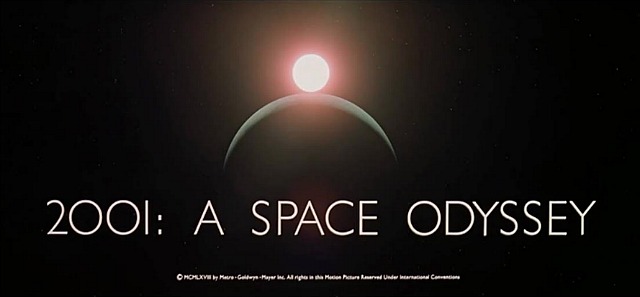
Chris Nolan wanted us to experience the 2001 he fell in love with when he saw it at age 7 or 8 with his father in Leicester Square, and which he seems to truly believe is still the greatest way to experience Stanley Kubrick‘s epic. But digital technology has bypassed 70mm for the most part, and I’m sorry but 70mm photography and projection just isn’t the cat’s meow any more. It hasn’t been for some time. The 70mm myth has to be recognized for what it is — a dream, a notion that no longer applies, a celluloid nostalgia trip.
The absolute infinite blackness of space and the visual punctuation of each and every little star look wonderful, on the other hand. And the well-amplified digital sound, pumped by the Salle Debussy’s superb sound system, was great. And I loved that old 1968 first-run program that they reprinted and handed out tonight.
6:50 am Cannes update: The usual tut-tutters and harumphers commented that I’m still failing to understand the difference between quality-level 70mm celluloid projection vs. 1080p Bluray resolution on a 65-inch 4K HDR monitor. “Nice bullshit qualifying,” I replied. “You’re basically saying that Nolan’s 70mm celluloid 2001 can’t look as breathtakingly sharp or clean as the 2007 Bluray, but it’s better nonetheless. I’ve been watching films my entire life, and my eyes know when they’re truly satisfied and when they’re not, and I’m sorry if this displeases the 70mm purist crowd but my eyes want what they want. In my book, a little tasteful grain-scrubbing is a VERY good thing. The 2007 Bluray is perfect.”
Noe Over Nolan
After reading the mostly-non-negative reviews of Gaspar Noe‘s Climax, a Director’s Fortnight film which is screening at the Theatre du Croisette at 6:15 pm, I’ve decided to see it instead of the Chris Nolan-endorsed, non-restored version of 2001: A Space Odyssey, which begins at 6:45 pm at the Salle Debussy. It feels tepid and timid to choose a film I’ve seen 15 or 20 times over something new, provocative, challenging, etc.
What if I arrive at the Theatre du Croisette and come upon a line that is way, way too long to offer any hope of getting in? I’ll bail on the Noe, run down the Croisette to see the Nolan, and try to see the Noe tomorrow (it’s screening at two venues but probably without English subtitles).
5:20 pm update: The Noe line is long and winding and bordering on ridiculous, and I’m at the end of it. Where’s the cutoff point? At best I’ll snag a shitty seat in the balcony with my legs turning numb from a lack of blood circulation. I’m sticking with the Noe but with trepidation. At least I know I’ll get a decent seat for the Nolan because of my semi-elite press pass.
6:15pm: We didn’t make it. No room at the inn. After waiting and hoping for 70 minutes. So we speed-walked over to the Salle Debussy and caught Chris Nolan’s 2001.
What Manner of Hell?
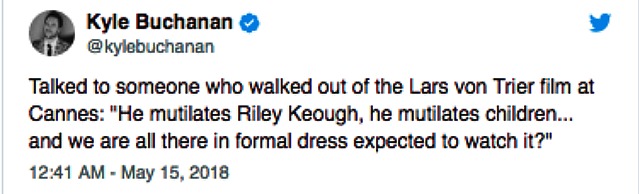
Terrific — we all get to sit through some horrific fantasia courtesy of Danish provocateur Lars von Trier. The film is about a serial killer (Matt Dillon) honing his brutal art. What’s the Cannes Film Festival history regarding explicit warnings of this sort? These are posted on (a) a hard ticket for Tuesday (5.15) morning’s screening and (b) an official Cannes screening schedule:





Elbowed Aside, Twice
Early this afternoon I caught a first-rate, highly recommended Ingmar Bergman doc, A Year In A Life, inside the Salle Bunuel. My plan was to emerge at 3:30 pm and step right into a pink-with-yellow-dot line for the 4 pm Chris Nolan discussion, set for the same venue.
Fuhgedaboudit. The outer lobby was mobbed, wall-to-wall bodies, limited oxygen. Access to the pink-with-yellow-dot line was blocked off, and a security guy told me to head downstairs. I flashed my pass and said, “But I’m here for the Nolan thing, and I’m a pink–with–yellow–dot press guy, which is almost as good as a white pass. Why can’t I just join the other semi-elites and wait in line?”
Sorry but you’re too late, there are too many others waiting, you’re not getting in, etc.
So I went back to the pad to write, read and fold laundry until it was time to line up for my next film, Thunder Road, which was market-screening on rue Meynardier at 8:30. But I got caught up in writing about 2001 and when I arrived at 7:50 pm, I was again told “sorry, you’re too late, line’s too long, you shoulda been here at 7 pm,” etc.
So I’m a free man in Paris tonight. I’m thinking of attending a Cinema de Le Plage screening of Jerzy Skolimowski‘s Le Depart (’67) with Jean–Pierre Leaud. It starts at 9:30 pm, which is when it starts to get dark here.
Midnight update: Le Depart is the worst Skolimowski film I’ve ever seen. Make that the only bad one. It’s a brisk mood comedy of all things. Jean-Pierre Leaud‘s acting could be so grating when he put his mind to it — his performance here is worse than his obnoxious filmmaker boyfriend of Maria Schneider in Last Tango in Paris, and that’s saying something.
Skolimowsky himself introduced Le Depart. “I made this film when I was very young,” he said, “and apparently it’s still watchable.”