Lady Bird is real-deal naturalism, a kind of 400 Blows-level vision of mother-daughter sturm und drang. Unfettered American heartland realism, no bullshit, perfectly performed, edgy but open-hearted, unsullied by magical realism, no script problems to speak of, and beautifully shot with blue-ish, stressed, film-like colors.
Why are you undecided, Academy? Is this or this is not The Year of the Woman? This is your default, your compromise, the movie you’ll proudly stand by five or 20 years hence. A little local movie that is actually “big” in a kind of Delbert MannMarty sense — a movie that tells the truth, owns its own turf, doesn’t play games.
The article’s implication was that Tarantino had strong-armed Thurman into performing an unsafe driving stunt and thereby caused her much grief and pain. Except it wasn’t that simple, Tarantino explains in the transcript. He made a mistake, he says, by reversing the direction of the shot but without test-driving it himself. He knew Thurman “was a shaky driver, but she had a license,” he says. The stunt was “a little thing” but he fucked up all the same. Ever since, he says, he’s been upset and sorry that he allowed it to happen.
“Watching [Uma] fight for the wheel…remembering me hammering about how it was safe and she could do it. Emphasizing that it was a straight road, a straight road…the fact that she believed me, and I literally watched this little S curve pop up. And it spins her like a top. It was heartbreaking. Beyond one of the biggest regrets of my career, it is one of the biggest regrets of my life. For a myriad of reasons.
“It affected me and Uma for the next two to three years. It wasn’t like we didn’t talk. But a trust was broken. A trust broken over a year of shooting, of us doing really gnarly stuff. Doing really big stunt stuff. I wanted her to do as much as possible and we were trying to take care of her and we pulled it off. She didn’t get hurt. And then the last four days, in what we thought would be a simple driving shot, almost kills her.
A friend who’s seen Clint Eastwood‘s The 15:17 to Paris (Warner Bros., 2.9) says it’s nothing to write home about. A brief episode inflated into an okay but no-great-shakes 94-minute film. Padding, back-story and whatnot. Starring the real-life Thalys train hero guys — Anthony Sadler, Alek Skarlatos and Spencer Stone, and costarring Judy Greer and Jenna Fischer.
The all-media screening is on Wednesday night, at more or less the same time as Universal’s Fifty Shades Freed screening.
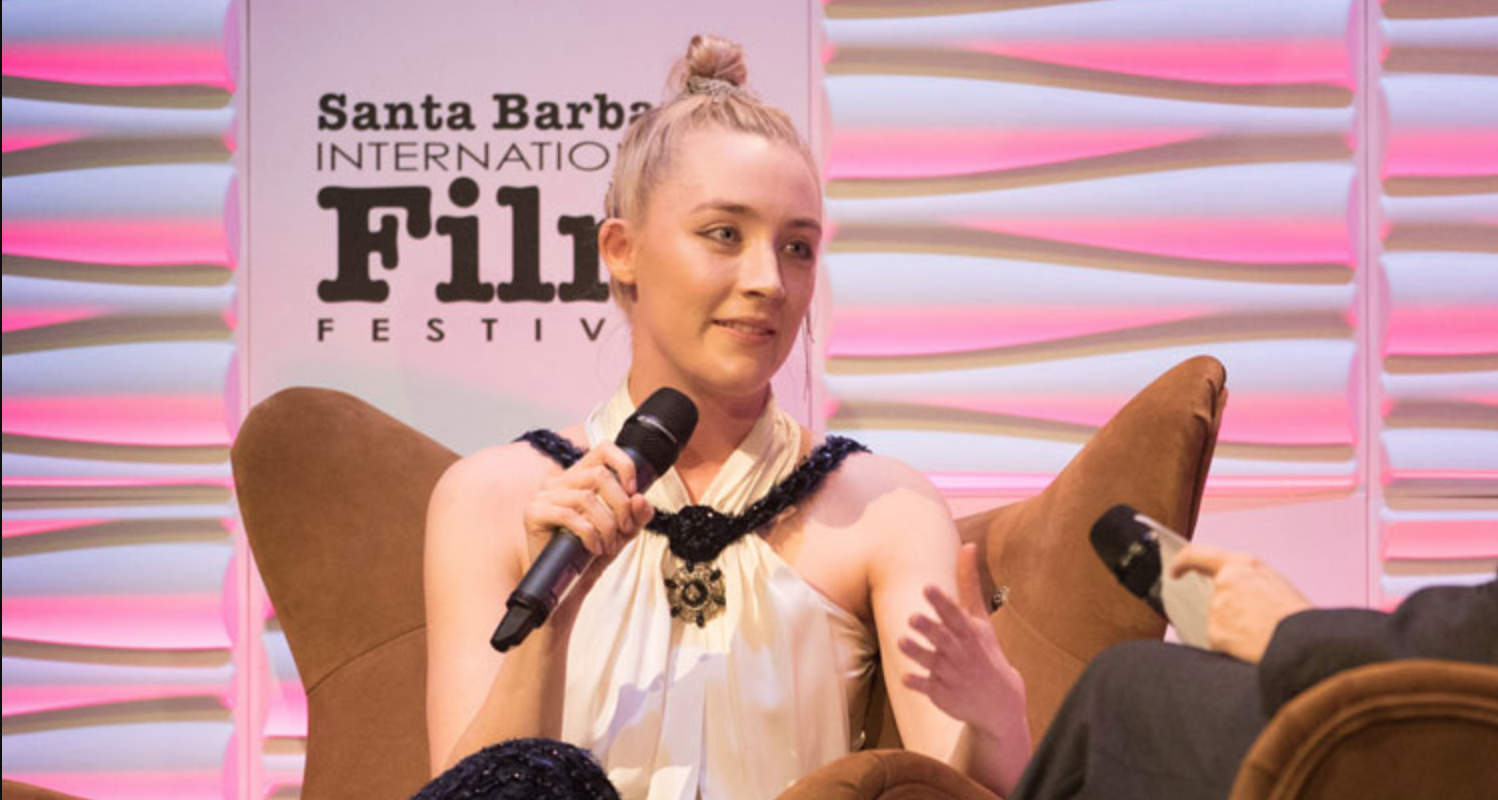
23 year-old Saoirse Ronan, who was honored last night at the Santa Barbara Film Festival but is also unjustly destined to lose the Best Actress Oscar to Three Billboards‘ star Frances McDormand, is at the top of her game right now. She’s obviously got it, and is certain to fortify her Streep-like portfolio by leaps and bounds over the coming decades. Everyone at the Arlington theatre, including moderator Anne Thompson, was thinking this last night.
But for all her intensity and brilliance Ronan has chosen to star or costar in more than a few iffy films over the last decade, and when you get right down to it she’s scored big-time in a stellar, triple-A, bull’s-eye fashion only twice — as the titular character in Greta Gerwig‘s Lady Bird and as Eilis Lacey in Brooklyn (’15).
She made a brilliant debut at age 13 in Joe Wright‘s Atonement (’07), playing a nearly demonic provocateur, and she acted the blazes out of her Susie Salmon role in Peter Jackson‘s The Lovely Bones, but the film was too Jackson-y and CG’ed to death. And she was completely delightful in Wes Anderson‘s The Grand Budapest Hotel (’14). And that’s as far as it’s gone so far.
Ronan has three films due for 2018 release, but the only one of real consequence will be Josie Rourke‘s Mary, Queen of Scots, which Focus will release on 11.2. Reactions to Dominic Cooke‘s On Chesil Beach (Lionsgate, 6.15) have been muted, and her other ’18 release, Michael Mayer‘s The Seagull, was shot in the summer of 2015 — do the math.
“Pete, it’s this kooky preferential ballot…” HE to sane people: For the 47th (or is it the 48th?) time, the three best films of the year are Dunkirk, Call Me By Your Name and Lady Bird. And what about the groundswell movement for Phantom Thread? Will someone please upset the Oscars in some way, shape or form? Could the Price Waterhouse guys arrange for another envelope screw-up?
Jeff Goldblum doing the same thing to his T-Rex pursuer that Steve McQueen did to the two “organization” assassins at the beginning of the San Francisco chase scene in Bullitt. Major market TV ads (Superbowl, Oscar telecast) don’t get much better than this. On the same level as Joe Pytka’s 2005 “I’m Spartacus” Pepsi spot.
“We’re not gonna take it! / No, we ain’t gonna take it! / Oh, we’re not gonna take it anymore!” — anthem of the long-horned steers who rebel against the Westworld owners and engineers in Season 2, which launches on 4.22.18.
From “Westworld Hate Will Continue To Spread,” posted on 12.5.16: “Like many others, I’ve gone totally negative on Westworld over the last three or four episodes. The HBO miniseries finally ended last night, but that doesn’t mean there isn’t a major revolt going on. I hate this series with a passion for just layering on the layers, for plotzing, diddly-fucking, detouring, belly-stabbing, meandering and puzzleboxing to its heart’s content.
With the exception of Michael Bay‘s Pain and Gain, Johnson has demonstrated time and again that he’s fundamentally opposed to appearing in films that are (a) good and (b) at least semi-believable. He makes big, dopey, adolescent cartoons. Jumanji: Welcome to the Jungle was a perfect fit. Originally posted on 12.8.16: “If Dwayne Johnson Is Starring, It’s Probably Empty, Glossy Dogshit.”
He calls himself Han Solo, but his voice, though residing in the deeper registers, has a kind of thin, reedy quality. Don’t tell me this guy is Han Solo because he’s not.
He’s around four inches shorter than Harrison Ford, for one thing. Sure, he’s trying to generate the old cavalier swagger and is half pulling it off, but his eyes are dark and drill-bitty and he’s, well, you know, Jewish. All my life Han Solo has been a tall, WASPy, casual-frat boy-with-an-attitude, but now he’s suddenly a 5′ 9″ Rabbinical student with narrow shoulders, doing his best to give off that devil-may-care and offering a passable substitute, but he’s not Han Solo.
In late 1942 Humphrey Bogart appeared on the screen as Richard Blaine, a sly, cynical, broken-hearted owner of a popular saloon in Casablanca. Forty years later David Soul played the same character in a 1983 one-hour TV series called Casablanca. For some hard-to-fathom reason the series was yanked after only three airings.
My secret hope-of-hopes has been that the top two Oscar prizes would be split — The Shape of Water‘s Guillermo del Toro winning for Best Director but something else winning for Best Picture. Like, for example, Greta Gerwig‘s Lady Bird. Because Lady Bird, at least, is one of HE’s three best films of the year, the other two being Dunkirk and Call Me By Your Name. But my spirit is wilting.
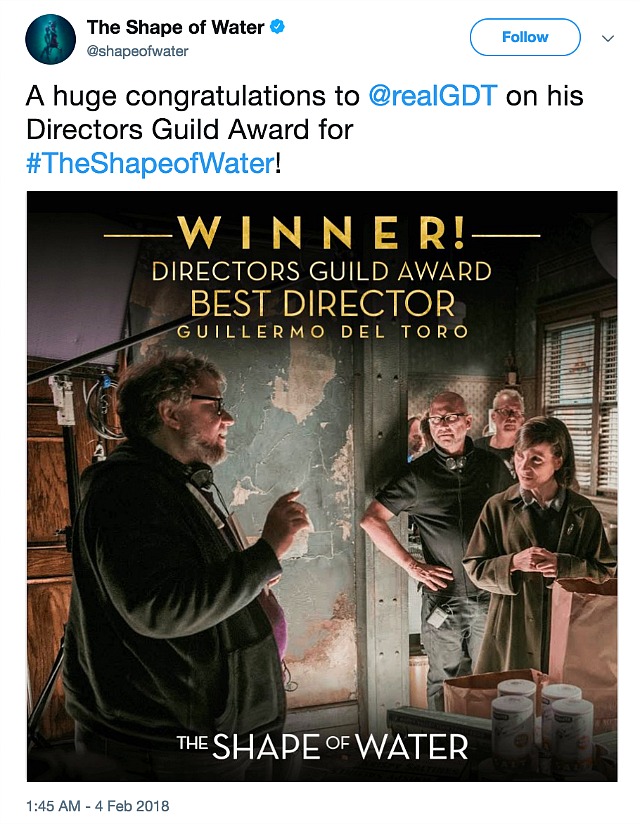
The Best Picture Oscar will probably go to The Shape of Water with Martin McDonagh‘s Three Billboards the principal alternate winner. Last night Del Toro won the Directors Guild of America’s top feature prize; Get Out‘s Jordan Peele won the Best First-Time “Woke” Feature Director trophy (or whatever it’s called).
From Owen Gleiberman’s “Drive, He Said” Variety essay: Quentin Tarantino “certainly needs to address the Kill Bill car scandal in a far more detailed and confessional manner. Because he’s in the murky middle of it, obviously, but also because Tarantino is in a position to shed light on how the vertiginous power dynamics of Hollywood operate, and how they might now change.
“There’s no denying that the car incident didn’t just happen out of ‘negligence.’ It was the result of a recklessness, an arrogance, a so-ingrained-it’s-taken-for-granted pattern of unchecked aggressive male dominion in the film business. Seen against the backdrop of #MeToo, against the pileup of accusations and a landscape that’s shifted, overnight, to a policy of zero tolerance, the Kill Bill incident looks, perhaps, like a second cousin of harassment: the cold exploitation of talent by those who surely knew better.”
“My dream is to retire. That’s not a one-liner; it’s true. To spend every year of your life with the abstraction of making a film, with a crew of 200 people and their passions and their stupid priorities, the pressure of having to deliver, the pressure of spending other people’s money and having to be nasty because you don’t want to give up your integrity? And then to show your film to the world and to have to talk about it and repeat your answer to the same questions again and again…? I used to see making films as a kind of paradise and I now realize it’s kind of a hell, to be honest.” — Luca Guadagnino in the fall/winter 2017 edition of Fantasticman.
I don’t know how many other directors share Guadagnino’s attitude, but he’s one of the very few with the balls to share it in a public forum. He’s said before that he could be happy doing something other than directing. I don’t entirely believe him. Being a hotshot, world-class director opens up so many doors and opportunities, after all. And Gudagnino is one of the few directors I would describe as genuinely happy and even joyful about his life, despite all the alleged negatives.
I say this as one who could never be where Luca is. I see life in terms of struggle and duty and working your fingers to the bone. “I went to sleep dreaming life is beauty / I woke and found that life is duty.”
It all boils down to that Robert E. Lee Pruitt line: “A man should be what he can do.” Whether it makes you happy or not is beside the point. A gift or a special ability has to be nurtured, developed and applied. Failing to do this is not only shameful but tragic.