

On 11.16 Variety mentioned a pull quote from this excerpt from Sarah Silverman‘s “I Love You, America” — “I love Louis, but he did these things.” But I didn’t listen to the whole thing until this morning. Silverman knows. I Love You, America, a talk show, premiered on Hulu on 10.12.17.
Masterful Shift
There are several keeper scenes in Alexander Payne‘s Sideways, but this is the best, I feel, because it really sinks into classic manboy immaturity and a messy emotional collapse.
At first, right after Thomas Haden Church‘s “Jack” tells Paul Giamatti‘s “Miles” that “they” have to return to the home of the plus-sized waitress (Missy Doty) to retrieve his wallet and more particularly the wedding rings, Giamatti is going “naah” and shaking his head and waving it off. But then Church’s pleading and wailing becomes more desperate and adolescent, and at 2:30 Giamatti’s expression suddenly shifts from one of sadness and resignation to astonished pity and compassion.
This is great, world-class, pool-of-human-experience acting, and the great Giamatti wasn’t even Best Actor-nominated that year. The ’04 nominees in this category were Jamie Foxx in Ray (the winner), Don Cheadle in Hotel Rwanda, Johnny Depp in Finding Neverland (c’mon!), Leonardo DiCaprio in The Aviator and Clint Eastwood in Million Dollar Baby.
I remember agonizing over the Giamatti snub, and deducing soon after that he didn’t get nominated because of that first-act scene in which Miles helps himself to some cash out of his mother’s bureau drawer. I actually shared this suspicion with Giamatti at Olio y Limone during the ’05 Santa Barbara Film Festival. I did so out of compassion and a keen resentment of life’s unfairness. He apparently hadn’t considered the stealing-from-mom angle, as it seemed to hit him for the first time: “Damn! Damn!”
Hold Your Tongue
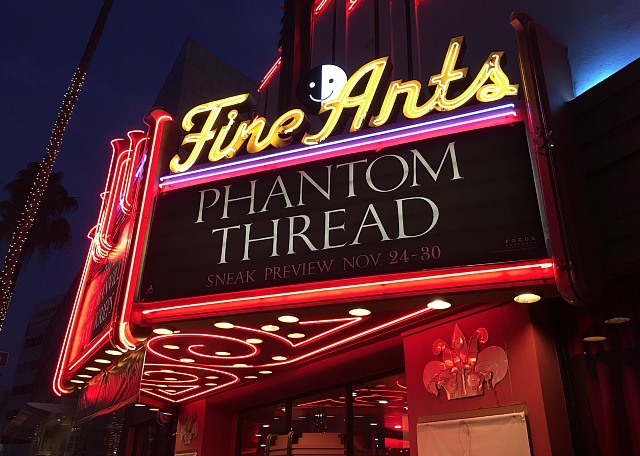
Paul Thomas Anderson‘s Phantom Thread (Focus Features, 12.25) screened this afternoon at Laemmle’s Fine Arts. The show began at 2:03 pm, and was over roughly 95 minutes later. No one’s allowed to say anything until 12.7, but the film was applauded when it ended. The Fine Arts marquee looked spectacular with red-toned Phantom Thread title art on both sides. The post-screening q & a featured Anderson and costars Vicky Krieps and Lesley Manville. A large designer drawing of a 1950s-era gown was hanging in a poster window.
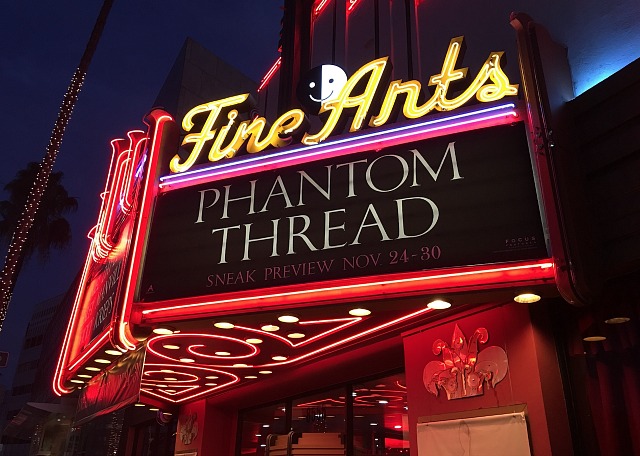
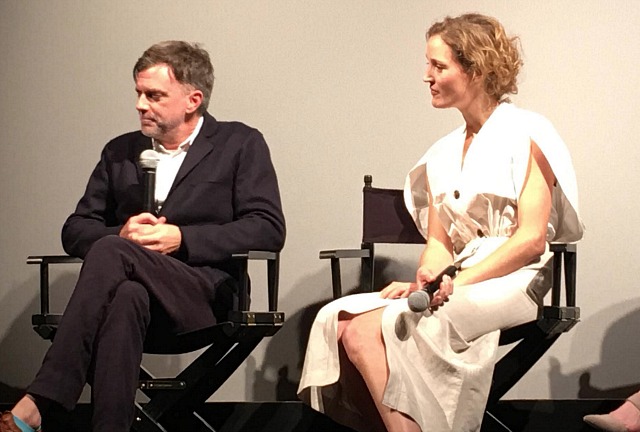
Paul Thomas Anderson, Vicky Krieps.

Krieps, Lesley Manville.
Son of Underground Scene
I wrote yesterday that while some have called Darkest Hour‘s London Underground scene “ridiculous,” in nonetheless works. I called it the most emotionally satisfying scene in the whole film, and the only one that made me sit up in my seat and go “this is probably bullshit from a historical perspective, but it’s connecting.”
Last night Chris Willman wrote in the comment thread that the Underground scene is “horrible…HORRIBLE. Any good will I had for the movie, and it was wavering, evaporated at that point. I don’t understand how it works or connects for anybody. No science fiction or fantasy movie has ever required such a suspension of disbelief from an audience.”
My response, tapped out this morning: “It’s a kind of fantasy sequence but it works all the same. It’s theatrically hokey and perhaps even simple-minded, but it’s (a) shrewdly timed, arriving just before Churchill’s grand climax inside Parliament, and (b) more importantly delivers what we want to hear after listening to cagey, measured expressions of political calculation for 90 or 100 minutes beforehand. It’s a pure-heart, resolve-of-the-people moment (“Never!”). It feels, yes, like a dream sequence, almost in the manner of a Rodgers & Hammerstein interlude. But emphatic emotion is what Darkest Hour needs at this third-act juncture, and as much as you may dislike the calculation, it pays off.”
Behind The Curve?
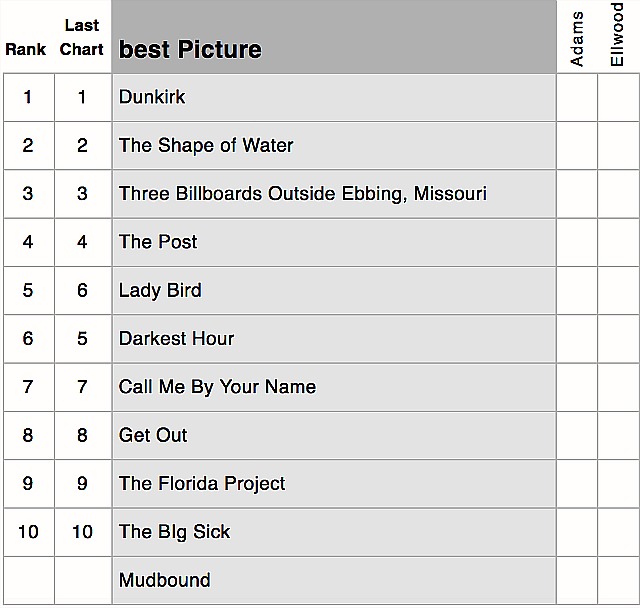
Dunkirk, The Shape of Water, The Post and Three Billboards outside Ebbing, Missouri continue to enjoy the Gold Derby and Gurus of Gold heat; ditto Darkest Hour to a slightly lesser extent. If you ask me the four hottest Best Picture contenders are Dunkirk, The Post, Call Me By Your Name and Lady Bird. Just how things seem at this stage.

Civic Duty
Hollywood Elsewhere has just signed Tom Steyer‘s impeach Trump petition at needtoimpeach.com. The tally is now at 2,809,000 — will probably hit 3 million by tomorrow or the next day. And Steyer now has a Times Square electronic billboard alerting passersby to the petition. What are you waiting for?
Slowhand
In the view of N.Y. Times critic Glenn Kenny, Lili Fini Zanuck‘s Eric Clapton: A Life in 12 Bars “comes up short” as a musical biography, but “plays substantially better as a story of recovery and recovered integrity.” I wouldn’t know as I bailed on this 135-minute documentary sometime around…oh, the 35-minute mark. I departed over issues with the technical quality of what I’d seen up to that point. I tried to explain my complaints on 9.11.17, in a post from the Toronto Film Festival:
Zanuck’s doc opens today (11.24), and will air on Showtime starting on 2.10.18.
“Lili Fini Zanuck‘s Eric Clapton: A Life in 12 Bars illustrates a rule about documentaries and particularly talking-head footage that bears repeating,” my review began.
“If you have an ample supply of alluring, great-looking, non-grainy footage, you’re free to forego talking heads. Just hire a top-tier editor, overlay some wise, insightful narration and you’ll probably be fine. But if your footage is mainly composed of grainy, shitty-looking photos mixed with black-and-white TV footage, you definitely need to intercut with well-recorded, high-def color footage of this and that knowledgable, insightful authority.
“The reason, obviously, is that you’ll want to occasionally free the viewer from the prison of fuzzy, shitty-looking stills and black-and-white TV footage, and you’ll also want to heighten the impact of your vocal observations as a way of adding intellectual intrigue and fighting the general monotony.
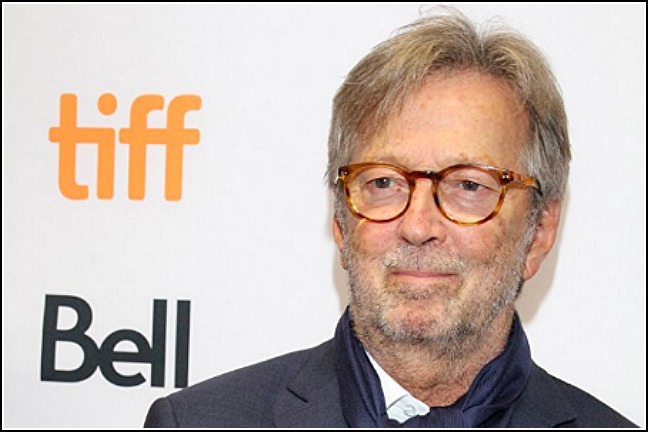
Eric Clapton, 72, during Sunday’s visit to the Toronto Film Festival to promote Lili Fini Zanuck’s Eric Clapton: A Life in 12 Bars.
Twitter Decision on Post Two Days Hence
Steven Spielberg‘s The Post (20th Century Fox, 12.22) screened in Manhattan last weekend at Loews’ Lincoln Square. Mark Harris moderated a post-screening discussion between Spielberg, Tom Hanks, Meryl Streep, supporting performance standout Bob Odenkirk and Matthew Rhys (who plays Daniel Ellsberg). A similar gathering will take place on Monday evening, 11.27, at the DGA and also on the 20th Century Fox lot. The Twitter embargo lifts that night at 9 pm. I for one am tapping out thoughts and preparing drafts in advance so I can post right at the stroke. By the way: I’m leaving 90 minutes from now to catch the first-in.L.A. press screening of Paul Thomas Anderson‘s Phantom Thread.
No Love, No Justice
With Forbes‘ Rob Cain having reported on 11.20 that Justice League will likely suffer a loss between $50 and $100 million, it’s safe to call this latest DC Extended Universe flick a dead monkey. Pic cost $300 million to make and $150 million to sell, meaning that the Zack Snyder-Joss Wheedon enterprise needs $750 million just to balance the books.
Right now the worldwide tally, seven days after opening on 11.17, is $315,816,643. With the bloom off the rose and returns dropping from here on, pic will have to double its current worldwide haul to reach $630 million, which would be $120 million shy of the break-even mark.
Now that the film has flopped and the game is over, what did the HE community think of Justice League?
Forgive me for not participating, but I don’t “do” movies like Justice League or the general DC realm for that matter. Until, that is, Matt Reeves‘ The Batman comes along.
The Underground Scene
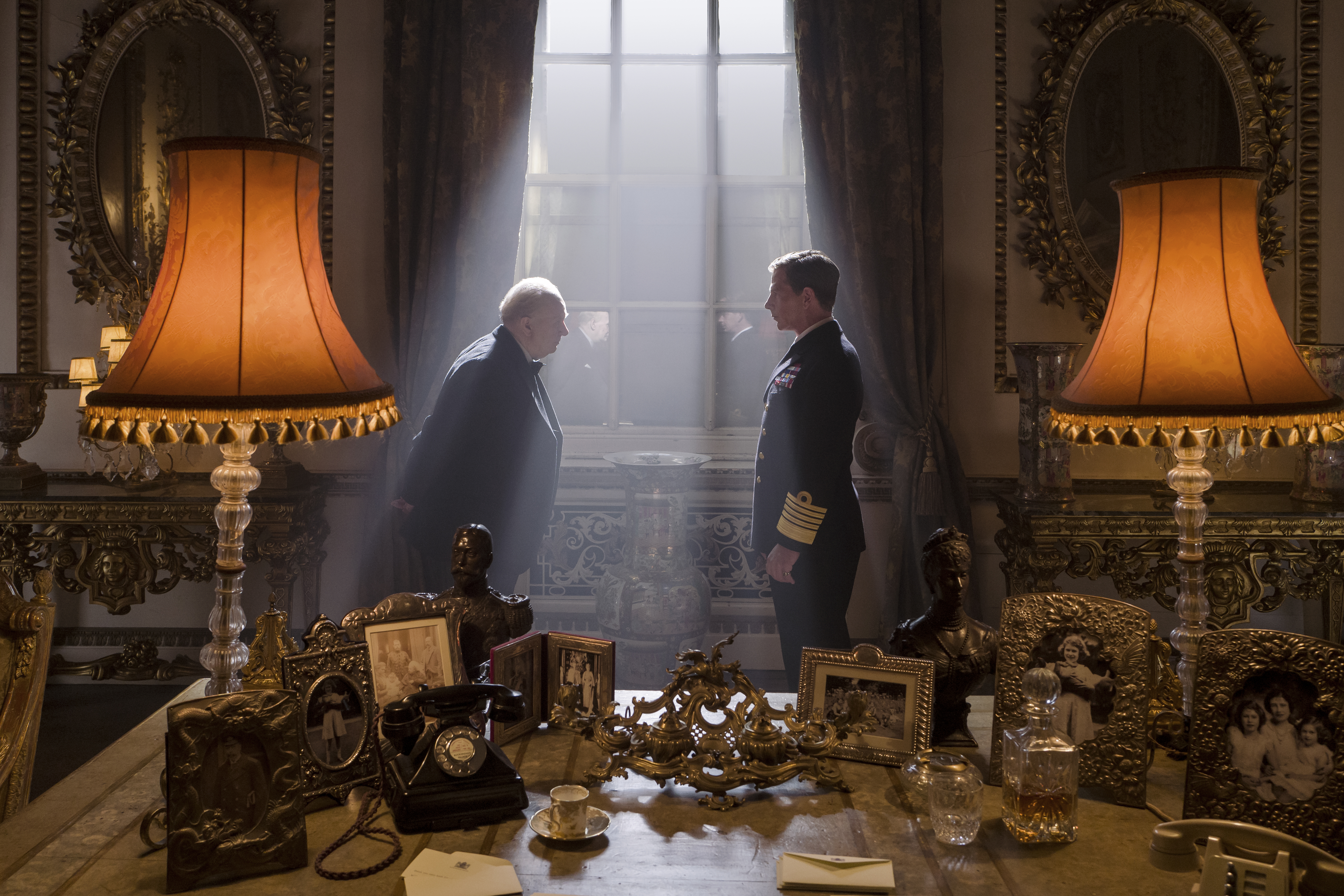
From A.O. Scott’s 11.21 review of Joe Wright‘s Darkest Hour: “The challenges facing Winston Churchill are of lethal seriousness, but the key to his effectiveness is his capacity for pleasure. He enjoys the push and pull of politics, the intellectual labor of problem-solving and the daily adventure of being himself.
“In grasping that joy, Gary Oldman partakes of it and passes it along to the audience. He is having fun, playing the part in every sense. And his blustery, blubbery charm, backed as it is by a sly and acute intelligence, is hard to resist.”
From HE 9.2.17 review: “Churchill is winningly played by Gary Oldman in a colorful, right-down-the-middle, straight-over-the-plate performance. Will this flamboyantly twitchy turn result in a Best Actor nomination? You betcha, but honestly? Oldman has delivered in a classically actor-ish, heavily-made-up way that could have been performed 30 or 50 years ago. There will be no ignoring Oldman’s work here, but it’s not wedded to the present-day zeigeist. It’s a golden-oldie performance, but delivered fresh with plenty of zing.”
Scott: “Like The King’s Speech, Darkest Hour is a serviceable enough historical drama. But like Dunkirk, it falls back on an idealized notion of the English character that feels, in present circumstances, less nostalgic than downright reactionary.”
HE: “Darkest Hour is a stirringly square, well-handled audience movie…it feels familiar and well-trod (how could it not be given all the recent Churchill portrayals?) but rousingly straightforward.”
Non-Racist Racists
Four days ago The Atlantic‘s Adam Serwer posted “The Nationalist’s Delusion,” a seminal portrait of the racist mindset of Trump Nation — a constituency of white, mild-mannered yahoos who don’t see themselves as racist at all.
“During the final few weeks of the [2016] campaign, I asked dozens of Trump supporters about their candidate’s remarks regarding Muslims and people of color. I wanted to understand how these average Republicans — those who would never read the neo-Nazi website The Daily Stormer or go to a Klan rally at a Confederate statue — had nevertheless embraced someone who demonized religious and ethnic minorities.
“What I found was that Trump embodied his supporters’ most profound beliefs, combining an insistence that (a) discriminatory policies were necessary with (b) vehement denials that his policies would discriminate and (c) absolute outrage that the question would even be asked.
“It was not just Trump’s supporters who were in denial about what they were voting for, but Americans across the political spectrum, who searched desperately for any alternative explanation — outsourcing, anti-Washington anger, economic anxiety — to the one staring them in the face. The frequent post-election media expeditions to Trump country to see whether the fever has broken, or whether Trump’s most ardent supporters have changed their minds, are a direct outgrowth of this mistake.

Key sentence: “These supporters will not change their minds because this is what they always wanted: a president who embodies the rage they feel toward those they hate and fear, while reassuring them that that rage is nothing to be ashamed of.
“Most Trump supporters I spoke with were not people who thought of themselves as racist. Rather, they saw themselves as antiracist, as people who held no hostility toward religious and ethnic minorities whatsoever — a sentiment they projected onto their candidate.
“’I don’t feel like he’s racist. I don’t personally feel like anybody would have been able to do what he’s been able to do with his personal business if he were a horrible person,’ Michelle, a stay-at-home mom in Virginia, told me.
“Far more numerous and powerful than the extremists in Berkeley and Charlottesville who have drawn headlines since Trump’s election, these Americans, who would never think of themselves as possessing racial animus, voted for a candidate whose ideal vision of America excludes millions of fellow citizens because of their race or religion.
“The specific dissonance of Trumpism — advocacy for discriminatory, even cruel, policies combined with vehement denials that such policies are racially motivated — provides the emotional core of its appeal. It is the most recent manifestation of a contradiction as old as the United States, a society founded by slaveholders on the principle that all men are created equal.”
They Won’t Forget
Please read the latest Seth Abramson twitter thread about Trump-Putin, kompromat and Trump Tower Moscow. For whatever reason the mainstream media seems to be dragging ass on this story. Or, if you aren’t caught up, scan a thread he posted in late August/early September.
What’s perfectly clear, Abramson tweeted, is the Trump-Russia scandal began in earnest the moment Trump corruptly gave Russia the 2013 Miss Universe pageant. Mueller will investigate many crimes — see Manafort and money-laundering — but it all comes down to a four-year-old scenario: Trump, Putin and Trump Tower Moscow.
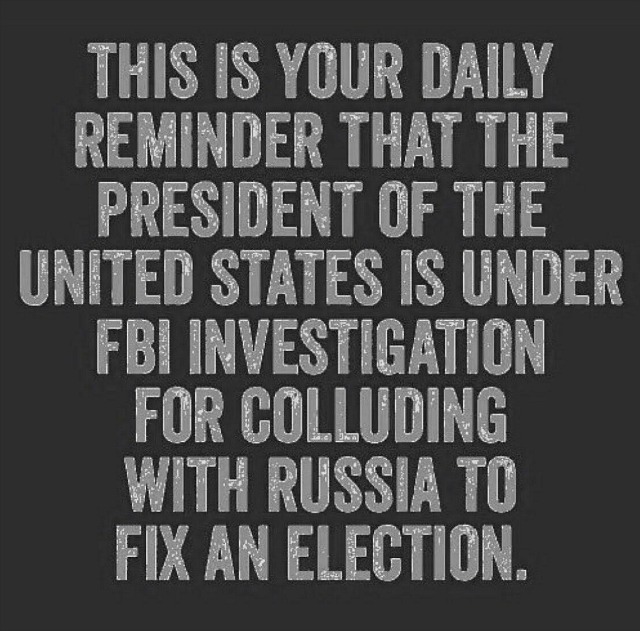
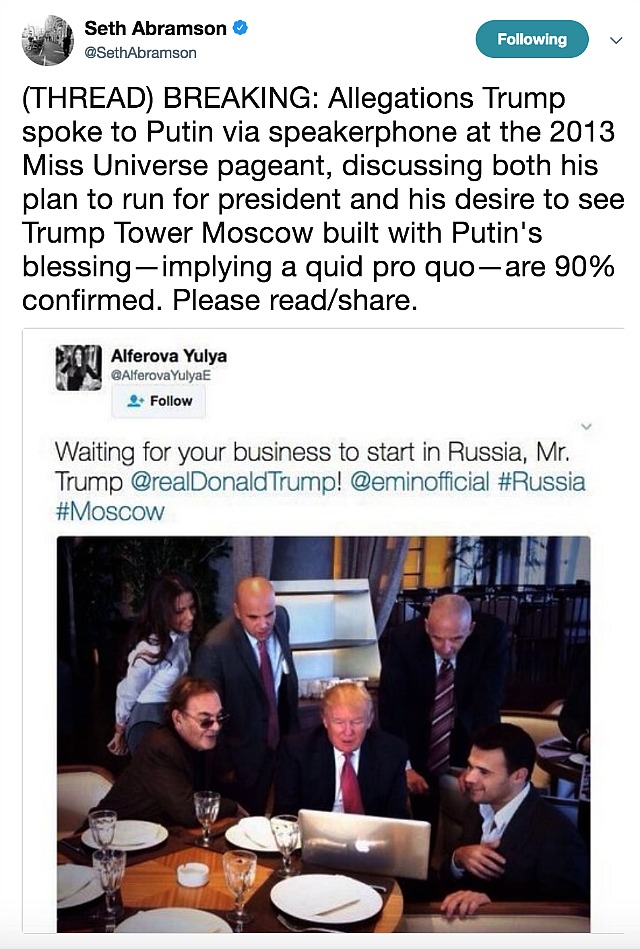
“We know a Trump Tower Moscow letter-of-intent was signed, then lied about; we know Trump and his team tried to convince us his only play for Trump Tower Moscow was a failed 2015 bid; we know Russians knew before we did that Trump was running for POTUS; we know Trump wanted to meet Putin at the 2013 pageant, and surrounded himself with every resource he could to make it happen telephonically, even as Putin was sending him every imaginable resource needed to get a Trump Tower Moscow deal done; we know a one-time Trump friend confirms all this.
“So while we don’t—yet—have 100% conclusive proof, every piece of evidence now available says (a) yes, Trump established a Trump Tower Moscow/presidential run quid pro quo with Putin in Moscow in November 2013, and (b) yes, he was lured to Moscow as part of a kompromat plot.”