Cut To The Puerto Rican Chase

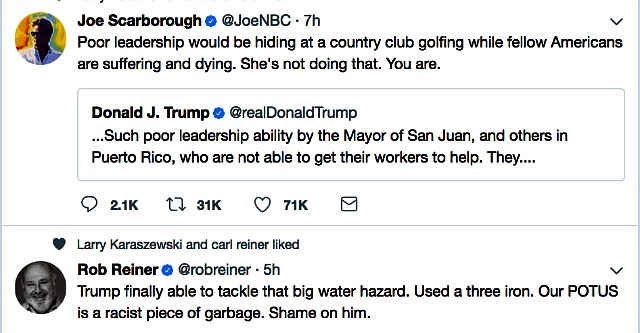
The bottom-line reason why Donald Trump didn’t react with particular haste or try all that hard to get vitally needed supplies to hurricane-ravaged Puerto Rico is easy to discern. He’s an America-First President, which basically means he’s the President of White American Bumblefuck Nation. He was elected to try and halt or at least slow the multicultural political tide by Making America White Again, and so it follows that when a Caribbean island of Hispanic Americans are struggling to find food and drinking water in the wake of a natural disaster, Trump and his minions are going to drag their feet when it comes to emergency measures. It’s that simple, that horrendous. The man is either a sociopathic racist or…you know, a racist sociopath.
From Paul Krugman‘s 9.29 N.Y. Times column, “Trump’s Deadly Narcissism“: “When Hurricane Maria struck, more than a week ago, it knocked out power to the whole of Puerto Rico, and it will be months before the electricity comes back. Lack of power can be deadly in itself, but what’s even worse is that, thanks largely to the blackout, much of the population still lacks access to drinkable water.

“How many will die because hospitals can’t function, or because of diseases spread by unsafe water? Nobody knows. But the situation is terrible, and time is not on Puerto Rico’s side: The longer this goes on, the worse the humanitarian crisis will get. Surely, then, you’d expect bringing in and distributing aid to be the U.S. government’s top priority. After all, we’re talking about the lives of three and a half million of our fellow citizens — more than the population of Iowa or metro San Diego.

“So have we seen the kind of full-court, all-out relief effort such a catastrophe demands? No.
Read more

Humpty Dumpty

Amazon-provided synopsis of Woody Allen‘s Wonder Wheel, attached to a screening invitation: “Wonder Wheel tells the story of four characters whose lives intertwine amid the hustle and bustle of the Coney Island amusement park in the 1950s: Ginny (Kate Winslet), a melancholy, emotionally volatile former actress now working as a waitress in a clam house; Humpty (Jim Belushi), Ginny’s rough-hewn carousel operator husband; Mickey (Justin Timberlake), a handsome young lifeguard who dreams of becoming a playwright; and Carolina (Juno Temple), Humpty’s long-estranged daughter, now hiding out from gangsters at her father’s apartment.”

How Honest Are Those Blade Runner 2049 Reviews?

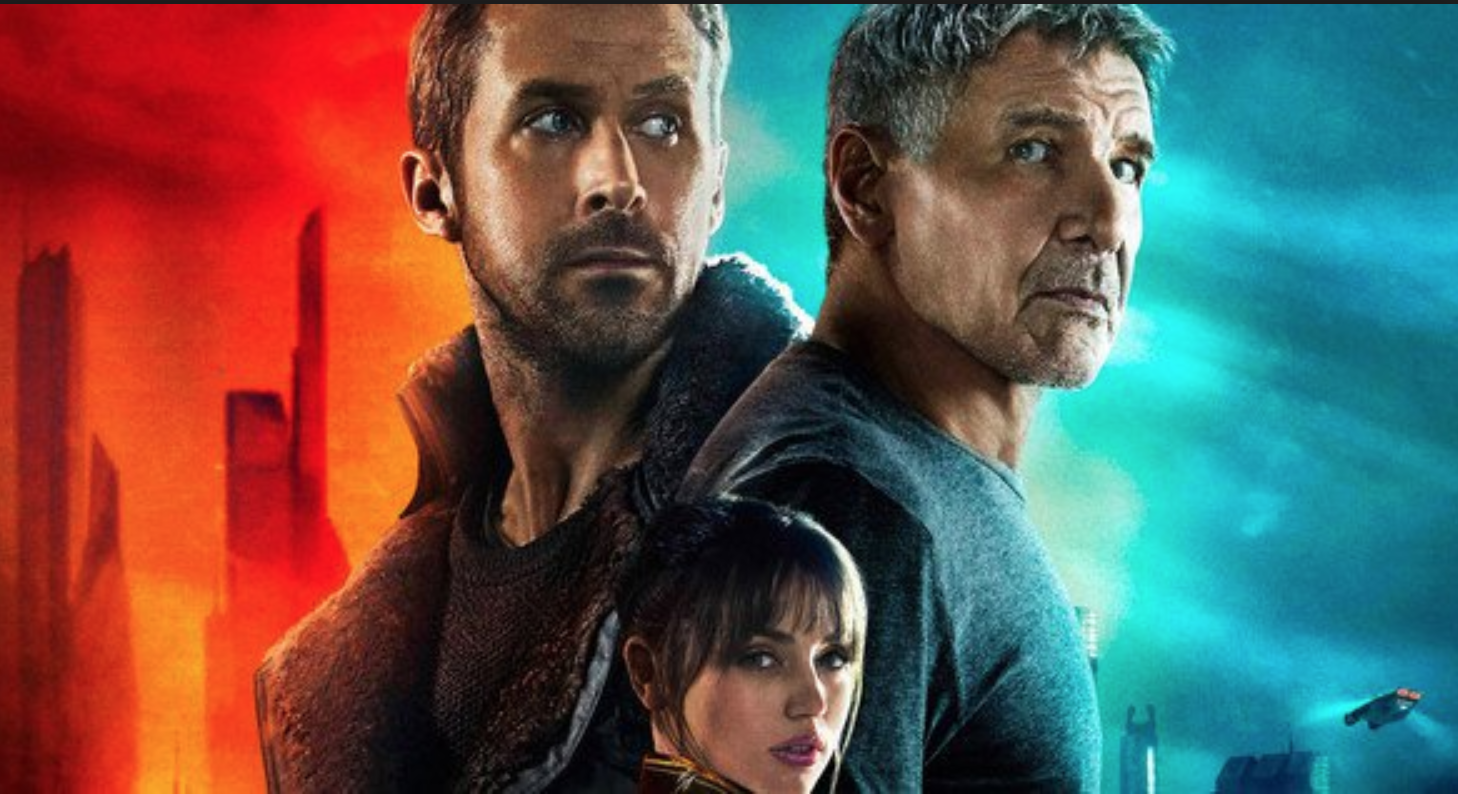
A visual knockout, fine. Jaw-droppingly beautiful, okay. But who completely trusts those Blade Runner 2049 reviews? Right now it has a Rotten Tomatoes score of 98 and a Metacritic score of 85. You know you can’t trust critics. You know that a lot of them (especially the super-brainy, balding, dweeby-looking ones) live in tents inside their own rectums, and that many of them write their reviews not for Joe and Jane Popcorn but with an eye toward what their effete colleagues are thinking and saying. You can trust Hollywood Elsewhere to lay it on the line, but who else?

Kevin Maher of the London Times says BR49 is “not without problems” and yet it has a 98% rating? The Village Voice‘s Bilge Ebiri says it “cannot achieve the sublime slipperiness” of Ridley Scott‘s original Blade Runner. Metro UK‘s James Luxford says “the film belongs to Ryan Gosling” and yet I was told by a critic friend that Gosling’s performance is fucking boring.

After scanning the Metacritic and Rotten Tomatoes scores, this same critic, not a huge fan of the film, said “I’m stunned that the reviews are this good.” Another critic said, “All I can say after sitting through nearly three hours of this [film] is thank God for Harrison Ford and Elvis Presley.” The latter refers to Ford’s Rick Deckard “living in some weird building somewhere, and among his entertainment options are life-size holograms of Elvis and Marilyn Monroe,” which are “pretty damned cool.”

I walk around in my canary-yellow sneakers like Woody Guthrie or Charles Bukowski and order the occasional hot dog or ice cream cone and rumble down the mean streets of Los Angeles on my scooter hog. I’m a real person and I don’t mince words, and if I like Blade Runner 2049 then maybe it’s got something. But you can’t trust the cloistered film monks. They live in their own world.

Just Call Me Cloudy

Hats off to Lexington-based tech guy Dominic Eardley for switching Hollywood Elsewhere from an ISP that was costing $440 per month to a newbie that’ll cost $200 a month with no loss in quality. I’ve been paying Liquid Web the higher fee for a dedicated server since 2011 or thereabouts, but two days ago Dominic switched me over to a managed WordPress cloud service from an Austin-based company called WP Engine. So far it’s loading quickly and feels just fine. Thanks again to Dominic for pushing me into this.

Not Half Bad

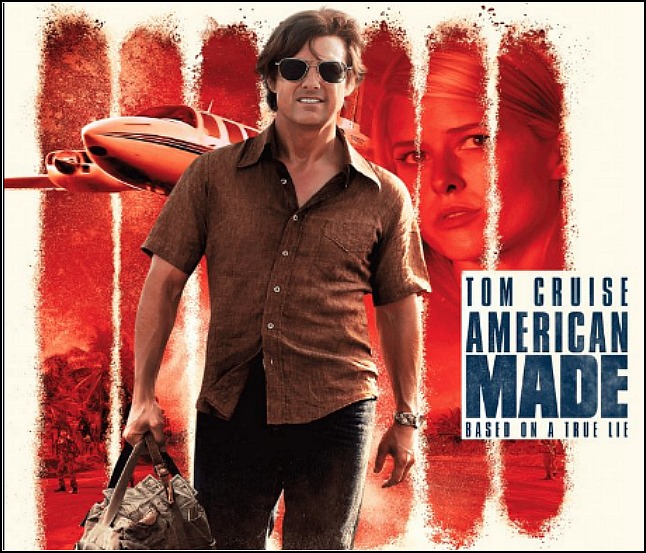
All in all Doug Liman and Tom Cruise‘s American Made, which I paid to see last night at the Hollywood Arclight, is a spry and frequently engaging drug-dealing dramedy. I felt irked and occasionally disengaged by the jaunty tone but never bored. The movie jumps and hops and bops around like a guy who’s just snorted a three-foot-long line of cocaine, which is appropriate given the storyline, and Cruise does his best to sell and smooth it all down with one of his patented charm-school performances.

It’s based on the real-life exploits of the late Barry Seal, a jowly-faced TWA pilot and risk junkie who began working for the CIA in the late ’70s as a flyover photographer of anti-U.S. Central American guerillas, and then as an arms smuggler and then a cocaine smuggler for the Columbia cartel guys (including Pablo Escobar), and then as a U.S. government informant against the Columbians after he was arrested and facing a 40-year sentence. He was clipped by a pair of Columbian assassins in ’86.

The problem for me was this: I wanted the movie to drill into the hard-core reality of Seal’s increasingly risky businesses and really immerse in the tension and the fear and the sweaty nitty gritty. American Made does this to some extent, but it also tries like hell to entertain the chumps by arching the tone and trying to make a lot of what Seal did seem funny and outrageous in a hoo-hah, can-you-effing-believe-this? sort of way. Every now and then I would chortle or guffaw, but mainly I wanted to experience what Seal’s wild ride was really like, without the tonal concessions to the popcorn-inhalers.

And that’s basically it. I didn’t feel burned by American Made. A fair amount of it intrigues, diverts, distracts, etc. But I didn’t buy a lot of the particulars.

I didn’t believe for a second that Cruise was doing anything more than resorting to the usual tricks and games — he’s basically doing Knight and Day again, playing the same grinning, irreverent sociopath. I didn’t believe Domhnall Gleeson as a laid-back CIA agent, certainly not with his dweeby manner, beanpole frame and stupid-looking Beatle bowl haircut. I didn’t believe Sarah Wright as Seal’s wife — too dishy, too pliant, too young and aerobically toned to be a mother of two and married to a guy who’s at least 20 years older. (In actuality she’s 22 years younger than Cruise, who turned 55 last July.)

Okay, I half-believed the Columbian cartel guys. And with Seal having assisted CIA efforts to arm the Nicaraguan contras and discredit the Sandinistas and having dealt with Reagan administration flunkies like Oliver North, I definitely believed in Doug Liman‘s investment in this story as his attorney father, Arthur Liman, served as chief counsel for the Senate’s investigation of the Iran-Contra Affair.

In his 10.2 New Yorker review, Anthony Lane writes that American Made “joins that small band of Cruise movies, like Magnolia and Collateral, which summon the nerve to dig around — to test the armor of his geniality, and to deconstruct that celebrated grin.” Yeah, I guess so but I wouldn’t get too carried away. American Made is a better-than-half-decent film, but it’s far too jokey and impish to be regarded as an art-movie equal of Magnolia, and it’s way, way below the level of Collateral.

Right now American Made has a Metacritic and Rotten Tomatoes rating of 65% and 85%, respectively. I regret to say that last night’s 9 pm show at the Arclight was sparsely attended.

Small Measure of Credit

More than a few women essayists (including The Guardian‘s Suzanne Moore, Chicago Tribune‘s Mary Schmich, The Independent‘s Julie Bindel, Fox News’ Penny Young Nance, The Atlantic‘s Sophie Gilbert) have argued, not inaccurately, that the late Hugh Hefner was not a true supporter of women, that he was basically a rich, high-end pimp, and that the sexual revolution he and Playboy promoted totally favored male libidos, etc. Which I won’t argue.

But you can’t say Hef wasn’t a culturally progressive mover and shaker in the ’50s and ’60s. In a self-absorbed, narcissistic way, agreed, and yes, his brand was eclipsed or certainly dated by the women’s movement starting in the early ’70s.  But in the era of Dwight D. Eisenhower and John F. Kennedy, he definitely moved the needle forward. From Jean Anouilh‘s Becket: “I’m afraid we can only do, absurdly, what it has been given to us to do.” Hef had his cultural moment, his chapter of honorable influence, and he managed it as best he could.

“Beautiful Nothingness”

“A very divided reaction among the dozen or so people I’ve spoken to that have seen Blade Runner 2049. Some are saying it’s a flat-out masterpiece whereas others think it’s a beautiful but emotionally empty exercise in style. To me it felt like beautiful nothingness. I wasn’t riveted by the narrative or the performances as much as stunned by the visuals. I need a re-watch to sort it all through. I can definitely call it one of the most visually beautiful films I’ve seen this decade.” — from a critic friend who wrote this afternoon.

I Go On Adventures, Not “Dates”

Bachelor #1, Lance Remmer, is too tense and guarded and conservative — because he wasn’t familiar with the name Farrah he asked host Jim Lange to repeat it. He’s basically a dick. The ridiculous yokel sideburns won by Bachelor #3, whose name sounds like Paul Knuckles, are instant disqualifiers. He picks his feet, comes from Tobacco Road. The only half-decent contender is Bachelor #2, an actor-artist named Joey Hooker with an easy way and a nice smile.

If I’d been asked what time of day I prefer, I would have said early morning and late evening, because they’re both peaceful and tranquil due to most of the people in your time zone being fast asleep and the sounds of traffic being at a minimum. I’m also a big fan of dusk.

22 year-old Farrah Fawcett, fresh from Corpus Christi, Texas, had arrived in Hollywood the previous year at the encouragement of agent David Mirisch. A contract she’d signed with Screen Gems was paying her $350 a week. She was making commercials, and would eventually break into guest-starring roles on TV serials. The famous poster shoot that launched her career wouldn’t happen for another seven years.

Gentle Tale, Nice Vibe

Everyone knows the set-up for Our Souls At Night, right? A pair of widowed 70somethings in a small town — Jane Fonda‘s Addie Moore and Robert Redford‘s Louis Walters — decide to forego loneliness and solitude by sleeping together. Not sexually but as a simple act of comfort and companionship.

Things are a bit awkward at first but not for long. They talk a bit and then a bit more, and they get to know each other, and they gradually come to everything good that you might expect to happen between two good people.

What happens doesn’t actually amount to a whole lot, but it seems like enough. The film isn’t about hanging with Louis and Addie as much as Bob and Jane, whom some of us have come to know pretty well over the decades. Louis and Addie are less wealthy and more conservative-minded than Bob and Jane, but otherwise there doesn’t seem to be a great deal of difference. Bob and Jane are good company for each other and for us.

What we get from their relationship are little comfort pills or, if you will, little spoonfuls of honey and squeezings of lemon in our tea. They speak quietly and gently to each other, never sharply or critically or sarcastically. Familiarity, trust…nobody’s in any hurry.

Our Souls At Night experiences a couple of mild downturns, mostly by way of Louis and Addie’s resentful grown children. Louis was a less-than-perfect father to his daughter (Judy Greer), and she reminds him of that for what I presume is the 179th time. Addie’s brief lack of vigilance led to a tragedy with her daughter, and so her alcoholic, occasionally abrasive son (Matthias Schoenaerts) reminds her of that also. Bluntly, hurtfully.

Schoenaerts’ character nearly destroys Louis and Addie’s relationship, and the film with it. He’s such an astonishing alcoholic asshole, and Addie, God help her, agrees with his view that she was the cause of her daughter’s death, and so Schoenharts, furious at Addie for her horrible non-error, pressures her into separating from Louis to make up for her mistake. What bullshit! Life is shorter than short, for God’s sake. If you’ve found a good thing, never let it go.

I wanted Addie to tell Schoenharts to go fuck himself, but she feels too guilt-ridden to do anything but indulge him. I wanted Schoenharts to bless his young son Jamie (Iain Armitage) by dying in a drunken car crash or slitting his wrists in the bathtub, but alas, no. Poor Jamie is living with an abuser, and is doomed to a life of anger and resentment and Al Anon meetings.

A movie that makes you wish for the absence or the death of a bad guy and then refuses to get rid of him is not, in my book, doing the right thing.

Read more