House at Twee Corner

Could there anything more “twee” than a gently emotional film about A.A. Milne, the creator of the “Winnie the Pooh” books? Especially with Milne being played by Domnhall Gleeson, one of the undisputed kings of Hollywood twee with his achingly sensitive manner, fucking carrot hair and watery blue eyes? When I read about Fox Searchlight’s Goodbye, Christopher Robin, which will costar Margot Robbie as Mrs. Milne, I went “aarggh!” Mrs. Tarzan and Jordan Belfort‘s insanely seductive gold-digging wife married to a dweeby English poet? In what universe will this film take place?
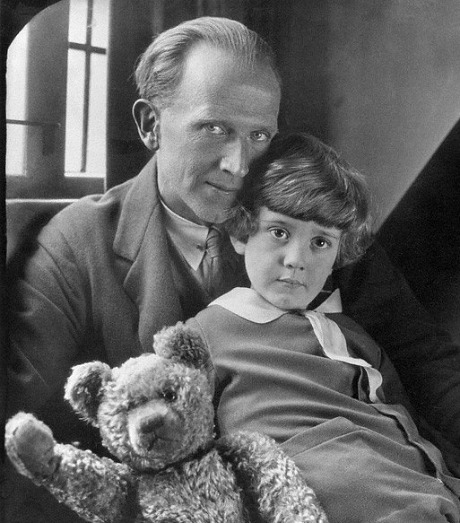

Winnie the Pooh author A.A. Milne and son Christopher Robin Milne, taken in the mid 1920s.

We’ll apparently be looking at another Finding Neverland (’04), in which Johnny Depp played another revered London-based author of a legendary children’s fable. Pic will be directed by Simon Curtis (Woman in Gold, My Week With Marilyn) with a script by Frank Cottrell Boyce and Simon Vaughn.

Is there any chance we’ll one day see a movie about Theodor Seuss Geisel, i.e, the creator of the Dr. Seuss books?

Will Curtis’s film acknowledge that Milne’s son, Christopher Robin Milne, who was the inspiration for the Christopher Robin character in the Pooh books, became more and more resentful of his father’s exploitation of his childhood and came to hate the books that had thrust him into the public eye?
Read more

Gold Standard

This teaser is all about emphasizing how “real” and un-CG’ed the shooting of the new Ben-Hur chariot race was. Director Timur Bekmambetov, costars Jack Huston and Toby Kebbell…all on the same page. Why, then, does the moment when Judah Ben-Hur’s chariot rides over the wreckage and he’s nearly thrown out of the chariot…why does that scene look utterly real in the ’59 version but like exaggerated CG bullshit in the newbie? And why does the new sequence look so bleachy and washed out compared to the William Wyler version, which is full of rich sandy browns and arid yellows with accents of blue and red? I’m not saying that Bekmambetov, Huston and Kebbell are lying about shooting their version realistically. I’m saying it doesn’t look or feel as arresting as the old version. I’m not being a knee-jerk crank here. I’m not saying “oh, the older stuff is always better.” The newbie really doesn’t look as good. Honest.

Listen to this again.

What’s Good?

I sent that male-betrayal thing I wrote about yesterday to an ex-girlfriend, and she wrote back today and basically said “Wow, you’re still angry at something that happened 36 years ago? Shouldn’t you be serene and cosmic and burning incense at this stage in your life?”

Response: “I’m not actively pissed off about this, not really, but it did happen, and it was fun to resuscitate it. I’m okay with Bob. He’s a good fellow. But what’s past is present and vice versa. The ghosts swirl around us. I live with stuff that happened when I was 8 or 20 or 42 just as vividly as when these incidents were fresh. That’s the joy of writing about this and that every day. Nothing is dusty or faded. Everything that has ever happened or will happen is alive and crackling.

“And I must tell you I’m well past being concerned about whether this or that post will reflect well or ill upon me. I get shat upon every day of the week and twice on Sundays on Twitter. There is no tranquility in this life for someone like myself. Not with guys like Glenn Kenny in the world. No solace, no serenity, no plateau. Well, there’s happiness in fits and starts, of course, but certainly not as a going proposition. There’s only the next story to write, the next film to see, the next experience, the next encounter, the next festival, the next interview…the river of it all. And it’s the happiest period of my life, by far.”

This’ll Be Good. You Can Tell.

The Night Of is an eight-part HBO series that will debut on Sunday, 7.10. It’s about a wrongfully accused guy (Riz Ahmed) caught in a murder investigation. John Turturro plays Ahmed’s lawyer. It’s been directed by Steve Zaillian, who co-wrote the script with Richard Price. The cinematography and editing are obviously high calibre. The 2013 pilot starred James Gandolfini in Turturro’s role. Everything collapsed after Gandolfini died in June 2013, but here it finally is.

Lonesome Town

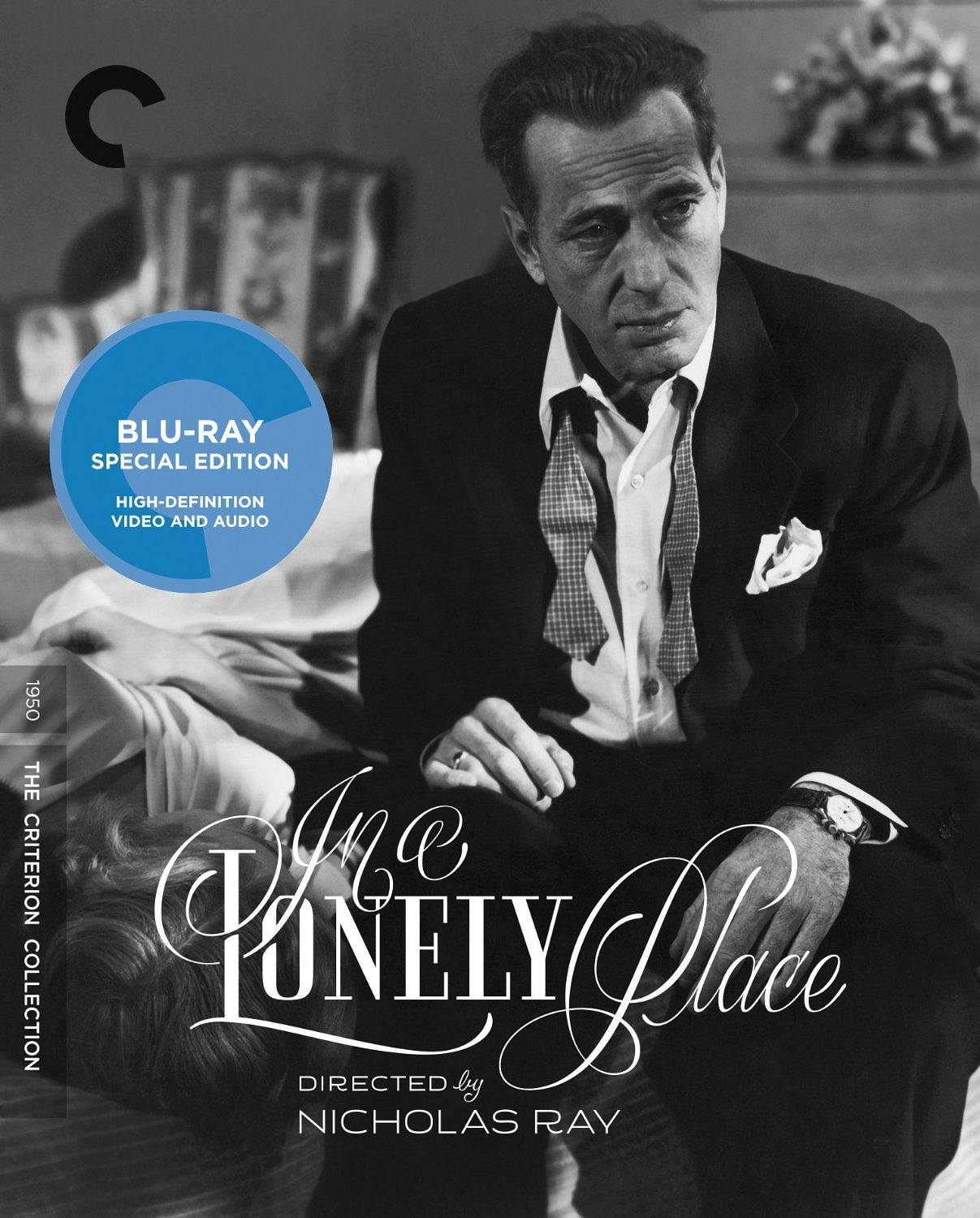
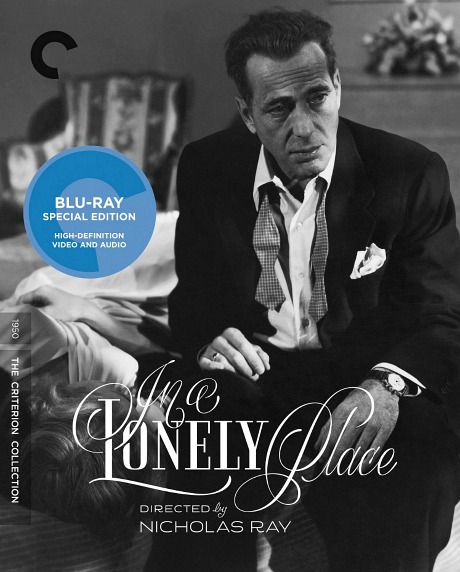
Because it popped on 5.10, or just as the Cannes Film Festival was getting underway, I ignored Criterion’s Bluray of Nicholas Ray‘s In A Lonely Place (’50). Last night I finally caught up with it. I had never thought of this downish Hollywood romance as anything special to look at, but now, thanks to Criterion, I’ve got a new attitude. The crisp black-and-white imagery is luscious and rich like a river…a river of glistening silver. It’s strawberry shortcake with whipped cream. The mine-shaft blacks are to die for. I was sitting up in my seat and going “whoa, wait a minute…this is excellent!”

A lot of times Criterion will make a classic film look darker or grainier than it should be. (The Only Angels Have Wings debacle is one example.) But every now and and then they’ll make a film look much better than ever before. This is one of those times.

Wiki boilerplate: “Humprhey Bogart stars as Dixon Steele, a troubled screenwriter suspected of murder and Gloria Grahame co-stars as Laurel Gray, a neighbor who falls under his spell. Beyond its surface plot of confused identity and tormented love, the story is a mordant comment on Hollywood mores and the pitfalls of celebrity and near-celebrity, similar to two other American films released that same year — Billy Wilder‘s Sunset Boulevard and Joseph Mankiewicz‘s All About Eve.”

Read more

Wrong Kind of Freckles?

I’ve read that Hollywood beauticians and makeup artists of the 1930s regarded Katharine Hepburn‘s facial freckles as appalling, and that they constantly (a) covered them with pounds of base and (b) urged dps to shoot Hepburn’s CUs with a vaseline-smeared lens. By the ’50s or certainly by the ’60s this view had more or less subsided. The culture has long accepted freckles as appealing or even beautiful, but I’ve never fully agreed. A smattering of freckles across the nose and upper cheeks is…well, fine. Reddish, light-brown pointillist accents upon alabaster skin. But I still prefer creamy, freckle-free complexions. Sue me.

I’m mentioning this because I was definitely going “whoa” when I gazed at that super-freckly model on the cover of yesterday’s New York Times Style Magazine, especially with the slogan “Real Beauty” placed to her left. Those hundreds if not thousands of teeny black and brown markings don’t look like freckles as much as…I don’t know what to call them. They’re like a cross between Hepburn or Lindsay Lohan-style freckles and…I’d better not say any more. The p.c. Twitter banshees (who, don’t forget, yesterday tried to have me flayed when I admitted to having speculated in my head in the immediate wake of the Orlando slaughter that the shooter might be a radical Islamic wacko) will probably shriek like Donald Sutherland at the end of Invasion of the Body Snatchers over what will sound to them like freckle prejudice.

Read more

Bodies On The Roof

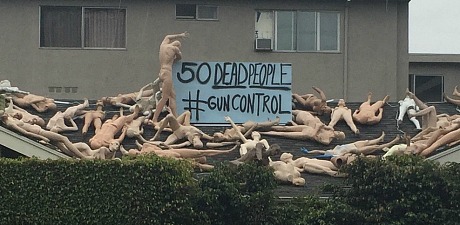
Sometime yesterday window dresser ChadMichael Morrisette, a.k.a. L.A.’s “mannequin man”, created a sobering art display on the roof of his West Hollywood home. Profiled by NBC News last night, Morrisette put 50 sprawled mannequins, representing the 50 Orlando clubbers killed Saturday night by jihadist-nihilist Omar Mateen, on view to remind observers what that horrific toll actually looks like. (The number of Pulse victims has been revised to 49 — the body of Mateen, killed by cops, was included in the original count.)


Snapped this morning at 8:40 am.

Morrisette: “We cannot have 50 Americans killed in a nightclub and continue to do nothing about it.”

We can’t, huh? When NRA-supporting yokels hugged their guns in the wake of the 2012 Newtown slaughter (20 kids, six adult staffers), I figured that was it — they have no souls, they’re immovable, they’ve gone around the bend. We can also guess what a good percentage of hinterland conservatives are probably muttering to each other privately about the Orlando tragedy. Remember — Islamic jihadists and hardcore gun-toting Christian righties are pretty much cut from the same cloth. This was the thrust of an “American Taliban” rant that Aaron Sorkin wrote for a Newsroom segment that aired in ’13.

Here’s an 11.20.14 profile of Morrisette by la-racked‘s Danielle Directo-Meston.

Note: Morrisette’s object d’art is on the roof of his home at the SW corner of Fountain Ave. and Orange Grove Ave., one block east of Fairfax.

Read more

A Single Image

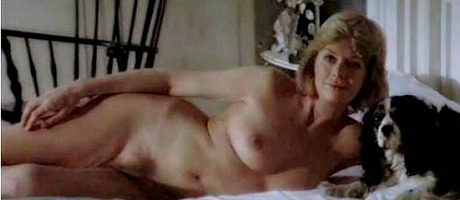
The prolific Robert Altman directed his share of minor films, and yet when I sit down and review them (including Three Women, A Perfect Couple, Buffalo Bill and the Indians, Quintet) I can always recall pieces — a scene, a shot or two, lines of dialogue. The other day I was reminded of Altman’s Images (’72), a schizy character study about a children’s book author (Susannah York) succumbing to fantasies and whatnot. And I realized I can’t remember a damn thing about it except this one static shot.

It stuck, I think, because York wasn’t exactly a daily workout Nazi and yet was unbothered by this. I was impressed by the ballsiness of it. Beyond this no impressions of Images remain.

You can’t stream Images anywhere. The only way to see it is to buy a region 2 DVD of $30 or a domestic DVD for $89. I’m not 100% sure I’d want to stream it even if I could.

York won the Best Actress award at the ’72 Cannes Film Festival for this performance. I’d somehow forgotten that she died in early 2011 from cancer at age 72. Seven favorite Yorkies: Alec Guinness‘s daughter in Tunes of Glory (’60), Sophie Western in Tom Jones (’63), Angel McGinnis is Kaleidoscope (’66), Margaret More in A Man for All Seasons (’66 — my all-time favorite), Alice McNuaught in The Killing of Sister George (’68), Alice in They Shoot Horses, Don’t They? (’69) and Rachel Fielding in The Shout (’78).

Most Penetrating, Dialogue-Free “Show” Moments in Film History?

Most of us agree with the “show, don’t tell” theme of this essay, but there’s nothing more infuriating than actors showing without sufficient context. The affecting facial expressions in this essay (such as Chewietel Ejiofor‘s at the end of 12 Years A Slave) work because the audience has been fully schooled on the reasons for the characters’ sorrow. Without these vital details just showing isn’t enough. As I said a couple of days ago, “Directors place a high premium on scenes in which actors say as little as possible or generally under-verbalizing the situation. They love it when actors can look wordlessly stunned or shocked or confused. In real-life situations, of course, people are constantly voicing their perceptions about what may or may not be going on or what they’re feeling or fearing. If the groundwork is insufficient, the ‘show it, don’t say it’ aesthetic is strictly a movie-realm thing, and is phony and irritating as hell.” (The essay was directed by Andrew Saladino and posted by The Royal Ocean Film Society.)

Harold Pinter’s Betrayal

Never rat another guy out when it comes to women. To put it more formally, one of the most paramount ethical codes between adult males is that you can never spill the beans on a friend or acquaintance if his girlfriend or wife asks you to reveal the truth about whatever (i.e., usually his deep-down feelings or some past behavior that has come under question).

Determining the factual or emotional truth of things is something that only a couple can sort out for themselves. It’s not yours to get involved. If a guy is lying to his girlfriend or wife about some indiscretion or affair or saying anything out of earshot that might get him in trouble, it’s none of your damn business and you’re obliged to say nothing. Omerta.

The truth will out sooner or later, but even if it doesn’t guys are absolutely honor-bound to protect each other. I’ve never run into a single fellow in my life who would even think of questioning this.

Except for one. He was a cartoonist-illustrator, and his betrayal happened in Manhattan in ’80 or thereabouts. I’ll call him Bob. We’d met each other in ’79 by way of a fetching lady writer we both felt for and admired (I was the new boyfriend and he was an ex), and then we got to be actual friends.

At some point in the middle of ’80 (i.e., after I’d been dumped by the writer) I began a mild flirtation with an iconoclastic female cartoonist whom Bob also knew. Let’s call her Shary. She was a respected, highly gifted artist and pretty besides. By coincidence she and I realized one day that we had booked seats on the exact same flight to Los Angeles. A day or two later I mentioned to Bob that I’d love to indulge in a mile-high club thing with Shary. It was just a fantasy, a wisp of a notion that came to mind and that I gave voice to.

A day or two later I called Shary and immediately sensed a chill. “What’s wrong?,” I asked her. “Oh, nothing,” she said. “Except that you told Bob you’d like to fuck me on the airplane.”

That was it for Bob. Written off for life.

Me to Bob later that day: “What the fuck, man…you told her about a dopey little daydream that I shared with you? What’s wrong with you?” Bob hemmed and hawed and laughed a bit, but the bottom line is that he didn’t know or care about a code of honor that exists among all men, in all nations, towns and communities in every region of the world. Takes all sorts.

I’m actually still “friendly” with Bob in a sense (we’ve hung a couple of times over the last decade) but I’ve always looked at him askance since that fateful day.

Note: Bob passed three or four years ago. Sorry.