What…You Don’t Get It?

Three days ago the Film Society of Lincoln Center unveiled a curious poster for the 54th New York Film Festival (9.30 – 10.16). A miniature industrial-pastoral thing out of Beetlejuice. Two miniature people dolls in a little rowboat on a simulated river running through some kind of industrial refinery or whatever. The important ingredient is that the poster was designed by Thai director Apichatpong Weerasethakul. The basic equation is that given the respect Weerasethakul enjoys in effete film-festival circles, his poster at the very least warrants interest and respect. To borrow from an idea in Tom Wolfe‘s The Painted Word, it’s not the art itself but the theory behind it that matters. In this instance the “theory” is not conceptual but factual and political. An endorsement by FSLC guys = dynamic, intriguing, something to talk about

Streaming Will Suffice

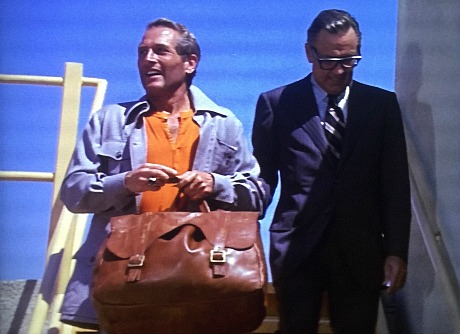
Due respect to the Masters of Cinema guys but Robert Aldrich‘s The Flight of Phoenix (’65) isn’t Bluray material. It’s mainly about a crew of older guys arguing about how best to survive being stranded hundreds of miles from anywhere in the middle of the Sahara desert, and finally deciding to build a new plane out of the wreckage of a crashed one. I’ve seen it two or three times on the tube, and as best I can recall it’s nothing more than a decently framed desert-locale thing, shot in color & 1.85 by longtime Aldrich collaborator Joseph F. Biroc, who also shot It’s A Wonderful Life. I certainly don’t remember any mesmerizing visuals. Pic runs 142 minutes, but it has only one truly gripping scene: “Dorfmann (Hardy Kruger) panics when four cartridges fail to start the engine and Towns (James Stewart) wants to use one of the remaining three cartridges just to clear the engine’s cylinders. Dorfmann objects, but Towns ignores him and fires one cartridge with the ignition off. The next cartridge succeeds.” And that’s it! Nothing else pops. I didn’t even see John Moore’s 2004 remake. Did anyone?

If God Has A Rooting Interest, Toni Erdmann Won’t Take Palme d’Or

In order of preference, the finest films I saw at the 2016 Cannes Film Festival are as follows: Olivier AssayasPersonal Shopper (the questionable ending is a slight thorn, but it obviously didn’t bother me that much), Cristian Mungiu‘s Graduation, Asghar Farhadi‘s The Salesman, David Mackenzie‘s Hell or High Water, Andrea Arnold‘s pagan-ish Wild Honey, Jim Jarmusch‘s quietly compelling Paterson, and Kleber Mendonça Filho‘s Aquarius, which I barely got into here but admired the more I thought about it, particularly for Sonia Braga‘s award-worthy performance as a scrappy apartment-building owner.

What is that, seven? Personal Shopper was the only home run, and to hell with the idea that a ghost story is automatically a genre sideliner and to hell with the press-screening booers. Graduation and The Salesman were the most substantial in terms of their moral/ethical questionings. All three are eligible for recognition at tonight’s big award ceremony. The only ineligible film is Hell or High Water, which was screened as a non-competitor.

Yeah, I’m pretty much resigned to the general presumption among critics that Maren Ade‘s Toni Erdmann, which I hated, will win the Palme d’Or.

If Erdmann is passed over for the Palme d’Or, Grand Prix or the Jury Prize (the last two being the festival’s second and third place film awards), this would allow for the possibility of the Best Actor prize going to Peter Simonischek. Please, God…no. His performance as the film’s titular character, a bulky, yellow-toothed creep who attempts to liberate his daughter (Sandra Huller) from a life of cautious uptight-ism with a series of passive-aggressive put-ons, is one of the most repulsive I’ve ever endured.

Read more

Gibson’s Jail Sentence

Blood Father is trash, but it does capture what an accomplished and winning actor Mel Gibson can be. Just because he lost his bearings, and his career, doesn’t mean that he lost his talent. Going forward, if all he gets to do is angry-crazy Mel Gibson shtick in boilerplate thrillers like this one, it would be a shame. Blood Father looks like a throwaway, and it is, but the best way to think of it might be as an audition: a way to remind people that Gibson, if given the chance, could juice up a serious movie. At some point, he deserves to be let out of the Hollywood doghouse.” — from Owen Gleiberman’s 5.21 Cannes review.

Response: Even if the 60 year-old Gibson hadn’t torpedoed himself twice, first with those 2006 anti-Semitic rants and then with those screaming racist epithets, he’d still be past his prime today. It’s natural for big-name actors to experience a little mojo loss at this stage. The difference is that Gibson went off a cliff. Twice. Tell me how he can alter the crazy-loon thing. I don’t see how.

Even if some forgiving producer or director was determined to resuscitate his acting career, what could Gibson be cast as? He can’t play romantic smoothies or refined cultivated types, not with those ’06 and ’10 imprints. He can’t be Richard Gere or Tom Hanks or Tommy Lee Jones. I could accept him as Jeff Bridges‘ old Texas Ranger in David Mackenzie‘s Hell or High Water, but he’s still got those negatives to contend with. I suppose Quentin Tarantino could cast him as an ornery grizzled sort (the kind of fellow Kurt Russell played in The Hateful Eight), but Gibson can never again sell the idea that he’s a man of trust, moderation and common sense. That pooch has been screwed and his prime potency period is over anyway.

Read more

Early Nightfall, Before The Serious Drinking Starts

A segue is a transitional shift from one thing to another, handled with skill and finesse. But here in Prague’s Old Town (Stare Mesto) the term is spelled Segway, and every Tom, Dick and Doofus is roaming around on these things. I try to ignore the corruption metaphor (which I’ve complained about previously) but every so often I’ll give the Segway kids a dirty look. I love it when they notice this.

Yeah, Segways are “fun” but Stare Mesto (which used to feel like a medieval village with fine restaurants, pizza parlors and bars — now it’s more or less a Disneyland theme park) is a relatively small region so why not enjoy the walk? Good for your heart, your leg muscles, your soul. Typical Croc-wearing stooge: “Because walking on all those cobblestoned streets is a bit of a strain on our feet, plus we’re here to eat and drink and party.” There isn’t a dime’s worth of difference between today’s sloth tourists and corpulent Romans groping wenches in an episode of I, Claudius.

Read more

Justin Lin and Space-Time Continuum

Is it fair to presume that with Justin Lin directing I’m going to hate Star Trek Beyond (Paramount, 7.22)? I think that’s a reasonable expectation. The Fast and Furious aesthetic applied to whooshing around in space and the adventures of Kirk, Spock, Bones, Chekhov and the gang? Uhm…no, thanks. Even with Idris “paycheck” Elba playing the baddie-waddie.

Seriously Miserable

I flew out of Nice this morning around 11:25 am, and arrived at Prague’s Vaclav Havel airport 85 or 90 minutes later. The Prague pad (U Obecniho dvora 793/2) is great but the wifi was completely non-existent. It took two or three hours of texting the Airbnb rental managers to convince them that the fault wasn’t with me but with a bad password. It took another two or three hours to find some kind of solution –a dinky little mobile wifi device that a tech guy bought around dinner hour.  The signal it’s currently generating is laughable. Around 4 pm I went down to a bar next door to use their wifi, but is it was filled with soccer fans watching a game — couldn’t concentrate. It’s just been a shitty day, and for all the trouble I managed to post exactly one piece (i.e., the Salesman review).

Read more

Things Not Said

Emad, a 30something Tehran school teacher (Shahab Hosseini), is playing Willy Loman in a stage production of Arthur Miller‘s Death of a Salesman, and his wife Rana (Taraneh Alidoosti) is playing Linda, Willy’s wife. An intriguing endeavor but the play, we soon learn, isn’t central to their story. Forced by structural problems to vacate their apartment building, the couple has moved into another place, a bit raggedy but reasonably spacious, that a friend has referred them to. The wrinkle is that it was recently vacated by a prostitute or, as locals describe her, “a woman with many male companions.” But things are otherwise okay. Emad and Rana are happy (they’re thinking about having a child), Emad enjoys his teaching job, the play is selling tickets, etc.

One day while Emad is out and Rana is about to take a shower, the front-door alarm sounds and Rana, presuming it’s Emad, pushes the buzzer. But it’s someone else — a client of the prostitute. We’re not shown what happens next, but Emad returns to signs of a struggle and blood stains on the floor. Rana has been taken to a hospital, he’s told. She’s okay but has suffered a head wound that requires stitches. She’s been assaulted but not raped.

The attack is bad enough, but from Eman’s perspective there’s another problem. Rana, traumatized and emotionally numb, is reluctant to share details about what precisely happened. At first she says she didn’t see her attacker’s face, but later she indicates that she did catch a glimpse. And then Emad finds someone’s cell phone and a set of keys in the apartment, and also a wad of cash. On top of which a pickup truck, apparently belonging to the attacker, is parked outside, and the keys Eman has found fit the door lock and the ignition.

Bit by bit, Eman becomes more and more anxious about Rana’s reluctance to tell the full tale, and he soon develops a notion that she might be harboring a secret of some kind. He doesn’t suspect her of infidelity but something about the attack doesn’t smell right, and he starts scowling and wondering what the fuck. He and Rana decide not to tell the police because there’s a slight stigma of shame that has rubbed off on Rana (Iran’s patriarchal notions about women make Donald Trump sound like Gloria Steinem), but Eman decides he’s going to find the culprit and give him what for.

And yet it’s all bottled up on both sides. Eman and Rana don’t really talk, but they bicker and give each other looks. And Eman continues to seethe. It all finally leads to a confrontation that doesn’t go well. I’m being deliberately vague.

Read more

Not Half Bad

It’s not the VFX (which are only decent) as much as the fleet, elegant editing that sells this puppy. I would have preferred a roadside conversation between Cary Grant and C3PO before the attack begins. (“Good Lord, that’s odd…that TIE starfighter is buzzing droids where no droids exist!”) Hats off to Vimeo wizard Fabrice Mathieu.

HBO, Spielberg Backing Adaptation of Kubrick’s Napoleon; Fukunaga May Direct

A little more than three years after Steven Spielberg announced an intention to produce a version of Stanley Kubrick‘s Napoleon, HBO has announced it will pool forces with Spielberg to make the historical biopic as a miniseries. Beasts of No Nation and True Detective helmer Cary Fukunaga is in talks to direct the sprawling tale, which I’m guessing will be a four- or six-parter.

Spielberg announced announced his support of the project on or about 3.3.13. Here‘s what I wrote that day:

Kubrick’s Napoleon history is common knowledge. He began work on Napoleon in 1968 just after 2001: A Space Odysssey was finished, and had completed a screenplay draft by July 1969. But MGM, which had agreed to finance, got scared about the film’s earning potential and pulled out.

I’ve read Kubrick’s Napoleon screenplay (the one dated 9.29.69), which I think is the same version contained in “Stanley Kubrick’s Napoleon: The Greatest Movie Never Made,” which Tashen published in 2011.

A German Kubrick site (which has English translation) concurs about the intensive ’68 to ’69 Napoleon period. Kubrick’s Napoleon history is also summarized in an 11.19.12 Andrew Biswell piece in the Telegraph.

Read more

Starting to Downshift, Absorbing Sights & Smells


I stayed at the Hotel Moliere during my first visit to the Cannes Film Festival in ’92. Thanks to Henri Behar for the $100-a-night sublet.

If I was a Cannes jury member I would strongly urge giving a major prize to Olivier Assayas’ Personal Shopper if only to convey a “fuck you” to the Philistines who booed it at the press screening. To those who’ve disputed my claim that they were booing the ending and not the film itself (which is my personal favorite so far), I can only say that I was there and could feel the current in the room (it was definitely slamming it) and that the crowd was simply protesting Assayas’s decision to not wrap things with a neat bow at the finale.

A smile from the proud owners of what appears to be a 1969 Citroen.

Read more

Conversation With A Master

I spoke this afternoon with renowned Romanian director Cristian Mungiu, whose ethical drama Graduation (a.k.a. Bacalaureat) was universally praised after screening yesterday morning. I called it “a fascinating slow-build drama about ethics, parental love, compromised values and what most of us would call soft corruption.”

I would be surprised if Graduation isn’t awarded by the Cannes jury in some major category, but expectations are often thwarted along these lines.


Graduation director Cristian Mungiu — Friday, 5.20, 2:30 pm.

We discussed the film’s view of things, which is basically how capitulating to soft corruption can seem at first like nothing but that it can slightly weaken your fibre and make you susceptible to harder forms down the road. I mentioned a story I passed along yesterday about my father having persuaded a Rutgers professor to give him a passing grade despite having failed a final exam, which was definitely a soft ethical lapse. Mungiu smiled and said “life is complicated.”

We talked about his two kids, ages 6 and 11, and the mostly older films he’s been showing them. Mungiu feels it’s better to expose them to classic silents at an early age before they become accustomed to today’s noisier, faster fare and lose the patience to absorb the artistry of Buster Keaton.

Read more