Battle of Algiers

“Accusing women of supporting Hillary Clinton just because she’s female is misogynistic [bullshit],” Lena Dunham recently wrote on her Instagram account. “Women are smart enough to make decisions based on a number of factors: policy, track record, campaign strategy. Yes, I think it’s time for a female president but I’m not part of a witch’s cabal that senses ovaries and suddenly must vote.” And the default reason that the vast majority of African-Americans voted for Barack Obama wasn’t for kinship. And the default reason that many boomers and GenXers voted for Bill Clinton in ’92 and ’96 wasn’t because he shared their generational perspective and vice versa. And the default reason that Hillary is expected to win in ’16 has little if anything to do with the fact that a woman in the Oval Office will symbolically strengthen the hand of women everywhere. I don’t blame Dunham or any thinking progressive woman for being on Clinton’s team for gender reasons — it totally makes sense. But in the same breath it’s obvious that Dunham is talking right through her hat.

Clinton’s gender will of course be the default consideration for women during the ’16 election. But Dunham tries to deny it anyway and other women are (presumably) raising their fists and going “yeah!” Or are they? There’s so much rage and animus among Type-A media and showbiz women these days, obviously and justifiably directed at the suppressive chauvinists of the other side of the canyon. And yet the tone of much of the commentary from go-getter women is fierce and militant and “shut up, you’re full of it.” The mantra seems to be “I despise men or at least I frequently sneer at their bullshit and therefore I am.” I’m not saying women are the least bit unwarranted in pushing back at sexist bullshit, but too much rage leads to intemperate statements. It’s like a guerilla war out there. It’s almost like the Irish against the British in the 1920s.


Same Pink Shirt

Paul Dano‘s extremely vulnerable, dug-in performance as the young Brian Wilson in Bill Pohlad‘s Love & Mercy (Roadside, 6.5) is an Oscar-worthy achievement if I’ve ever seen one. On the other hand SAG and Academy members are notorious for ignoring this or that performance if it doesn’t seem like their kind of thing so you never know. On the other hand they’ve often saluted performances for which an actor has gqined or lost a lot of weight (i.e., Robert DeNiro in Raging Bull, Matthew McConaughey in Dallas Buyers Club). Perhaps the fact that Dano packed on 30 pounds to play Wilson and then turned around and lost it…maybe.


Zoe Kazan, Paul Dano at Cannes premiere of Paolo Sorrentino’s Youth.

“Maybe I Should Have Had An Affair With Him Myself”

The last time I checked David JonesBetrayal (’83), a note-perfect adaptation of Harold Pinter’s 1978 stage play, is still not available via disc or high-def streaming. Until recently the only way you could see it was to watch a murky version on YouTube. Now, via recent uploads, you can watch four of the best scenes in a somewhat cleaner condition. Pinter’s scheme, of course, is to run the natural order of the scenes backwards but for the sake of this post, here they are in sequence. The first is between literary agent Jeremy Irons, publisher Ben Kingsley and Kingsley’s wife Patricia Hodge — a scene that I love for the repeated use of the term “brutally honest.” It’s followed by a hotel-room scene in Venice (actually happening a year earlier) in which Kingsley discovers that Hodge and Irons have been lovers for five years. The third is the “modern prose” scene in which Kingsley, post-Venice, says nothing about the affair to Irons during lunch, but at the same indicates everything. The fourth clip is a scene in which Irons and Hodge meet at a pub to talk about their long-past affair and how she’s just told Kingsley everything. The fifth and final clip, in which everything is hung out to dry, is a scene between Irons and Kingsley. This is one of Kingsley’s greatest-ever performances, and you still can’t find a decent-looking version of Betrayal anywhere, for any price.

Read more

A Death of Remarkable Delicacy and Finesse

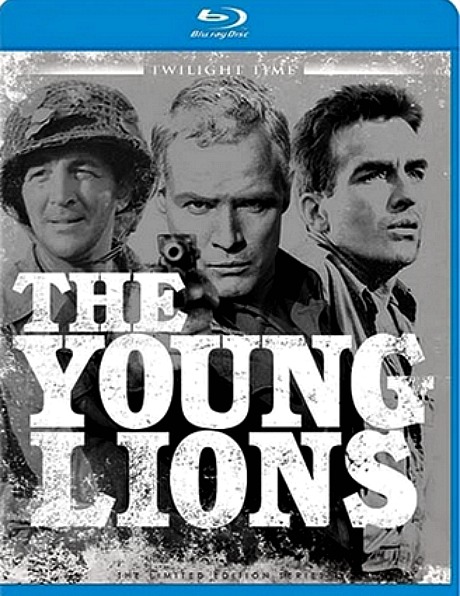
I hate paying $30 dollars for a Bluray when I know that a high-def streaming version will be available down the road. I’ve nonetheless ordered the Bluray of Edward Dymytryk‘s The Young Lions (Twilight Time, 6.9), mainly because I’m a sucker for black-and-white Scope as well as an admirer of legendary dp Joe McDonald (My Darling Clementine, Call Northside 777, Viva Zapata).

The Young Lions has always been sold as a war drama when it’s actually a rather talky piece about three guys who aren’t very lion-like or war-daddyish at all, and are more caught up in wrestling with personal issues than in fighting the enemy.

On the German side is blonde-haired officer Christian Diestl (Brando) who becomes more and more repelled by war as his military experiences accumulate. Stateside there’s a just-enlisted American Jew with jug ears — Montgomery Clift‘s Noah Ackerman — grappling with anti-Semitism in the ranks along with a louche showbiz type — Dean Martin‘s Michael Whiteacre — dealing with his own selfishness and cowardice.

Given Diestl’s disdain for war and the fact that he spends almost the entire film not shooting or even aiming at anyone, it’s a joke that the Twilight Time Bluray jacket features an image of Brando pointing a handgun at the camera.

At least I now have an excuse to trot out an eight-year-old piece about one of Brando’s greatest death scene, which happens near the finale of this 167-minute film.

Read more

To Serve and Protect

Kardblock is an AdBlock software that prevents any mention of the Kardashians from appearing on your computer, iPad or phone screen. The founder/creator is James Samir Shamsi, a Los Angeles marketing guy behind a “social media growth hackers” site called Chameleon. Shamsi is also working, he says, on coding that will block any Justin Bieber-related content.

Avert Your Eyes

Yesterday Jill Bauer and Ronna GradusHot Girls Wanted, a doc about the cruel underbelly of the amateur porn industry, had its Netflix debut. (I was going to write “unseemly aspects” but do porn producers have any seemly aspects?) Pretty young women have been used, abused and exploited for…well, centuries, of course, but more particularly since the advent of the industrial age and aggressive capitalism and all that. This is simply the latest wrinkle, and it’s not going to stop. For years I’d regarded amateur porn as a bit less odious and predatory than the established, old-school porn industry. But impressions change. Particularly, judging by this trailer, when you let docs of this sort sink in. I tried watching this last night but for some reason Tunnel Bear won’t let me access my Netflix account.

It’s the same with the meat industry in a sense. You go to the market and see those nice red cuts of sirloin and tenderloin and think of that grilled aroma with the sauteed peppercorns and garlic butter– a pleasure. But then you watch this and this and the idea of eating meat seems distasteful if not appalling. The meat industry has shrunk by over a third since the mid ’70s and more and more of us are leaning vegetarian, but is the meat industry going to fold up and die any time soon? No.

Read more

Compassion For Aloha?

A.O. Scott‘s Aloha review in the N.Y. Times is one of the kindest, bravest, warmest, most wonderful assessments of an allegedly Godforsaken film that I’ve ever read in my life. Yes, I stole most of that line from John Frankenheimer‘s The Manchurian Candidate but that’s beside the point. I’m wondering if the second wave of reactions to Cameron Crowe‘s film is going to be about pity, kindness, easing up, cutting the poor guy a break, sensible laments, etc. Now that the West Coast viewers are starting to attend early afternoon shows and East Coasters are three hours into the cycle, I’m asking HE readers if any soft pans can honestly be written or has Crowe’s rope just run out? I don’t mean to sound treacly or sentimental but I used to be one of Crowe’s journalist pallies and don’t want him to see go into a fetal-tuck position. This is a guy who once held mountains in the palm of his hand.

Paul Verhoeven Is Watching

I’m sorry to think this way but if the MIT cheetah robot’s motor and balancing skills are sophisticated enough to leap hurdles (and without padded robot feet!), how far away, technologically speaking, could a smart Robocop robot be? Five or ten years? Less? Not that any responsible party would want to build one, given the ramifications instilled by the films, but still…

Eisenberg’s Pain

Every actor who’s starred in a memorable, top-notch, award-worthy film soon realizes that the vast majority of films he/she will be offered in the wake of this landmark achievement will not be on the same level, or even close to it. And that must hurt. I’m betting, in fact, that once this realization has truly sunk in a wave of depression quickly follows. This is reality, Greg. Then they grim up and think positively: “Okay, most films are just okay or not bad and yes, some are crap, but I’m making good money and enjoying my off-screen life and I just have to hang in there and hope that I’ll be cast in something as good as The Social Network sometime within the next five or ten years…hopefully. Who knows?” Here’s a paragraph from a 15 year-old interview with Tony Curtis I did at a Beverly Glen delicatessen:  “At one point I handed Curtis a list of his 120 films and asked him to check those he’s genuinely proud of. He checked a total of 18. He didn’t check The Vikings. He didn’t check The Outsider. He checked Houdini. Every film he made after Spartacus in 1960 up until 1968’s The Boston Strangler, he didn’t check. He checked his role as a pair of mafiosos — Louis ‘Lepke’ Buchalter in 1975’s Lepke and Sam Giancana in the 1986 TV movie Mafia Princess.”

Anyone Sampled San Andreas 4DX?

I realize there’s only one theatre in Los Angeles showing San Andreas with the 4DX experience (i.e., inside Regal’s L.A. Live plex), and that New York and other cities don’t have a 4DX option at all, but if anyone’s seen San Andreas this way please share. As I mentioned two days ago 4DX “was a big reason why I surrendered to San Andreas, which I saw on an IMAX-sized screen at Prague’s Cinema City Novy Smíchov. 4DX isn’t just about seats that shake and tilt and vibrate in synch with the action (which is what the D-BOX experience more or less delivers) but facial air jets, misty water sprays, leg ticklers, back pokers, fog simulators, scents and warm air. You don’t have to be too thick to understand the transcendent joys of real cinema — you just have to relax and embrace the dumb and go with it. And it’s cool — the perfect physical compliment to watching submental destruction unfold for the better part of two hours.”

Fast Car


Some kind of commercial was being filmed late yesterday afternoon inside Prague’s central train station. They were using a beautiful Tatra 77, built in the mid 30s, as a prop. From Wiki page: “The Tatra 77 was an automobile manufactured by the upper class Czechoslovakian automaker Tatra between the two series. T-77 is the first mass-produced car with an aerodynamic body. In four years, a total of 255 models were manufactured. Its successor, built in 1936, was called the Tatra 87.”

Read more

Even By Standards of Silent-Film Era, The Lodger Had Problems

Last night I saw Alfred Hitchcock‘s The Lodger (’27), a vaguely kinky, London-based parlor drama about the terror caused by a Jack The Ripper-type killer, called “The Avenger,” who mysteriously murders attractive blondes on Tuesday evenings. (We’re not told if he’s a stabber or a strangler — maybe he just eyeballs his victims and they drop dead on the spot?) Suspicions quickly surface that a recent arrival at a London boarding house — a tall, good-looking but oddly behaving fellow (Ivor Novello) — may be the killer. Hitch encourages you to weigh this possibility for a good 75% of the film until revealing that Novello is just a queer duck who’s looking to find the man who killed his sister. Novello’s innocence is first hinted at when Daisy (June Tripp), the daughter of the boarding-house owners as well as a model, begins to feel affection and attraction for him, which understandably infuriates her much-older detective boyfriend (played by Malcolm Keen, who was nudging 40 during filming but looked closer to 45 if not 50) and adds to…well, the uncertainty factor, I suppose.

The Lodger was the first Hitchcock film about an innocent man wrongly accused of a crime. It was also Hitch’s first commercial success (it pretty much launched his career) and was also the first film in which he performed a walk-on. (He’s seen from the rear during a scene in which the presses of a major newspaper are printing news of The Avenger’s latest killing.) But this is a rather stiff and primitive little film — more “interesting” than good. Portions are nicely framed and focused, and yes, Hitchcock manages to implant a notion that for certain wackos there’s a kind of erotic charge that accompanies the murder of pretty girls. But he was only 27 during filming with only two or three previous films under his belt, and he just didn’t have enough knowledge or polish at this stage in his life. Not enough, certainly, to satisfy a guy like me watching The Lodger 88 years hence.

Read more