

This five-day-old Swedish skydiving video is terrific, perhaps even legendary, up until 1:31, which is when the GoPro camera flies off the guy’s head and it starts spinning faster than a light-speed clothes dryer for about 3000 meters (a little less than two miles) straight down. I’d been told that this video was a serious mindblower. Half of it is tedious. If only GoPro cameras had, say, little gliding wings that would automatically pop out and stabilize the camera when exposed to unnatural turbulence. The camera didn’t survive the fall but the memory card was intact.
Celibacy, Retreat, Withdrawal
Reposting of 2.2.15 HE review/discussion: “One of my last Sundance viewings was I’ll See You In My Dreams, a mild-mannered septuagenarian love-affair drama with Blythe Danner and Sam Elliott. We’ve all accepted the everything-older-is-younger theology (i.e., 70 is the new 60) and so it doesn’t exactly feel like a head-turner when Danner’s Carol Peterson, a widower somewhere around 70, hooks up with the same-aged Bill (Elliott), a mellow, white-haired dude who owns a boat. The only unusual and frankly unbelievable aspect is hearing that the slim, good-looking Peterson hasn’t been intimate with anyone for 20 years, which is when her husband passed.
“Everyone understands mourning and recovery, but pretty ladies in their 50s don’t become nuns because their husbands have died. Sooner or later they get back into it because sex is the nectar of life and the grand metaphor of appetite and engagement. Not schtupping means quitting on some level. It means you’re ‘too old’, and who wants to live a life that doesn’t include that intrigue? Not having sex is in the same boat as not enjoying good food, not hiking, not bike-riding, not petting your dog, not campaigning for a cause or a candidate, not laughing, not going to parties, not cooking, not visiting Italy, etc. It’s anti-life. Especially if you’re still slim and fetching, as Danner/Peterson clearly is.
Nearly One-Third Gone
We’re now three and a half months into ’15, and a glance at the calendar tells me that except for Alex Garland‘s Ex Machina (which I’ve seen and admired but have yet to review), there are no films of any real consequence opening between now and May 1st. So let’s call this a four-month assessment — the 20 best films from the first third of 2015. And let’s get rid of any distinction between theatrical, VOD and cable — if it opened on a reputable screen of any size between 1.1.15 and 5.1.15, it qualifies. And no distinctions between docs and narrative either. A good portion of the following were seen at a 2014 festival, on HBO or during Sundance ’15 — relatively few are 2015 theatrical newbies.
Disputes, additions and subtractions are encouraged. Pics are listed in order of value, preference, voltage, intrigue and in some cases importance:
First Quintet: (1) Alex Gibney‘s Going Clear: Scientology and the Prison of Belief (HBO); (2) Douglas Tirola‘s Drunk Stoned Brilliant Dead: The Story of the National Lampoon (Sundance ’15); (3) Yann Demange‘s ’71, (4) Asghar Farhadi‘s About Elly (no chance to review it yet, but Farhadi is a master — this is easily one of the most grounded, on-target and yet disquieting films I’ve seen this year); (5) Noah Baumbach‘s While We’re Young;
Cavett and ’70s Cacophony
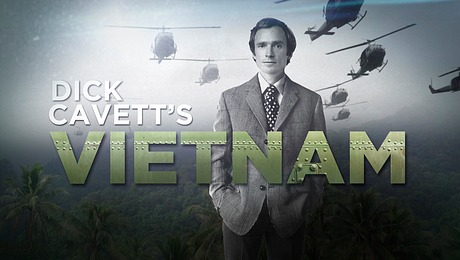
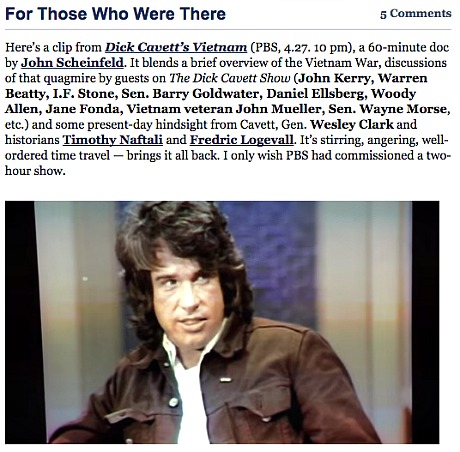
A few days ago I riffed about Dick Cavett’s Vietnam (PBS, 4.27), a riveting one-hour re-immersion into the anger and arguments against the Vietnam War during the early to mid ’70s. As I said before it’s a piece of stirring, well-ordered time travel. This morning I had a pleasant chat with Cavett about the show and other things. He mentioned that during a discussion following a Los Angeles performance of Hellman vs. McCarthy that only a handful had seen Dick Cavett’s Watergate, which aired last August. Cavett said that then and there he wished that PBS would put a bit more effort into letting people know about these shows. I understand why PBS marketers have used the image of a spiffily-dressed Cavett standing in front of what looks like a scene out of Francis Coppola‘s Apocalypse Now, but there’s something a wee bit odd about it. Cavett is a good fellow, sharp as a tack. Again, the mp3.
No Libertarian
Yesterday on Salon Joan Walsh urged reporters and commentators to “stop calling Rand Paul a ‘libertarian.’ Stop it right now. ‘I’m not advocating everyone go out and run around with no clothes on and smoke pot,’ Paul said in 2013. ‘I’m not a libertarian. I’m a libertarian Republican. I’m a constitutional conservative.’

“See, 2016 reporters? He said it himself. He’s not a libertarian. Why keep the myth alive in tedious, insight-free campaign coverage?
“Think Progress’s Judd Legum runs exhaustively through the record, but here are a few highlights. First of all, he’s staunchly anti-choice, supporting the ‘Life begins at Conception Act’ and pretty much every other piece of anti-abortion legislation that’s come before him. He’s got a 100 percent rating from the National Right to Life Committee.
It Works
I don’t follow golf (hah!) and five minutes ago I didn’t know or care who Rory McIlroy is or was. But I know now. Who’s the director of Ripple? Who cut it? Who scored?
Jingle in The Pockets
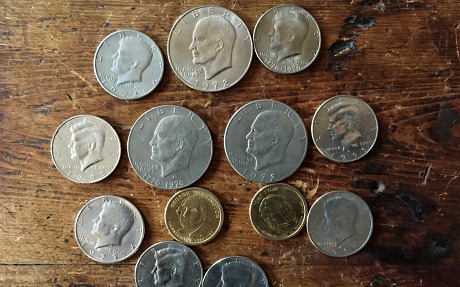
I don’t play thigh and knee-slap drums like I did in my teens and 20s, but I got into the habit of always carrying around a pocketful of silver for high-hat and cymbal effects. Mostly dimes, some quarters. Last week I asked a bank teller for some Kennedy half-dollar coins and for some reason she had a few Eisenhower dollars (’71 to ’78) to spare. It just feels right to carry them around. The more of a jingly sound, the better. The other night at a West Hollywood falafel joint I was out of singles so I gave an Eisenhower to a young female cashier. She studied it, caressed it, moaned slightly. I guess the more accurate word is cooed.
Long Time Coming
Cinema Guild has been screening Asghar Farhadi‘s About Elly, his 2009 masterpiece, for New York-area critics but not LA-area critics…yet. It opens in New York this Friday (4.8) but not in Los Angeles and other cities until early May. I’ve been hearing for years about Elly, made and released two years before A Separation (’11), but it hasn’t had any kind of U.S. theatrical release until now. So today I asked the Cinema Guild guys if I could please be sent a DVD screener or be allowed to watch it online. That’ll happen tomorrow, I gather.

Distractions Are Essential
“It’s just an accident that we happen to be on earth, enjoying our silly little moments, distracting ourselves as often as possible so we don’t have to really face up to the fact that, you know, we’re just temporary people with a very short time in a universe that will eventually be completely gone. And everything that you value, whether it’s Shakespeare, Beethoven, da Vinci or whatever, will be gone. The earth will be gone. The sun will be gone. There’ll be nothing.
“The best you can do to get through life is distraction. Love works as a distraction. And work works as a distraction. You can distract yourself a billion different ways. But the key is to distract yourself.” — Woody Allen in a 2013 “What I’ve Learned” Esquire piece.
It would obviously be a worthy endeavor if somehow the finest 5000 films could be saved and digitally encoded and sent out into space on hundreds of sentinel-like, torpedo-shaped cruisers. Hundreds of them, travelling every which way. It might take decades or centuries but eventually some intelligent civilization would find one of them, and then all that beauty would at least be somewhere.
Rolling Stone UVA Rape Retraction Story Is Obviously A Movie
Over the last 12 years there have been, by my count, three significant films about journalistic screwups at major publications, two of them concerning the N.Y. Times. 2003 saw the release of Billy Ray‘s Shattered Glass, about the exposure of several fabricated news stories by New Republic staffer Stephen Glass. Ten years later Samantha Grant‘s A Fragile Trust: Plagiarism, Power, and Jayson Blair at the New York Times, a documentary, was released. And on 4.17 Rupert Goold‘s True Story, a truth-based thriller based on a memoir by discredited N.Y. Times reporter Michael Finkel, will hit theatres. I’m now betting that within a couple of years we’ll be watching a fourth movie in this vein, one about the staggering screw-up by Rolling Stone reporter Sabrina Rubin Erdel and her editors in the UVA rape story of 2012, which has now been retracted and discredited. The Rolling Stone saga has the potential to be All The President’s Men in reverse — not a story of a liar or a plagiarist but an entire news organization turning a blind eye to basic journalistic essentials because the news story presented a politically correct legend — i.e., campus rapes are commonplace and college authorities rarely seem to do enough to adequately condemn or prevent them.
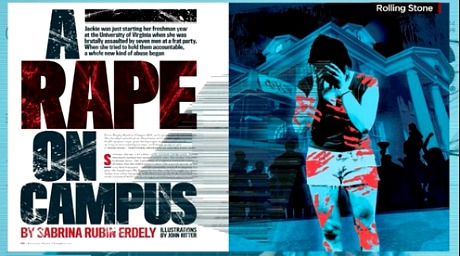
The moviegoing public will never be that interested in films about journalistic malfeasance, but Shattered Glass, at least, was a gripping, above-average melodrama about faking it in order to get ahead. It regarded an anxious American go-getter mentality that lusted for fame regardless of how that fame is achieved, and in so doing seemed to put its finger on something unsettling in the culture. In my view there’s something just as unsettling contained in the story of Rolling Stone reporter Sabrina Rubin Erdel and her editors in the reporting and almost total lack of fact-checking of the UVA “Jackie” story, which has now been retracted and discredited. It’s basically a tale of a reporter who so believed in the politically correct legend contained in a story about a gang rape of a woman named “Jackie” at the University of Virginia that Erdel (and her asleep-at-the-wheel editors) decided that the “facts”, ignored or unexplored as they seem to have been, weren’t as important as the general story it told, and how that story supported a description of a deplorable problem (i.e., campus rape is definitely prevalent today) that the p.c. crowd wanted to call attention to in a big way.