Ennui-Tinged Power Couple

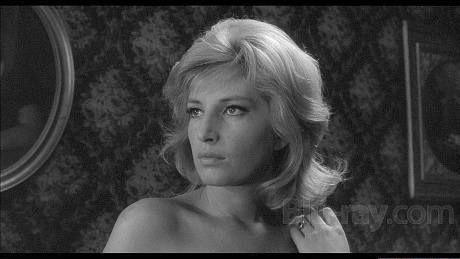
The upcoming Criterion Bluray of Michelangelo Antonioni‘s L’Eclisse (6.10) has me wondering why it’s so hard to find detailed information about the romantic relationship between Antonioni and Monica Vitti, who were quite the seismic historical couple. He made her into “Monica Vitti” and she made his movies sexy, moody and cool (if you regarded feeling nothing as “cool”). For a four- or five-year span (’59 to ’64 or thereabouts) they had a huge impact on world cinema and filmmakers everywhere. Vitti had starring roles in Antonioni’s four huge landmark films of that period, each sharing a common mood/theme about existential ennui and spiritual enervation among Italy’s jaded elite — L’Avventura (’60), La Notte (’61), L’Eclisse (’62), Red Desert (’64). What was the exact nature of their affair? Exactly how long were they together? The books about Antonioni are mostly critical appreciations of his art, but accompanied by somewhat sketchy or under-detailed accounts of his personal life. Was the Antonioni-Vitti relationship more or less the same kind of quid pro quo arrangement that has existed between many middle-aged, brand-name directors and younger talented actresses (you mold me into a classy, highly respected, world-famous star by casting me in your super-brilliant films and I will reciprocate in the usual ways) or was it something more? Vitti reportedly helped Antonioni raise production funds for L’Avventura. Were there shades of a Jules Dassin-Melina Mercouri partnership for a time…or not? I ask because Antonioni-Vitti were apparently “together” for the same five or six-year period that their creative relationship lasted. I don’t know the particulars but I’d like to. I only know that you can’t find much online about their history. If there’s a tell-all book of some kind I can’t find it on Amazon. If there’s a source I should be looking at, please advise. People have written about the career-propelled marriage between David O. Selznick and Jennifer Jones — why not Antonioni-Vitti?
Read more

Leviathan Guys

The Leviathan press conference began at 12:30 pm, ended around 1:20 pm. Director Andrey Zvyagintsev, producer Alexander Rodnyansky and costars Alexey Serebryakov (the victim), Vladimir Vdovichenkov (the lawyer buddy from Moscow), Elena Lyadova (the cause of all the trouble) and Roman Madyanov (the fat corrupt mayor). You’d think with all the Palme d’Or talk the Salle du Presse would be packed, but it wasn’t. I asked a question about the gallons of vodka that the characters consume. Given the general life-mirroring nature of this film, is this really how many or most Russians put it away? The answer (spoken in Russian, translated into French and then into English with headphones) was “this is quite amusing” and “what about the Japanese?…they’re just as bad.” Before the press conference started a female journalist tried to help me pronounce “Zvyagintsev” correctly. The accent is on the second syllable; it goes something like “ZivYAHgintsev.”

Read more

Not That Much

With the exception of Kristen Stewart‘s alert, quietly arresting performance as a personal assistant to Juliette Binoche‘s famous, middle-aged actress undergoing an emotional-psychological downshift, Olivier Assayas‘s Clouds of Sils Maria is a talky, rather flat experience. It isn’t Persona or Three Women or All About Eve, although it seems to be occasionally flirt with the material that these three films explored and dug into. MCN’s David Poland has written that it sometimes feels like “a female version of My Dinner With Andre” — generous! But on that note I’ll give Poland credit for thinking about this rather airless and meandering chit-chat film more than I did. It just didn’t light my torch. I agree with Poland on one point — it would have been a more interesting film if Assayas has focused more on Stewart and costar Chloe Moretz, who’s playing a version of herself. I have to catch Kornel Mundruzco‘s White God (a.k.a. “the dog movie”) at the Salle Debussy at 2:30 pm so read Poland’s review and decide for yourself if you want to sit through this thing when it opens stateside.

Last Significant Cannes Screening

Starting in exactly 30 minutes (and I’m still at my desk): Olivier Assayas‘s Clouds of Sils Maria avec Juliette Binoche, Kristen Stewart and Chloe Grace Moretz. Boilerplate Wiki synopsis: “Maria Enders (Binoche) has a successful acting career and a loyal assistant (Stewart) but when a young actress (Moretz) interprets a role in a new movie — the same role which made Enders famous — her world starts to crumble. Haunted by her past life, she withdraws along with her assistant to the Swiss town of Sils Maria.” And this, presumably, is what the movie’s about — i.e., to live or to hide away and die. It had better not be about Binoche sitting around and moaning — just saying.

Walkout Club

“The festival is often criticized for its allegiance to established auteurs, a loyalty that leads to sighs of familiarity and worse, especially when it comes to work like Still the Water, the latest from another Cannes regular, Naomi Kawase, which opens with a man slitting a goat’s neck. I left after an hour of empty landscapes, talk and the sight of a second goat having its neck slit.” — N.Y. Times critic Manohla Dargis in her latest Cannes report. For years I’ve been getting roasted in this space for my occasional walkouts. “How dare you?,” “You call yourself a critic?,” “You have to see the whole thing!,” etc. But everyone does it from time to time, and there’s nothing dicey about saying “I saw this much of a given film and then I bailed, but here’s what I thought about the portion that I saw.” In my own small way perhaps I’ve helped to make the world a bit safer for those who wish to write this.

Leviathan Crushes It — Almost Certain to Win Palme d’Or

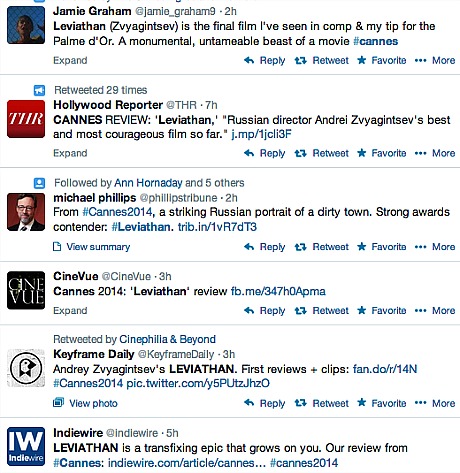
Well, that tip I got the other night about Andrey Zvagintsev‘s Leviathan turned out to be correct. It’s a drop-dead brilliant, awesomely-composed-in-every-respect melodrama and moral tale that concurrently serves as a microcosm of (or metaphor for) a morally compromised, ruthlessly malevolent, bare-knuckled Russia. Vladimir Putin will love it! (Kidding.) Political corruption, lust and infidelity, way too much vodka, blackmail and thuggery, gunshots, bromide-dispensing priests who kowtow to powerful scumbags, huge whale skeletons, crashing waves, rotting ships — this puppy has it all plus the aura of a majesterial art film plus opening and closing musical passages by Phillip Glass plus the most beautifully lighted, handsomely composed widescreen photography (by Mikhail Krichman) I’ve seen in a long time. And of course, Zvyagintsev, 50, best known for The Return (’03) and Elena (’11), is the grand maestro extraordinaire. And the acting — Elena Lyadova, Vladimir Vdovichenkov, Dmitri Seleznev, Aleksey Serebryakov, Anna Ukolova — isn’t “acting” but rooted, rock-solid behavior that kicks ass all the way around the block and back to your driveway. The consensus inside the Salle Debussy lobby among a few select critics was that Leviathan, a home run if I’ve ever seen one, is a very likely candidate to win the Palme d’Or. It just delivers on all fronts to such an impressive degree…I don’t see how the jury can deny it.

Read more

Moonlight Bauble?

Set in the South of France in the 1920s, Woody Allen‘s Magic in the Moonlight is “about a debunker (Colin Firth) brought in to help unmask a possible psychic swindler (Emma Stone)…complications ensue…a backdrop of wealthy mansions, the Côte d’Azur, jazz joints and fashionable spots for the wealthy of the Jazz Age,” etc. The atmospheric aroma of Midnight in Paris meets A Midsummer Night’s Sex Comedy meets the Houdini vs. Margery the Medium dispute? Firth needs to be in something good. The Sony Pictures Classics release opens on 7.25.14.

“Words of Wisdom, Lloyd…”

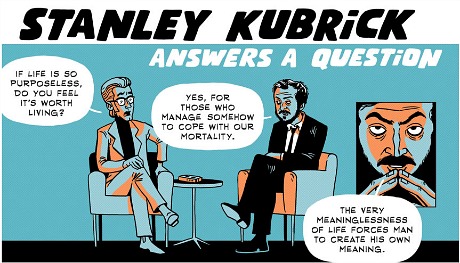
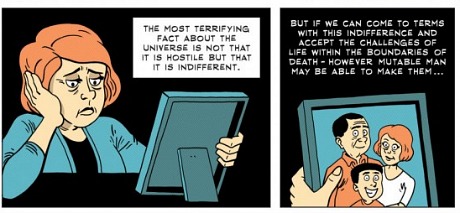
I first read this Zen Pencils comic-book illustrated piece called “Stanley Kubrick Answers A Question“…what, three or four days ago? But the quote comes from a 1968 Playboy interview Kubrick gave soon after the release of 2001: A Space Odyssey so what difference does it make? Kubrick’s response to the shadow of hovering death and the general meaningless of scrambling around for fulfillment on this speck of matter isn’t earth-shattering, but it’s one the most sensible I’ve ever read. LexG would do well to take heed. Ditto anyone going through a dark patch.

Mommy is A Hyper Hand Grenade

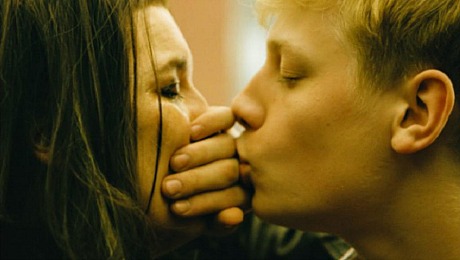
Xavier Dolan‘s Mommy is, for me, the third levitational flick of the 2014 Cannes Film Festival, the other two being Damian Szifron‘s Wild Tales and David Cronenberg‘s Maps to the Stars. That said, the first 50 minutes of Mommy is punishment — assaultive, infuriating, occasionally amusing but more often lemme-outta-here. But I could tell toward the end of my session with this boxy-is-beautiful psychodrama (which I was only able to watch for 75 minutes due to an appointment I was honor-bound to keep) that Dolan had gotten hold of something that was not only focused and working but was slowly building into something more. I didn’t “like” watching much of it, but Mommy is an eye-opener — a movie like no other I’ve seen during this festival. No apologies, full throttle, very few shadings…exclamation!


Mommy costars Anne Dorval, Antoine-Olivier Pilon.

I’m still no Dolan fan (Heartbeats, his second film which I saw here four years ago, sounded the first warning) and his general off-screen rep is that he’s a bit of a histrionic handful. But when I read a line from a review by Hollywood Reporter critic Stephen Dalton that “The Ego has landed,” I knew I had to submit myself.

Read more

Loach Isn’t Necessarily Retiring

British director Ken Loach said during a Cannes press conference this morning that he’s not necessarily retiring, which is good to hear. I don’t know what to say about Jimmy’s Hall, his latest film which screened early this morning. It’s a Loach thing through and through, of course — mid-tempo, working-class, earnest, low-key, authentic, political. But it’s a bit of a shrugger. It’s just a no-frills, true-life drama about Irish rabble-rouser Jimmy Gralton upon returning to his native home after more than 20 years spent in the U.S., his conflicts with conservative forces who feared the possible igniting of a leftist movement, and Gralton’s subsequent deportation back to the U.S. There are vague echoes, of course, of today’s 1% vs. 99% equation, and a refrain of the old rule about dissidents always dealing with struggle and adversity. The painterly textures and atmosphere are what moved me the most. I miss the visual splendors of rural, old-time Ireland (the small-village architecture, the browns and greens, the candle-glow lighting) that Loach has often captured in his films, and which are exquisitely presented here. He shot it on that dying technological format known as celluloid.