

I was going to catch Bryan Singer‘s X-Men: Days of Future Past at the Pathe Wepler tonight but I think I’ll wait until tomorrow — too popular, long lines, sold-out houses, etc. $90.7 million domestic by tonight, $110 million by tomorrow night (bigger than Avatar), $171 million foreign, $261.8 million worldwide. There’s almost a 20-point difference between the 91% Rotten Tomatoes score vs. the 74% Metacritic rating. That means there’s a little grumbling going on so what’s the HE verdict? It’s okay to rave, of course, but does anyone hold with Amy Nicholson’s view that “there’s not a line of dialogue that isn’t exposition, as though screenwriter Simon Kinberg feared that if he stopped drilling home his messages about peace, love, and social panic, we might think we were simply [looking] to have fun…it’s like discovering your box of Milk Duds is really chocolate-covered vitamins.” Or Robbie Collin’s opinion that it “squanders both of its casts, reeling from one fumbled set-piece to the next…it seems to have been constructed in a stupor, and you watch in a daze of future past.” A stupor?
Sad Monster’s Manifesto
Not long before Friday night’s Isla Vista mass killing, 22 year-old Elliot Rodger apparently sent a 106,000-word biography called “My Twisted World” to a Santa Barbara TV station. Here, apparently, is the document. It makes for very creepy reading. Sad, curious, at times horrifying. A tolerable writer, Rodger relates his story in relatively clear terms. I’ve never read an explanation of a mass killing quite as personal or elaborate as this one.
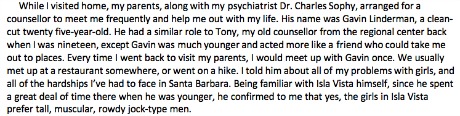
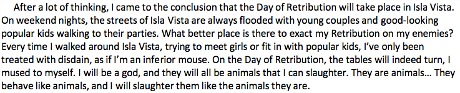
Rodger was very much a child of the entertainment industry and no stranger to occasional privelege. Hotshot industry dad (documentarian, second-unit director, photographer) and an actress stepmom. Even his shrink, Dr. Charles Sophy, is an author who’s appeared several times on the tube.
Marvel and the Disney “Stink”
In a 5.24 post, Badass Digest‘s Devin Faraci says he’s hearing that the Marvel problems (Edgar Wright quitting Ant-Man, Drew Goddard leaving Daredevil, Marvel wrestling control of Thor: The Dark World away from director Alan Taylor) ) are “coming from higher up than [Marvel topper] Kevin Feige — Disney execs are sticking their fingers into the Marvel pie. Marvel [has] always been autocratic but things have been getting uglier over there for some time, especially now that Disney is getting involved. Why would the studio fuck with the division that’s making money and having a huge cultural impact right when they’re at their best? Because of dumb egos. Hollywood is dumb, run by dumb, venal people, and the executives who aren’t creative resent the people who are, and want to get their stink on the movies.”
Denzel vs. Russian Mafiosos
We all remember Edward Woodward as The Equalizer back in the mid to late ’80s — a tough, disciplined loner who helped people who lacked the courage or strength or resources to stand up to bad guys who were giving them trouble. Anyone who saw Denzel Washington as “Creasy” in Tony Scott‘s Man on Fire knows that he’s a perfect choice to succeed Woodward in a film version of The Equalizer (Columbia, 9.26), but the trailer is indicating (to me at least) that director Antoine Fuqua is no Scott and that Richard Wenk‘s script might be on the primitive side…maybe. Let’s hope not.
Lonely American Psycho
The late Elliot Rodger‘s “day of retribution” video — taped a day before last night’s Isla Vista massacre — is obviously one of the most twisted and pathetic messages ever captured along these confessional lines. The dialogue is ghastly. The guy was a monster but what fairly good-looking guy kills young women because he can’t get laid? A friend has opined that Rodger was basically Patrick Bateman — a sociopath who couldn’t see beyond his disease. On the video Rodger was saying a couple of the same things that a certain member of the HE community has ranted about (loneliness, no one will “do” him, etc.), but girlish indifference or rejection is not, I suspect, the real reason he murdered six people last night. How many hundreds of thousands of young guys out there are enduring the anguish of a loveless, sex-less life right now? Life is hard, man, and girls have been breaking hearts since the beginning of time…what else is new?, live with it. The 22 year-old Rodger, who died from a gunshot wound to the head (probably self-inflicted), is reportedly the son of Hunger Games second-unit director Peter Rodger. The first thought I had when I read this bit of information was “who raised this kid?” The second thought was a question — how does a guy evolve without being distracted by feelings of basic decency and respect for the sanctity of life? The third thought was that Elliot Rodger is roughly the same age as Dzhokhar Tsarnaev, the Boston Marathon bomber.
Cannes Jury All But Insults Leviathan With Screenplay Award
The 67th Cannes Film Festival jury (honcho Jane Campion + Sofia Coppola, Willem Dafoe, Nicolas Winding Refn, Leila Hatami, Gael Garcia Bernal, Carole Bouquet, Jeon Do-yeon) has handed the prestigious Palme d’Or to Nury Bilge Ceylan‘s Winter Sleep, a highly respected film in some critical quarters but by no means the recipient of unqualified universal praise.
I’m in no position to applaud or disagree as I missed the Ceylan but I’m snarling anyway because the jury has also backhanded Andrey Zvyagintsev‘s Leviathan with a piddly consolation prize — a Best Screenplay award, which Zvyagintsev has shared with Oleg Negin. Leviathan was/is easily the most dazzling competition film of the festival — it blew everyone away — and the jury has given it the smallest honor they could without ignoring it entirely. They knew they had to give Leviathan something with all the praise being shouted from the rooftops so they did, but they denied it the Palme d’Or, the Grand Prix and the Jury prize, at least one of which it absolutely deserved.
Brilliant, guys! If there’s such a thing as bad jury karma, Campion & Co. are feeling the pangs right now. This definitely falls under the heading of “forehead smacker.”
The esteemed Bennett Miller has deservedly won the Best Director prize for Foxcatcher, his much-admired psychological murder melodrama with Steve Carell, Channing Tatum and Mark Ruffalo. Good fellow, superbly crafted film, etc.
The Grand Prix award (the second place Beat Picture trophy) went to Alice Rohrwacher‘s The Wonders.
The Jury Prize (i.e., the third-place Best Picture award) was split between Xavier Dolan‘s Mommy, for which honors have been widely expected, and Jean-Luc Godard‘s Goodbye to Language, which few critics except for N.Y. Times Manohla Dargis expressed much excitement about.
Julianne Moore, allegedly asked to return to Cannes for tonight’s ceremony but a no-show regardless, won Best Actress for her fading actress role (a companion to Juliette Binoche‘s in Clouds of Sils Maria) in David Cronenberg‘s Maps to the Stars. Timothy Spall won the Best Actor prize for his lead role in Mike Leigh‘s Mr. Turner.
Handheld Time
I’ve got a second-class ticket on a noon train for Paris, and I need to leave within 20 minutes. A seven or eight-block walk. I’ve been in this town for 12 days as of today. I love this festival like no other but I’m happy to take leave. No au revoirs or a bientots because it never stops.
Cannes Awards Predictions
Over the last 36 hours I’ve sufficiently conveyed my view that Andrey Zvyagintsev‘s Leviathan is the only grand-slammer of the now-all-but-concluded Cannes Film Festival. It would be extremely perverse for the Jane Campion-led jury to give the Palme d’Or to anything else. Yes, I failed to see Nuri Bilge Ceylan‘s 196-minute Winter Sleep and Abderrahmane Sissako‘s Timbuktu so my judgment lacks the necessary perspective, but neither was greeted with the across-the-board, close-to-ecstatic praise that the Russian melodrama has attracted. I just knew during Thursday night’s screening at the Salle Debussy that Leviathan all but had it in the bag. Everyone sensed this (including, trust me, the Movie Godz who look to the Cannes awards to provide inspiration and guidance). If it doesn’t win this evening I’ll…I don’t know what I’ll do. Perhaps I’ll content myself with the usual forehead-smacking and rancid after-vibes
And you never know. The jury might give the prize (I can’t believe I’m actually writing this) to Xavier Dolan‘s Mommy. The first 75 minutes of this film, as noted, are way, way too manic and abrasive with a dysfunctional dead-end vibe that is truly suffocating, but you know that juror Nicholas Winding Refn, unable to even begin to suggest that Ryan Gosling‘s all-but-dismissed Lost River (which I found enjoyably audacious) might be a worthy recipient, has stood up for the Dolan. A lot of Cannes journos have gone apeshit for it.
Nobody knows anything, of course. I know that some predictions are over the falls in a barrel. One guy believes that Mike Leigh‘s Mr. Turner, which many respected but no one was truly over-the-moon about, will take the Palme d’Or. No. Fucking. Way. The Independent‘s Kaleem Aftab has actually written that he sees the competition for the Grand Prix jury prize (essentially the second-place award) as being between Mommy and Naomi Kawase‘s Still the Water, which almost everyone instantly dismissed. He also said that Leviathan is an “outside candidate” for the award. Really, he did.
I’m predicting (a) Leviathan for the Palme d’Or, (b) Mommy or Winter’s Sleep for the Grand Prix Jury prize, (c) Foxcatcher‘s Bennett Miller for Best Director (although this could go to Dolan or Sissako), (d) Leviathan or Mommy for Best Screenplay, (e) Mr. Turner‘s Timothy Spall for Best Actor, in part for expertly burying his dialogue with a deep-in-the-throat guttural grumble that I couldn’t make heads or tails of half the time, and (f) Two Days, One Night‘s Marion Cotillard for Best Actress as her respectable but unexceptional portrayal of a depressed, Xanax-popping wife and mother going door-to-door and asking several co-workers to vote against laying her off has been met with unmitigated praise…go figure.
Those Nutty Muslim Fundies
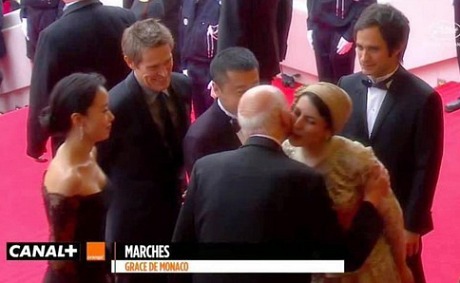
“We, the undersigned, a group of student Muslim brothers and sisters, ask the cultural and media branch of the judiciary to prosecute Leyla Hatami for her sinful act of kissing a strange man in public, which according to article 638 of Islamic Criminal Justice carries a prison sentence. Furthermore, the action of this film star has hurt the religious sentiments of the proud and martyrs-breeding nation of Iran and as such we also demand the punishment of flogging for her, as stipulated in the law.” — Excerpt from complaint filed with Iran’s judiciary by Hizbullah Students, a group with links to Iran’s Revolutionary Guard, as reported on 5.22 by the Guardian‘s Damien McElroy and Ahmad Vahdat.
Man Needs To Step Up
I don’t care if Quentin Tarantino becomes Michael Keaton…fine with me. But if he wants to do something about it, now’s the time while he still has a few sprigs left. If I’m not mistaken Keaton “did something about it” a while back, by the way. This is the 21st Century, the age of the Jetsons. You don’t have to look like Uriah Heep unless…you know, it doesn’t matter to you.
Wright Has My Respect
A respectful salute to Edgar Wright for leaving Ant-Man, the dumbest sounding FX-driven transformation movie in cinematic history, over creative differences. I’m guessing the departure was preceded by Wright saying to the people on his team, “More and more this movie is shaping up into something truly legendary in terms of idiotic material and potential career ruination. I have to save myself. I won’t go down with this film!” Word around the campfire is that Marvel asked for an extensive rewrite of the script, which is late in the game with the cast in place. The official statement reads as follows: “Marvel and Edgar Wright jointly announced today that the studio and director have parted ways on Ant-Man due to differences in their vision of the film. The decision to move on is amicable and does not impact the release date on July 17, 2015.” Update: Latino Review has posted a credible-sounding account of what happened, based on reporting: http://www.latino-review.com/news/exclusive-the-inside-story-on-the-divorce-between-marvel-edgar-wright-over-ant-man.
