Criterion’s Red River Is Shorter By Six Minutes

Hollywood Elsewhere to anyone who can shed light, but particularly Howard Hawks biographers Joseph McBride and Todd McCarthy: The forthcoming Criterion Bluray of Howard HawksRed River (’48) is described on the Criterion website as being a “4K digital restoration of the rarely presented original theatrical release version” that runs 127 minutes, as opposed to 133-minute version that was on the Masters of Cinema Bluray that streeted on 10.28.13.
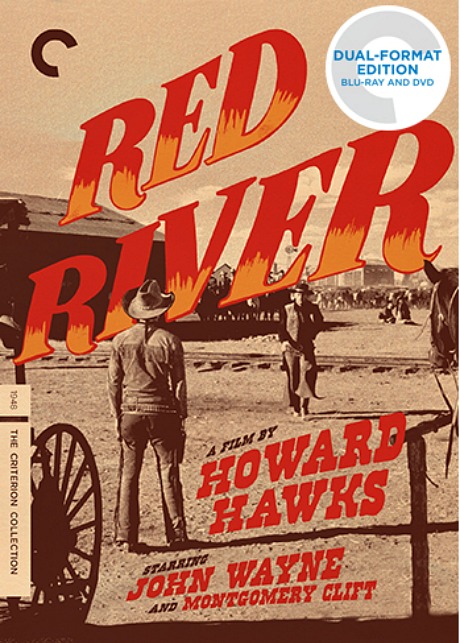
The Criterion disc will also include a 2K restoration of the “longer version” (i.e., 133 minutes), which is the same version found on the Masters of Cinema Bluray.
Read more

“Nature’s Wrath,” etc.

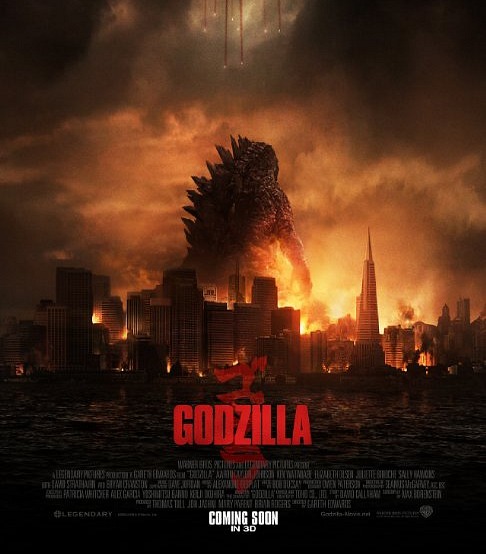
The one-sheet for the forthcoming Godzilla (Warner Bros., 5.14) has a nice inferno-ish quality. Molten lava, blast furnace, etc. A colorful descendant of the black-and-white cityscapes of Tokyo aflame in the original Gojira. The movie, of course, will almost certainly be sludge. At last summer’s ComicCon director Gareth Edwards said that his Godzilla “will be portrayed [more] as an anti-hero rather than a villain,” adding that the beast “is a representation of the wrath of nature…we’ve taken it very seriously and the theme is man versus nature and Godzilla is certainly the nature side of it. You can’t win that fight. Nature’s always going to win and that’s what the subtext of our movie is about. He’s the punishment we deserve.”

I don’t know what city is going to be attacked within the film (looks like San Francisco), but principal photography began last March in Vancouver, and then things moved to Honolulu in late June. Principal photography wrapped on the weekend of 7.13/14.

Ash Friday

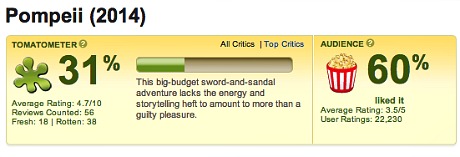
I am committed to catching a 12:10 pm 3D screening of Pompeii at West Hollywood’s Grove plex. I am a lamb going to slaughter. With a Rotten Tomatoes rating of 31%, Pompeii almost certainly sucks ass. And yet RogerEbert.com’s Glenn Kenny, of all people, has given it half a pass. “The action scenes are choice, and once the clouds of ash and shooting fire and churning seas start up, Pompeii achieves a momentum that most sensationalist studio fare can’t touch.” I am determined to hate on this film, but whenever I see something with a pre-determined prejudice, I always notice one or two things that I like and I come out shrugging and going “Aaahh, didn’t blow as badly as I expected.”

Kang Is Out To Lunch

Not only is TheWrap critic Inkoo Kang dead wrong in stating that the conclusion of Hany Abu-Assad‘s Omar (Adopt, opening today in N.Y. and L.A.) is “weak” and “strangely numbing” and “a tacky resolution.” She’s so dead wrong that I’ve decided that henceforth she needs to be regarded askance. (There’s a difference between having a distinct opinion and apparently missing what other sensible, informed critics have observed.) Salon‘s trustworthy Andrew O’Hehir has described Omar‘s finale as “a shocking final explosion that seems inevitable in retrospect.” And N.Y. Times critic A.O. Scott has declared that “the film’s final scene feels shocking and abrupt, but also chillingly inevitable, consistent with the logic of a situation that defies all reason.”

Read more

Railroad Chicken

If you’re shooting a scene on rural railroad tracks, you need to do two things. One, you need to contact local railroad authorities and make double-sure about which trains will be coming along at exactly what time. And two, you need at least two production assistants with walkie-talkies to be watching several hundred yards away in both directions in case a rogue train shows up unexpectedly. If you haven’t done both these things, it’s your own damn fault if something goes wrong. Another sensible idea: if you’re shooting with a bed on the train tracks and you suddenly realize that a rogue train will be roaring through in a minute or less, you get the hell out of there. Forget about the bed and run like hell or jump off the railroad trestle bridge…simple.

“I Hope To See You In Chicago”

“Actors have been lashing out against their profession and its grip on their public images since at least Marlon Brando,” James Franco remarks in a 2.19 N.Y. Times Op-Ed. “Brando’s performances revolutionized American acting precisely because he didn’t seem to be ‘performing,’ in the sense that he wasn’t putting something on as much as he was being,” he states. This is precisely what Brando seems to be doing during this lightly absurd 1965 press conference for Bernhard Wicki‘s Morituri, a World War II thriller made during Brando’s ten-year stinker phase (which wouldn’t end until The Godfather). Brando has obviously decided not to sell but to “be.”

Read more

Two-Person Race

Grantland‘s Wesley Morris and Chris Connelly both believe that Lupita Nyong’o will take the Best Supporting Actress Oscar. So do I.

Needs To Be Seen

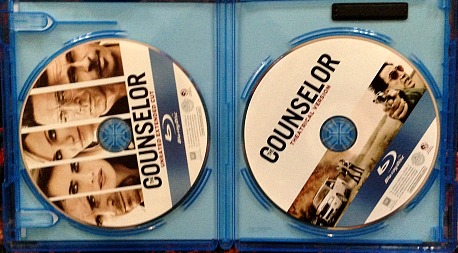
I’ve now watched the extended cut (138 minutes) of Ridley Scott‘s The Counselor twice — via iTunes in Prague and again last night on Bluray. There are one or two new scenes but it’s basically the theatrical cut with each interesting scene (which is nearly every one) running a bit longer. Some seem to go on a bit too long, but with a film like this “talkier” is generally better. In my mind the added length makes it a tastier, more satisfying meal all around. A cold meal, of course — The Counselor pretty much revels in its lack of compassion. But there’s no doubting this is one clear hard diamond — philosophically precise and commanding and unyielding and even (I know how this sounds) oddly personable in a perverse sort of way. I’ve posted a ton of material on this film, and we’ve all agreed that The Counselor doesn’t deliver the payoff that audiences tend to go to movies for. It is nonetheless a smart, well-engineered, well-oiled, first-class thriller-cum-philosophy lecture piece that comes from the pit of Hell. The Counselor is about as strong and uncompromising as a film of this type can theoretically get.

Read more

Feel Granger’s Pain

The Trailers From Hell guys are to blame for this post. Yesterday they put up a featured link for a grade-Z 1972 Italian exploitation sleaze-flick called Amuck (nudity, sex scenes, sadism, murder). After watching 20 or 30 seconds I was about to click off when I noticed that poor Farley Granger (Strangers on a Train, They Live By Night, Rope) had a lead role. Granger and his longtime boyfriend Robert Calhoun moved to Rome in the early ’70s for the work and whatnot, but to have once been at the very peak of your profession only to wind up accepting icky exploitation gigs as your drawing power fades…the humiliation! Many actors who’ve fallen on lean times have gone this route. Thank fortune that Granger rebounded on the Broadway stage in the late ’70s and ’80s (The Seagull, The Crucible, The Glass Menagerie, Deathtrap, The King and I, A Month in the Country). In 1986 he won an Obie Award for his performance in the Lanford Wilson play Talley & Son. Granger died on 3.27.11 at age 85.