





HE and Jody Jasser are training into Manhattan late this morning. The first order of business is a 1:15 screening of Richard Linklater‘s Hit Man, at the Paris theatre on 58th, comped tickets courtesy of Netflix friendos. (Thanks, guys!) Then two or three hours of strolling around, and then a 7 pm dinner with friends at Novitá, 102 E. 22nd St., at the corner of Park Ave.
[Partly borrowed from “Peak Years“, posted on 3.11.13]:
Which present-tense, brand-name directors are peaking right now? In 2024, I mean. Generally speaking peak director runs last around ten years, sometimes a bit longer. You would think 15 or 20 or even 25 years would be closer to the norm, but I’m not talking about mere productivity or financial success — I’m talking about peak years, great years.
Two things have to happen for a director to enjoy a special inspirational run. One, he/she has to be firing on all cylinders — adventurous attitude, good health, relentless energy. And two, the culture has to embrace and celebrate his/her output during this run of inspiration.
Just being a gifted filmmaker doesn’t cut it in itself — the public (or at the very least the critics and the award-bestowing fraternity) also has to agree.
David Lean had a high-quality ten-year run run from Brief Encounter (’45) through Summertime (’55), but his prime-zeitgeist period lasted only eight years — The Bridge on the River Kwai (’57) to Dr. Zhivago (’65). The poorly received Ryan’s Daughter nearly finished him off, but then he came back in ’84 with A Passage to India.
John Ford‘s zeitgeist decade ran from The Informer (’35) to My Darling Clementine (’46), then he began to caricature himself with his Monument Valley western films of the late ’40s and ’50s. Ford then resurged with The Horse Soldiers (’59) and The Man Who Shot Liberty Valance (’62).
Alfred Hitchcock did superb work in the ’30s and ’40s, but his window of mythic greatness lasted only nine years — Strangers on a Train (’51) to Psycho (’60).
Billy Wilder‘s grace period ran ten years — Sunset Boulevard (’50) to The Apartment (’60).
Francis Coppola‘s window ran from The Godfather (’72) to One From The Heart (’82).
Oliver Stone had a 13-year window — Salvador (’86) to Any Given Sunday (’99).
So far [written in ’13] Alejandro Gonzales Inarritu has had a decade-long grace period — Amores perros (’00) to Biutiful (’10).
David Fincher has enjoyed an eleven-year window so far — Fight Club (’99) to The Social Network (’10).
In HE’s book Geta Gerwig is cuurently peaking, obviously, although the prospect of her making a Narnia film depresses me. Todd Phillips, who pole-vaulted up to a new level with 2019’s Joker and appears to have a slam=bang sequel with Joker: Folie a Deux, is peaking bigtime as we speak. Who else?
In an 11.1.11 interview with N.Y. Times columnist Frank Bruni, Alexander Payne, who’d recenty turned 50, admitted that he’d made too few movies up to that point, and that he intended to pick up the pace.
“I’m in my prime right now,” Payne said. “I still have energy and some degree of youth, which is what a filmmaker needs.”
Is Payne concerned about using it before losing it? “Oh yeah,” he said. “Big time. You look at how many years you have left, and you start to think: How many more films do I have in me?”
He mentioned, for the second time in our talks, that Luis Buñuel didn’t really get going until he was in his late 40s. That consoles him. The Descendants, then, isn’t just a movie. It’s a marker, a dividing line between his slowly assembled oeuvre until now, including Election (1999) and About Schmidt (2002), and the intended sprint ahead.
“I want to move quickly,” he said, “between 50 and 75.”
On the other hand Andrew Sarris‘s remark about artists having only so much psychic essence (i.e., when the cup has been emptied, there’s no re-filling it) also applies.
Sidenote: While I did pretty well as a journalist and a columnist in the ’90s and early aughts, my big decade began in ’06 when I took HE in to a several-posts-per-day bloggy-blog format. Everything was pretty great for 13 years until the wokester zealots ganged up on me in ’19 and ’20.
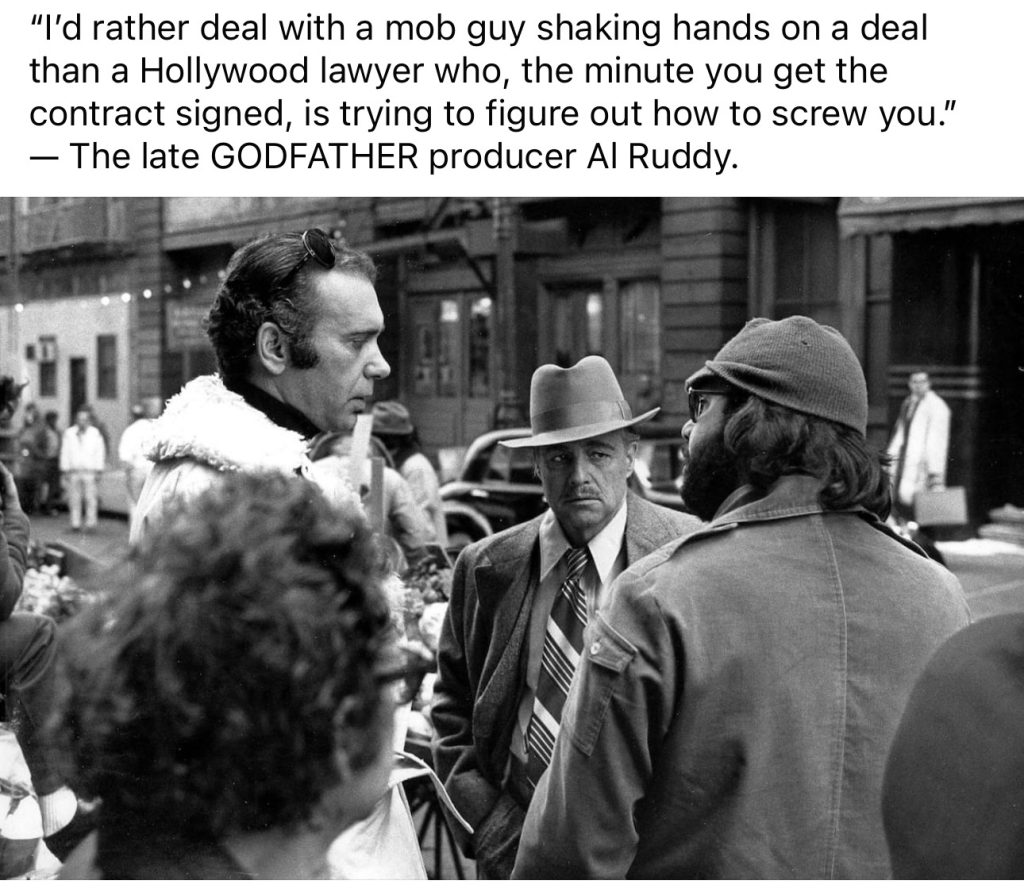
In all candor, my strongest recollection of the recently deceased Godfather producer was the unfortunate fact that he wore a profoundly ugly tuxedo to the 1973 Oscars (i.e., the watched-by-tens-of-millions ceremony that raised high the Godfather legend).

“[Some wokester-influenced kids] believe that male and female are concepts invented by straight white men. They think their bodies and minds are mismatched, and that without pharmaceuticals and operations, happiness will elude them.” — Miriam Grossman, psychiatrist, author andf public speaker.
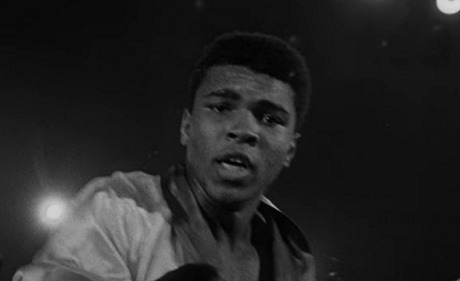
I’d forgotten that the 20 year-old Muhammad Ali (initially known as Cassius Clay) had a fast cameo in Rod Serling‘s Requiem for a Heavyweight(’62).
Directed by Ralph Nelson, pic was a critically respected adaptation of the televized Playhouse 90 version, which Serling originated and produced in ‘1956.
Serling and Nelson won Emmy Awards for the ’56 version. Nelson also directed the multi-Oscar-nominated Lillies of the Field (’63) and Charly (’68).
I’ve never seen a kinescope of the ’56, but the writing in the feature version is exceptional — concise, bitter, eloquent, surprisingly emotional at times.
Produced by David Susskind, Requiem for a Heavyweight is free to watch on YouTube.

I prefer Wolfies because it sounds flip and irreverent — a title you can repeat to your friends with a slight grin on your face.
I really don’t like saying Wolfs.
The tone is deadpan sardonic — flirting with dark comedy without actually going there. This might be okay.
Harry Cohn, the willful, manipulative, deeply loathed honcho of Columbia Pictures, died of a heart attack on 2.27.58. He was 66 years old. An “extravagant” funeral service was held in stage 12 on the Columbia Studios lot. Almost the entire Hollywood community attended. Famous observation from Red Skelton, one of the mourners: “It proves what Harry always said — give the public what they want and they’ll come out for it.”
Posted on 7.5.17: I was taking in the splendor of old Hollywood yesterday, and more specifically the Mediterranean-style Crescent Drive mansion where Columbia Pictures chief Harry Cohn lived from 1946 until his death in ’58.
I swear to God I felt Harry hovering nearby, or at least a spectral remnant. “Who the hell are you?” Cohn’s ghost said. “I’m Jeffrey Wells, samurai poet columnist,” I replied, “and one of the few guys in this town who remembers you and even mentions you from time to time so show a little respect.” The ectoplasmic Cohn grumbled as he floated away, heading for the pool area.
All my life I’ve read that Cohn was a crass, tyrannical bully-boss, grudgingly “respected” but feared and most certainly despised.
Screenwriter Ben Hecht famously referred to Cohn as “White Fang.” Like other studio chiefs of his day Cohn had a quid pro quo relationship with mob guys, was something of a racist thug (“The Kid in the Middle“, a BBC doc, reports that Cohn had goons threaten Sammy Davis, Jr. over his relationship with Kim Novak), reportedly hastened the death of poor Curly Howard (the woo-woo guy with The Three Stooges) and of course was always trying to fuck the hottest actresses.

The plural of hippopotamus is hippopotami**, right? What’s the plural of moose? Meese, I think. What’s the plural of wolf? The last time I checked, it was wolves.
If my windshield wipers start making that irritating glass-squeak noise, I don’t even think about it — they’re instantly shut off. What kind of twerp lets that sound continue?
Wolfs synopsis: “Two illiterate professional fixers find themselves hired for the same job.” In this context I’m presuming that the word “illiterate” means “dumb guy” or “vaguely out-to-lunch guy,” and man, that really goes hard against the Clooney-Pitt legend.
** pronounced “Hippopotam-eye” or “Hippopotamy” as in “my, oh my.”
“But I never made it. But in that era it was JFK, it was Muhammud Ali, it was Sean Connery, Howard Cosell…you can go all down the list…that’s a real man. I want to be like that someday.” — Jerry Seinfeld during q & a sitdown with Bari Weiss, posted this morning.
Back in the day the world was overflowing with classic masculinity and noblesse oblige right-stuff role models…slender physiques, handsome features, big white teeth, debonair vibes, wealth and self-assurance.
Eternal smoothie Cary Grant was my favorite rich uncle from the time I began watching his black-and-white films on the tube until he aged out and retired in the mid ’60s.
Burt Lancaster, James Garner, Robert Redford, Paul Newman, Kirk Douglas, Steve McQueen, 1950s horse-cock tenor Frank Sinatra, Alain Delon, Jean Paul Belmondo, young Marlon Brando…loved those guys with all my heart. They were the gold standard of my tweener and early teen years..
I grew up in a world in which conventionally attractive or semi-attractive people were the ones who got laid the most often. Trust me — I used to do quite well at the Westport Players Tavern in the mid to late ’70s, and I had a good sense of what worked and what didn’t.
Posted on 2.11.15: “Standards of hotness change over time. I’ve said more than a few times that sexual attractiveness standards have definitely evolved in favor of the notties over the last…oh, 10 or 12 years. We’re now living in an age, partly if not largely perpetrated by the films and scenarios of producer-director Judd Apatow, in which Schlumpies and Dumpies have been sold to the public as the kind of people you want to go out with, go home with, get married to, etc.
“When I was in my 20s and carousing around Schlumpies and Dumpies got no action whatsoever. They stayed home, watched TV, wept in their beds, jerked off, etc. But today they make out.
“If a bearded guy in an Apatow movie has bigger breasts than Cameron Diaz and a dumpy milky-white body with eight or nine pimples on his fat white ass…cool! If a lead actress looks like one of the Andrews Sisters but with somewhat wider or heavier facial features…crazy mama!”