Stuffed To The Gills

I’ve run variations of this most eagerly waited films of 2013 list a couple of times since December. The count is now at 58, although I’ve deleted some titles and added four or five. But things evolve and clarify as time moves along so it can’t hurt to go over it once more. As usual, please point out any mistakes or anything I’ve missed.


(l. to r.) Bruce Dern, Will Forte, Alexander Payne during filming of Nebraska.

I understand that it’s my lot in life to mostly suffer through the winter and spring, nibbing whatever morsels I can find, and then succumb to numbing fatigue and occasional nausea during the May-July blockbuster season and then, finally — finally! — get a little satisfaction come early September and some serious nutritional soul food in late October, November and December.

It’ll never happen, but I wish the quality stuff could be spread out a bit more. A very small portion of these films will open in the spring and summer and two or three might not come out until 2014 (especially those directed by Terrence Wackadoodle), but if the vast majority are in fact going to open in 2013, the accepted industry practice of only releasing the goodies only between Labor Day and Christmas means that something close to 45 or 50 will have to open within a four-month window, or roughly 12 per month or three per week.

That’s a lot to absorb and process, and that’s not even counting the crap popcorn stuff. So we’ll all be looking at a very full fall-holiday season, and the game will begin six and half months from now. Get some rest.

(1) John WellsAugust: Osage County.

(2) Alexander Payne‘s Nebraska.

(3) Alfonso Cuaron‘s Gravity;

(4) George Clooney‘s Monuments Men (a.k.a., cousin of The Train).

(5) Paul Greengrass‘s Captain Phillips.

(6) Martin Scorsese‘s Wolf of Wall Street.

(7) Jason Reitman‘s Labor Day.

(8) Joel and Ethan Coen‘s Inside Llewyn Davis.

(9) Bennett Miller‘s Foxcatcher.

(10) John Lee Hancock‘s Saving Mr. Banks.

(11) Ridley Scott‘s The Counselor.

(12) Spike Lee‘s Oldboy.

(13) Luc Besson‘sMalavita.

(14) Steve McQueen‘s 12 Years A Slave.

(15) Baz Luhrman‘s The Great Gatsby (which might have issues).

(16) Spike Jonze‘s Her.

(17) Anton Corbijn‘s A Most Wanted Man, based on a John le Carre novel and costarring Willem Dafoe, Rachel McAdams, Philip Seymour Hoffman, Robin Wright.

(18 & 19): Terrence Malick‘s two ventures — the Austin-based film formerly known as Lawless (who knows what it’s called now?) plus the relationship vehicle Knight of Cups with Christian Bale and Natalie Portman. It could be that neither will be released until 2014 or 2015. You know Malick. (2)

(20) Wes Anderson‘s The Grand Budapest Hotel. Cast: Ralph Fiennes, Tilda Swinton and Jeff Goldblum, Willem Dafoe, F. Murray Abraham, Jude Law, Adrien Brody, Edward Norton, Harvey Keitel, Jason Schwartzman, Bill Murray, Mathieu Amalric, Owen Wilson.


(l. to r.) Meryl Streep, Ewan McGregor, Julia Roberts during filming of August: Osage County.

(21) James Gray‘s Nightingale, a New York-based period drama w/ Jeremy Renner, Marion Cotillard and Joaquin Phoenix.

(22) Guillame Canet‘s Blood Ties, a 1970s cops-and-criminals drama w/ Marion Cotillard, Clive Owen, Billy Crudup, Mila Kunis, Zoe Saldana, James Caan, Noah Emmerich.

(23) David O. Russell‘s Abscam movie (once known as American Bullshit — starts shooting in March so might not be ready this year…who knows?

(24) Noah Baumbach‘s Frances Ha (seen & praised at Telluride 2012 — definitely worth its weight).

(25) Richard Linklater‘s Before Midnight (a major Sundance 2013 highlight and an all-but-guaranteed Oscar contender for Best Original Screenplay).

(26) Stephen FrearsMuhammad Ali’s Greatest Fight.

(27) Sofia Coppola‘s The Bling Ring.

(28) Lars von Trier‘s Nymphomaniac.

(29) Wong Kar Wai‘s The Grandmaster — I don’t want to know from this film as all Asian combat/martial-arts films will be instantly ignored in this corner from now until the day I die. I will not go there under penalty of death, fines and imprisonment.

(30) Pedro Almodovar‘s I’m So Excited (all things Pedro!),

(31) Joe Swanberg‘s Drinking Buddies (Anna Kendrick, Olivia Wilde, Jake Johnson).

(32) Jean-Pierre Jeunet‘s The Young and Prodigious Spivet (Judy Davis, Helena Bonham Carter, etc.).

(33) Peter Landesman‘s Parkland.

(34) Diablo Cody‘s untitled film (which was called Lamb of God when I read the script last year).

(35) Brian Helgeland‘s 42 (Jackie Robinson biopic w/ Chadwick Boseman and Harrison Ford).

(36) Oliver Hirschbiegel‘s Diana (Princess of Wales biopic/love affair with Naomi Watts).

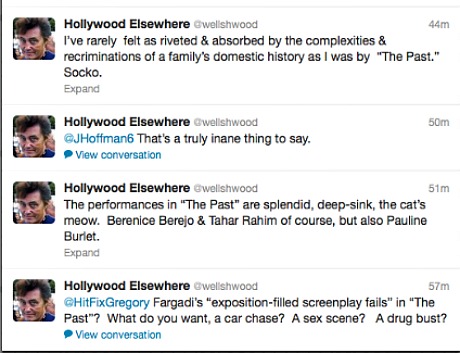
(37) Asghar Farhadi‘s The Past.

(38) John Michael McDonagh‘s Calvary.

(39) Paolo Sorrentino‘s La Grande Bellezza.

(40) Hossein Amini‘s The Two Faces of January.

(41) Francois Ozon‘s Jeune at Jolie (an apparent riff on Luis Bunuel‘s Belle du Jour).

(42) Terry Gilliam‘s The Zero Theorem.

(43) Woody Allen‘s Blue Jasmine.

(44) Roman Polanski‘s Venus in Fur.

(45) Danny Boyle’s‘s Trance, a crime thriller w/ James McAvoy, Vincent Cassel, Rosario Dawson. (Fox Searchlight, April).

(46) John Crowley‘s Closed Circuit.

(47) Susanne Bier‘s Serena — a period reteaming of Jennifer Lawrence and Bradley Cooper.

(48) Errol Morris‘s The Unknown Known: The Life and Times of Donald Rumsfeld.

(49) Ryan Coogler‘s Fruitvale — the big hit of Sundance 2013, acquired by the Weinstein Co.

One could also include Ben Stiller‘s The Secret Life of Walter Mitty, Nicholas Winding Refn‘s Only God Forgives, Ron Howard‘s Rush, David Cronenberg‘s Maps to the Stars. Neill Blomkamp‘s Elysium, Joseph Kosinski‘s Oblivion, Robert Schwentke‘s R.I.P.D., Sam Raimi‘s Oz: The Great and Powerful and Guillermo del Toro‘s Pacific Rim (9).

Hard One To Review

I don’t know why I’ve had so much trouble posting a review of Steven Soderbergh‘s Side Effects except to say that while I knew I was watching an efficient thriller with unexpected twists and turns, it didn’t get me in the gut. It didn’t turn me on as much as placate me in the way that all Soderbergh films do because they’re always so smart and disciplined and well crafted. But the whole time I was going “hmm, interesting” or “yeah, nicely done” more than “oh, super-cool…I really love this.”

My second problem with reviewing Side Effects in a timely way is that I saw it before Sundance/Santa Barbara, and by the time the embargo was up I had moved on to other places and currents and I had trouble restarting. The initial mojo had left the room. I need to review films fairly quickly…tap, tap, tap…throw it out there. I tried to get it up two or three times and it wouldn’t happen.

The third problem is that it’s hard to review Side Effects without spoiling the plot turns. It’s a bit like Psycho in that you start out with a Janet Leigh-like character (i.e., Rooney Mara‘s)…an attractive woman who’s flawed but basically sort-of sympathetic. And then things turn suddenly and then your allegiances shift over to…well, not a Tony Perkins-like character but a basically good guy (i.e., Jude Law‘s) who’s either made a serious mistake or has been played…and then some more twists occur. I really can’t figure how to dive into this without saying anything.

Mara’s Emily Taylor has a mild-mannered husband (Channing Tatum) just getting out of prison term for insider trading and is therefore a woman with reason to feel at least semi-hopeful about things, but she’s also a little glum and disconnected and not into sex. So she goes to see Law’s Dr. Jonathan Banks, a psychiatrist who prescribes a new medication that he’s getting paid to dispense. This brings Emily back sexually but makes her act…well, oddly in other ways. Or maybe she was always odd. That’s as far as a I can go with this, I think. Things take a sudden turn and before you know it Law is in serious trouble, and then…

I don’t what else to say except there’s some nice lesbo action in the third act. Jesus, I’m dropping the ball here. I have to stop.

Side Effects is a very good film (I actually wouldn’t mind seeing it again) but it’s more of a head-trip thriller than anything else. It has a post-2008 recession vibe, or…maybe I really mean an ’09 or ’10 vibe. It has the same general attitude as The Girlfriend Experience, in a sense, and the last few Sodies for that matter — Magic Mike, Contagion, even Haywire. Quiet ruthlessness, rhymes and reasons on hold, walls closing in, people finagling each other, sidestepping rules or making up their own. A very chilly realm.

Parkland Script Review

On 2.6 I expressed disappointment that Peter Landesman‘s Parkland, a currently-shooting drama about the killing of President John F. Kennedy on 11.22.63, will not strictly focus on the activities at Dallas’s Parkland hospital (which the title obviousiy implies) but will involve various locales and perspectives. But then I was sent a draft of Landesman’s script. I finished it last night, and I have to say it’s a sturdy, convincing, well-structured effort.

There’s no telling how the film itself will turn out. There are probably 50 ways Landesman can screw things up and he’s a genius if he can think of 35 of them, but I know authentic-sounding dialogue and good screenwriting architecture and when scenes run just the right length, and there’s no question that on paper at least Parkland is a taut, gripping recreation of a dark and horrific day. It smells like reality.

Dark and Horrific Day is a more truthful title than Parkland as Landesman’s script follows four story lines with four separate clusters of characters in a host of Dallas locations. (The film has been lensing in Austin but will go to Dallas for some pickups, or so I’ve read.)

Roughly half of the script deals with the Parkland gang including Dr. Jim Carrico (Zac Efron), Dr. Malcolm Perry (Colin Hanks), Dr. Jerry Gustaffson and Nurse Doris Mae Nelson (Marcia Gay Harden), who attended to the mortally wounded JFK as well as his assassin, Lee Harvey Oswald, on 11.24. Another Parkland character is Father Huber (Jackie Earl Haley), who administered last rights to the President.

The other half is split between three groups. About 25% or 30% focuses on Abraham Zapruder (Paul Giamatti), the guy who took the famous 8mm color footage of JFK’s murder, and all the people who dealt with him that day — a couple of film processing guys, Dallas Morning News editor Harry McCormick, FBI agent Forrest Sorrels (Billy Bob Thornton), Life editor Richard Stolley. Maybe 15% deals with Lee Oswald (Jeremy Strong), his older brother Robert (James Badge Dale) and their loony-tune mother, Marguerite Oswald (Jacki Weaver). And 5% or 10% focuses on two FBI agents — Gordon Shanklin and James Hosty (Ron Livingston) — who destroyed letters and other paper documents concerning Oswald and his wife Marina.

Largely based on Vincent Bugliosi‘s “Reclaiming History,” Parkland is definitely an “Oswald acted alone” movie.

If you agree with Howard Hawks‘ definition of a good film containing “three great scenes and no bad ones,” then Parkland will be a good film because it has several very…well, perhaps not necessarily “great” but very strong scenes.

A strong scene is a back-and-forth that makes you sit up in your seat and go “wow, that was something” or “whoa, intense stuff.” It’s a moment that you know you’ll remember. There are at least three such scenes at Parkland hospital (Carrico and Perry’s attempts to save Kennedy’s life inside trauma room #1, angry FBI and Secret Service guys removing JFK’s casket in defiance of Dallas police officials wanting to perform an autopsy, Oswald being wheeled into Parkland and reactions of staffers), at least two or three scenes with Zapruder, two exchanges at Dallas police headquarters involving Robert Oswald (one with Lee, another with a police officer), a scene acquainting us with Marguerite Oswald’s dementia, a making-room-for-the-casket scene on Air Force One, and a burial-of-Oswald scene at the very end. What is that, ten?

Some of the descriptions of JFK’s wounds and certain procedures followed in the trauma room indicate that Parkland will be fairly bloody and graphic here and there. Not for the squeamish unless, of course, editing intercedes.

Parkland will come out sometime around the 50th anniversary of JFK’s murder.

Ignoring Key Distinction

In a rant about Rex Reed‘s mean-spirited remarks about Melissa McCarthy‘s weight in his review of Identity Thief, Deadline‘s Michael Fleming sounds wise and perceptive for the most part, but also in basic denial by failing to acknowledge a difference between garden-variety corpulence and morbid, health-threatening obesity, which is a national pestilence as well as a dark metaphor.

Wise and perceptive: “I don’t care who the girl is, it hurts to be insulted about your weight, or to be defined by it. If I was McCarthy’s husband, brother, father or even her agent and I saw Reed, I’d have to fight off the temptation to open a can of whup-ass on him. I’d hope that I would be smart enough to swallow that urge and instead see Reed for what he is: a tired, cranky old critic who in this case lost his basic sense of compassion. He really ought to try rising above superficial cruelty and recognize what it takes for a woman like Melissa McCarthy to overcome to become a singular talent. If the movie sucks, fine, go to town, but c’mon Rex.”

Basic denial: “I don’t know if [Reed] has kids, but I have two daughters. It sensitizes you to many things, including the temptation to obsess about being rail thin. All you want for your girls is that they feel comfortable in their own skin, and McCarthy is a shining example of that. Reed obviously doesn’t even consider that McCarthy is breaking boundaries and making it okay for girls all over to feel good about themselves even if, when they look in the mirror, they don’t see a waif-like Victoria’s Secret model staring back.”

Fleming presumably understands that no fair-minded person would ever slam McCarthy for being simply overweight or corpulent or rotund or whatever term you want to use for someone who has girth. I know I have a reputation for being a fat-person antagonist but I’ve never had the slightest issue with acceptable, no-big-deal fat in the vein of Charles Laughton or Peter Ustinov or John Candy in Only The Lonely or Lou Costello or Oliver Hardy in the 1920s and ’30s. I agree that the mindset among God knows how many tens of millions of women that you have to be skinny thin is neurotic and oppressive, but Fleming knows perfectly well that, Reed’s cruelty aside, McCarthy’s issue is not her failure to be thin as a reed but her being much more than just fat. Some people are simply bulky — it’s just the way they’re built — but McCarthy’s size is way over the top. She’s clearly indulging in a way that’s not going to be good for her in the long run.

Is Fleming saying that all the people who have voiced fears or suspicions that Gov. Chris Christie will probably face serious health issues down the road unless he loses some weight…is he saying such talk is cruel and heartless and without merit? I doubt that. It’s obvious that McCarthy is in the same boat as Christie, and her proclaiming that she’s comfortable with being dangerously overweight is nothing to applaud or be proud of. On one level she’s saying that she accepts herself and that, I suppose, is temporarily fine as far as her present-tense attitude is concerned, but on another level she’s saying to millions of morbidly obese women out there that everything’s fine, that they should embrace their neuroses and keep eating crap and make themselves as super-sized as they want because they’re beautiful people inside and that’s what matters. Which is true on one level — who a person is spiritually and emotionally and creatively is the key thing. In this sense I worship Guillermo del Toro. And I’ve always admired Orson Welles.

But obesity is a national disease that has gotten worse and worse over the last two or three decades. Corporate crap food + kids spending all their time online and playing video games and watching the tube and not exercising + the situation as conveyed in Food, Inc is not a rumor. These are facts. Except for upscale urban healthies (i.e., people with a semblance of discipline who care about their bodies and exercise now and then) we’ve become a nation of sea lions. And Fleming knows this. And he should know that applauding McCarthy as a “shining example” of positive self-acceptance is not the right way to put it.

Instinct Monkeys

Yes, it makes perfect sense that Identity Thief, by most accounts a landmark stinker (25% Rotten Tomatoes, 37% Metacritic), is expected to earn $35 million (or $10 million more than projected) by Sunday night, even with Nemo putting a significant dent in attendance in Massachusetts, Rhode Island, Connecticut and (to a lesser extent) New York City

If people want to see something, you can’t stop ’em. They don’t give a shit about anything. They just want to see it.

And the people who wanted to see this reportedly agonizing comedy (which I might see today or tomorrow if Jason Bateman or one of his pallies slips me a pass…sorry) are Bridesmaids fans (particularly Melissa McCarthy fans) who don’t read or care about reviews. Which accounts for…what, 90% of the moviegoing public? And no, there wasn’t any kind of rally-round-McCarthy sympathy factor over the Rex Reed hippo review because, as I just said, 90% of the public doesn’t read reviews or the review-aggregate sites. They’re in their own realm and off the grid.

Same principle apples in the case of a really well-reviewed movie that doesn’t look right for whatever reason. They look at the ads and decide if it has what they want and if they sense that it doesn’t, game over. They won’t go with a gun pointed at their heads. They’re incredibly thick and stubborn. The girly-girls refused to see Silver Linings Playbook (which is now at $84 milllon) for weeks and weeks until finally award-season hoopla turned them around, but before that happened they were adamant. Not for us!

I realize, yes, that millions wanted something to go to last night, and Identity Thief was the only new wide-release comedy out there, and most people want to kick back and enjoy themselves on a Friday night. I get it. I get it. But they’re still slow and thick and obstinate.

Steven Soderbergh‘s Side Effects — a much, much better film than Identity Thief — pretty much tanked. Yesterday it made $2,800,000 on 2600 screens, or about $1075 per screen. Maybe $8.5 or $9 million by Sunday night. Over and out and on to Netflix.

Nice

Earlier today Awards Daily‘s Ryan Adams posted several one-sheets inspired by the 2012 Best Picture nominees. The show, co-sponsored by the Academy of Motion Picture Arts and Sciences and Gallery1988 (7021 Melrose Ave. just east of La Brea), is called “For Your Consideration.” My favorite by far is Matt Owen‘s Amour poster.

Took Long Enough

“If you’re any kind of fan of Stanley Kubrick‘s The Shining, Rodney Ascher‘s Room 237 is one of the greatest pure-pleasure organisms out there as it very entertainingly explores numerous hidden-meaning interpretations (some fruit-loopy, some fascinating) various folks have found in Kubrick’s 1980 classic. It’s so incredibly dense and labrynthian and jam-packed with thoughts and probes and speculations that you almost have to see it twice — there’s just too much to take in during one sitting.” — from a 9.14.12 Toronto posting.

Nemo Shortfall?

10:20 pm Update: So Nemo is (a) a serious Boston blizzard and (b) snow and slush in greater New York City. I remember the blizzard of ’78 (I was living in Westport, Connecticut at the time) and this doesn’t sound like a repeat of that for anyone in the Tristate area. A hassle for thousands, I’m sure, but I for one feel like slightly let down.

Lay Off

Melissa McCarthy is a sharp, provocative, never-boring comedian. She plays obnoxious, compulsive, anti-social low-lifes who are oblivious to how appalling their behavior is. The fact that she’s obese fits right in with this. What undercuts this, of course, is that she’s in the same unhealthy boat as Gov. Chris Christie, who gets called out all the time for his girth. Watch McCarthy in one of her films and you can’t help but say to yourself “she’s funny and brilliant but on some level she’s also self-destructive.”

Chubby is one thing but whopper-size means you’re possibly flirting with a shorter life span (i.e., John Candy). Maybe. You can’t keep that thought out of your head.

I missed last Tuesday’s all-media screening of Identity Thief and I probably won’t see it anytime soon, but if I’d posted something I never would’ve gone after McCarthy’s weight like Rex Reed did in his New York Observer review. “Hippo,” “tractor-sized,” “a gimmick comedian who has devoted her short career to being obese and obnoxious with equal success,” etc. I respect that she’s brainy and nervy and accept the fact that she’s plus-sized, and that’s more or less it.

Except for the obesity metaphor, that is. Fatter comedians are thought to be funnier than slim ones, and maybe that’s true on some level. But McCarthy would still be funny if she were 30 or 40 pounds lighter. I don’t think it’s being mean or insensitive to say she should work on that.

Davis and Baxter

Bette Davis gave a legendary performance as the snapdragon Margo Channing in Joseph L. Mankiewicz‘s All About Eve. Insecure, proud, bitchy, tempestuous…quite the bucking bronco. But watching her the night before last on a sizable screen reminded me that by today’s standards, Davis looks roughed up for a woman who was only 41 or a young 42 when the film was made. Strikingly attractive but with puffy features and baggy eyes and other indications of age gaining the upper hand.


(l. to r.) Anne Baxter, Bette Davis, Marilyn Monroe and George Sanders in All About Eve.

Honestly? By today’s standards Davis looks like a woman of 55 or even 60 with dyed hair. (I suppose that “dyed hair” is a redundant term — who doesn’t these days?)

If Davis were around today at this age she’d look much better as she probably wouldn’t be smoking at all (only kids and low-lifes smoke these days) and not drinking half as much (probably restricting herself to wine), and of course she would have had those bags taken care of. It’s not a felony to look your age or a bit older. Not everyone ages well. But no 41 or 42-year-old actress working today would dream of allowing herself to look like Davis did back then. Society expects 45 year-olds to look like 35 year-olds, 60 year-olds to look like 50 year-olds and so on.

Anne Baxter‘s Eve Harrington is, of course, quite the conniving liar — playing the role of Channing’s most devoted fan and assistant when all she wants is to push Channing aside. But by today’s standards, Baxter’s readings are so sterile and poised she almost seems inhuman. She’s supposed to be calculating but she reads her lines like a bloodless sociopath. At the end of the day most of the characters — Margo, Celeste Holm‘s Karen Richards, George Sander‘s Addison DeWitt, Thelma Ritter‘s Birdie — have seen through her, but you’re wondering why Gary Merill and Hugh Marlowe‘s characters don’t. They’re supposed to be sharp operators.

True story: I was driving along Melrose Ave. near Doheny in late 1983. (Or was it ’84?) I noticed that a new BMW in front of me had a framed license plate that came from a dealer in Westport, Connecticut, where I had lived only five years earlier and which is next to my home town of Wilton. I pulled alongside the Beemer and saw right away that it was Baxter (who looked pretty good for being 60 or thereabouts) behind the wheel. I rolled down my window and said, “Hey, Westport…I’m from Wilton!” And Baxter waved and smiled and say “Hiiiiii!” She died of a brain aneurysm a couple of years later.

Could Silver Nitrate Sparkle Be Simulated?

The night before last I attended a special screening of Joseph L. Mankiewicz‘s All About Eve on the 20th Century Fox lot. I’d been invited by Fox’s restoration guru and archive protector Schawn Belston and Fox Home Video’s in-house publicist James Finn, and it was delightful watching this 1950 Best Picture winner in such a clean, rich and spotless state. The source was a DCP but we were basically watching the version contained in the Bluray that came out two years ago.

But in his opening remarks, Belston said that the DCP Eve is a visually different entity than what was seen by audiences 62 years ago when nitrate (or “silver nitrate“) prints were the industry standard for monochrome. Famous (or infamous) for having been phased out in 1953 because they’re highly combustible, nitrate prints delivered a glistening, gleaming quality. Somebody once wrote that they seemed to be “etched in liquid silver.” And even the best digital mastering can’t recreate this. The Eve I saw Wednesday is very nice but it doesn’t shimmer. It looked sumptuous but a bit flat.

Is this an arcane observation? Yes. Will most people who buy the All About Eve Bluray share this view? No. But I nonetheless began to wonder why a gifted digital engineer couldn’t somehow devise a form of software that would simulate that gone-but-not-forgotten silver nitrate look. Seriously, why not?

In 2001 MGM Home Video released a Moby Dick DVD managed to simulate the look of a special faded-color blend that dp Oswald Morris and John Huston came up with when they made their release prints by blending color with a monochrome or “gray” negative. I saw a reel of that film once at the Academy, and the simulation that MGM Home Video came up with wasn’t quite the same thing — it lacked a blunt scontrasty quality that delivered a steely, grayish color — but at least they made an effort, and it wasn’t half bad.

Something tells me that at least an effort could be made to simulate that silver nitrate sparkle through some kind of tweaking software. I think it could be a marketing tool to boost sales of old black-and-white classics on Bluray. Faced with a choice between purchasing the currently available Bluray of All About Eve and a Special Liquid Silver Edition, I wouldn’t think twice about it — I’d buy the latter.

Has anyone ever heard of anyone at least theorizing that a process along these lines could perhaps be created?

This morning I asked a knowledgable expert about this possibility and he said it wasn’t in the cards. “The main thing about nitrate,” he said, “is that unlike safety stock, it looks crystal clear [and] you can’t simulate this look because you would first need an original camera negative, and then you need a white-white screen, preferably one smelling of cigarette smoke…but there’s no replicating the look of that absolutely crystal clear base. You can’t do it.”

Okay, a true replication can’t happen but shouldn’t technicians at least try to create a software makeoever process that would make restored black-and-white classics look a little more sparkly and a little less flat?