Les Miserables Finale Saves The Day

“I have to separate myself from the haters on Les Miserables,” I explained to friends this morning. “Because as uncomfortable as I was during the first two hours, I succumbed once Eddie Redmayne and the fiery young lads (including the very noteworthy Aaron Tviet) raise the flags and man the barricades, which starts about 40 minutes before the end. And it sunk in. It got to me.

“And I finally understood, having never seen the stage musical, what Les Miz mania is all about. And I became, at least as far as this section was concerned, a Les Miz queen.”

Otherwise the film, as passionately and energetically composed as it is, felt like a chore to me, something to endure and get through rather than sink into and revel in with my heart wide open. All that agony, all that cruelty. “This is a movie about grime and dirt and suffering at the hands of cruel horrid gargoyles,” I muttered at the halfway mark. One can only stand so much horrific behavior and the infliction of agony in any realm.

For me the tattered, labored, forced-march emotions and general intensity, those constant closeups and that relentless operatic warbling wore me down more and more. I wanted to retreat about an hour in but I stuck it out, and was glad, finally, that I did.

My first glance at my watch happened at the 40-minute mark. I checked it two or three times over the next hour or so. But I forgot all about the time once the the 1832 June Rebellion in Paris began. Although it’s a grind getting there.

Anne Hathaway will definitely snag a Best Supporting Actress nomination for those looks of panic and ache and desperation as she sings her Fantine role — she really does have to play Judy Garland over the next two or three or four years. Hugh Jackman fully deserves a Best Actor nomination as the tale’s moral heo, Jean Valjean — the feeling and the vocal reach are entirely there and sustained start to finish. I had no problem at all (unlike some I’ve spoken with) with Russell Crowe as Inspector Javert — he can sing well enough and holds his own and brings the necessary gruff steel. And Redmayne is surprisingly strong, steady and solid as Marius, a student revolutionary who tumbles for Amanda Seyfried‘s Cosette (adopted daughter of Valjean, biological daughter the late Fantine).

Also excellent are Tviet, Samantha Barks (as the jilted-in-love Eponine), Sacha Baron Cohen and Helena Bonham Carter as the scummy Monsieur and Madame Thenardier, and little Daniel Huttlestone as Gavroche, a street kid who stands with the barricaders.

And yet if you remove the sweeping effect of the final 40 minutes I mostly agree with today’s reviews by The Hollywood Reporter‘s Todd McCarthy and to a somewhat lesser extent by Variety‘s Justin Chang.

Key McCarthy quote: “A gallery of stellar performers wages a Sisyphean battle against musical diarrhea and a laboriously repetitive visual approach in the big screen version of the stage sensation Les Miserables. Victor Hugo‘s monumental 1862 novel about a decades-long manhunt, social inequality, family disruption, injustice and redemption started its musical life onstage in 1980 and has been around ever since. But director Tom Hooper has turned the theatrical extravaganza into something that is far less about the rigors of existence in early 19th century France than it is about actors emoting mightily and singing their guts out.

For Les Miserables “is a film that, when all the emotions are echoed out at an unvarying intensity for more than 2 1/2 hours on a giant screen, feels heavily, if soaringly, monotonous. Subtle and nuanced are two words that will never be used to describe this Les Miserables.”

Two ladies that I came with were weeping, and I get it, I get it. Their feelings are absolutely valid. The aches and passions of this classic tale are strong and elemental and speak to compassion and charity and cries for social justice, which is why it has played so long on stage and touched so many. But how many Les Miz fans have ever participated in an Occupy demonstration?

God help me and call me a sap, but I really fucking love the ending with the banners waving and the barricades up and the proudly defiant “Can You Hear The People Sing?”
Promised Land Is Okay

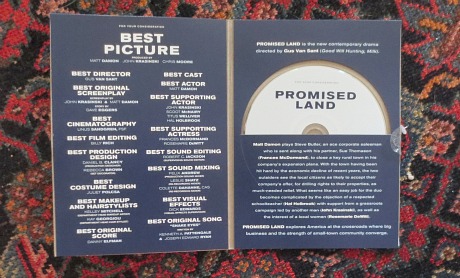
I’d been told that Gus Van Sant, Matt Damon and John Krasinki‘s Promised Land (Focus Features, 12.28) was Capra-esque, which means upbeat in a sort of sappy, dipshitty sort of way + emotionally on the nose. I was also told it has a little Local Hero in its bloodstream. Well, it’s not channeling Frank Capra or Bill Forsyth. It plays its own tune, and is, I feel, an entirely decent “message” film (i.e., fracking sucks) that feels nicely balanced and shaded and well acted. It flows along.

Only one thing feels miscalculated. I’m speaking of a third-act surprise that kinda knocks everything off-balance because it feels perversely thrown in because some producer said “you know what? this movie needs a third-act jolt.” But I wouldn’t call it fatal. It’s just one of those “did they really need to do that?” moves.

Promised Land is a liberal-humanist social drama that follows a predictable path. You can tell that from the synopsis and the trailer and the poster. But the writing and the unforced acting styles put me at ease early on and I just went with it. It’s a kind-hearted, well-acted, reasonably intellligent thing — naturally, agreeably paced. In fact, I watched it twice. Okay, not intentionally. If you don’t take the screener out the feature automatically plays again so I just sat there and submitted.

At the outset Damon is a nice guy with an Iowa farm background who’s all suited up and smiley and working for an evil natural gas company called Global Crosspower Solutions. He arrives in a small Pennsylvania town to sell a drilling project to the locals and pass a lot of money around. And the usual questions about the chemicals used in fracking (i.e., high pressure drilling for gas) and the water table being poisoned and cows dying and all that. But enough of the locals want those fat Global checks.

And then an environmentalist (Krasinki) comes along and starts letting people know the facts. And Damon starts getting pissy and resentful (he hasn’t been trained by Global about how to deal with green types?) and feeling a little bit guilty besides, and then a lot guiltier. And you know where it’s all heading.

Damon and Krasinki handle their lead roles nicely. Also believable and planted are Hal Holbrook‘s jowly, fair-minded guy and an anti-fracking advocate, Rosemarie DeWitt‘s local teacher with eyes for Damon, and the always impressive Scoot McNairy as a resentful farmer. It’s too bad that Frances McDormand‘s natural gas rep (an ally of Damon’s Steve Butler) isn’t developed sufficiently and winds up seeming arid and floundering at the end, but I shrugged this off.

One of my favorite bits is when Krasinki delivers a Sesame Street-level demonstration of what fracking is to a classroom filled with 10 year-olds. It’s highly amusing because the idea is to reach the (probably) uniformed audience — we’re the ten-year-olds! Hah!

Promised Land probably isn’t going to be nominated for anything, but there’s no shame in just being a decent, good enough small-town drama. I didn’t feel burned or fucked with. It’s a smart, pleasant sit.

Boiled Down, Translated

The gist of this 12.5 Pete Hammond Deadline piece (“Zero Dark Thirty Gives Sony Early Awards Heat But Will It Last?”) is that a lot of people don’t know what to stand by Best Picture-wise, but they don’t like the idea of giving the Oscar to another Middle-Eastern conflict film made by the great Kathryn Bigelow and Mark Boal.

I’m presuming that older Academy milquetotast types are telling Hammond “Bigelow again?” and “more Middle East terror tension?” and “why can’t we find a nice consensus movie that fits the warmly emotional paradigm that we all want to give the Best Picture Oscar to, and…you know, without anyone getting blown up or double-tapped…something that explains who we are and what we really want and need?”

Some would like to give it to Lincoln or Les Miz but they’re not feeing the current in the rapids and they can feel the ardor cooling down (certainly with Lincoln). They’ve found a film that “fits that warmly emotional paradigm” in Silver Linings Playbook, of course, but that’s not knocking everyone down either. Cattle are happiest when they’re being led along. And if they’re not being led along they wander around in search of water and grass. What Hammond is telling us is that Academy members don’t know which way to turn.

They have two choices. They can go with the unassailable Zero Dark Thirty — the flinty, pruned-down CIA docudrama with Jessica Chastain‘s super-tough heroine, or with the jazzy, spazzy, warmly emotional and hyper-intelligent Silver Linings Playbook, the movie that restored respect to the seriously tarnished romantic comedy genre and confirmed that director-writer David O. Russell is at the top of his game these days, and that Bradley Cooper (NBR’s Best Actor winner as of today) and Jennifer Lawrence are forces of nature and growth-spurters extraordinaire.

NBR Chooses ZDT for Best Pic; Cooper Over DDL

The National Board of Review is a mostly discredited organization that carries no real weight or sway, but the fact that they’ve given their Best Picture award to Zero Dark Thirty feels like a whoo-hoo nonetheless. They’ve also given their Best Director award to ZDT‘s Kathryn Bigelow and Best Actress trophy to Jessica Chastain…three fresh biggies for ZDT!

Memo to Indiewire‘s Anne Thompson: Daniel Day Lewis has always been a top Best Actor contender, but Lincoln itself has either run out of gas or never had it to begin with. Certainly not the high-octane brand. Yes, it’s Steven Spielberg‘s best since Saving Private Ryan, but events aren’t falling into place. It’s over or close to it.

There’s also a little Silver Linings momentum kicking in with Bradley Cooper snagging the NBR’s Best Actor trophy. Cooper, it seems, has acquired solid-gold cred today as a Best Actor contender. No pushing him off to the sidelines or going “yeah, maybe” anymore. David O. Russell also won the Best Adapted Screenplay award for Silver Linings Playbook. SLP haters need to bow and back off and scatter for the time being.

I’ve seen Django Unchained, and if you ask me the NBR giving their Best Supporting Actor award to Leonardo DiCaprio is bullshit. They’re kowtowing to a big movie star. DiCaprio’s venal plantation-owner character has no arc, no depth…it’s just showboating. SLP‘s Robert De Niro is a far more deserving recipient. Ditto Lincoln‘s Tommy Lee Jones, The Master‘s Phillip Seymour Hoffman, Arbitrage‘s Nate Parker, or Magic Mike‘s Matthew McConaughey.

Ann Dowd winning Best Supporting Actress for Compliance is a nice thing and well deserved — good for her.

Congrats to HE’s very own Rian Johnson for winning the NBR’s Best Original Screenplay for Looper.

Wreck-It Ralph won for Best Animated Feature. The Oscar in this category will go for this or Tim Burton‘s Frankenweenie…right? The Best Directorial Debut award has gone to Benh Zeitlin for Beasts of the Southern Wild…great.

Michael Haneke‘s Amour has won the Best Foreign Language Film award. And Searching for Sugar Man has won the Best Documentary award.


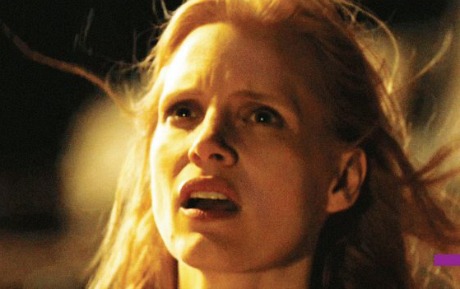
Jessica Chastain in Zero Dark Thirty.

Death Comes Suddenly

An iMac I bought in early ’09 has been showing signs of age over the last year or so. Today it fell out of the wheelchair and started gasping and talking gibberish. I knew it would die sooner or later, but I’ve been hoping it might last a little bit longer. Every string runs out sooner or later. I’m taking it down to a Mac specialist over lunch in hopes of at least saving data. I have two Macbook Pro 13-inchers in fine shape, but I’ve never synched the iPhone with them. Learning curve.

Stinko

Even though I couldn’t make myself sit through Cloud Atlas when I caught a Toronto showing, I respected that it was a huge passion project for co-directors Lana and Andy Wachowski and Tom Tykwer, and that it took a lot to shoot and piece together. I can be cruel at times, but it seems a little too cruel of Time‘s Mary Pols to call it 2012’s worst film. Worse, even, that John Carter — that’s saying something.

Edge Of It

“This is a phenomenal piece of action filmmaking, and an even better piece of nonaction filmmaking,” New York‘s David Edlestein has written about Zero Dark Thirty. “It also borders on the politically and morally reprehensible.” And yet he’s calling ZDT his #1 film of the year. Or maybe that’s why.

I Solemnly Urge

Remember nobody giving A Better Life‘s Demian Bichir a chance to land a Best Actor nomination last year because Life was too indie and he didn’t have a well-funded campaign behind him? And his getting nominated anyway? The same needs to happen this year with Middle of Nowhere‘s Emayatzy Corinealdi, winner of the 2012 Gotham Awards’ Breakthrough Award and a 2013 Spirit Awards nominee for Best Female Lead. Because she delivers with such bearing, for one. And because it’s necessary (if you want to be fair) to nominate at least one actress from a smallish indie.


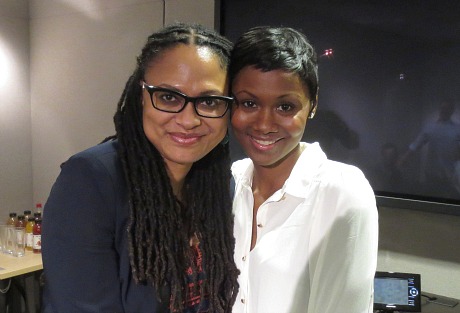
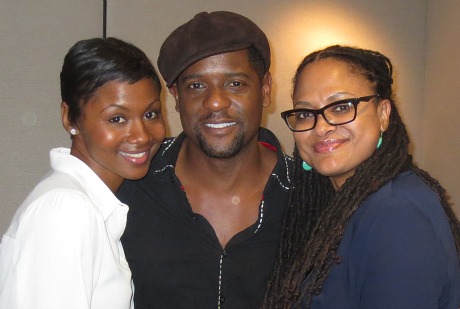
(l.) Middle of Nowhere director-writer-producer Ava Duvernay; (r.) Emayatzy Corineladi — 12.3, 9:15 pm.

Corinealdi and director-writer Ava Duvernay attended last night’s Hollywood Elsewhere- and Participant-sponsored screening of Middle of Nowhere, and then sat for a nice little q & a. It was great to see Nowhere again and to recall my first reaction (“Nowhere Deserves Everything“), which I posted on 10.21.

So in a perfect world the 2013 Best Actress nominees would be Corinealdi, Silver Linings Playbook‘s Jennifer Lawrence, Zero Dark Thirty‘s Jessica Chastain, Amour‘s Emmanuelle Riva and Rust & Bone‘s Marion Cotillard.

Yes, Corinealdi’s best shot is with the Spirit Awards. But she really does give “one of those performances” that stands out big-time, and I mean just as inescapably as Bichir did last year. With a quiet, steady, home-run performance as an emotionally torn wife of a convict, she’s that real, that good.

Duvernay’s film has also been nominated for the Spirit’s John Cassevetes Award, and two of her supporting actors — Lorraine Toussaint and David Oyelowo — have been respectively nominated for Best Supporting Actress and Best Supporting Actor.

“The script is an interior story of a woman,” Duvernay recently told Script interviewer Jeanne Veillette Bowerman. “You’re in her head. You’re with her when she’s alone. You’re facing her challenges with her, which is not exactly the purview of most studio films. Add onto that she’s a black woman, then you add onto that you’re doing something with a black woman but it is not a comedy, and it’s not an historical drama, it didn’t fit into any paradigm that was currently in the industry.

“For me, as a part of that industry, it was clear, and I place no blame, that is what the industry is. So the question became, if you’re on the outside of that dominant culture, what do you do? Nothing? Complain? My solution was to make my own stuff on the outside.”


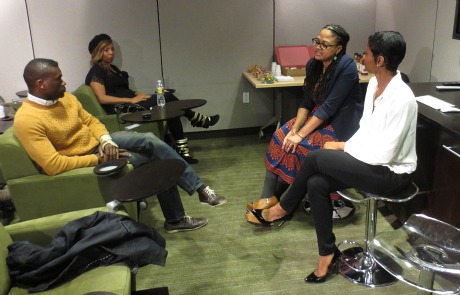
(l. to r.)) Corinealdi, Blair Underwood, Duvernay.

Fron HE reader Ben Lauter, who attended last night:

Middle of Nowhere is an incredible emotional journey of quiet intimacy. With assured writing and directing by the talented Ava DuVernay and astonishing, fully-realized lead and supporting performances by Emayatzy Corinealdi, David Oyelowo, Lorraine Toussaint, Omari Hardwick and Edwina Findley, it marks one of the year’s great cinematic surprises.

“Corinealdi occupies just about every scene of a story that effectively details the tug of war between heartbreaking, lingering love and the tentative renewal found in fresh romance. The character may face much ambivalence, but the performer shows no such signs of it, offering up a revelatory, captivating performance full of both vulnerability and toughness.

“Her interactions with the somber and regretful Hardwick stand as a neat contrast to the quietly playful ones involving Oyelowo’s world-weary, but lighthearted jocularity. Both of her love interests offer a nice relief from the domestic scenes at home, in which Ruby, Ruth and Rosie separately reflect upon their triumphs and tragedies of life and love.

“These scenes are as loving as they are rough, and from that complex contradiction comes some of the film’s most evocative scenes. Toussaint in particular does a marvelous job of showing her matriarchal power, knowing what’s best for her children and why, even when they themselves may not, skillfully riding the edges of her advice-giving boundaries to modest success.

“Mention must also be made of the movie’s wonderful, crisp visual style, which by far makes full use of a mere $200,000 budget. Middle of Nowhere is the kind of film that lives or dies by the strength of its characters, the performers who breathe life into them, the writing, and the confidence of their creator. Because these are all present here, this is a movie to discover.”

Play It As It Lays

A combination of the title (why a “glimpse”? who cares about Roman numeral III?), the cowboy hat, the arrow in the chest, the banana and pickle posters and the ’70s hair has me worried, or at least has given me pause. Every time I say the title it comes out as A Glimpse Inside the Mind of Charles Schwab, Investment Broker. Directed and written by Roman Coppola, opening in mid February and distributed by A24 and Film Buff.