48 Frame Staying Power + Jackson Turnaround

It’s a curious thing to have harbored mostly negative reactions to all things Peter Jackson for many years (aside from Heavenly Creatures and a fair-sized portion of The Lovely Bones), and then experience an abrupt turnaround within a four-month period due to (a) his funding, producing and promoting of Amy Berg‘s brilliant West of Memphis, and (b) his using 48 frames per second photography in The Hobbit and advocating for this new technology, which is altogether stunning.

Jackson’s reactions to the 48 fps hoo-hah out of Cinemacon appeared yesterday.

“Nobody is going to stop,” he told Entertainment Weekly. “This technology is going to keep evolving. At first it’s unusual because you’ve never seen a movie like this before. It’s literally a new experience, but you know, that doesn’t last the entire experience of the film; not by any stretch, after 10 minutes or so. You settle into it.”

The post-demonstration rumble, I was told, was that Warner Bros. execs have confided that perhaps the 48 fps image could be roughed up a bit so as to look a bit more “cinematic” and less high-def video-ish. (This was seemingly alluded to in Jackson’s remark about how 48 fps technology is going to “keep evolving.”)

The bottom line is that once younger audiences get a taste of it, 48 frames per second will be here to stay. I’m dead certain there won’t be any going back to 24 fps when it comes to CG fantasy and action and heavily immersive atmosphere-spectacle films. I knew in an instant during the Cinemacon screening that it would soon be the only game in town for those genres. Action sequences are incredibly affecting at 48 fps, and I was knocked out by the realism of Jackson (and Andy Serkis’s) CG Gollum character in 48 fps. You know it’s CG, of course, but it’s hard to dismiss it out of hand, as I do regularly with 24 fps, because it looks so real.

Remember Dean Goodhill‘s Maxivision, the 48 fps 35mm process that Roger Ebert has been passionately promoting for the last twelve or thirteen years? It never took off, and it’s certainly dead now that Jackson’s digital 48 fps process has the spotlight, but there’s no way that 48 fps will recede. Not a chance.

Straight character- and dialogue-driven dramas can and probably will remain in the 24 fps mode without any issues or complaints, although I would advocate an industry-wide acceptance of at least 30 frames per second overall. 30 fps is cleaner and more fluid with reduced pan blur during motion shots. Only two mainstream films have been shot and exhibited at 30 fps — the original Todd AO roadshow presentation of Fred Zinneman‘s Oklahoma! (’55) (a restored version of which was screened in Hollywood in ’84 or thereabouts) and Michael Todd‘s Around The World in Eighty Days (’56). Exhibitor complaints about cost resulted in a downgrading of Todd AO to 24 frames with the release of South Pacific (’58).

“Yeah, Pretty Much”

Significantly, the audience laughed and clapped after Mel Gibson said the above words — an admission that he’d done a lot of screaming on that Joe Eszterhaus audio tape — during a chat with Jay Leno the night before last. People will forgive you for almost anything as long as you speak calmly in their presence and turn on the charm, etc.

Great Frame Rate Debate

Ignore Part One and start with Part Two of this six-part WGBH discussion (which isn’t a “debate” but a power-point lecture or class) of frame rates, which of course is very timely with the very recent unveiling of Peter Jackson‘s The Hobbitt at 48 frames per second. The participants were moderator Bruce Jacobs, the renowned frame-rate pioneer Douglas Trumbull (who got things going with Super 70, later known as Showscan, back in the late ’70s), Mark Schubin and Larry Thorpe.

This discussion, which happened in Boston (or Cambridge) in early November 2010, has just been uploaded. It actually took place over two days (11.3 and 11.4).

Picks


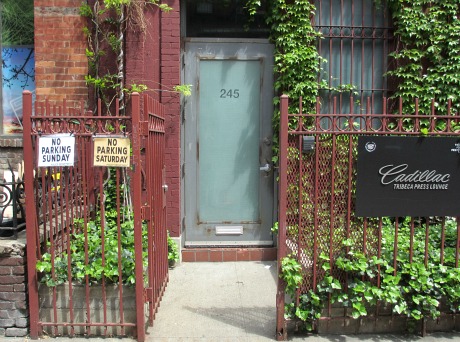
18th Street facade of press headquarters for Tribeca Film Festival. Free sliders, wifi, computers, drinks, coffee and ice cream bars inside.

Read more

Tankful of Lobsters

“I have my own theory about President Lincoln‘s death. I think John Wilkes Booth was innocent. I don’t even think it was an assassination. I believe that Abraham Lincoln had a vision about what the Republican party would become in 150 years, and he shot himself.” — Jimmy Kimmel at tonight’s White House Correspondents’ Dinner.

Diagnostic

Nicholas Stoller and Jason Segel‘s The Five-Year Engagement is a tank…a dead manatee. Yesterday it earned a lousy $3.4 million in 2,936 situations, averaging $1158 per screen. That forecasts a $10 million weekend haul, or about 50% of what Universal, its distributor, was looking for.

So what happened? Was it the prospect of sitting through a relationship that never goes anywhere and just kind of flounders around? Was it the Jason-Segel-isn’t-a-star factor, or should I leave that one alone? Does this hurt Segel and costar Emily Blunt, or was it just the so-whatter concept or…?

Truman Show

This Sunset Strip footage, shot around 1948 or ’49, is mainly of the Sunset Plaza area. Commercially restrained, to say the least. None of the riff-raff atmosphere of 2012, or of ’92 or ’82 for that matter. The traffic isn’t anywhere near as congested as it is today. And those cars! And that young dark-haired girl (who’s either dead or in her 80s right now) crossing the street. 16mm footage is relatively smooth, probably shot with a tripod.

“She Has Followers…”

“It’s hard to say whether Sound of My Voice is a wholly bogus and pretentious indie enterprise or a weirdly compelling bit of low-budget storytelling,” writes Movieline‘s Stephanie Zacharek, an obviously bright critic and a fine writer whom I don’t trust any more. “Probably it’s a little of both — this is the kind of picture that may often make you snort audibly, even as you’re wondering how the heck it’s going to resolve itself.

“And ultimately, even if the payoff isn’t quite what it should be, the picture leaves a faint chill in its wake. You probably won’t feel totally shafted for sticking with it — maybe just a little punk’d.”

Incidentally: I really don’t like to watch people eating. A shot of somebody slipping or stuffing any sort of prepared food into their mouth pretty much ruins any idea I might have at the moment to eat or sample something. And my skin positively crawls when I watch someone applyiing pate or some exotic spread to a cracker of some kind and then popping it into their mouth.

“Dial M” Mauled By Fascists

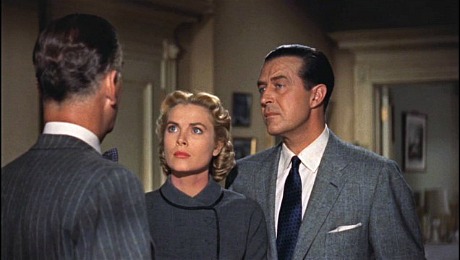
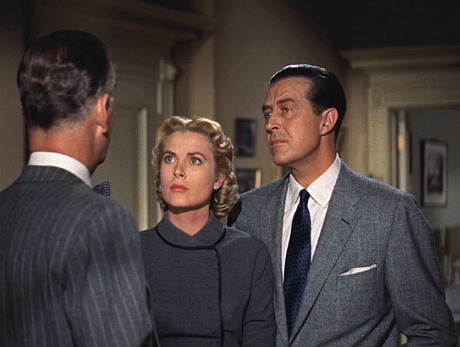
Alfred Hitchcock‘s Dial M For Murder may well have been composed so that 1.85 projections would look presentable, but that doesn’t mean that a 1.78 or 1.85 version will look better than the basic and very pleasing boxy proportion that people have been watching for decades.

I’ve been examining Dial M for Murder all my life at 1.33 or 1.37. I saw it in 1.33 or 1.37 3D at the Eighth Street Playhouse in the West Village in the early ’80s. And the compositions and framings were and are entirely satisfactory and didn’t need to have their tops and buttons CHOPPED OFF WITH A MEAT CLEAVER.

The 1.78 or 1.85 a.r. on the Dial M For Murder Bluray was favored because of one reason only — because this a.r. conforms to the 16 x 9 aspect ratio of high-def flat panels. The people who made this call were nothing but a FASCIST REVISIONIST GANG.

“We have a vision,” their manifesto reads. ‘A vision of all films shot from the early ’50s to mid ’60s with their tops and bottoms CHOPPED OFF, and we will stop at nothing to achieve that goal. Because of 16 x 9 high-def screens, we are committed to killing visual information. And we will succeed because we have the factual data and research to back up the assertion that these films were shot to be shown at 1.85, but could also be shown at 1.33 or 1.37 for purist film buff screenings and for television airings and VHS and DVD versions.

“Repeat after us: WE HAVE A VISION, and it is about KILLING VISUAL INFORMATION by slicing off the tops and bottoms of films.”

These films look completely fine and have much more breathing space at 1.33 or 1.37 and in fact are VISUALLY PREFERRED this way by the Movie Godz and all good men of taste and conscience.

I feel like Gregory Peck‘s Captain Ahab at the end of Moby Dick: “Oh, damn thee, 1.85 aspect-ratio fascists! To the last I grapple with thee. From hell’s heart I stab at thee. For hate’s sake I spit my last breath at thee!”

Tony, Margot, Mark & Inspector Hubbard

It’s been suggested (but not confirmed) by HE reader Pete Apruzzese that the 1.85 fascists may have their way with a possibly forthcoming Bluray of Alfred Hitchcock‘s Dial M For Murder. I’ve seen this talky 1953 drama, which was originally shot in 3D, countless times on broadcast TV, VHS, DVD and theatrically, and each and every time at 1.33 or 1.37. But Warner Home Video may — I say “may” — have chosen to present its forthcoming Bluray at 1.78 in order to conform to 16 x 9 screens.

Apruzzese has tirelessly and tediously pointed out that in 1953 the studios, terrified by the threat of television, decreed that all standard Academy ratio films shot in 1.33 would henceforth would be shot or framed so that they would look presentable at 1.85, and that 1.85 would henceforth be the going thing because it looks wider than television and blah, blah. That’s true as far as it goes but

The exceptions to 1.85 croppings in the mid ’50s to mid ’60s — 1.66 presentations, I mean, as well as perfectly pleasing 1.33 or 1.37 renderings on VHS and DVD — are too numerous to even mention in condensed form, but the fact is that the decision to present films of this era in either 1.78 or 1.85 aspect ratios is simply an accomodation (some would say a capitulation) to the fact that high-def screens are 16 x 9 and that 1.78 or 1.85 films fully occupy these screens, and that 1.33 or 1.37 do not. The primitives out there want every inch of their flatscreen TVs utilized, and the home video companies, terrified of their shrinking market share, are complying.

DVD Beaver‘s Gary W. Tooze reported six years ago that a British PAL Hitchcock box set, assembled by Warner Home Video, contained a 1.85 or 1.78 version of Dial M For Murder. “Many Hitchcock films were composed for both framings and projected theatrically in the US at 1.85:1,” Tooze notes. “As suspected this PAL edition is indeed cropped from 1.33 to 1.85:1, although it has slightly more horizontal information than the R1 transfer. Strange decision to transfer in opposition to the Region 1 [version]!”

A few hours ago I explained to Apruzzese that Dial M for Murder 3D “has always been shown at 1.33. If it’s going to be presented in a 1.78 a.r. on Bluray, it’s because the 1.85 and 1.78 fascist gang has muscled the home video community into thinking this way. Congrats on mauling another 1.33 film for no good reason other than arrogance.”

[For whatever idiotic technical reason, the jump page on this story refuses to appear when the story has been posted in full. So I’m breaking it into two chunks — part 2 in the next post.]

Poster Meets Street

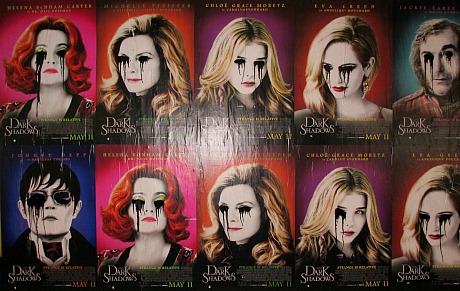
I’m flying to Berlin next Thursday and hanging there nine or ten days before heading down to the Cannes Film Festival so I haven’t much time to see Dark Shadows. It has to be Monday, Tuesday or Wednesday. I’m currently pleading my case so we’ll see. If they refuse to budge I can see it at a commercial cinema in Belgium on 5.9 or in Berlin on 5.10, or a day before it opens in the States.