If imitation is the sincerest form of flattery, monkey laughter is easily the least in this regard.
Monkey laughter is basically forcedreactivegiggling — a suck-up tactic used by vaguely fearful employees or kiss-assers of any stripe…a way of flattering bosses or admired colleagues or anyone they’re looking to get in good with.
It could be argued that almost all social laughter is untrustworthy, to this or that degree. Which is why I always slightly flinch or recoil when I hear or see it. I usually mutter to myself, “There goes another phony…performance giggling…another attempt at some form of social advancement.”
Movie-theatre laughter is 100% honest. Ditto the “watching TV in the living room” kind. Ditto reading something or other.
This is not a big deal, but HE is once again mildly irked by another obviously ill-fitting POC inserted into an early 19th Century British film, an Oscar-nominated comedy short called Jane Austen’s Period Drama.
The hunky Hawaiian actor who stands out like a sore thumb (although his narrow eyes, smallish cranium and aggressively bulging cheekbones will presumably meet with Justin Chang‘s approval) is listed in the credits as Ta’imua, but whose full name is Lachlan Taimua Hannemann.
Ta’imua plays Mr. James Dickley, a pretentious, posturing fellow with an appalling ignorance of female biology. Co-director and co-writer Julia Asks plays Miss Estrogenia Talbot. Her directing-writing collaborator is Steve Pinder The producer is Elli Legerski.
Why did Asks, Pinder and Legerski hire a young, resplendently brawny Pacific islander to play an eligible bachelor in a Jane Austen satire set in the early 1800s? Gee, who knows?
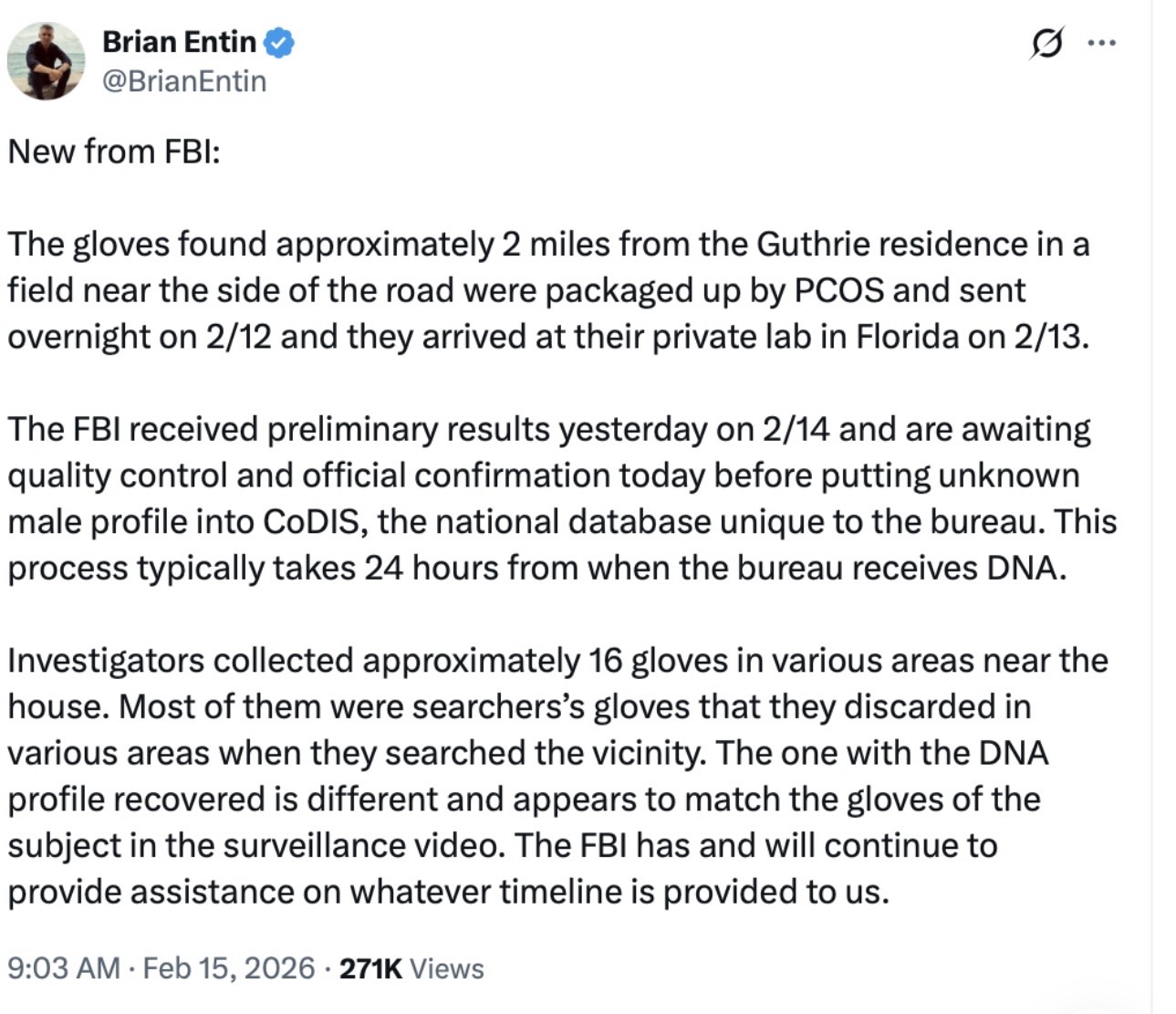
HE is becoming angrier and angrier with all the empty noise and nocturnal flashing-cop-light spectacle (Tuscon fuzz, FBI raiding homes with zero payoffs) and the endless, infuriating brain-tease speculation from Ashleigh Banfield, Megyn Kelly, Brian Entin, Fox News and all the others (investigators, security experts, former lawmen, MSM anchors and reporters across the universe) who have NEXT TO NOTHING on their plates.
They’re all just sitting or standing there or poking around the cactus fields with their fingers up their butts, and with ALMOST NOTHING TO SAY except “maybe maybe, could be, who knows?, DNA blah blah blah one or two gloves found and sent to Florida or Quantico blah blah blah blah”…sounds like, could be, no arrests”…it’s mostly bullshit, I tell you!…mostly empty noise, and I’m asking myself “how are the authorities managing to be so bad, so inept, so Mack Sennett or Keystone cops in their search for poor abducted Nancy Guthrie?”
The Guthrie case is two weeks old — the third week has begun — and it really, REALLY is time, fellas, for a good old-fashioned “enough!!…we’ve all had enough of this crap so put up or shut up and stop pissing around because the general man-on-the-street impression is that the authorities are farting, farting, farting in the wind.”
Why doesn’t the FBI take a chance and pay $100K to that sketchy, scurvy-sounding TMZ gremlin who claims he knows what’s up? C’mon, what can they lose? They can afford to drop the dough with Trump involved in the case. Even if the gremlin turns out to be a fraud, that’ll at least distract from the empty Tuscon void.
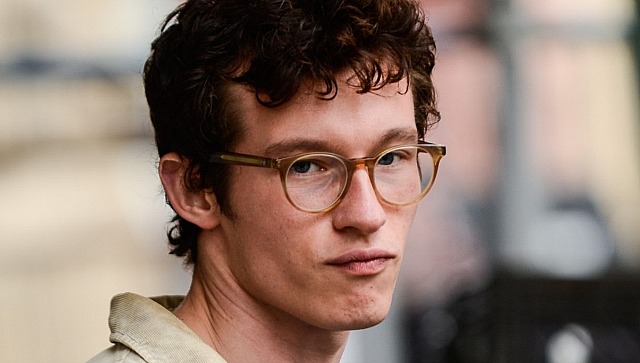
Eight and a half years ago I became the first and (as far as I know) only movie columnist to publicly observe that Callum Turner has menacing, feral, wolf-like eyes.
Key passage: “I like the idea of a young New York guy (Callum Turner) discovering that his married dad (Pierce Brosnan) is having it off with a significantly younger hottie (Kate Beckinsale), and then slipping into the situation and boning the girlfriend himself.”
Here’s how I put it: “The only thing that gives me slight pause is the fact that Turner has eyes like Johnny Hallyday‘s, which is to say eyes like a timber wolf — a timber wolf in stylish, round-rim glasses.
“Some guys have warlock eyes (Stephen Frears), some have big cow eyes (Cary Grant), some have Chris Walken eyes (me), some look like otters (Benedict Cumberbatch) and others have eyes like Turner…just saying.”
We’ve all read that Turner may be cast as the next James Bond, and in so doing might nudge Jacob Elordi aside.
Turner’s cold eyes would be a perfect fit for this legendary British agent. A believable Bond actor has to be able to “bring the cruel”. Sean Connery had this in spades; ditto Daniel Craig.
When asked about the Bond buzz during a Berlin Film Festival press conference for Rosebush Pruning, Turner said it was “too early” and that he wouldn’t be commenting.
Callum Turner is immediately asked about playing the next James Bond at the Berlin Film Festival.
“I’m not going to comment.” His ‘Rosebush Pruning’ co-star Tracy Letts then interjects: “… I’m the next James Bond!” pic.twitter.com/LIUS73TEEh
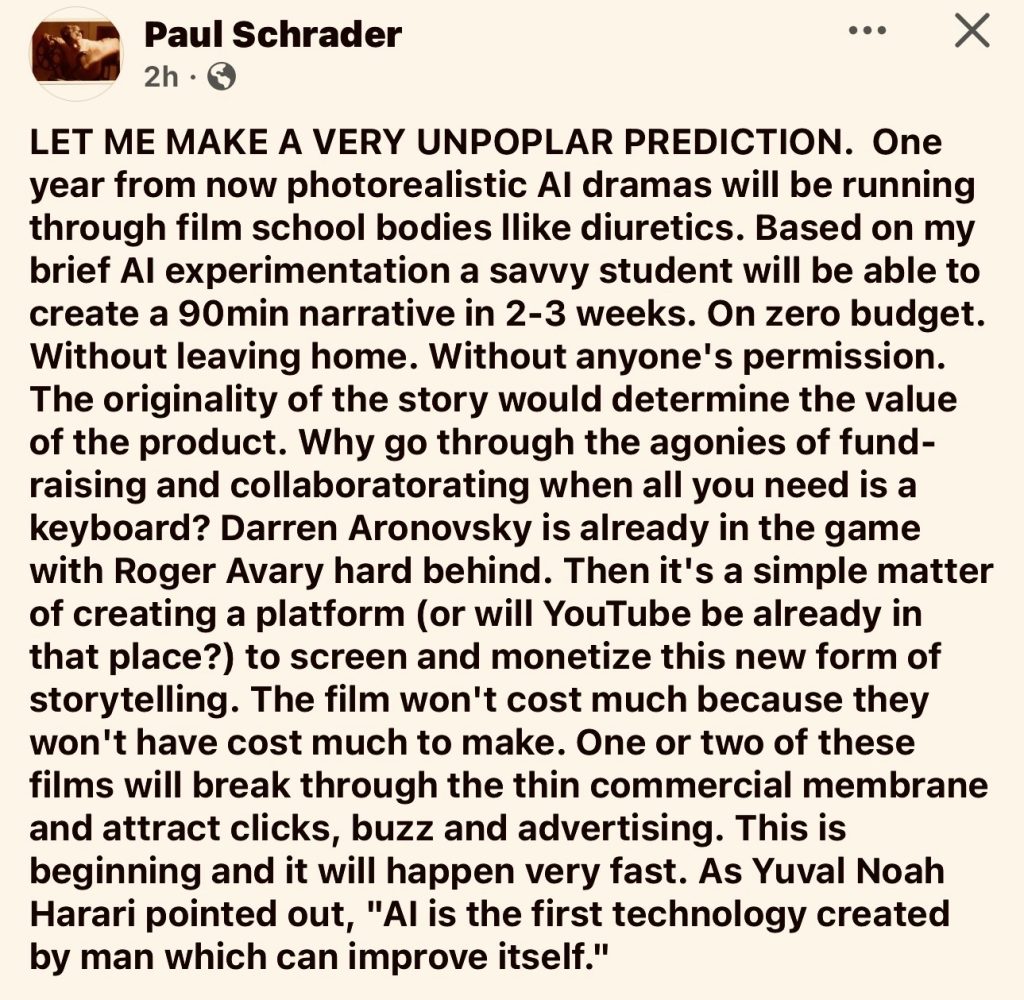
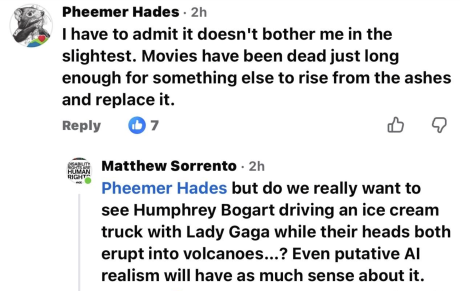
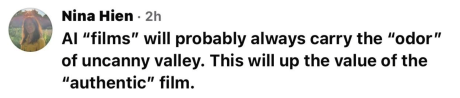
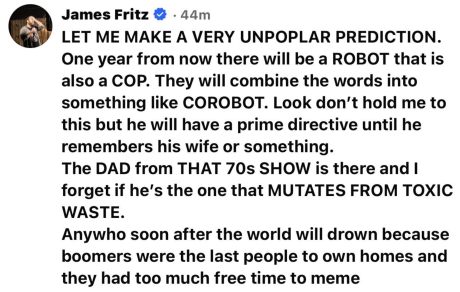
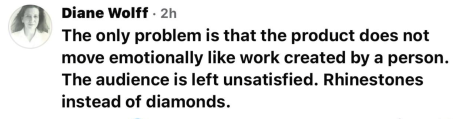
HE to Schrader: This was presumably triggered by that empty, dimension-less, Ruairí Robinson-produced duke-out video between Brad Pitt and Tom Cruise…right?
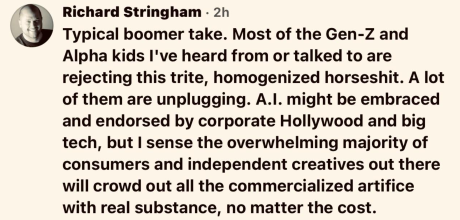
AI robotic-digital diversion is a wide-open, free-flowing cesspool**, and so the Colisseum cheap-seat serfs will always have chuckles galore on their phone screens.
As long as there are well-educated, enterprising filmmakers with hungry hearts, aggressively curious minds and resonating, real-deal perceptions (capable of recognizing the eternal cosmic goods, panoramic window-pane soul vistas, the loneliness of the long-distance runner…all that good stuff) there will be stories and journeys that will intrigue and nourish the usual 5% to 10% of the viewing public…the percentage that has always found the common gruel of mass entertainment boring, narcotizing, soul-numbing.
I for one live for the kinds of “books, films, movies and plays” that guys like Robinson will never be able to create. First and foremost because they don’t care to. They’re interested in (shocker!) delighting the Shallow Hal majority, just like the Roman Colisseum managers were a couple of thousand years ago.
All hail the proscenium-arch realms of Paul Schrader, Chloe Zhao, Sean Baker, Jonah Hill, Pawel Pawlikowski, pre-Barbie and definitely pre-NarniaGreta Gerwig, Luca Guadagnino, pre-FoxcatcherBennett Miller, Josh Safdie, Timothee Chalamet, Alejandro G. Inarritu, pre-DetroitKathryn Bigelow, pre-OdysseyChris Nolan, Martin Scorsese, Celine Sciamma, Joachim Trier …hell, an entire parade of forthcoming filmmakers who will not only be capable of pissing off people like me but are probably, impishly eager to do so.
Life is full of pain, irritation, and hair-trigger emotions that we need to quickly suppress.
I’ll occasionally zone out and misplace things…phone, keys, wallet. But the anxiety isn’t what it used to be due to Apple tags. I haven’t permanently lost anything in several years. (Last September’s Venice wallet theft doesn’t count.)
The other night I was in a Walmart, standing before a collection of watches and talking to a cool sales lady. Somehow or some way I put my iPhone 15 Max Pro plus a black external battery down on a glass case. There’s no rational explanation for walking away and leaving it there, but that’s what I did. Scatterbrain.
I hurried out to the car to retrieve the phone…of course not. I drove back home (two and a half miles) to do a “Find My Phone” search on the newest Macbook Pro. It told me the phone was right next to the Walmart store, seemingly on a sidewalk. I drove back with the laptop and hooked into Walmart wifi. I was standing exactly on the spot where the icon insisted the phone would be, right outside the main entrance…zip. A Walmart employee, a receipt checker in his late 40s or 50s, took pity and started searching around with me. He was carrying a small flashlight, as was I.
I was staring at the Macbook screen, honestly puzzled and scratching my head, and then the icon changed its mind and moved inside the store. Great! Except it said the phone was in the men’s jeans and T-shirt section, which I hadn’t visited. So to retrace my steps I walked back inside to the watch counter and there it was…just sitting there. The sales lady hadn’t given the abandoned phone to a store manager for safekeeping. She had just left it there, or maybe she was like me and hadn’t noticed it or whatever. Either way nobody grabbed it for a half-hour or so, and there it still was. Peace in the valley.
I went over to the good samaritan and told him the news. “Thanks for being a good soul,” I said, patting him on the shoulder.
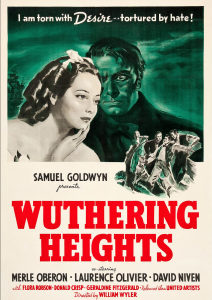
Justin Chang‘s review of Wuthering Heights posted four or five days ago. In the final paragraph he reaffirms his belief in woke presentism — in this instance diverse casting in centuries-old British settings.
“Over the years, the question of Heathcliff’s ethnicity has generated no shortage of debate,” Chang writes. “He is described in the book as ‘dark-skinned,’ a ‘gypsy in aspect,’ ‘a little Lascar,’ and ‘an American or Spanish castaway’ — all terms that have been deemed ambiguous or inconclusive enough that the character has been played onscreen, almost invariably, by white actors.
“Andrea Arnold’s Wuthering Heights (2012), in which Heathcliff is played by the black actors Solomon Glave and James Howson, is a rare and worthwhile exception.
“[Director Emerald] Fennell has been forced to defend herself for casting a white male lead (Jacob Elordi), and it struck me that her deployment of two actors of color, Hong Chau and Shazad Latif, in key supporting roles could have been a calculated kind of insurance against criticism, a way of still laying claim to a token measure of diversity.”
That’s important, no? Inserting POCs in a film set in late 1700s England, I mean.
Friday night around 7 pm: Roughly seven hours ago or just past 12 noon, “the man who claims he knows the identity of Nancy Guthrie‘s kidnapper[s] and her location” got in touch with TMZ’s Harvey Levin. The FBI recently doubled its offer for information that leads to Guthrie’s rescue, from the initial $50K to $100K. This is the amount that the Guthrie gremlin wants in exchange for coughing up info about her adbuctors (“the name of the main individual”) and where she’s located. In two payments, he says.
If you were the FBI authority making the call, would you send $100K to this dude? I would. What the fuck, right? Take a chance.
I’m been sensing for days that poor Nancy Guthrie may have expired. Levin vaguely hinted yesterday that something bad may have happened. Here’s hoping she’s fine.
Emerald Fennell‘s Wuthering Heights, which I sat through early last evening, is the female gaze in action. Not that there’s anything wrong with that. It used to be fine to have male gaze movies until the wokeys decided that white males are fundamentally repellent. Female gaze movies are obviously more in synch with today’s swing of things. The best kind of romantic-sexual films are both at once.
But Emerald Heights (not a typo) is a kind of masturbation porn for women. Overall it adopts an odd, montage-y, surface-skimming scattershot approach. Not much in the way of dramatic build or smoothly blended spirit fiction or elegant symphonic whatever. Fast-forward pacing, many short scenes, abrupt cutting — a cinematic equivalent of speed-reading.
It’s basically anti-period (i.e., anti-Bronte realism) with a standard, thoroughly-pointless-within-the-narrative diverse casting of Hong Chau and Shazad Latif as significant supporting characters. Plus the curiously gaudy and flamboyant production design is crazy. The sparkling walls and that lurid, ultra-red hallway.
Fennell’s film is a sweaty, highly stylized bodice ripper for the womenfolk, and not at all for the guys. Well, somewhat but not really.
Margot Robbie goes in for the expected heavy breathing…she pouts, pants, shudders and moans, but for all the pelvic thrusting and vigorous rutting and licking and damp fingering (fingers in mouth, I mean) and rain-soaked groping, and for all the luscious erotic objectification of Jacob Elordi’s muscular, horse-like torso by Fennell and her Swedish dp, Linus Sandgren, there’s no “tits and ass” here…not visually or otherwise.
I don’t mean to sound like a dog, but Fennell is not into accommodating anything that even approaches the male gaze. Not even a slight wink in that direction. There’s not a single Bernardo Bertolucci-esque capturing of female nipples or navels or gloriously rounded hips or moist heaving tummies** in Emerald Heights, much less any discreet eyeballing of anyone’s junk or hairy thatch…not a single side-boob glimpse, and not a single apple- or pear-shaped female ass in the moonlight (or daylight for that matter). And no implied hand jobs and certainly no suggestions of sword-swallowing or any slight residue of gleaming whatever a la Lars von Trier’s Nymphomaniac.
Nothing, in short, for the dudes sitting by their girlfriends or wives in the seats. There’s not a single, red-blooded, hetero hard-on moment in the entire film.
Friendo: “I didn’t need Wuthering Heights to be softcore jerkoff porn. But I did want to be moved by it, and the film, while watchable, left me cold and glum.”
I also want it clearly understood that in all my decades upon this planet, I have never, ever made out with a girl in the pouring rain. I don’t think anybody has. Not even during the pouring rains of Woodstock ‘69. Has anyone ever just stood in the pouring rain without running for cover? Van Morrison did in the early ’70s, but who else?
I was thinking about the Wyler-and-Toland all through the Fennell. After arriving home around 8:30 pm and after catching the two most recent episodes of The Pitt, I went upstairs and watched portions of the 1939 film on my iPhone 15 Max Pro. It’s streaming on HBO Max.
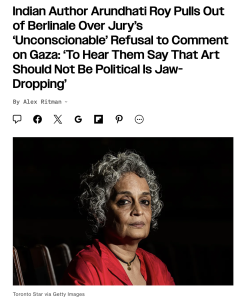
During yesterday’s opening press conference for the 2026 Berlinale, jury honcho Wim Wenders, asked about Gaza genocide, said that movies should operate in a realm above or at least separate from politics. “We have to stay out of politics because if we make movies that are dedicatedly political, we enter the field of politics,” he said. “But we are the counterweight of politics, we are the opposite of politics. We have to do the work of people, not the work of politicians.”
Alarmed response from Indian author Arundhati Roy, who has pulled out of participating in the festival: “This morning I heard the unconscionable statements made by members of the jury of the Berlin film festival when they were asked to comment about the genocide in Gaza. To hear them say that art should not be political is jaw-dropping. It is a way of shutting down a conversation about a crime against humanity even as it unfolds before us in real time — when artists, writers and filmmakers should be doing everything in their power to stop it.”
HE statement: I’m fine with political filmmaking as long as it’s provocative or transgressive (i.e., anti-woke, anti-kneejerk Israeli hating). I’m also fine with zero political content. But I get what Wenders was trying to say, which is that agenda art is not good art. Passionate political filmmaking has a necessary place in our world, of course, but Wenders was making an anti-woke statement, and good for him.
Halfway through Steven Soderbergh;’s The Limey (’99) the late NickyKatt muses about TV fare. “Why don’t they make shows about people’s daily lives?,” he asks. “Shows you’d be interested in watching, y’know? Sick Old Man or Skinny Little Weakling. Big Fat Guy…wouldn’t you watch a show called Big Fat Guy? I’d watch that fucking show.”
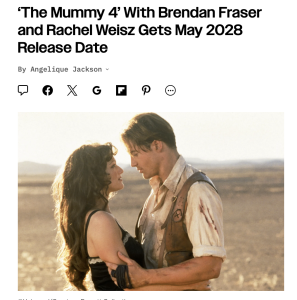
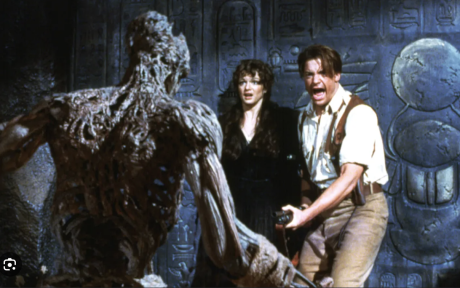
Yesterday Variety ran a piece about Brendan Fraser and Rachel Weiss being officially cast as Rick and Evelyn O’Connell for a fourth installment of Univeral’s profitable Mummy franchise. Directed by Matt Bettinelli-Olpin and Tyler Gillett, pic will presumably shoot later this year or sometime in ’27. It will open on 5.19.28.
Then it hit me…a brainwave. If Universal were to call the film in question Fat Mummy, I would run to the nearest plex when it opens. Imagine it! A mummy with a weight problem. The script would write itself. Like Snakes on a Plane, Fat Mummy is one of those lightning-in-a-bottle titles that everyone (and I mean everyone) would pay to see theatrically or rent or stream or whatever…instant mayhem.
Last night I decided to give Boogie Nights another try. I was somewhere between moderately upbeat, mixed and mezzo-mezzo when I first saw it 28 and 1/2 years ago, but I’m afraid it’s gone down in value. Sorry but it has.
The tension-filled, third-act drug deal scene is still terrific, but otherwise I found myself losing patience early on. The basic reason is that director-writer Paul Thomas Anderson shows so little respect for his San Fernando Valley porn-world characters, and you start to lose patience as you ask yourself, “Jesus, is there anyone in this film who isn’t a figure of ridicule…who isn’t thoughtlessly smug or a dumb-ass, an asshole, a dupe or some kind of none-too-bright?
Yes, okay..there are several exceptions. Mark Wahlberg, Burt Reynolds, Julianne Moore and Heather Graham‘s “Rollergirl” are okay hangs, plus the reasonably sensible second-fiddle characters played by Don Cheadle, Philip Baker Hall, Robert Ridgely and Nina Hartley as well as Thomas Jane‘s moustachioed, coked-up macho guy who loses his mind during the climactic drug deal with Alfred Molina.
But so many others are portrayed as foolish, stupidly vain, naive, not very sharp…gullible or goofy or indifferent 818 yokels who are lacking in fundamental smarts, taste and class. I just got tired of their one-dimensional banality.
I knew the drug deal scene was coming, of course, so I hung in there but man oh man…
Boogie Nights basically makes cynical, snide fun of this low-rent porn demimonde in the same way that Robert Altman‘s Nashville (’75) made fools and hicks out of all its characters except for Keith Carradine, Lily Tomlin and Allen Garfield.