“Dream Ooze”

From the get-go my feelings about David Fincher‘s The Girl With The Dragon Tattoo were positive but qualified. But one thing I was 100% about was the main-title credit sequence, which appeared yesterday on YouTube. It was a cocreation between Fincher and Blur Studio‘s Tim Miller, whom I spoke to briefly around noon today.

Blur, which Miller co-founded in 1996, specializes in animation and VFX, and Miller himself is into comic-booky fanboy stuff. He appears ready to graduate into feature film directing, as he plans to direct that Deadpool movie for 20th Century Fox that Ryan Renolds is attached to.

Miller has known Fincher for years, but didn’t work for him until Fincher asked him to deliver some renderings for a “making of Zodiac” featurette that explained how certain visual effects were composed. There’s another project based on The Goon, the Dark Horse character, that he and Fincher have been trying to launch.

The Dragon Tattoo main-title theme is that everthing is covered in a kind of black oil, which Fincher came to describe as “dream ooze.”

“David wanted to do something new and fresh, something that might redefine main-title sequences like Se7en‘s main-title sequence did,” Miller relates. “He wanted it to be abtract, and so we started gathering references, mostly through the fine art world. We put a ton of shit together, and there was one artist who had made himself black and stood in a gallery, and that’s more or less where the dream ooze came from, and which eventually led David to say ‘let’s make this a unifying element’, and from that — David’s emails are little haikus of perfect prose — I wrote the abtract vignettes.” And they were off to the races.

Miller didn’t have time to chat any more than five minutes so that’s all I got, but at least I had a chance to tell him I think the Tattoo main title sequence is very cool and striking, and that he and Fincher should feel good about that.
Wanna Hit Someone

Well, not really. “Hitting people” is not a door that any reasonable person wants to unlock and walk through. But on this, my second day of Time-Warner wifi constipation, I’m feeling an urge to at least punch my refrigerator. I lost an entire story this morning when it wouldn’t save…phffft. Right now, after three modem shutdowns and reboots, the wifi is working in a sluggish, covered-in-molasses 1998 way. A Time Warner tech guy was supposed to be here a half-hour ago to install a new modem and increase my download speed to 50 mpbs. Nothing puts me into a darker, snarlier mood pocket than this.

Naked

With great effort, director-screenwriter Larry Karaszewski has found an Australian print of Frank Perry‘s Last Summer, and will be screening it on 1.19 at the Egyptian Theater. Star Barbara Hershey, who was so influenced by the film that she changed her name to Barbara Seagull for several years based on a scene in Last Summer, will join Karaszewski for a post-screening q & a.

Here’s a Last Summer trailer that Karazszewki cut together,

Also coming up on February 4th is a screening of The Loved One plus a reunion of the cast and crew including Robert Morse, Jonathan Winters and Haskell Wexler.

Artist Soup

I should have linked earlier today to a 1.10 Guardian piece by Joe Uitichi about Artist blowback. Key graph: “Empire‘s Damon Wise believes that most mainstream criticism is nowadays based around finance and marketing rather than the real worth of a film. ‘Is the film commercial, is it awards-friendly, or is it both? Contrarian reviewers imagine themselves to be somehow part of that process, and a film like The Artist is complete bait for that kind of reporter.”

Great Expectations

The Salt Lake Tribune‘s Sean Means interviewed me a lonnng time ago about Sundance 2012, and now here it finally is. The piece, I mean. Myself and a few others (David Poland, Jen Yamato, Omar Moore, Peter Knegt, Ray Pride) listing the films they’re most looking forward to when the festival kicks off. Only nine days from now.

Universal’s Bluray Buffing of 13 Classics

All but buried on Deadline is Pete Hammond‘s 7.10 story about the thirteen classic films being restored by Universal to honor its 100th anniversary, and slated for Bluray release between now and the end of the year. Hooray for Universal and shame on those studios who’ve failed to honor their classic films in a similar fashion. Like Paramount, for example, which as far as I know is still refusing to create a Bluray for George StevensShane. Dilletantes!

The Bluray kickoffs are Robert Mulligan and Alan Pakula‘s To Kill A Mockingbird (1.31), and Lewis Milestone’s All Quiet on the Western Front (2.14).

The other Universal films getting the full restoration and Bluray treatment are both 1931 versions of Dracula (English and Spanish-language), Frankenstein (1931), The Bride of Frankenstein (1935), Abbott and Costello’s Buck Privates (1941), Pillow Talk (1959), The Birds (1963), The Sting (1973), Jaws (1975), and Out of Africa (1985).

The restoration process for each film took up to six months and cost anywhere from $250,000 to $600,000 a title. Plans are being drawn up to tour the films as well, and the blueprint is to accelerate restorations in the future.

“I would like all of our films to be restored,” Universal honcho Ron Meyer told Hammond. “And hopefully as the years go on more and more of them will be done. I think we need to do more film restoration. All of us need to do it.”

Are you listening, Brad Grey? The ghost of George Stevens is hovering above Paramount as we speak, flipping the bird at you and your Paramount Home Video vision-free underlings.

Here’s the URL for Universal’s 100th anniversary website.

Bag Lady

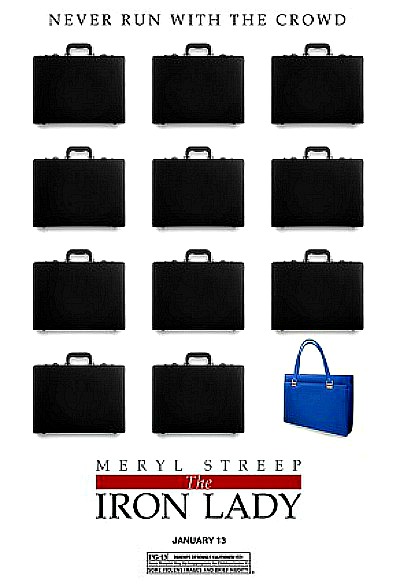
I’ve been led to believe (perhaps unwisely) that this is the new official Iron Lady one-sheet. For what it’s worth I think it’s okay. Any one-sheet that eschews the obvious in favor of a metaphor gets my vote. It’s obviously pitching to independent-minded women. (I think.) Thatcher might have been an elite-favoring conservative, but she stuck to her guns. The blue Asprey bag was some kind of signature thing.

All Younger Then

I did a Movieline sitdown with Leonardo DiCaprio at The Grill in Beverly Hills about two years prior to his April 1995 appearance on Late Night with David Letterman. Razor sharp, he was. Crackling energy. And trusting (as many younger guys tend to be.) It’s a little hard to absorb or accept that this happened almost 20 years….whoa. Time moves relentlesly, and does not suffer fools.

Here’s my 1993 Moveline piece. (Thanks to Stu Van Airsdale.)

Couch Lucas

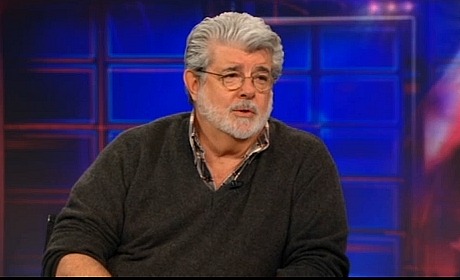
Ignore George Lucas‘s Daily Show comment (delivered last night) that Red Tails (20th Century Fox, 1.20) is as close as he’ll ever come to making a sequel to Star Wars. The thing to focus on is his claim that Red Tails is essentially a 1942 movie (like the 1951 Flying Leathernecks, Lucas said). The heavily CG’ed look argues with that notion up and down. If it looked and felt like a real 1942 film, I’d be the first one there on opening day.

I wrote the following in a July 2011 piece called “World War II Video Game“: “Could the World War 2 dogfight sequences look any more fake? What a non-pleasure it’ll be to wallow in visual values and terms that have nothing to do with 1940s verisimilitude and everything to do with Lucas wanting to slick this thing up as much as possible.

“Lucas has been struggling with this sucker since filming began in March 2009 and reshoots happened in March 2010. Obviously it’s a troubled and ungenuine enterprise. Failure of this sort couldn’t have happened to a nicer guy. The director of record is Anthony Hemingway.

From the Wiki page: “Production began in March 2009. Principal photography took place in the Czech Republic, Italy, Croatia and England. Lucas took over direction of reshoots, in March 2010 as Hemingway was busy working on episodes of the HBO series Treme. Hemingway will have final approval over the footage.”

What Killed War Horse’s Oscar Hope?

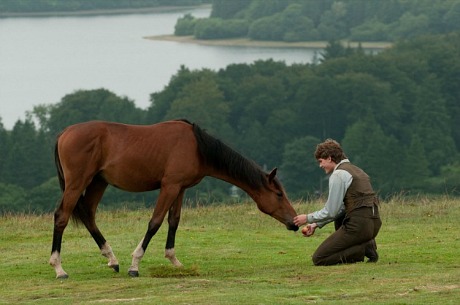
War Horse is far from a dead animal. It may be “on its way to the Oscar glue factory”, as an Oscar wag remarked earlier today. But it’s a solid commercial hit with the middle-American family crowd (almost $56 million after two weeks in theatres) and it’s even possible that it’ll land a Best Picture nomination, and that director Steven Spielberg might pull off a Best Director Oscar nomination, despite his having been excluded from the DGA’s list of Best Director nominees.

But given this morning’s DGA announcement and other recent indicators listed today by Hollywood Reporter columnist Scott Feinberg, the likelihood of its winning the Best Picture Oscar is now almost nil. And the chances of Spielberg being nominated for a Best Director Oscar are clearly diminished, although, as noted, it could still happen.

“I sensed a bit of a bump in the road for War Horse, as reflected in my 1.8 Oscar forecast,” Feinberg wrote today. “Although the film was one of the Producers Guild of America’s 10 nominees, it was also snubbed by the Screen Actors Guild (despite featuring a huge international cast that seemed like a strong option for the best ensemble category), the Writers Guild of America (despite the fact that many of its chief rivals in the adapted screenplay category had been deemed ineligible), and the Art Directors Guild (despite the fact that the film’s production design, coordinated by Oscar winner Rick Carter, is one of its greatest strengths).”

So what were the factors that decisively killed War Horse‘s Oscar chances? Was there a Norbit factor (or two or three) that took it down?

My own oft-repeated view is fact that anyone with a smidgen of taste or perspective knew from the get-go that Spielberg’s film didn’t have the internals that would make it go all the way, and that the only thing it had going for it was the fact that many respectable professionals (including Indiewire columnist Anne Thompson and Fox publicity honcho Bumble Ward) admitted it had made them cry.

I have an odd theory. I could be off-base, but I believe that a particular line of dialogue did a lot to stop War Horse. That’s right — one line.

It was spoken during the no-man’s-land, barbed-wire scene when the British and the German soldier are cutting through the wire that has totally entangled Joey. And they start talking about this and that, and the British soldier says (I’m paraphrasing from memory), “You know, here we are…soldiers from opposing sides, standing in a muddy no-man’s-land at night and helping this poor beast get free of the wire. Heh…you know something? I think we should give him a name. But what could we reasonably call him, given that he’s a horse and we’re in the middle of a war? Wait…I know! I think we could call him ‘war horse.’ It kinda fits, you know?”

I was already slumping in my seat when that scene began. But after the British soldier said it I muttered to myself, “Holey moley! All right, that’s it…no way this thing wins the Best Picture Oscar. In fact, it may not even be nominated.”

I was going to call this article “Joey Goes Down,” but I didn’t want to sound smug or snide.