Old Lefty

A month ago I wrote that if Richard Nixon returned to earth “with the same mind and spirit and perspective that he had before he died in the ’90s but in the body of a go-getter Congressman from Southern California, he’d probably have a tough time getting re-elected because he’d be considered too moderate, too thoughtful, too practical…a guy who doesn’t get the ideological fever of the Tea Party or the debt-ceiling shutdown or any of the things that Eric Cantor or Michelle Bachmann believe in. He could almost be a centrist Democrat by today’s standards.”

Now comes a Kurt Andersen guest column in the 8.6 N.Y. Times that continues the Nixon Love. It’s called “The Madman Theory,” which is misleading as it suggests an Armageddon scenario caused by a hair-trigger fanatic. But it’s mainly an achievement check-list of a U.S. president who’s undergoing a major reputation upgrade — long regarded by boomers as one of the worst all-time ogres, but now seen as our last decisively liberal chief executive. (Bill Clinton was basically Dwight D. Eisenhower.) Nixon was more than a little pathetic in a psychological-obsessive sense, agreed, but otherwise…

“A lot of us swooned over Obama partly because he seemed so prudent, straightforward and even-keeled. But now, with Republicans spectacularly applying the Madman Theory for the first time in domestic politics, Obama’s nonconfrontational reasonableness isn’t looking like such a virtue.

“It’s frustrating. We’ve had presidents who were intelligent and progressive but also cynical and ruthless when necessary. Effective, tough-minded, visionary liberals such as F.D.R., Clinton…and Nixon.

“In popular imagination, Nixon remains nothing but a great goblin — scowling bomber of Southeast Asia, panderer to fear and racism, paranoid anti-Semite, dispatcher of burglars — but the truth is, he governed further to the left than any president who followed him. The overreaching Euro-socialist nanny state that today’s Republicans despise? That blossomed in the Nixon administration.

“Spending on social services doubled, and military budgets actually decreased. He oversaw the creation of the Environmental Protection Agency, the Occupational Safety and Health Administration, and the Consumer Product Safety Commission. His administration was the first to encourage and enable American Indian tribal autonomy. He quadrupled the staff of the Equal Employment Opportunity Commission, almost tripled federal outlays for civil rights and began affirmative action in federal hiring. He supported the Equal Rights Amendment and signed Title IX, the law granting equality to female student athletes. One of his Supreme Court appointees wrote the Roe v. Wade decision.

“Nixon made Social Security cost-of-living increases automatic, expanded food stamps and started Supplemental Security Income for the disabled and elderly poor. It helped, of course, that Democrats controlled the House and Senate. But it was the president, not Congress, who proposed a universal health insurance plan and a transformation of welfare that would have set a guaranteed minimum income and allowed men to remain with their welfare-recipient families.

“It was Nixon who radically intervened in the free market by imposing wage and price controls, launched detente with the Soviets, normalized relations with Mao’s China and let the Communists win in Vietnam.

“And, for good measure, the budget for the National Endowment for the Arts grew sixfold, by far the biggest increase by any president.

“The idea of Nixon — Nixon? — as a de facto liberal provokes cognitive dissonance, especially among people over 50. Facts notwithstanding, they refuse to buy it, as if they’ve been fooled by a parlor trick. But the only trick involved is judging Nixon circa 1970 by the ideological standards of 2011.

“My late mother, who voted for every Republican presidential candidate from Wendell Willkie through George H.W. Bush, became a Democrat in her 70s. “These black hats,” she said of the G.O.P. right, “have gotten as nutty as fruitcakes. Nothing they say shocks me anymore.” She voted five times for Nixon, whose Madman Theory was a tactical posturing to make the Communists think he was an unhinged, reckless fanatic itching to wreak havoc. But a national Republican Party dominated by actually unhinged, reckless fanatics itching to wreak havoc in America? I think that would’ve shocked her. I think it probably would’ve even shocked Nixon.”

Market That Time Forgot

I have a curious affection for L.A. supermarkets that have resolutely refused to get with the 21st Century super-flamboyant, super-abundant, jack-up-the-prices modernization trend. A couple of days ago I visited this dumpy little Vons at the corner of Santa Monica Blvd. and Barrington, and was amazed to note that it has exactly the same facade as it did 28 years ago, when I first arrived out here. It isn’t rustic enough to qualify as a classic landmark or anything, but there’s something vaguely cool about a market that just stands up to the scuzz by refusing a facelift.

Justice

Many years ago Ben-Hur screenwriter Gore Vidal dismissed the meaning of the title of Lew Wallace‘s 1880 novel, “Ben-Hur: A Tale of the Christ.” “It isn’t a tale of the Christ,” said Vidal. “It’s the tale of a war between a Roman boy and a Jewish boy.”

Which is why the movie ends after the chariot race sequence. Finito, resolved. Even though it continues for another half-hour or so because director William Wyler needs to be faithful to Wallace’s pious novel, and so we’re stuck with the sloggish remainder. And all you can do is look at your watch.

The crucifixion finale is supposed to be about Christ’s blood washing away the anger of an unjustly persecuted man and saving his mother and sister from leprosy. But the movie would be massively frustrating without the feeling of justice delivered to Stephen Boyd‘s Messala by what happens to him in the chariot race.

People don’t care about “happy” or “sad” endings — they want endings in which the characters receive their just desserts. Movies always “end” after the moment of justice occurs. The finale of The Godfather, Part II is satisfying because Al Pacino‘s Michael Corleone has met with a kind of justice, which is to say a state of solitude and spiritual frigidity after the murder of his brother Fredo. It’s a fate that he’s earned so it feels right.

And Vidal’s gay subtext in the relationship between Messala and Judah is unmistakably there in Ben-Hur. It’s an old story, but I love re-reading it:

Vidal, who wrote much if not most of the screenplay, says in the “Making of Ben-Hur” doc that he suggested to Wyler that the characters’ conflict scenes be written as “a lover’s quarrel.”

“Wyler said, ‘What do you mean?’,” Vidal recalls. “I said, could it be that the two boys had some kind of emotional relationship the first time around, and now the Roman wants to start up again and Ben-Hur doesn’t — and doesn’t get the point?

“Willie said, ‘Gore, this is Ben-Hur. You can’t do that to Ben-Hur.’ I said, well, if you don’t do something like that you won’t have Ben-Hur. You’ll have an emotiveless mess on your hands. And he said, ‘Well … you can’t be overt.’ I said, I’m not gonna be overt. There won’t be one line. But I can write it in such a way that the audience is going to feel that there is something emotional between these two that is not stated, but that blows a fuse in Messala. That he is spurned. So it’s a love scene gone wrong.”

Here’s that story I wrote yesterday about the forthcoming New York Film Festival showing of the restored Ben-Hur.

Elizabethan Detour

Trailer uploaded today, feature playing Toronto Film Festival, skepticism about the hand of Roland Emmerich prevailing, etc. I’m not fully persuaded that Anonymous, which sounds like kin to Untitled, is the greatest title.

No Middle Ground

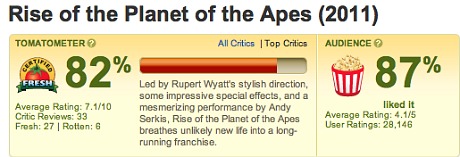
Critical response to Rise of the Planet of the Apes is 80% wowser, over-the-moon, delirious and ecstatic. The general tone isn’t “yeah, pretty good film, worth seeing” but “this is really an exception…summer’s best popcorn flick…Serkis deserves an Oscar nomination…much better than expected,” etc. And about 20% of the critical community just can’t seem to get it. Not in a somewhat or mostly negative way, but sharply, at times harshly…right into the trash bin. I haven’t read a single half-and-halfer except for Peter Debruge‘s Variety review.

Here’s a Vulture summary of Oscar nomination shout-outs for Serkis.

Less So

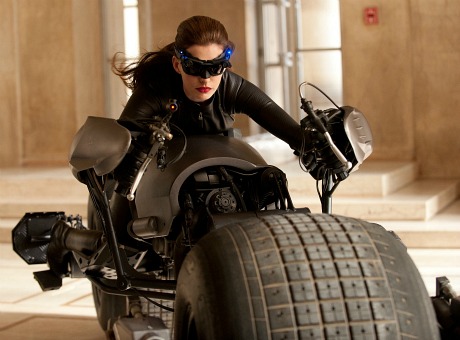
What am I supposed to do with this? Black-attired Anne Hathaway with black goggles, riding a totally standard fat-tire Batman motorcycle, etc., etc. Should I feel relieved that she doesn’t have cat ears? Fine.

Odd Chortles

As I noted earlier this week, the second half of The Change-Up is better — certainly more tolerable — than the first half, which is mostly foul, rancid and sub-mental. And there’s one second-half bit that got me. I didn’t laugh, exactly, but I guffawed or tittered in some kind of pleasurable way. Because I recognized the moment. Because I’ve been there.

Ryan Reynolds is inside Jason Bateman‘s attorney body, and is working late at the office. And Bateman’s wife, played by Leslie Mann, calls him about something or other. The punchy Bateman listens for a few seconds and asks, “Uhm…who is this?” Exhausted and resigned to his detachment, Mann answers, “Your wife.” Actually I didn’t titter or chortle — I laughed. Because that’s me. I fuzz out on all kinds of things, all the time.

Last night I was watching Ruben Fleischer‘s 30 Minutes or Less and just trying to hang in there and tough it out and make it through to the end, etc. And then came a moment when Danny McBride and Nick Swardson, playing crass, brain-dead asshole-antagonists who force Jesse Eisenberg‘s pizza-delivery guy to commit a bank robbery by strapping a remote-triggered bomb to his chest, decide to kidnap Eisenberg’s love interest and would-be girlfriend, played by Dilshad Vadsaria.

Like Aziz Ansari, who portrays her brother, Vadsaria is of Indian ancestry. And I smirked a bit when McBride and Swardson break into a toilet stall where she’s hiding and let her know she’s captured and call her “slumdog.” Which they’re using, of course, because of Danny Boyle‘s Slumdog Millionaire. We’re all familiar with how low-rent types tend to seize upon certain films or TV shows if they’ve made some kind of strong impression about exotic cultures, and for whatever reason it struck me as amusing that these dickwads would use Boyle’s film…that’s all.

There’s also a moment, by the way, in which Ansari talks about having rented The Hurt Locker but never watching it and the unopened Netflix package containing the Hurt DVD just lying around his apartment for weeks on end. I was wondering if this is a satirical reference to dumbasses who have trouble watching strong, well-reviewed films that don’t have that cheap, fast-food, big-corporate quality that doofuses tend to patronize on opening weekends, or are Fleischer and screenwriter Michael Diliberti slipping in a comment about their own faint dislike of Kathryn Bigelow and Mark Boal‘s film? It’s the former, I’m guessing, but I’m not sure.

Roger Ebert, by the way, has called The Change-Up “one of the dirtiest-minded mainstream releases in history. It has a low opinion of men, a lower opinion of women, and the lowest opinion of the intelligence of its audience. It is obscene, foulmouthed, scatological, creepy and perverted.”

Hydrangeas

I make factual and typographical mistakes each and every day on this site. Which I try to correct as quickly as I can. So I’m sure MCN’s Michael Wilmington will appreciate being told that he’s made a mistake in his 8.3 review of John Frankenheimer‘s The Manchurian Candidate (’62), or the MGM Bluray rather. Apart from the fact that Wilmington doesn’t mention that the quality of the Bluray is highly unexceptional, I mean, and smothered in digital mosquitoes.

The error, which readers are invited to spot, is in the following graph: “Now, as we watch, the scene keeps shifting from the New Jersey hotel lobby to the Manchurian theater and back again. Would we like a demonstration? The affable Doctor Yen, a man who almost never stops smiling, calls on Sgt. Shaw, asks him to pick the man he likes best of all his fellow soldiers — and Shaw picks Cpt. Marco. No dice, says Yen. They need Marco to get Raymond his Medal of Honor. Pick another. Raymond chooses the very likeable Ed Mavole, who is puffing away happily on a joke cigarette that Yen’s men have mischievously filled with yak dung. Fine.”

I’ll admit that the Candidate Bluray looks a little better on my 50″ Vizio than an earlier DVD version does, and that the blacks are richer, and that there’s more information on the sides.

Oscars Being Rattner-ized

Brett Ratner and Don Mischer will co-produce the 2012 Oscar telecast, it was announced earlier today. Ratner has promised an emphasis on laughs. Something tells me he doesn’t mean the brainy Steve Martin or Bill Maher kind…no offense. I’m guessing he’ll coarsen things up and take the show in a kind of drop-your-pants Animal House direction. I’m just guessing. It’s probably safe to say that the show will also be a little less gay, by which I mean it’ll have less of a song-and-dance Las Vegas glitter vibe.

Movieline‘s Christopher Rosen nailed it when he wrote that “the only way Tom Sherak and Dawn Hudson could have enraged the online community further with the selection of an Oscar co-producer for 2012 is if they’d hired Michael Bay.”

Vernacular

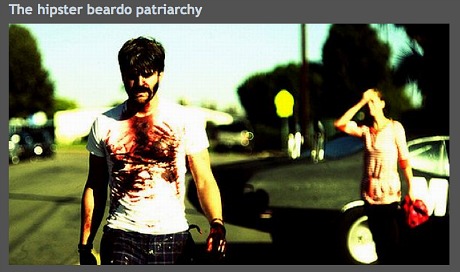
My first reaction to Glenn Kenny‘s Some Came Running pan of Evan Glodell‘s Bellflower was, “Hey, he likes using the term ‘beardo’ as much as I do!” I don’t know when it began to catch on, but I’ve used “beardo” a lot over the last two or three years (and twice in Bellflower riffs). It basically means “pretentious or self-centered jerkoff who wears a beard.”

“In his review of the inventive enfant-terrible indie Bellflower for The A/V Club,” Kenny writes, “Keith Phipps hits on something crucial about the film that I’ve yet to see any other reviewer mention. He says that ‘after a point’ it becomes ‘a film about men who hate women, and it comes awfully close to endorsing that point of view.’

“Well, screw that, I’ll go even further: it doesn’t ‘come close’ to endorsing that point of view, it absolutely embodies that point of view, it can see no other possibility but that point of view, it is that point of view.”