We're All Unitarians

Six days ago Time‘s Richard Corliss reprised a suggestion originally made by Jamie Stuart (posted as a Hot Blog comment on 9.1.09) that the Oscar show “needs to adopt a Top Ten, American Idol-like framework, gradually counting down from #10 to #1 throughout the program to create suspense.”

We all know why this idea will never fly with the Oscar-show producers. One, the makers of the films to be eliminated early on would feel insulted (despite the obvious honor of being Best Picture nominated in the first place), and two, the Academy would be indicating proportionate vote tallies by staging a preferential countdown, and they never indicate anything. And I hear that.

But at the same time this is why the Oscar show as we’ve known it is dying on the vine. However they tweak it to try and reach under-30 viewers, it is basically (and always will be) an older person’s presentation of pomp — a stately, hide-bound, proscenium-arch event produced each year with an amiable mule-like mindset and an instinctual deference to the-same-but-slightly-different. They may deny it, but the people running that show have always felt a responsibility on some level to never let the Oscars become a show that the ghost of Bob Hope wouldn’t recognize.

Corliss is right — a Best Picture elimination scheme would “add welcome suspense” and perhaps be “too entertaining.”

The vast majority of moviegoers out there see going to the movies as akin to visiting a theme park. Just as the vast majority of producers working for the big studios see their job as producing theme-park-like entertainments. There’s obviously a slot for this kind of thing, and there’s obviously an economic necessity to keep this kind of crap coming. But too many people go to movies looking only for cheap highs and jerk-off diversion. And these people — hear my call and mark my words — are the problem, and the only way to properly regard and produce the friggin’ Oscar telecast is to tell these people to get off the Oscar lawn.

Academy honcho Tom Sherak needs to man up, Clint Eastwood-in-Gran Torino style, and say the following to everyone within earshot: “Movies are a religion, and whether some of you get this or not, going to see the best movies — not the Battle: Los Angeles-type films that happen in the late winter, spring and summer but the end-of-the-year quality stuff — is the same thing as going to church and, in a manner of speaking, taking Holy Communion. They’re about values (philosophical or otherwise) and emotion and contemplation and quality of life and spirit. And that’s what the Oscar show needs to be — superficially a muscle-car thing about discipline and smarts and non-draggy pizazz, but primarily a deep-water thing about spirit and soul.

“Everything that happens on the show, including the funny stuff, has to be some kind of reflection of the satori aspect. The Oscar show needs to be the biggest Unitarian movie-church service of the year, and if that means that not as many atheists and agnostics will watch, good. But they will watch, you see. Because even the shallowest people out there understand that the best movies contain and in fact propel notions of spirit and emotion and profound transcendental recognition.”

Little Baby

For the last couple of years I’ve been using a Canon PowerShot SD 1400 IS for fine-quality 14 megapixel stills and 720p video. But I’ve been waiting all along for the next one with 1080p video, and now it’s here — the Canon PowerShot 300 HS. It has 12.1 megapixels but with a slightly more sensitive processor, a high-speed burst capability when taking stills, a zoom capability while shooting video, and slow-motion video. It’ll ship in less than two weeks.

Finality

The better films will sometimes wait until the last few minutes to allow a flawed character to redeem himself in some way. The unusual (and I think great) thing about this scene is that Anthony Quinn‘s redemption comes too late to matter, and all that’s left is devastation. I’ve said this kind of thing 100 times, but you couldn’t end a film today with the lead character finally realizing that he’s been a thundering asshole and has totally screwed himself. The last film to try this was Woody Allen‘s Sweet and Lowdown.

Infamy + History

One of the best riffs ever written by Awards Daily‘s Ryan Adams: “One reason [Oscar co-host James] Franco fell flat is because he was already in postmortem mode, doing an instantaneous mental autopsy of his onstage oblivion, already seeing his tiresome lines shrivel and wither on the vine…before bothering to prop them up with any game-face grinning facade.”

“No matter how many flashy autotune gimmicks the producers concoct to drag the Oscars into the 21st Century, it’s all just slapstick lipstick on a 3D pig without re-tuning the writing to bring it up to date. No matter how ‘fresh’ the presenters’ physical appeal, until the Oscars wise up and realize their writing staff is stale, the hosts can’t help but stink up the joint.”

Question: Why do certain guys transfer TV shows to YouTube without delivering decent sound?

Clean Fastball

Nine years after opening in theatres, John Lee Hancock‘s The Rookie arrives on Bluray on 3.29. You can count the number of G-rated, family-friendly films that are as good as this on one hand. “Remember the Titans was entertainment, using every trick and ploy to stir the emotions, ” I said in my original review. “The Rookie works its magic without seeming to milk, shovel, or pull anyone’s chain.”

Hard Times

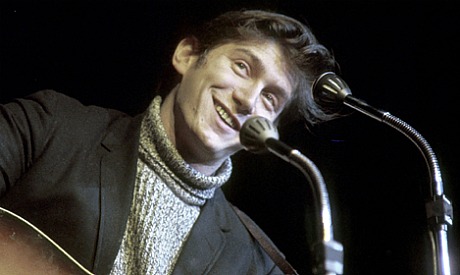
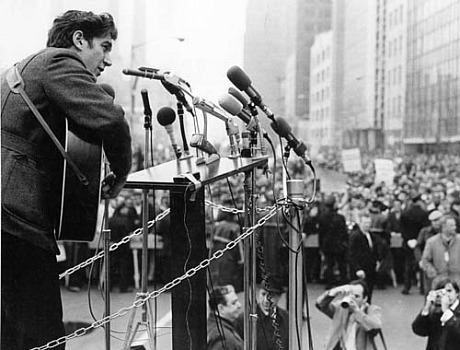
It’s obviously tragic when a good and gifted man takes his life, especially when alcohol has played a part. This is what happened with poor Phil Ochs, the folk-and-protest troubadour who composed and performed famously in the ’60s but gradually lost the thread and then his reason for living. He hung himself in 1976, at age 35. Partly because of bipolar affliction and depression and booze, but also because he couldn’t find his way out of disappointment with how ’60s activism evolved, and because he failed to find a new musical groove that worked for his audience.

I’ve always respected Ochs — he cared deeply and his music had its rhyme and place — but I’ve never felt much ardor. I’ve always thought of him as a one-trick pony who ran out of luck and favor. He was fine at what he did when the winds of history and culture filled his sails, but he wasn’t much of a stayer.

In his heyday Ochs would literally flip through the N.Y. Times or the Village Voice and write a song about something that had riled him up. This fit the times when peacenik social protest and activism ran like a river through everything. But eventually street radicals took the stage, Nixonian repression kicked in, the “We” spirit waned and Ochs couldn’t adapt to the “Me.”

Ochs’ Wiki page quotes one of his biographers: “By Phil’s thinking, he had died politically in Chicago in 1968 in the violence of the Democratic National Convention; he had died professionally in Africa a few years later, when he had been strangled and felt that he could no longer sing; [and] he had died spiritually when Chile had been overthrown [in 1973].” In his 1969, at the age of 29, Ochs released an album (his sixth) called “Rehearsals for Retirement.” What kind of 29 year-old even flirts with such a notion?

Ochs tried to do more than just sing about social issues, true, but somewhere along the way the Gods stopped assisting.

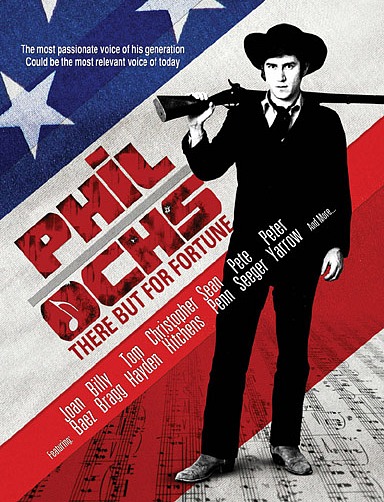
Kenneth Bowser‘s There But For Fortune, which opened yesterday in LA, the Valley and Pasadena, tries to change the impression I mentioned earlier, or at least make Ochs’ story seem more layered and textured.

It covers Ochs’ activist-singer period in the manner of several other ’60s docs, which is to say rotely. Too many other films (including Martin Scorsese‘s masterful Bob Dylan: No Direction Home) have delivered similar material. Anyone presenting yet another doc about ’60s culture in 2011 needs to figure some way of doing it differently. I only know that when Bowser’s doc began, I said to myself, “Here we go again.”

Bowser’s doc gathers force when it charts Ochs’ decline, but you’re still left with a residue of a guy whose life became stuck in first gear.

Bowser mentioned some mitigating factors when we spoke a couple of days ago. From the late ’60s through the early ’70s, Ochs was “riding a wave of manic depression,” he said. “Going in manic and coming out depressed.”

It wasn’t just Ochs’ bipolarism or alcoholism or defeatism that led to his suicide, Bowser said, but also the fact that his audience that “wasn’t willing to accept him outside of the political protest realm.” This despite some interesting musical excursions (performing a Carnegie Hall concert in a glammy gold suit in 1970, getting into African music “ten years before Paul Simon“) and two noteworthy non-protesty albums (“Pleasures of the Harbor” and “Gunfight at Carnegie Hall“).

For me, one of the most telling moments in Bowser’s film comes when Gaslight Cafe manager Sam Hood calls Bob Dylan, whom Ochs deeply admired, a “prick.” The implication is that Ochs, for all his failings and weaknesses, was a nicer guy. Maybe so. But survival and winning and genius aren’t necessarily married to “nice.” I immediately thought that Ochs might have made it through the ’70s and into a longer or happier life if he had a little more Dylan in him, and I don’t just mean his vision or talent.

Impunity

I didn’t disagree with Arianna Huffington‘s recent remark about unpaid Huffington Post contributors threatening to strike, which was basically “go ahead…no one will notice.” At the same time I couldn’t help chuckling at the similarity in tone between this and a line spoken by Oscar Werner in Martin Ritt‘s The Spy Who Came In From The Cold:

Mulching of John Edwards

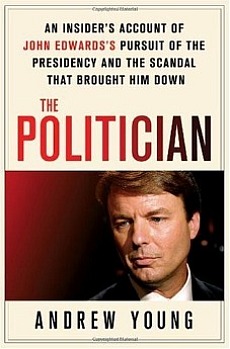
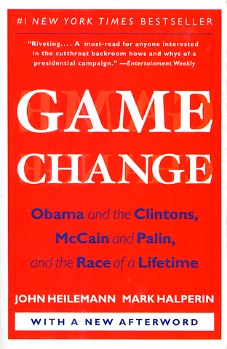
If I was Aaron Sorkin I would want my John Edwards movie, an adaptation of Andrew Young‘s “The Politician“, to appear before Jay Roach and Danny Strong‘s Game Change. Sorkin’s intention to write and direct for theatrical was announced last July. The latter is a forthcoming HBO adaptation of Mark Halperin and John Heilemann‘s best-seller that reports in depth about Edwards’ presidential campaign and concurrent affair with Reille Hunter.

Sorkin’s Oscar-winning, West Wing-fortified brand is such that his film could follow Roach’s and everything would be more or less okay. It ain’t the timing as much as the quality, etc. (Penny Marshall‘s Big was the final age-changing comedy released in the late 1980s, but it was the best.) Plus Sorkin’s film will focus mostly on Edwards, Young and Hunter while Strong’s screenplay will tell the stories of all the major players in the 2008 election.

But there’s no question that (a) being the second guy to tell the same story a few months after another version is never a desirable thing, (b) Joe Popcorn’s interest in a film about Edwards will probably be at least somewhat diminished if Roach’s HBO version comes out first (which appears likely), and (c) Roach and Strong’s Recount, the HBO film about the disputed Florida election that aired in ’08, was a highly absorbing, very well-written piece, so Sorkin’s Edwards movie kicking their Game Change ass in the telling of Edwards story isn’t exactly a done deal.

Sorkin’s will naturally be more detailed and probing (and almost certainly more devastating from Edwards’ personal perspective), but if Strong tells it well and Roach casts the right actors as Edwards and Hunter, the HBO version could make a lasting impression. I haven’t made any calls, but logic dictates that both films would want to come out during during the 2012 election cycle. My guess is that Roach and Strong’s HBO film will be out in early ’12 with Sorkin’s film (presuming it happens) hitting theatres sometime between the summer conventions and November 2012.

Hollywood Elsewhere is asking the usual sources to please send along PDFs of Strong’s script, which I’m told has gone out to actors, as well as a draft of Sorkin’s, if and when anyone has seen a copy. Thanks.

Behold A Pale Elephant

All the elements look immaculate in a quasi-Malicky sort of way. Every shot, line, garment and prop has been carefully selected, and shot just so. Nothing slapdash. But a voice is telling me to be a little bit suspicious of films with trailers that try to underscore things with delicate piano music and choirs. It opens on 4.22.

Update: Nothing gives me more pain and regret that posting a sentence that is grammatically incorrect. I’m not going to repeat the error that was up yesterday (i.e., Friday), but I do apologize.

"Adonis DNA"

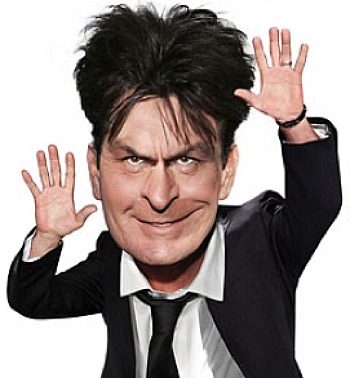
Mark Harris‘s New York 3.3 piece about the over-exposure and self-immolation of Charlie Sheen is on-target and nicely written, etc., but Darrow‘s illustration kinda says it better. Sorry.

Peep-itude

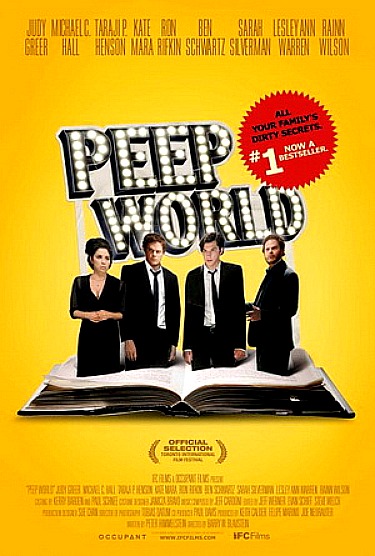
To go by the trailer and a clip, Barry W. Blaustein‘s Peep World (IFC Films, 3.25) might be moderately decent or perhaps even good. A cool, high-pedigree cast (Michael C. Hall, Rainn Wilson, Sarah Silverman, Stephen Tobolowsky, Taraji P. Henson, Judy Greer, Alicia Witt, Lesley Ann Warren, Ron Rifkin), snappy dialogue, dysfunctional family, etc. But the narration style is awful. And the word on the film isn’t so hot.

Michael Rechtshaffen‘s Toronto Film Festival review said it “very much wants to be The Royal Tenenbaums when it grows up.” And also The Celebration, the 1998 Danish Dogme film. “Unfortunately, the ripe setup quickly devolves into sophomoric shtick…[and this] leaves the talented cast high and dry,” he says. “Only Silverman manages to find lasting comic inspiration with Peep World‘s least obnoxious character, relatively speaking.”

That said, a phone-call scene between Hall and Wilson contained on the apple.com page isn’t half bad.

Outta Here

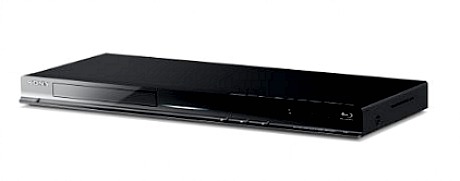
I’m firing the Sony S380 Bluray player I bought it last weekend. It’s finished. I’m taking it back to Best Buy on Sawtelle this afternoon, and I’d love to punch it a couple of times and then throw it against the wall for dramatic effect, and then kick it and spit on it. I hate brand-new machines that fuck with you because their designers are assholes.

There’s nothing wrong with the picture quality at all, but the bugger gave me all kinds of trouble with aspect-ratio control. I had to struggle and call around and ask questions just to figure out how to make 1.33 to 1 aspect ratio films (i.e., those released from the mid ’50s and back) look like they should without getting that irritating horizontal taffy-pull effect. Plus the Bluray remote doesn’t have an instant return to the DVD home screen command button. You have to click up and then sideways and find the right control….the hell with that. Plus the remote command action is sluggish; the TV needs a second or two to think before responding.

I got the 1.33 to 1 thing working well for a time (I was quite pleased, in fact, that the S380 delivers almost a perfect box effect by displaying the full height of those old films) but then it reverted to problem status. I’ve been told by a home-video specialist who dropped by to get a wifi-friendly Samsung 8500. I’ve never liked the name Samsung (i.e., too Korean) but I’m done with Sony Bluray players for life. I’d honestly like to put the S380 in the middle of Westbourne Drive and run over it with my car.