

In David Carr‘s 10.22 piece about Alex Gibney‘s Client 9: The Rise and Fall of Eliot Spitzer (Magnolia. 11.2), Gibney says that Spitzer “was a force for good. There’s always been corruption in American business, but the new class of rich has become untethered to normal people. They are only tethered to other rich people, and here you have a rich and powerful guy who cares about what is happening to those people and decides to punch back.”
Forget It
In the view of Indiewire‘s Anne Thompson, Conviction has brought Sam Rockwell “the role of his career, playing the real-life rebellious and volatile Kenny Waters, who grew up neglected and abused and ended up with a murder conviction, in prison for life. His sister, Betty Anne Waters (Hilary Swank), finished high school, put herself through college and law school, over eighteen years, in order to figure out a way to prove that he was innocent of the crime.
“Rockwell shows us how this guy feels — angry, hopeful, despairing, suicidal, never sure if it will work out, hanging onto his sister to deliver his freedom. It’s tough, real, upsetting stuff.”
Wells response: Put this idea out of your head right now! “Rockwell delivers his usual cut-up performance, playing the doofus-yokel brother who’s indifferent to authority or caution or…I don’t know what the character’s problem is, and I don’t care that much either,” I wrote on 9.30. “I do know that when you hire Sam Rockwell you’re going to get one of his head-scratchy, soft-shoe-shuffle performances that are mainly about how hip-weird and hip-dorky he can be if the director doesn’t tell him to get down and focus his ass and stop hacking around.”
Lawrence on the Line
About three hours ago I spent a few minutes talking with Jennifer Lawrence, whom everyone is more or less assuming will be one of the five Best Actress nominees for her performance in Winter’s Bone. She was in Los Angeles for whatever reason, although her primary activity right now is playing Raven Darkholme / Mystique in Matthew Vaughn‘s X-Men: First Class, an origins prequel set in the 1960s. The pic wraps in December and will open next June.
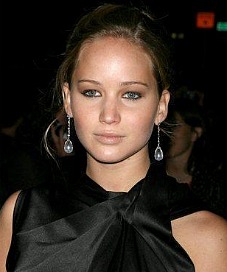
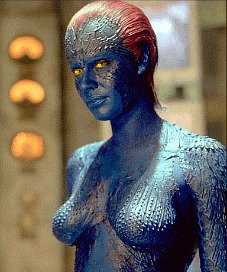
(l.) Likely Best Actress nominee Jennifer Lawrence; (r.) Rebecca Romijn as Mystique.
We didn’t speak much about Winter’s Bone; I just told her what I think is almost certain going to happen with the nominations, and she said “thank you.”
She’s living in a place in London’s Notting Hill distrtict, and that her X-Men commute is mostly a drive to Pinewood Studios. We spoke about how lethal London cab drivers can be. We talked briefly about Mark Tonderai‘s House at the End of the Street, which is kind of Psycho-ish, she said. I tried to talk a bit about The Beaver, which she has a costarring role in, but I’m sure she’s been told to stay away from that subject — she certainly didn’t say much.
Only 10% of her screen time will be as Mystique, she said. It takes X-Men: First Class makeup artists about six hours to transform her into Mystique with the blue skins and the scales, she added. (She has a nickname for the process or the makeup or whatever — “Mystink.”) I asked if official photos have been taken, and she said the idea was to keep her appearance under wraps until just before the film’s release. I said if the world has to wait until next summer for a shot, fine, but if an un-approved shot makes it onto the web I won’t be sorry.
Chart Is Dated
The Best Actress locks are Black Swan‘s Natalie Portman, Annette Bening for The Kids Are All Right (no Julianne Moore unless Focus takes Scott Feinberg‘s advice and pushes Bening and Moore together) and Jennifer Lawrence for Winter’s Bone. There are three prime contenders for the two remaining slots — Anne Hathaway for Love and Other Drugs , Michelle Williams for Blue Valentine and Nicole Kidman for Rabbit Hole (a.k.a. The Griefersons).
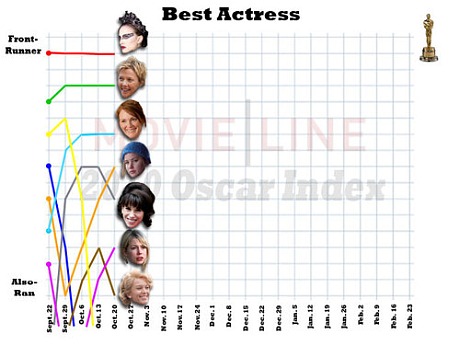
No offense, but the guys who posted this Movieline Best Actress chart on 10.20 didn’t quite understand all the ramifications and considerations that I’ve pointed out in today’s piece.
Lesley Manville needs to play it smart and go for Best Supporting Actress for her work in Another Year — she’ s a near-cinch to win if she does this. Sally Hawkins‘ Made in Dagenham performance doesn’t match the quality of her work in Happy Go Lucky — let’s face it. When Naomi Watts (portraying Valerie Plame) is outed as a CIA agent in Fair Game, she goes into a strange gopher hole of denial that doesn’t feel all that compelling or admirable. And whatever fervor may have existed for Diane Lane‘s Secretariat performance has gone away due to ebbing box-office, I’m afraid.
That Hathaway Resistance
One of the oldest award-season prejudices is to deny consideration to any film that feels the least bit romcommy — anything that feels a little too fast or frothy or up-moody. And especially a performance in a film that dances to this kind of tune. This thinking might well be intensified, I’m thinking, in the case of an “emotional comedy” that isn’t exactly romcommy as much as a hybrid of romcom + earnest emotionalism + relationship anguish + grappling with a debilitating disease.
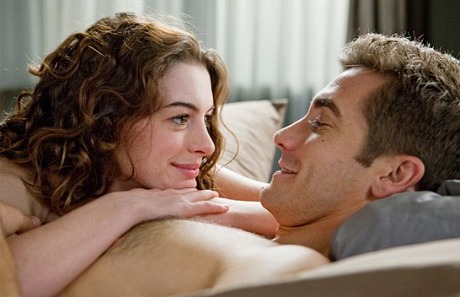
But throw it all together and you have the mule-like refusal of some award-season handicappers to even consider the idea that Anne Hathaway‘s performance in Love and Other Drugs might be Oscar-worthy, even as a speculative who-knows? type deal, which is what at least half of the flotations out there are composed of. This is presumably due to the belief that to qualify for an acting award you have to solemnly suffer and pour your heart out in a somewhat doleful and non-pizazzy way (like Annette Bening does, for example, in The Kids Are All Right).
Also working against Hathaway thus far has been the fear-of-Ed Zwick factor, but that, as noted in my recent review, is not a concern this time around.
I’ve been passing along ecstatic reader reviews of Love and Other Drugs for several months now and some of the awards handicappers won’t bite. A few days ago I saw Love and Other Drugs and earnestly praised Hathaway’s performance, but apart from Gurus of Gold voters Pete Hammond and Suzie Woz and two or three others, awards handicappers aren’t biting.
Two exceptions are Scott Feinberg and In Contention‘s Kris Tapley. Both have short-listed Hathaway — fine.
But to my knowledge Indiewire‘s Anne Thompson, TheWrap‘s Steve Pond, Awards Daily‘s Sasha Stone and The Envelope‘s Tom O’Neil haven’t touched notions of Hathaway with a ten-foot pole. And what about USA Today‘s Anthony Breznican? You’ve gotta watch that guy, Breznican. Because he’ll pull a fast one if you’re not careful.
And don’t give me that “oh, we haven’t seen the film yet” stuff. Who really knows if Christian Bale‘s performance in The Fighter has the chops to compete in the Best Supporting Actor race, but that hasn’t stopped certain handicappers from saying “Bale looks like a comer!”
Real Life
There’s one aspect of Paranormal Activity 2 that’s at least semi-noteworthy. The two lead females, Sprague Grayden and Katie Featherstone, look like actual married suburban moms with their somewhat pudgy, unspectacular, slightly droopy bodies — pot-bellied and sway-breasted with no particular evidence of arduous workout regimens. These are the kinds of female shapes you see all the time in the malls, but almost never (or certainly rarely) in mainstream films.
This observation obviously doesn’t apply to the teenage daughter, played by Molly Ephraim, although it can be safely assumed that if she adheres to typical suburban eating and workout habits she’ll resemble Grayden and Featherstone in a few years’ time. But it does apply in a lumbering-dork male sense of the term to Brian Boland.
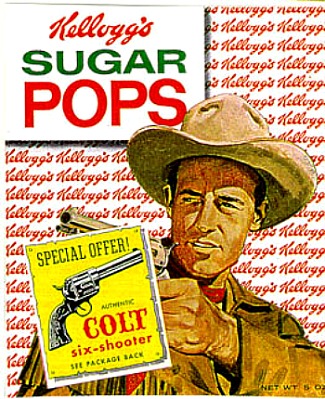
Guy Madisons of Today
I came upon this 1950s cereal-box promotion for Guy Madison‘s Wild Bill Hickock character, and I thought to myself, “That poor guy…couldn’t act a lick but he got a 20-year career out of being hunky.” Who qualifies on this level today? Guys of ambivalent persuasion who can’t act to save their lives but are doing pretty well by virtue of their genes and will probably lead relatively comfortable lives. Or have we reached a point where hunkiness doesn’t last like it used to?
“In 1944, while visiting Hollywood on leave from the Coast Guard, Madison’s boyish good looks were spotted by a talent scout from David O. Selznick‘s office and he was immediately cast in a bit part in Selznick’s Since You Went Away. Following the film’s release in 1944, the studio received thousands of letters from fans wanting to know more about him.
“He was signed by RKO Pictures in 1946 and began appearing in romantic comedies and dramas but his wooden acting style hurt his chances of advancing in films. In 1951, television came to the rescue of his faltering career when he was cast in The Adventures of Wild Bill Hickok, which ran for six years.
“Following his television series, Madison appeared in several more films, mostly westerns, before leaving for Europe, where he found greater success in spaghetti westerns.”
Madison died of emphysema in 1996 (most likely due to smoking), and is buried in Forest Lawn cemetery in Cathedral City.
Hee Haw
In a 10.24 Washington Post article called “Gauging The Scope of the Tea Party Movement in America,” reporter Amy Gardner, drawing upon a herculean effort to canvass and quantify “hundreds of local Tea Party groups,” says that the Tea Party “is not so much a movement as a disparate band of vaguely connected gatherings that do surprisingly little to engage in the political process.
“The results come from a months-long effort by the Post to contact every Tea Party group in the nation, an unprecedented attempt to understand the network of individuals and organizations at the heart of the nascent movement.
“Seventy percent of the grass-roots groups said they have not participated in any political campaigning this year. As a whole, they have no official candidate slates, have not rallied behind any particular national leader, have little money on hand, and remain ambivalent about their goals and the political process in general.
Midway through the piece she writes that “the Tea Party has been accused of racism by its political opponents” due to “comments from some prominent members and signs at several major rallies this year that attacked President Obama for either his race or the false belief that he is a Muslim.
“At [Tea Party] rallies, organizers have kicked out questionable members and have sought to project a more tolerant image,” she writes. “But the [Washington Post] interviews found that Obama’s race is, in fact, important in more than one in 10 Tea Party groups.
“Andy Stevens, 68, a video producer and a founder of the Tea Party Patriots in Anacortes, Wash., said he described Obama’s race and and religion as ‘somewhat important’ to members of his group because they remain troubled by what they see as the president’s un-American and un-Christian behaviors.
“In Stevens’s view, those include Obama’s ‘socialist’ policies and intentional failure to mention ‘the creator’ when talking about inalienable rights.
“There are questions that don’t get answered, like citizenship and his birth certificate,” Stevens said. “I don’t know why questions keep popping up all the time. If something is irrefutable, the questions wouldn’t keep popping up.”
Hudson and 10th
It’s 6:45 pm, and that laptop on the counter underneath the hanging lava lamp on the far right is mine. And that’s my quota for the day.

In The Cellar
A good number of people have now seen Paranormal Activity 2. I agreed with the booers at my Thursday-night screening that the ending is too cryptic. And I disliked angry-douche-dad-with-glasses because he never faced the situation and spent all of his time denying or firing the maid or being elsewhere. I had no problem with the waiting-for-it. But why did they bring up the idea of a demon contract (i.e., sacrificing your first born as repayment) without hinting if angry-dad cut such a deal or not?
"Big Fan of Trojan"
Levi Johnston is a nice-enough guy, but he’s coasting. And that’s one thing you really don’t want to do when you’re young. You need to struggle, suffer, test your limits, fail, search around, feel lonely and eat shit. That’s how you find out who you are. Coasting gets you nothing.