Full Tank

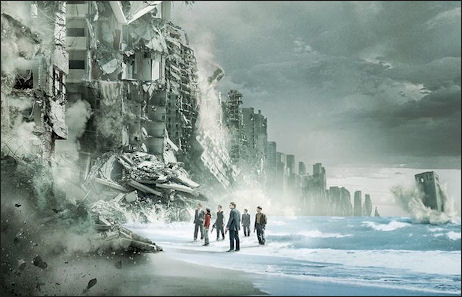
A financial-sector guy who always sends me reactions to HE stories rather than post a public comment says he’s totally smitten by Inception. “I saw it yesterday and the only knock I can come up with on it is that it might be too good,” he writes.

“I was telling some co-workers that this guy might be the answer to every gripe people have about Hollywood these days. ‘There are no original stories,’ ‘Too much CGI,’ ‘Sick of 3D,’ ‘Everything is dumbed down,’ etc. Nolan is making high-level high stakes popcorn movies that deliver on almost every angle and in the face of a degree of difficulty that no one else has to face. We are witnessing the natural progression of genius and we have no idea what his ceiling is.

“The only question that exists for Nolan now is not ‘can he’ but ‘for how long can he do it?’ Obviously that remains to be seen, but right now at this moment, he’s the best screenwriter and director on the planet — due respect to Ridley, Almodovar, Coens or any other name you want to throw out there. No one else can pull of something this good of this scale twice in a row. We should remember this time when a real genius is at his absolute best and the future looks brighter still. It’s a good time to be into stuff like this.”

Soul Snatchers

If by clapping three times I could eradicate all forthcoming comic-book movies (and thereby impose a permanent frown on the faces of Devin Faraci, Drew McWeeny and the rest of the die-hard Comic-Con crowd), I would clap three times. Same difference if I could magically eliminate the notion of a superhero from the minds of all men, women and children on the planet earth, you bet.

For comic-book movies are surely the scourge of the film industry — agents of infantilism and same-itude, a pox upon the art and intrigue of storytelling, a tumor inside the ribcage of our movie-making culture.

The good news about comic-book movies is that they occasionally fail (Jonah Hex) or fall short (Kick-Ass), proving if nothing else that this mostly deplorable genre is not infallible. The bad or dispiriting news is that this may not be giving Hollywood execs sufficient pause, as the continued and growing success of San Diego Comic-Con (which kicks off Thursday) seems to suggest.

“I’m not quite sure how we reached a point where Comic-Con became the engine that drives Hollywood but that is absolutely the case,” laments critic Marshall Fine.

“A steady diet of comic-book and zombie and other fantasy movies is like a steady diet of Big Macs for the mind and soul. Unfortunately, no one will ever make the Super-Size Me revealing the brain-deadening effects that overconsumption of these films is having. Yet it’s out there, slowly stripping audiences of their ability to focus on anything that doesn’t distract them with big flashes and booms and super-powers and the like. It’s a self-fulfilling prophecy, in which feeding this particular beast allows it ultimately to consume all our brains, and take over the culture.

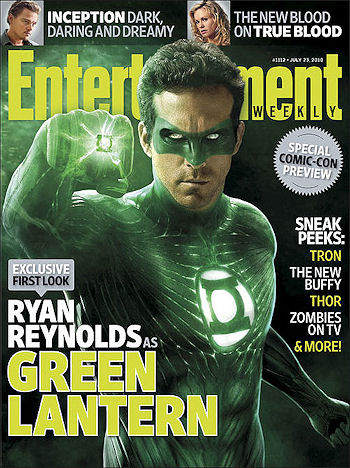
“Ah, Comic-Con: the tail that wags the entertainment dog. Would that we were able to brutally crop that particular tail. Instead, it’s being celebrated on the cover of Entertainment Weekly, as though it isn’t yet another harbinger of what is destroying movies that make you think and feel something other than the brief endorphin rush of cheap thrills.”

Calling Morgan Spurlock! There really is a documentary in this — an exploration of how comic-book movies transformed from a live-wire Hollywood phenomenon into something approaching a cultural pestilence.

Her London Moment?

95 minutes after my L.A. arrival I was speaking with Ophelia Lovibond, whom I took an instant shine to when I saw her in Sam Taylor Wood ‘s Nowhere Boy, which the Weinstein Co. still hasn’t released. (It’ll open domestically on 10.8) So Joe Popcorn doesn’t know Lovibond at all.

But the fact that she was chosen to costar in William Monahan‘s London Boulevard (which she says will open in November) and Ivan Reitman ‘s Friends With Benefits makes her, at the very least, an “industry” favorite — i.e, a name, a comer, a significant presence perhaps on the way to bigger and better things.

I have to do another interview right now but I’ve read Monahan’s London Boulevard script and I know Lovibond’s character, “Penny”, and I suspect (though I obviously don’t know) that her performance in this character-rich crime drama will do good things for her, and perhaps even put her on the road to snagging a lead role in a significant, grade-A film. We’ll see.

“Every so often an actor or actress you haven’t noticed before will just catch your eye,” I wrote on 10.30.09. “It helps if they can act, of course, but movie cameras just like certain people. And right away you’re thinking you’d like them to stick around. For me, this happened when Ophelia Lovibond came on-screen in Sam Taylor-Wood’s Nowhere Man. I should have made some noise about her in my 10.29 review but I didn’t know her name. (The press notes weren’t much help.)

“She’s in two scenes with Aaron Johnson (who plays John Lennon), one of them an outdoor quickie sex scene. Lovibond — curious name — has a certain directness, a straight-from-the-shoulder quality. And she has Liz Taylor eyes.”

Southbound

I’m about to catch a flight from Oakland to Burbank. A busy day awaits. A chat with Ophelia Lovibond (Nowhere Boy, London Boulevard) at 3 pm, an interview with Salt director Phillip Noyce at 6 pm, and then a dinner at 8 pm.

Passion Reviled

N.Y. Times columnist Frank Rich has written a tasty retro-bashing of Mel Gibson‘s The Passion of the Christ in today’s edition, “The movie was nakedly anti-Semitic, to the extreme that the Temple priests were all hook-nosed Shylocks and Fagins with rotten teeth,” he states. “It was also ludicrously violent — a homoerotic ‘exercise in lurid sadomasochism,’ as Christopher Hitchens described it then, for audiences who ‘like seeing handsome young men stripped and flayed alive over a long period of time.’

“Nonetheless, many of the same American pastors who routinely inveighed against show-business indecency granted special dispensation to their young congregants to attend this R-rated fleshfest.

“It seems preposterous in retrospect that a film as bigoted and noxious as The Passion had so many reverent defenders in high places in 2004. Once Gibson, or at least the subconscious Gibson, baldly advertised his anti-Semitism with his obscene tirade during a 2006 D.U.I. incident in Malibu, his old defenders had no choice but to peel off.”

Ghost Syndrome

What’s the deal if you’re the author of some excellent magazine articles from the ’90s, ’80s or before that have never been scanned or archived, and therefore aren’t findable on Google? I’ll tell you what the deal is. Your work pretty much ceases to exist, and if you’ve retired or moved to Tibet or what-have-you then you’re pretty much a ghost. Magazine writers have to have their hands and pawprints in the 21st Century cyber world, or they’re dead.

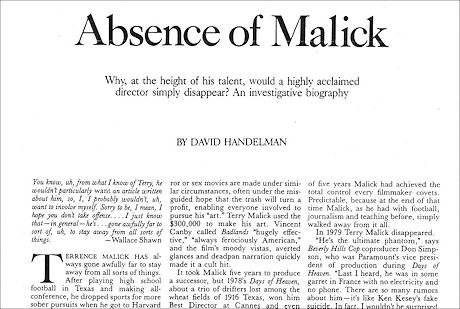
Last night I heard from TV and feature writer David Handelman, who’s in the prime of his life and decades from being over. But the “ghost” syndrome has affected one of his articles — i.e., a superb 1985 piece he wrote for California magazine called “Absence of Malick.”

Handelman wrote that he was mildly pissed that I’d mentioned the California article but not his name in a March 2009 HE piece called “Malick, Olstein & Me” — a recollection of how I nearly died researching and writing a laborious Malick profile in ’90 and ’91, only to see it manhandled and diminished by Los Angeles editor Andy Olstein in ’95. I wrote Handelman back and explained that I’d forgotten his name that day and was unable to Google any record of his Malick piece online, so I just moved on.

The long and the short is that I said I was sorry and fixed the March ’09 piece — it now contains the proper credit. I explained that the best thing that day would have been for me to stop writing “Malick, Olstein & Me”, and then drive down to the Academy library on La Cienega and dig up Handelman’s California piece (which is almost certainly in the Academy’s Terrence Malick file) and yaddah-yaddah. I should have but I didn’t because I felt it more important to get the piece done and worry about fixing the knick-knack oversights later.

I told him that when I discovered that (a) there was no Google mention of his 1985 Malick article, and (b) that at least two others had ripped off the title “Absence of Malick” I figured it was open season and there were bullets flying and I wasn’t about to stand up in the midst of it. A Google search told me that Andrea Vancher wrote a piece called “Absence of Malick” for American Film in February 1991, and that David Gregory made a film called Absence of Malick in 2003. There’s also a Caryn James article that uses it, I think.

“You created that title as far as I know, and here are two people who ripped you off cold,” I told Handelman. He wrote back and explained that Andy Olstein, who was working under California editor Harold Hayes in the mid ’80s, had thought it up. Olstein again!

Here‘s a recent article by Handelman called “The Ones That Got Away.”

Welcome Difference

The second time is the charm with Inception, especially if you catch it in IMAX. It definitely comes together with a second viewing while the things you enjoyed the first time are agreeably underlined and intensified. My ambiguous feelings about Chris Nolan‘s epic have now been significantly lessened. I am pretty much in the boat now. Faraci was more right than Scott. Inception is dense and challenging, but a masterpiece of its kind.

Sound quality is a key factor. I made my 8:30 pm showing at the Metreon last night, and what a pleasure to (a) actually be able to hear all the dialogue (which was more than I could say for the sound at last Tuesday’s Lincoln Square all-media) and (b) pick up on all those plotty-pat expositional doo-dads that I missed (or wasn’t entirely sure about) the first time.

The first time I missed Leonardo DiCaprio‘s line about how the spinning dreidle will keep going in a dream but will collapse in reality. Last night I heard it. Plus I could actually hear about 85% of Ken Watanabe‘s dialogue last night whereas last Tuesday I was able to make out very little of it.

Warner Bros. publicity made a serious mistake in not showing Inception in IMAX to the assembled media last Tuesday. It’s a much more riveting film in IMAX — simple as that. IMAX sound is much sharper, cleaner and stronger than regular theatre sound.

Notice to all distributors: I’m telling you the God’s truth when I say that the sound in Lincoln Square’s theatre #1 isn’t good enough and in fact is infuriating. And anyone who tells you otherwise is a liar or an incompetent schnook. My ears have been frustrated and driven nearly to madness in that theatre twice now — i.e., with Inception and with Tim Burton‘s Alice in Wonderland.

Vigorous and Then Some

Boxoffice.com’s Phil Contrino reports that by Sunday night Inception will have $58,500,000 in the domestic bank. It made $21.3 million yesterday on 3792 screens, counting about $3 million made from the Thursday midnight shows. So it really made about $18 million last night — let’s be fair.

The last figures I saw were 18 first choice, 23 unaided awareness, and a 48 definite interest, which indicated to me (and I realize I’m not exactly a box-office wizard-slash-Nostradamus) a $45 to $50 million take. So this is a little better than expected — fine.

“Grrl Power”

This afternoon’s shock is that while Hollywood Reporter critic Kirk Honeycutt is down with Salt, Variety is silent — slacking off! And no Todd McCarthy Indiewire review either. But the Star‘s Marshall Fine is on the job: “Long story short: It’s the most exciting popcorn movie of the summer.”

Brown Suits Don’t Make It

The one thing that holds Alfred Hitchcock‘s Vertigo back from full emotional/psychological integration is a thing that Hitchcock himself lamented after the fact: James Stewart looks too old and square and plugged-up to be a tragic romantic figure. You just can’t invest in him as a man with an unruly libido. And that awful brown suit he wears in the early to middle portion of the film is like anti-matter. It’s the worst looking suit ever worn by a movie star in Hollywood history.

I understand that anyone of any age can fall ridiculously or pathetically in love, but the Stewart of Rear Window — a younger (and slightly younger looking) fellow with a less constricted vibe — should have played John Ferguson, not the Kiwanis Club Republican that Stewart seems to be in Hitchcock’s 1958 film. Stewart could have shaved five years by blonding his hair, but he went white-ish gray — mistake. He looks too tense and stodgy to fall for a woman 20 or 25 years younger. Plus he and Kim Novak are just not a good visual fit — he looks like her sleazy uncle, or some insurance salesman who’s paid for her favors behind his frumpy wife’s back.

Band-Aid Response

Apple announced this morning it will give free “bumper” cases to iPhone 4.0 owners suffering from the “death grip” problem — i.e., losing reception bars due to holding the lower-left portion of the phone with a bare hand.

I’ve had a bumper from Day One and never had any reception problems (i.e., other than the usual call-dropping that I’ve gotten used to with Apple and AT&T).

When I was waiting in line to buy this phone at the Apple store on West 14th on 6.24, I read that the bumpers were being given free to buyers in England. Anyone paying attention knew the metal-band antenna was a problem that day. The Apple guys could have have chilled this whole issue down significantly if they’d been willing to forego charging $29 for the bumpers and just given them away. But they had to be greedy.