DreamWorks Days

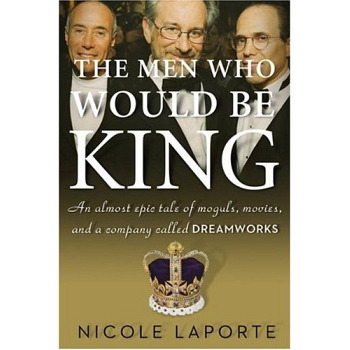
There are two interesting snippets from Michael Cieply‘s short N.Y. Times piece on Nicole LaPorte‘s upcoming history-of-DreamWorks book, “The Men Who Would Be King: An Almost Epic Tale of Moguls, Movies, and a Company Called DreamWorks” (Houghton-Mifflin, 5.4). Both involve Terry Press, the company’s battle-axe marketing chief.
The first is that “it was Ms. Press who had the courage to tell Steven Spielberg — correctly, as it turns out — that Amistad was not destined to win Oscars.” I spit my coffee out when I read this. A fact that was dead-pig obvious to anyone with a smidgen of taste had to be gently broken to Spielberg, who was so deeply embedded in his own little membrane that he actually thought he had an Oscar contender in that godawful film.

To my dying day I’ll remember how I felt when Anthony Hopkins‘ John Quincy Adams began to deliver his closing argument to the jury and John Williams‘ upifting music was mixed in so loudly that I was having trouble hearing some of the words. I was convinced that the projectionist had accidentally cranked up a separate music track by mistake.

The second snippet is a description of Press “sobbing as Bill Condon, the director of Dreamgirls, console[d] her on learning that the much-promoted movie musical had not been nominated for the Best Picture Oscar.” I wasn’t much of a Dreamgirls fan, but I can understand Press, who had worked so hard and so early to build awareness for Condon’s film and particularly to beat the Oscar drum for it, being shattered by this snub. Pretty much everyone was dumbfounded, but out of this debacle came what has now become a rule-of-thumb — don’t push your Oscar-calibre film too early or too hard.

Speaking of corporate membranes, I wonder if LaPorte’s book will report what I for one was feeling when DreamWorks publicity was just beginning to allow journalists to see American Beauty, which later won the Best Picture Oscar, in the late summer of ’99. What I detected felt like concern, or at least a form of uncertainty. I had to beg and beg to persuade them to let me see it. Their reluctance was such that it was hard not to suspect that something about Sam Mendes‘ film might be problematic.


Former DreamWorks marketing chief Terry Press; author Nicole LaPorte

After I finally saw American Beauty at Skywalker Sound on Olympic Blvd., I remember immediately phoning Mitch Kreindel, who worked right under Press, and saying, “Are you kidding me? This film is extra. It got right inside me. The plastic paper bag and the ending melted me down. It could go all the way.” But until that consensus began to build up and sink in, I don’t think some people in upper DreamWorks management (and I’m not saying Press was necessarily one of them) really knew what they had. And if they did know what they had, they sure gave a good impression to the contrary.

But you have to give Press credit for Ridley Scott‘s Gladiator snagging that Best Picture Oscar, I think, and especially for bad boy Russell Crowe also taking an Oscar for his performance as Maximus (which he seems to have revisited, in a sense, in his upcoming Robin Hood turn.) Crowe’s Gladiator performance was strong and impassioned, but it wasn’t that great. A lot of shrewd politicking went into that win, is all I’m saying.


Stars Are Over But…

The three basic points in David Gritten‘s 4.24 Telegraph piece about the waning of movie stardom (“Have Stars Lost Their Shine?'”) is that (a) yes, movie stars ain’t what they used to be, (b) they’re certainly getting less upfront cash and are increasingly settling for back-end deals but (c) they’re still pocketing relatively hefty amounts when they agree to make big dumb-ass CG Eloi tentpole films.

Bottom line: The idea of getting humungous paychecks for films that aspire to quality and class and end-of-the-year awards is pretty much out the window.

(a) “Increasingly fewer films are dependent on big-name stars for financial success. Instead, they’re mostly driven by a simple, compelling conceit, a remake of a success in another medium (The A-Team, Prince of Persia) or by being part of a lucrative franchise (Iron Man 2, Toy Story 3, Shrek Forever After, Twilight: Eclipse).”

(b) “But these films are pre-sold to the public on their overall concept. If they happen to feature stars whose popularity has recently dimmed, it doesn’t matter; they’re not the most important factor.. Movie stars are in decline because, for better or worse, movies simply no longer need them.”

(c) “Huge fees for stars have come to look like a ludicrous luxury. These days, actors who less than a decade ago were receiving $15 to $20 million upfront are now taking a modest advance and a share of back end profits — if any. Look back six or seven years, when leading A-listers included Tom Cruise, Julia Roberts, Nicole Kidman, Gwyneth Paltrow and Denzel Washington. One cannot say any of them is bigger now than then.”

(d) “It’s a telling reflection that at the height of Avatar‘s success, Sam Worthington and Zoe Saldana could have walked the length of Oxford Street without being stopped or recognized.”

Champ

Yesterday afternoon L.A. Times/”Company Town”‘s Ben Fritz reported that “just four days after debuting on store shelves, Avatar has sold 2.7 million Blu-ray discs to consumers in the U.S. and Canada, according to 20th Century Fox — more Blu-rays than any previous movie has sold.

“The previous record holder, The Dark Knight, has sold 2.5 million Blu-rays since its debut 16 months ago.

“Fox also sold 4 million standard definition DVDs. The combined total makes Avatar the biggest DVD launch of the year, breaking a previous mark of 4 million Blu-ray and DVDs combined set by The Twilight Saga: New Moon on its first weekend in March.”

Nice Outfit

If I had to listen to singing of this quality this for very long, I would literally get sick. Conan O’Brien and Jim Carrey performing Five For Fighting‘s “Superman (It’s Not Easy)” at Saturday night’s “Legally Prohibited From Being Funny On Television Tour” — Gibson Amphitheater, Los Angeles, 4.24.10.

Time Of Our Life


The Paris Metro never keeps people waiting for 15 minutes. Ever. Even on Sunday nights. This happens only in New York, and most frequently, in my experience, with the L line.

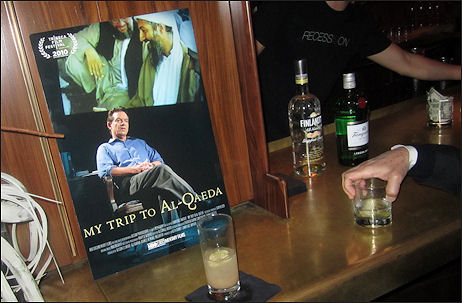
Taken during today’s Royalton Hotel after-party for Alex Gibney’s My Trip To Al-Qeada — Sunday, 4.25, 6:40 pm.

Nizza on Ninth Avenue near 45th Street — Sunday, 4.25, 8:55 pm.
Half of the Tirbeca Film Festival hub-bub has been occuring on West 23rd Street and Eighth Avenue, mostly at Chelsea Clearview Cinemas. That’s IHOP publicist Jeff Hill eyeballing the camera.
Talk-Through

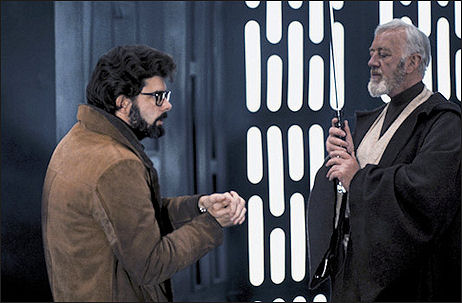
“And then you do this Jedi serenity waiting-to-die thing….yeah, that’s it…your eyes closed, waiting for it…and then…no, you won’t be struck or fall…your brown tunic will fall and Obi-Wan will just, y’know, dematerialize. That way he’ll transform rather than die, without actually getting tagged by a light saber. No, I just want it that way. Alec? I don’t care, dammit, if it makes no sense to you. Listen, Alec…I wrote this, I’m the director.”

Drugged Splendor

Selectively speaking, Ashley Horner‘s brilliantlove is an exceptionally hot and skillful depiction of sexual delirium. A tale about a lickin’ love affair between a couple of none-too-brights that succumbs to melodramatic poisoning by way of (horrors!) money and ambition, this British-produced Tribeca Film Festival entry, which I caught the night before last, is at the very least a stylistic stand-out. And yet I’m not sure where it stands (or writhes) in the annals of erotic cinema.

I know it feels a bit more feverish and free-fall than vaguely middlebrow sex films like Sex and Lucia and Warm Summer Rain and the like, but isn’t quite as kinky as Last Tango in Paris or graphic as The Brown Bunny or as given to obsessive perversity as In The Realm of The Senses, and yet it’s definitely a cut above. It’s certainly above the realm of Michael Winterbottom‘s 9 Songs, which I found tedious.

I said “selectively” because the story isn’t all that great. It would’ve been fine for me if brilliantlove had just been about the simple matter of Manchester (Liam Browne), a novice photographer, doing Noon (Nancy Trotter Landry), a taxidermist, over under sideways down. I certainly would have preferred a less dramatically loaded story. One about healing the broken wing of a small bird, let’s say, and the commitment that such an effort may require of two kids with very little money. Something along those lines.

That sounds like I’m describing straight hard-R porn, I realize, but Horner is very good at capturing that erotic dreamwhirl feeling that takes over when you’ve really lost yourself in someone else and you’ve long ago stopped noticing their less than radiantly attractive aspects because you’re just breathless and sliding around and shrieking and crying and finding God, or being kissed by Him/Her.

This movie really gets and recreates that, and it’s all the more remarkable due to the fact that Browne and Landry, while pleasantly or nominally attractive, aren’t model- or movie star-fetching. I for one have a major blockage about women with big feet, but Horner’s special touch somehow persuaded me to put this phobia aside.

Ass To Mouth

“So, Jeff…are you thinking about seeing The Human Centipede?,” an IFC guy asked me a night or two ago. My response was something along the lines of “Gee, I…uhm, well, not at the moment but…” That was party-speak for “I’ve heard such repellent things that I tossed it out of my mind and haven’t given it a second thought until ten seconds ago.”

“It’s time to add a new type of bad movie to the ever-growing list: The aggressively bad movie,” wrote Horror Chick on 4.23. “There’s no ironic badness or nudge-nudge wink-ery here — it’s more like ‘screw you, you were sucker enough to see this movie and now we will do our best to make bile shoot straight up your esophagus and launch out your nostrils’ bad.

“Our prime example is The Human Centipede (in theaters — or maybe just Manhattan’s IFC Center). ‘Wait,’ you say, ‘isn’t that the ass-to-mouth movie?” Yes. Yes it is. In every literal and figurative sense.”

Needs A Finish

Anyone who’s ever succumbed to addiction or dealt with an addict over an extended period knows what a fascinating monster denial can be. Addicts can be right on the edge of obliteration with death blowing cool air on the back of their necks and still they don’t think they’re in any kind of trouble. Lindsay Lohan‘s dad has his issues, but at least he understands this.

I’ve seen where addiction ends up, and it’s always the same place if the victim doesn’t wake up. I’ve said before that Lindsay’s saga needs an ending — she needs to save herself or she needs to die, which at least might have an instructive effect in the same way that James Cagney going to the electric chair in Angels With Dirty Faces may have helped the Dead End Kids to fly straight. All I know is that the people in the Collisseum cheap seats are getting restless. They don’t want another Whitney Houston saga that lasts for years and years. Poop or get off the pot.

Gibney's Spitzer Doc Surprises

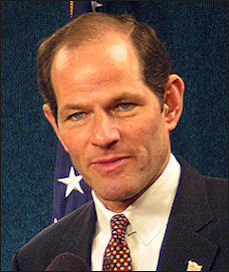
It was known, of course, that Alex Gibney‘s Untitled Eliot Spitzer Film, which screened earlier this evening via the Tribeca Film Festival, would focus on the sudden and scandalous fall of Eliot Spitzer, the former New York Governor, due to his involvement with prostitutes. What I didn’t anticipate, and what in fact surprised the hell out of me, is that the doc unfolds and holds like a masterful political suspense drama.


Untitled Eliot Spitzer Film director Alex Gibney during post-screening q & a; former New York Governor Eliot Spitzer.

I was expecting a smart and comprehensive recap of the Spitzer saga — a kind of PBS Frontline-type deal. What I got instead was a totally gripping nest-of-vipers thing with a complex and self-destructive anti-hero and a great supporting cast including an assemblage of powerful, politically connected bad guys worthy of Sidney Lumet or Scott Turow or John LeCarre even, and all of them real as hell.

Gibney has always been a first-rate documentarian. But in Spitzer and his psychology and the forces that conspired against him he’s found a great political melodrama that not only matches but enhances his abilities, resulting in a beautiful synchronicity. This movie is going right into my list as one of the best films of 2010.

What a dirty, stinking story this is — a balding oddball hero with the right ideals and goals brought down by a fatal flaw, but whose public exposure and ruin is orchestrated by his powerful enemies, and not just any enemies but some of the same financially speculating, double-dealing Wall Street scumbags whose actions brought this country to the brink of financial ruin. Goodness falls, evil triumphs — great movie material!

It is always the mark of a top-notch film when you think you know what it’s going to do plot-wise, and it more or less does that in terms of what it “tells” but with so much more punch and pizazz and intrigue than you expected. And you come out of it going “wow, damn good!”

One analogy is Fred Zinneman‘s The Day of the Jackal (1973), a thriller about a man hired to assassinate former French president Charles DeGaulle. You know going in that he won’t succeed, but the film holds you regardless. Another similar work is Lumet’s Prince of the City (1981) — a movie packed to the gills with cops, attorneys and prosecutors but which finally delivers a moralistic tale about dark urges, choices, alliances and a New York City demimonde.

One of Spitzer’s enemies, Home Depot co-founder Kenneth Langone, talks to Gibney for the film, and is quite the fascinating character. Sptzer’s other foes included former NYSE chairman Richard Grasso, former Citibank/Salomon Smith Barney analyst Jack Grubman, former Merrill Lynch analyst Henry Blodget, former AIG honcho Hank Greenberg and Canary Capital Partners’ Edward Stern, to name but a very few.

I’m being kicked out of the Starbucks I’m sitting in so that’s all she wrote, but this is a stellar knockout documentary. It’s actually called Client-9 in the opening credits, but that title is just a temp, Gibney said. Distribution ought to happen by the fall. It’s too early to say, of course, but this looks to me at the very least like a prime contender for the 2010 Best Feature Documentary Oscar, whatever the competition. Because it’s sharp and true and riveting as hell, and that’s what gets the gold.