

I was going to run an embed of A.O. Scott‘s latest Movie Picks video — i.e., a tribute to Peter Yates‘ beloved The Friends of Eddie Coyle (’73). But of course, the Times tech guys (the very model of foot-dragging obstinacy) couldn’t be bothered to post it on YouTube. Bu then I happened on this Aliens piece, which ran last week…fine.
Beats YouTube
This high-quality clip from There Will Be Blood was sent this evening as a sampler by Movieclips co-founder Rich Raddon. The idea behind Movie Clips.com is “to give movie lovers, movie bloggers, and everyone else a place to easily find and embed licensed movie clips,” Raddon says. “I love YouTube but the quality is lacking and the search is difficult with all the UGC.
Except that you can watch YouTube clips on an iPhone, no sweat, and you can’t watch Movieclips.com on an iPhone. That’s not the whole ball game, of course, but mobility matters. Somehow and some way the Apple folks have to allow other video-viewing modes and softwares to play on their device.
“We have been working with the studios very closely over the course of 18 months to make Movieclips.com a reality,” Raddon says. “At some point we will have everything, but with the studios it is a process…the fact that we have over 12,000 clips from 6 of the 7 studios speaks to my years running the LA Film Festival (10 years) and the trust that is needed with these types of partnerships.
“Movieclips.com is not perfect. We will be closer when we reach an agreement with the Criterion Collection and the remaining studio Disney (we want that Miramax library!). But we are going about this in the best way possible, in a unique collaboration with the studios wherein we work with them on all the sensitivities with this type of content.”

Serbian Howl Factor
A Serbian Film, an envelope-pushing (to say the very least) political allegory about Serbian repression and censorship, had a midnight showing on Sunday night/Monday morning night at South by Southwest, reports Speakeasy‘s Eric Kohn.
The film reportedly depicts rape and murder, “unspeakable” perversions, “on-camera sexual acts involving violence and young children,” “newborn porn” and “the unique magic of rigor mortis.” Delightful sounding! I’m truly sorry I missed it.
“After the movie ended, an awkward silence filled the room,” Kohn reports. “Screenwriter Srdjan Spasojevic, fielding questions during a q & a, described the movie as an angry reaction to the country’s rampant censorship laws. ‘This is a diary of our own molestation by the Serbian government,’ he said. ‘We’re giving this back to you.’
“After the screening, some audience members wondered if Spasojevic’s dour tone was actually a ruse — that the filmmakers didn’t take the material all that seriously and the movie was simply intended as exploitation for its own sake.”
Which is precisely what some critics said in 1976 about Pier Paolo Pasolini‘s Salo: The 120 Days of Sodom. Pasolini called it a a political allegory about Italian fascism while others suspected he simply used this as a metaphorical rationale/license to indulge his own sexual/erotic appetites and fantasies.
Descendants This Year?
An official Fox Searchlight release says that principal photography on Alexander Payne‘s The Descendants begins today in Oahu and Kauai. George Clooney, Judy Greer, Beau Bridges, Matthew Lillard, Robert Forster (hooray, Bob!). Payne is directing a screenplay adapted by himself, Nat Faxon and Jim Rash, based on the novel by Kaui Hart Hemmings.
But will it come out in late 2010? No word, no hint. I called Fox Searchlight’s Manhattan publicity office — zip. Joel and Ethan Coen‘s True Grit starts shooting this week (or imminently) also, and it’s locked to open on 12.25.10. If The Descendants shoots for 12 or 14 weeks it’ll be done in June, which gives Payne three or four months to cut it together. That’s doable. Clooney‘s The American, the Italy-based assassin movie from director Control‘s Anton Corbijn, will open sometime in the early to mid fall.
This Year’s The Hangover?
Most people don’t focus or even think about the weekend films until a few days before. That would explain the not-great tracking numbers for Hot Tub Time Machine in today’s report (3.15). The trailers have been online for sometime, but MGM/UA doesn’t seem to be spending much on LA billboard advertising. Maybe it’s a “viral campaign.” Jett says that all of his Syracuse pallies are down for it, but the tracking…I don’t know. Opinions on how big?
An over-the-top ludicrous tone, but ludicrous in “quotes” — winkingly so, intelligently so. Four guys together having an outrageous and disorienting adventure in which they’re behind the eight ball for most of the duration. That’s where the Hangover analogy comes from. That’s what Jett was saying, in any case.
Public Enemies
The gist of author Michael Lewis‘s “The Big Short: Inside the Doomsday Machine” is that the ’08 meltdown — the destruction of $1.76 trillion in subprime mortgage market holdings — was basically driven by “mass delusion,” says a HuffPost summary.
“The incentives for people on Wall Street got so screwed up…because their short term interests were so overpowering,” Lewis told 60 Minutes (or somebody else). “And so they behaved in ways that were antithetical to their own long term interests.”
In other words, they got drunk and crashed the family car and totalled it — blood and screams and shards of glass all over the pavement. These guys committed acts that were far more menacing and destructive than the Chicago gangsters and desperado hold-up men of the 1920s and ’30s. Much worse than anything Pablo Escobar ever did. And most of America is just…oh, well, whatever. I’ll wager that the followers of Sarah Palin and Michele Bachman are mainly thinking, “If we play our cards right, maybe we can be the ones to fleece the country and make out like bandits…next time!”
Spalding Gray + Criterion
Over the weekend HE’s Moises Chiullan saw Steven Soderbergh‘s Spalding Gray doc And Everything is Going Fine (which had its debut at Slamdance two months ago) at a South by Southwest screening. I’m not sure which day it showed (I’m in a hurry and the SXSW search engine blows) but Moises liked it, etc.
He mentions that during the q & a, one of the producers (Joshua Blum or Amy Hobby) answered a question about plans to release Gray’s performance films on DVD by saying, “We hope to see a box set come out through the Criterion Collection in 2011, but the deal’s not done yet.”
The set would presumably include Swimming to Cambodia, Monster in a Box, Gray’s Anatomy and the Soderbergh pic. Producer Kathie Russo (i.e., Gray’s widow) added “it’s a real shame that not even Swimming to Cambodia is out on DVD, so this is a great opportunity to finally get this stuff out there.”
Solitary Man
In the view of Marshall Fine, Noah Baumbach‘s Greenberg (Focus Features, 3.19) “is not an audience-friendly film in any sense” and yet “it rewards those who are open to it. You have to work at it to gain access and hang with it, squeezing pleasure and the occasional chuckle out of its bitter beauty where you can.
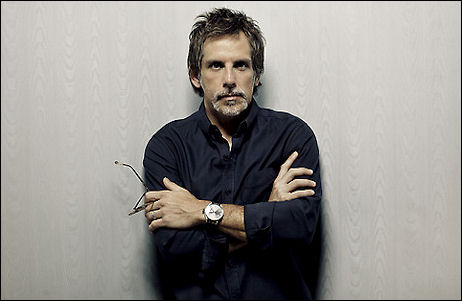
“Prickly, abrasive, fragmented – that describes both Ben Stiller‘s performance as the title character and the film itself.
“Stiller’s Roger Greenberg is a man perpetually dissatisfied with everything about life and the world. As this roughly paced, sometimes jaggedly plotted film moves forward, we begin to see Greenberg for what he is: a miserable, tortured human being who can’t seem to stop broadcasting his pain to others.
“Baumbach has made an uncomfortable but fascinating film, one that could have been comic in an antic or wisecracking way, had he infused it with a little more warmth. But Greenberg doesn’t do warmth — he does pain, anger, longing and self-loathing. And Baumbach wants us to accept him as he is, on his own terms.”
What we have here, I sense, is a fairly intimate reaction on Fine’s part. He seems to recognize the personality and pathology of Stiller’s character. Perhaps (who knows?) as a submerged aspect of himself, or perhaps from a recollection of a family member or a close friend. In any case he’s clearly put off, and yet he recognizes that the film is up to something different — i.e., drilling in close, dealing a straight hand, not going for the intelligent yuks that Baumbach delivered in The Squid and the Whale.
I recognized Greenberg also, partly within my younger, less productive self and partly in the personality of my late brother, Tony. I didn’t find it “entertaining,” per se, but there was no rejecting the film, which I found refreshingly undiluted and stark and uncompromising.
I was especially impressed with Greenberg’s “settling in with the manner and psychology of Stiller’s character without feeling the need to go all ‘story’ on the audience. The humor is so subdued and embedded within situation and milieu that it’s not humor — it’s John Cassevetes-like introspection. I’m obviously saying that with respect.
“Is Greenberg funny? In a LQTM sense, yeah, but to most people LQTM isn’t what they go to movies for. I do, however. I was quietly smirking at Greenberg the whole time, having a quiet little blast with it. And then it grew on me the second time. I didn’t realize how sublime the ending is until I saw it again. That’s my fault.
“Stiller’s performance, in any event, seems to me like a landmark-type thing — a seriously ego-free inhabiting of antsy-quirk neuroticism. Being, not acting, and certainly with any audience comfort-winks. A breakthrough of some kind.”
Variety’s Uncertain Review Policy
In the wake of Variety‘s recent decisions to (a) pull a negative Robert Koehler review of a minor film called Iron Cross because of producer threats that might have affected a $400,000 ad buy and (b) lay off chief film critic Todd McCarthy, several pundits (including Roger Ebert) have declared that the legendary trade publication is more or less finished. Or at least that the die is cast toward that end.
But now Variety really seems destined for extinction with Joshua Newton, the producer and director of Iron Cross, telling The Wrap‘s Sharon Waxman that Variety publisher Neil Stiles informed him not long ago that “he planned to cease all reviews this year, in 2010.”
This statement argues with a paragraph in Michael Cieply‘s 3.15 N.Y. Times story about Variety‘s (and The Hollywood Reporter‘s) fortunes, to wit: “At a Tuesday morning meeting, [Variety publisher Neil] Stiles mentioned a plan to package reviews for sale to some of the many mainstream papers that have dropped their critics to save money. It is part of an effort to syndicate material or franchise the Variety name to publications around the world.”
Newton also accuses Variety editor Tim Gray of “lying through his nose” when he told L.A. Times columnist Patrick Goldstein and Gawker “that he removed the Iron Cross review because of concerns it had errors.” (I prefer “lying through his teeth.” You can blow your nose or sniff out a story with it, but you can’t tell a whopper through it.)
It’s a fascinating blunt-spoken q & a. No one’s presuming that Newton’s view is the last word or that Variety doesn’t have a different recollection or viewpoint, but wow…what an implosion. I suppose it’s possible that Newton is completely misquoting Stiles about his alleged intention to zotz all reviews sometime later this year, but a voice is telling me Newton probably didn’t invent this statement out of whole cloth. This is staggering. No McCarthy reviews was one thing, but no reviews at all? That can’t be true. It’s too radical a notion.
The Man Who Fell To Earth
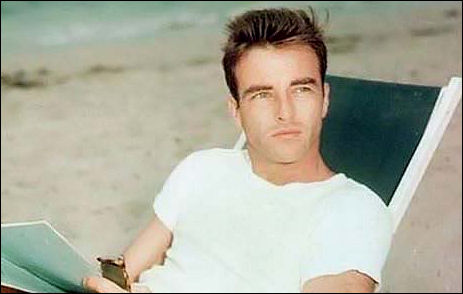
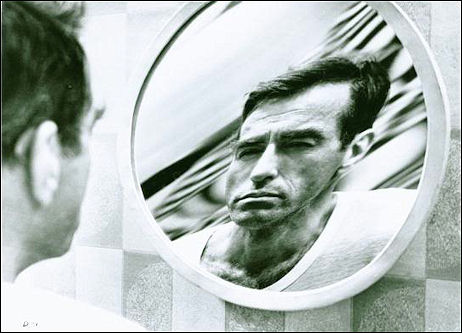
A film series tribute to Montgomery Clift began at BAM Cinematek on 3.11, and will end two weeks hence on 3.25.
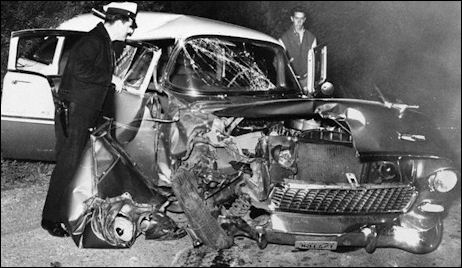
I’ve read two books on Clift (Patricia Bosworth’s and another one) and feel I know most of his story. He had a ten-year film career (’46 to ’56) before the Los Angeles car accident that ruined his face and pretty much turned him into a wreck — “the slowest suicide in Hollywood history.” Alcohol and pills and the stress of living in the closet eventually led to his death in 1966 — at age 45! — from “occlusive coronary artery disease.”
How many of his pre-accident films present Clift in a truly luminous and commanding state, that anxious and willowy God-like thing that made his rep and his name? Four — Red River (shot in ’46, released in ’48), A Place in the Sun (’51), I Confess (’53) and From Here to Eternity (’53).
He made other intriguing or fascinating films, but no other major-league star was so totally ruined as Clift was after the smash-up. He didn’t just look different but seemed internally mangled and mashed in.
During those first seven years (River to Eternity) he seemed to be coming from a relatively calm and steady place for the most part — a serene one at times. Plus he had those beautiful, perfectly chiselled features. But after the pile-up he acquired the look and manner of an out-and-out spaz — a twitchy-fidgety fellow with bulging eyeballs and jug ears, and a voice (or vocal delivery) that seemed impaled by nerves. This transformation was first evident in The Young Lions in ’58. Matthew Garth in Red River was no more. Clift had nowhere to go but to become a character actor, which he did and quite well at that.
Marilyn Monroe reportedly once described Clift as “the only person I know who is in worse shape than I am.”
The BAM Cinematek selections include Red River (Howard Hawks, 1948); The Heiress (William Wyler, 1949); The Big Lift (George Seaton, 1950); A Place in the Sun (George Stevens, 1951); From Here to Eternity (Fred Zinnemann, 1953); I Confess (Alfred Hitchcock, 1953); Lonelyhearts (Vincent J. Donehue, 1958); The Young Lions (Edward Dmytryk, 1958); Suddenly, Last Summer (Joseph L. Mankiewicz, 1959); Wild River (Elia Kazan, 1960); The Misfits (John Huston, 1961); Freud (Huston, 1962).
Hubble 3D
“The newly resurgent 3D format gets an out-of-this-world showcase in Hubble 3D,” writes Variety‘s Justin Chang. “Structured around a tricky NASA service-and-repair mission, the latest Imax venture from producer-director Toni Myers (Space Station 3D) lingers to transfixing effect on images captured by the famous telescope, inspiring the viewer’s awe in the possibilities of giant-screen cinema as well as the mysteries of space.
“Shortly after the Hubble Space Telescope was launched in April 1990, scientists discovered a tiny yet damaging flaw in its primary mirror, which was rectified by a crew of astronauts in 1993. Since then, the telescope — roughly the size of a school bus, and the most sophisticated of its kind ever put into orbit — has undergone regular service missions, enabling ever sharper, clearer and wider-ranging glimpses of the universe.
“Pic documents the most recent of these excursions, the STS-125 Mission — which, though initially canceled in the wake of the 2003 Columbia shuttle crash, went ahead successfully in May 2009. A 700-lb. Imax 3D camera was installed in the shuttle’s cargo bay, while Myers and d.p. James Neihouse trained the astronauts to use it, also positioning HD cameras throughout the spacecraft.
“Apart from shots of the astronauts going about their routines inside the shuttle and marveling at the properties of zero gravity — which turns out to be ideally suited to 3D, as floating objects provide a natural depth of field — most of the footage is devoted to the spacewalks undertaken by those repairing the telescope.
“Narrator Leonardo DiCaprio (who also did the voiceover honors for global-warming docu The 11th Hour) works hard to impart a sense of the mission’s danger, enumerating the various risks to the astronauts’ safety as well as the many points at which the repair procedure hits a snag.
“Fascinating as much of this footage is, the docu’s strongest images are to be found elsewhere. As though keenly aware that the sight of a shuttle launch never loses its thrill, Myers and Neihouse film the blast-off twice — first from a distance, so you can appreciate the big-picture spectacle of a column of flame against a blue sky, and then from up close, so you can feel the roar of the rockets, an effect that should make any theater quake if its sound system is working properly.
“Most mesmerizing of all are the photographs taken by Hubble itself, expertly enhanced through computer-visualization techniques applied by the Space Telescope Science Institute in Baltimore. Consequently, Hubble 3D comes as close as any film to reproducing the curious, cosmic sensation of floating through outer space; with the bonus of the telescope’s infrared camera and ultrasharp focus, pic affords tremendous views of everything from the young stars emerging from the Orion Nebula to a black hole in the more distant Virgo Cluster.
“It’s an experience so pure and vivid, you may actually wish for less of DiCaprio’s voiceover — which, though useful in explaining what you’re looking at, becomes a bit of a distraction. In space, no one can hear you narrate.”