

It goes without saying, I presume, that Bill Condon allegedly agreeing to direct the final Twilight movie — i.e., Breaking Dawn — sounds weird. Like he’s slumming, I mean. We all have to keep body and soul together and I wish him the best. Maybe he can make something more out of a franchise that everyone turned on last November when New Moon was seen. It’s been rumored that the latest one, Eclipse, also smells.
Risking Wrath
To me, Gregg Kinnear signing to play President John F. Kennedy in an allegedly right-wing-friendly History Channel miniseries called The Kennedys means one of two things.
One, Kinnear isn’t all that worried about liberal Hollywood establishment types frowning at this decision, which some are certain to do. Or two, he really needs the work and is willing to risk offending those (like Robert Greenwald and former Kennedy confidante Theodore Sorenson) who’ve sounded alarms about the tone and political leanings of the forthcoming epic.
Rabid conservative Joel Surnow is exec producing The Kennedys. The screenplay has been written by Steve Kronish while Jon Cassar will direct. Kronish and Cassar are alums of the right-wing-minded 24, which Surnow co-created. A History Channel spokesperson told Daily Variety‘s Michael Schneider that that the mini’s script “is currently being annotated and vetted by History’s resident historians.”
Katie Holmes is also on-board, presumably hired to play Jackie Kennedy. Barry Pepper and Tom Wilkinson will also costar.
Update: Yesterday afternoon (4.28) L.A. Times columnist/blogger Patrick Goldstein claimed to have read “the scripts” (he doesn’t say how many) and concluded that they’re “pretty impressive, and certainly well within the bounds of propriety, especially considering the reams of conspiratorial, often sleazy revisionist histories that have been written about JFK’s womanizing and the Kennedy family dysfunction. The casting of Kinnear as JFK also makes it hard to believe that Surnow is doing a hatchet job, since if Kinnear is anything, judging from most of his roles, he is the epitome of someone who represents middle-American decency and idealism.”
Crackpots United
Part Two of Robert Welkos‘ article about Hollywood Blogger Wars, subtitled “Crackpot Ratings – Nikki Finke, Sharon Waxman, David Poland, Jeffrey Wells” — went up last night. Poland is deemed the crackpot-wackiest (i.e., level 5), followed by the equally-rated Harry Knowles, Tom O’Neil and Sharon Waxman (level 4) and then myself (level 3), and then Scott Feinberg and Sasha Stone (level 2) and finally Nikki Finke (level 1).

Wait — Finke is the least crackpotty blogger-columnist of everyone in the front lines?
Significant excerpt: “As for the Hollywood blogosphere, the sad truth is that no matter how many cutting edge directors Anne Thompson of IndieWire fawns over at Cannes, or Kristopher Tapley of In Contention handicaps the Oscar race (Up in the Air breaks out of the gate and into the lead, and Precious is charging hard along the rail at the quarter-mile pole…on the backstretch, it’s Inglourious Basterds weaving through traffic…into the far turn, it’s Avatar pulling away by 24 lengths, and it’s The Hurt Locker winning by a nose!…), they will never get the eyeballs that Perez Hilton, who draws horns on Kate Gosselin and writes headlines like ‘Chelsea Handler Makes Us Pee Pee!’
“Still, you can’t ignore these bloggers. They’re growing more influential by the day, while setting Old Media back on its heels.”
What's With The Attitude?
In a USA Today piece about Robert Redford‘s The Conspirator, Anthony Breznican says it “follows the race to hunt down the small band of Confederate sympathizers” who helped plot to murder President Abraham Lincoln and his cabinet.
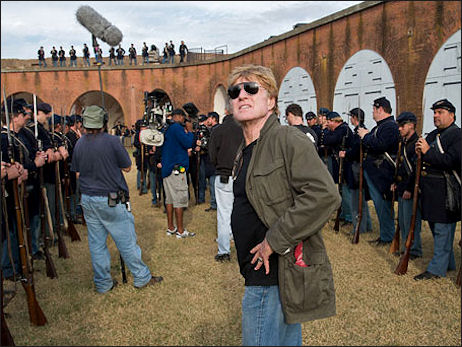
And yet Breznican decides against mentioning what I reported on 4.16 after reading James Solomon‘s Conspirator script, which is that (a) the plot and the chase are handled in flashbacks and (b) the basic plotline of The Conspirator involves a young attorney (James McAvoy) being reluctantly assigned to defend Mary Surratt in her conspiracy trial.
“The main arc belongs to McAvoy,” I explained. “He starts out actively hostile, but comes to see that Surratt has been wrongly charged. But Penn, it appears, will provide the lump-in-the-throat moments.” Redford hedges with Breznican about Surratt’s guilt or innocence, but the script I read seemed fairly resolved about the matter — i.e., she may have been circumstantially guilty in a sense, but she basically got a bum rap.
Then Breznican says a curiously hostile thing — he describes the film as “Law & Order: Civil War Unit.” Which is basically a way of saying “perhaps this movie isn’t so hot with no distributor and all…it seems to me like it might be a little tepid and formuliac, kind of like a TV series.”
I didn’t detect any hint in the piece that Breznican had read Solomon’s script, so why didn’t he do so if he’s going to describe it for his readers? Solomon’s script didn’t feel to me like any Law and Order-type procedural, I can tell you. What I read felt like solid first-rate material — “a sturdily-written, high-calibre thing,” as I said on 4.16. “And there’s no missing the grace and gravitas woven into Surratt’s character.”
Breznican sounds like a bright youngish guy (which he is) half-dismissing the work of a much older guy from another era who hasn’t directed a really good film since 1994’s Quiz Show, and implying that Redford is possibly over the hill. That’s how it read to me, at least. The young getting onto the old.
"Dying To See It"
Due respect paid to Award Daily‘s Sasha Stone, who posted this Allocine-generated clip from Woody Allen‘s You Will Meet A Tall Dark Stranger before me. It’s not much, fairly standard, etc. Obviously Antonio Banderas is thinking about doing the nasty with Naomi Watts and vice versa.
Killer Repels Me
Last night I finally saw Michael Winterbottom‘s The Killer Inside Me. It’s not a “bad” film, but the savage beatings of Jessica Alba and Kate Hudson are certainly sickening and easy to loathe. Most of the audience was in a lousy mood to begin with because the stars arrived so late and spent so much time on the red carpet that the film started 45 minutes late, so it wasn’t that much of a stretch to tip over into animosity.
On top of which I was strongly rooting for Casey Affleck‘s chilly-eyed psychopathic lawman to get caught, especially with his mumbled Texas accent making at least half of what he said indecipherable, which goaded me into wishing it would all end sooner rather than later.
I know the game that this movie is playing. It’s saying “are you going to be a moral milquetoast and take offense at some deeply offensive depictions of violence, or are you going to be cool and get beyond that?” To hell with that game. I am not and never will be cool when it comes to films of this sort, and I’m rather proud of that fact. And I don’t care how milquetoasty that makes me sound.
This isn’t some icky piece of exploitation or some Eli Roth butcher movie. Winterbottom has gone down the wrong path here, but he’s an accomplished director who deserves basic respect. The problem is that The Killer Inside Me is fairly flat and mundane except for the beating scenes and, okay, maybe one or two of the sex scenes. It isn’t especially scary or humorous or suspenseful or thrilling — I know that much. All it allows you to do, really, is wallow in repulsion. Okay, repulsion mixed with amazement.
Just because Winterbottom and co-screenwriter John Curran have closely adhered to the original Jim Thompson novel doesn’t mean it has some special integrity badge. All this means is that they’ve closely adhered to the original Jim Thompson novel, and so what? Thompson is renowned as a great pulp-noir writer, yes, and this movie will make whatever sense of decency you carry around in your heart melt into stomach bile and leak out your anus and dribble down your leg.
All any of this means is that various producers managed to raise the cash on the names of the three stars, and IFC decided to distribute and here we all are with Jessica Alba’s pus and mucus and blood splattered all over our laps….what did we do to deserve this?
I’m amazed, really amazed, that the producers of this thing — Chris Hanley, Andrew Eaton and Bradford L. Schlei along with exec producers Lilly Bright, Chad Burris, Randolf S. Mendelsohn, Jordan Gertner and Fernando Sulichin, co-executive producer Tricia Vam Klaveren and co-producer Susan Kirr — thought it might actually generate interest or sell tickets. Well, it did generate interest on the part of the super-ballsy IFC Films, and it’ll probably sell tickets to the nocturnal Quasimodo types.
Anyone who sees The Killer Inside Me and says to a friend or a girlfriend, “Hey, I want to take you to this cool new noir about this mumbly Texas cop who shuffles around and beats his mistress and his wife to death when things boil to a head”…the person who wants this film to be seen by others is extremely hip and fundamentally diseased. They are a carrier of some kind of spiritual plague with really, really sophisticated taste buds….ooh, yeah.
I suppose that’s a kind of selling point if you want to be perverse about it. I don’t know if it’s an Antichrist-type thing, but maybe it is. The problem is that it’s not sick-funny — no talking fox, no afterbirth. Maybe IFC could go with a slogan that says “are you fucked up enough to want to see The Killer Inside Me?” Hey, I know — maybe the Criterion Collection could release a Killer DVD sometime next fall? Get some high-falutin’ Lincoln Center-affiliated film snob to write the liner notes. The Criterion guys, trust me, are perverse enough. Because you really do need to be a terminal film dweeb and suffering from lupus of the soul to “enjoy” a film like this.
It was clear during the Glenn Kenny-moderated q & a that the audience was doing everything it could do to suppress its dislike of the film for the sake of politeness. I wasn’t convulsing with hatred for this thing, although I was certainly sickened. Here’s the irony: I had heard and read so many ugly warnings that Killer failed to live up to expectations. I was saying to myself, “Gee, this isn’t that disgusting. Well, it is but I’m able to watch it with a certain dispassion. I thought I was going to be retching in the aisles.”
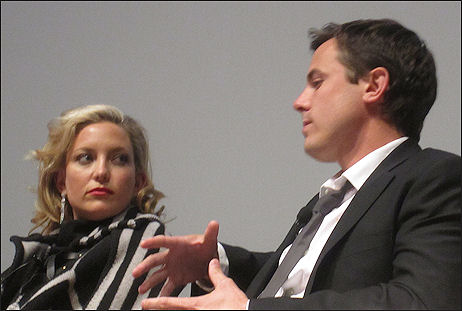
Screen International‘s David D’Arcy wrote last January that Winterbottom’s “staggeringly violent” adaptation of Jim Thompson’s 1952 novel “reaches a new extreme in the cinematic depiction of a psychopathic murderer. It is hard to watch — and for some will be impossible — regardless of any psychological logic behind its many killings. Audiences up to their ears in serial killers may enter this film thinking they already know them all. Winterbottom will prove them wrong.”
The video below the first paragraph is actually part 2 but I ran it first because it leads off with Affleck talking about why he wanted to do the film. He basically said that he was impressed by the fact that both the Thompson novel and the screen adaptation offered a psychological explanation for his character’s murderous acts. Hudson decided to do the film, apparently, because she hasn’t made a quality film along the lines of Almost Famous in ten years and her name is synonymous with “empty formulaic chick flick” so she figured what the hell, do an artistically downbeat film for a change. I don’t know why Alba agreed to do this, but I’ll bet she regrets it on some level.
Gibney Discusses
This is four days late, but here are four sequential videos I shot of Alex Gibney‘s q & a following last Saturday’s screening of his Untitled Eliot Spitzer Film. Here are part 2, part 3 and part 4. A fascinating discussion. And here’s my 4.24 review again. (Tribeca Film Festival honcho Geoff Gilmore is the one standing next to Gibney.)
Herzog Waldo
This would obviously be more amusing if the Werner Herzog imitator was more Herzogian, which is to say less British-sounding. And yet the narration is just right.
Liman Talks Game
Movieline‘s Stu VanAirsdale ran into Fair Game‘s Doug Liman last night (i.e., at an event I missed due to seeing Michael Winterbottom‘s The Killer Inside Me) and of course spoke to him about the film, which will show at next month’s Cannes Film Festival:
STV: “It’s kind of a weird climate for this film. There was Nothing But the Truth, which was kind of mishandled. Then there was Green Zone , which audiences were very cool toward. Where will Fair Game fall in this political intrigue/spy thriller spectrum?”
Liman: “I think it’s in the spectrum of ‘it’s a really great movie.’ And a lot of other movies that have been about the war or dealt with the war have not been great movies. In fact, they’ve been motivated more by politics than by story, and that’s been a turn-off to audiences. This is sort of the first political movie that’s been made where I feel like the commitment was there from the first moment to story and character, and not to politics.”
STV: “I overheard you a moment ago mentioning Naomi Watts is outstanding in this. Can you elaborate?”
Liman: “It’s the best she’s ever been. She is just extraordinary in the film. I don’t think there’s anybody — I don’t care how hardcore Republican they might be — who’s not going to look at the film and say, “That was an extraordinary performance. That was a once-in-a-lifetime performance.”
It is now incumbent upon HE commenters, obviously, to politely dispute Liman by pointing out previous political films that were made with a real commitment to “story and character and not to politics.” I’m presuming that Liman really meant to say “story and character first and politics a distant second.”
Balls Felt Like Concrete
N.Y. Times critic A.O. Scott has delivered one of his perfect little sonnet pieces on James Foley and David Mamet‘s Glengarry Glen Ross (1992). Except he doesn’t mention Foley. No one who talks about this film ever does. Because GGR is a show about one thing and one thing only — Mamet’s “hard-boiled, lyrical mysticism,” as Scott puts it.
Except it’s not, as Scott infers, a commentary on the “the current economic crisis [that] had its origins in the real-estate bubble and bond market frenzy of the last decade.” Nor is it an essential expression of the Clinton-changeover ethos of 1992, when the film was released. Glengarry Glen Ross is based on Mamet’s real-estate job in the late ’60s but it became what it became because it understood and reflected the emerging greed and malice of the Ronald Reagan era — when the seed of everything that stinks today was sewn, in the view of Paul Krugman — and that is when the play’s vitality was greatest, when it gleamed and instructed like a demon orator.
I saw Gregory Mosher’s original New York production just before opening night — some time in mid-March of 1984 — with N.Y. Times theatre critic Frank Rich sitting a few aisles away, and with a truly electric snapping-turtle cast — Joe Mantegna, Mike Nussbaum, Robert Prosky, Lane Smith, James Tolkan, Jack Wallace and J. T. Walsh. And I am telling you that night was it — the Glengarry Glen Ross apogee.
Foley’s film improved upon Mamet’s stage play by way of Alec Baldwin‘s live-reptile speech to the salesmen (“Third prize is you’re fired”) and Kevin Spacey‘s performance as the office manager (i.e., Walsh’s part), but was otherwise only so-so. In my head I’ve always blamed this on the influence of producer Jerry Tokofsky, whom I’ve always heard was a bit of a cowardly lowballing weasel, but I wasn’t there so what do I really know? Nothing.
The movie took too long to get funded and so, as noted, it came out too late — it missed the cultural synchronicity. And Foley smothered it in standard-issue noir atmosphere — darkness, neon, constant rainstorms — and in so doing blew off the unfettered, straight-from-the-shoulder, granite-like clarity of the play. And Jack Lemmon overdid the jittery desperation of the sweaty downswirling salesman known as Shelley “the machine” Levene. (For my money Robert Prosky did him better on-stage — anxious and vulnerable but also snarly, pugnacious, testy.)
Worst of all the film doesn’t have Joe Mantegna as Ricky Roma — a role that Mantegna owned like Humphrey Bogart owned Duke Mantee in The Petrified Forest and Jason Robards owned Murray Burns in A Thousand Clowns. Al Pacino does very well with the part — his handling of the big existential pitch speech that closes Act One is effectively phrased — and we all understand that movie stars like Pacino routinely take parts away from guys like Mantegna for the most sensible of reasons, but it was still wrong.
To my knowledge Mantegna’s Roma was never captured on film or tape (even audio tape), and for this history does not look kindly, especially upon Jerry Tokofsky.
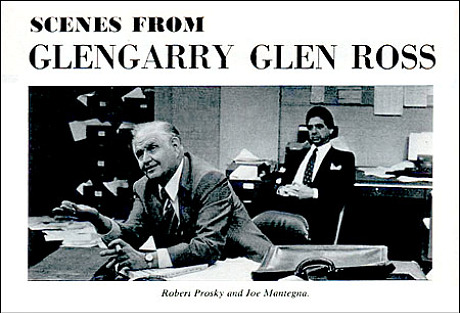
Robert Prosky, Joe Mantegna in Gregory Mosher’s original 1984 stage play of Glengarry Glen Ross
Get Low Schmooze
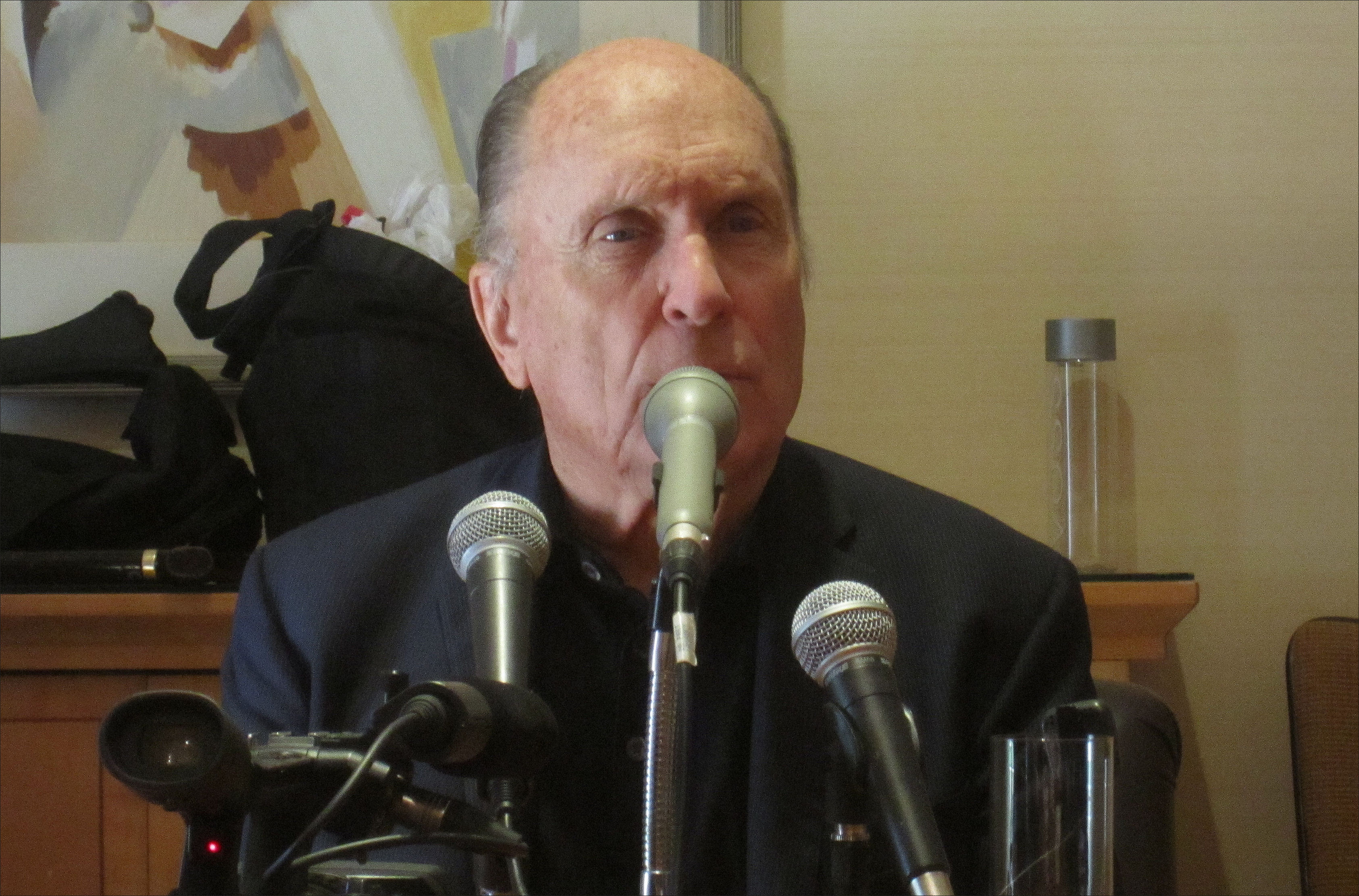
Get Low star and executive producer Robert Duvall said during today’s junket that Crazy Heart director Scott Cooper recently met with Brad Pitt about directing The Hatfields and the McCoys for Warner Bros….if and when Pitt decides to clear a place in his schedule. An excellent script about the legendary family feud of the 1800s has been written by Eric Roth, Duvall said. Pitt’s Plan B would produce with Pitt playing “the main guy,” Duvall said. Duvall would costar, and T-Bone Burnett would do the music.
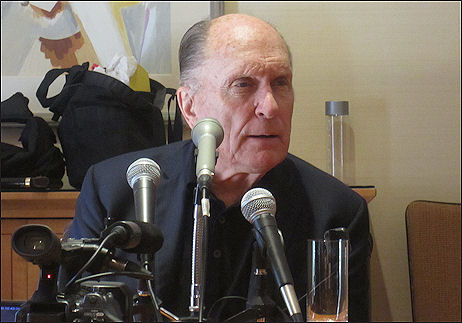
Get Low star/executive producer Robert Duvall during this afternoon’s Four Seasons press junket — Tuesday, 4.27, 3:10 pm.
Get Low costar Bill Murray — Tuesday, 4.27, 2:45 pm. I love it when Murray takes a disliking to journalist who ask vapid questions, as he did today in the case of a certain questioner. Go, Bill!
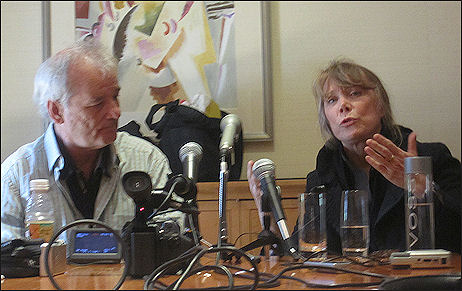
Murray, costar Sissy Spacek