Invictus Is…

The one sterling asset in Clint Eastwood‘s Invictus is…actually, make that two sterling assets. One is the fact that Eastwood is Eastwood and that there’s something I love about sinking into his films, even when they’re not double-grade-A. The other is Morgan Freeman‘s performance as Nelson Mandela — a thing that will carry Invictus along with ticket buyers and probably reap Oscar glory.
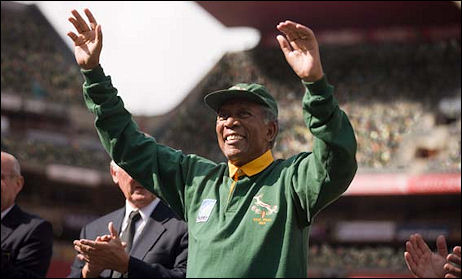

Morgan Freeman in Clint Eastwood’s Invictus

Freeman’s performance is not a deep-mine thing or a dazzling revisiting of a still living-legend whose face and manner are well remembered by millions. But it’s really quite satisfying — soothing — to watch Freeman, nearly a dead ringer, adopt a slight accent and step into Mandela’s shoes and walk around with a slight stoop and a faint grin and radiate that serene wise-man thing.

There’s no question Freeman will end up as one of the five Best Actor nominees, and I’m betting right now that he’ll win. He’s obviously playing a more stirring and inspirational guy than George Clooney‘s Up In The Air traveller, and a more sympathetic and charismatic figure than Daniel Day Lewis‘s Guido in Nine. He’s dealing with the same sort of historical turf that Christopher Plummer stands on in The Last Station, but Freeman has better lines and a stronger spirit.

His toughest competitors are A Single Man‘s Colin Firth, The Hurt Locker‘s Jeremy Renner and A Serious Man‘s Michael Stuhlbarg. But we all suspect that two out of these three are facing uphill odds, under-valued as they currently are by go-along pundits.

Otherwise Invictus has problems, but not ones that involve what it is. The problems it has are about what people are expecting it to be.

Invictus is a nice, cleanly told, mildly stirring South African sports film that should have been released in the late spring or early summer. Because if it had been it wouldn’t have all this weight on it. It could have been directed by Roger Donaldson, and I don’t mean that as a put-down to Donaldson or Eastwood. It just is what it is, but the fact that it’s the latest Eastwood film with a December opening has everyone hot and bothered. Well, cool down.
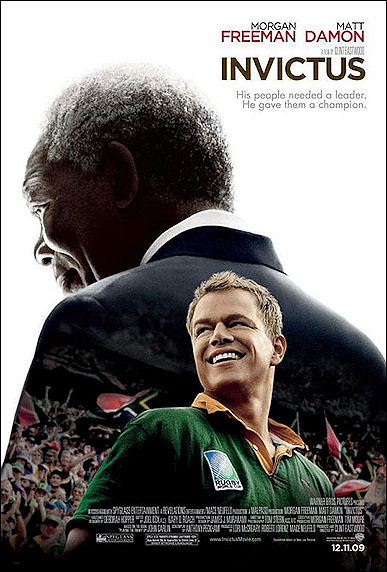
Invictus does remind us of what a centered and wise and very cool guy Mandela was — it gives off a contact high in this respect. But it’s all exposition, exposition, exposition and more exposition. And there’s almost no “story” in the sense that there are no character turns, no twists, no nothing in the way of surprises or intensifications. A good amount of it — most of it, really — is about South African government employees watching rugby games or standing around offices or sitting on buses or in the backs of cars or watching TV. (TV screens get a major workout in this film.) Or about athletes jogging and playing rugby and working out.

Invictus is about an “important” subject — one we should think about and perhaps learn from — but it mainly just ambles along. It kinda gets off the ground at the end, but rousing sports-movie finales don’t travel like they used to because we’ve seen them so damn often. You can’t just have the good-guy team win and show everybody cheering. That’s not enough any more.

This is one reason why Invictus doesn’t really go “wow” or “kaboom.” It’s fine and very agreeable in some respects. Anyone who writes in and says “You’re wrong” or “I loved it!” will not get put down in this corner. But there’s no getting around the fact (and it pains me to say this, being a major fan of Unforgiven, Play Misty For Me, High Plains Drifter, Breezy, Million Dollar Baby and Gran Torino) that Invictus is second-tier Eastwood.

Freeman and the take-it-easy, don’t-push-it quality to Clint’s direction are two winning elements. But it should have been a more layered thing. On one level there would have been what we have now — an above-board, what-you-see-is-what-you-get story about how a rugby team and a championship game helped bring a divided nation closer together. And there also would have also been…something else. A more penetrating look at the travails and fears of Mandela or Matt Damon‘s Francois Peinaar. A parallel story, a powerful subplot, a more prominent undercurrent or some other big thematic echo. Something.
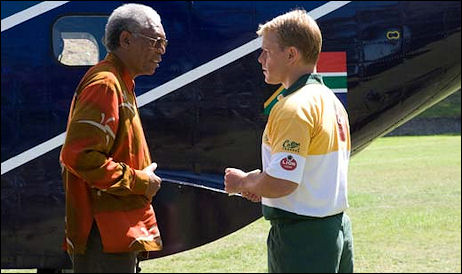

Morgan Freeman, Matt Damon

The first half-hour is the best part, by far. Freeman’s manner and personality are quite winning, and I was particularly impressed by a scene in which he gives a low-key address to some white staffers who are presuming they’ll be fired by the new Mandela administration. There’s also a good moment as the film begins in which we’re shown a white high-school rugby team practicing behind a chain-link fence and some young black kids playing rugby in the lot across the street, and the way they react differently when Mandela’s little motorcade drives by. All of this early stuff is quite good.

But once the rugby-championship element kicks in Invictus starts to flatten out and restrict itself to lateral passing back and forth. People said that Martin Scorsese‘s The Age of Innocence was a movie about cufflinks. And that Anthony Minghella‘s Cold Mountain was about a man walking through the woods. Boiled down, Invictus is (after the first half-hour) about people watching TVs, watching the rugby team play in a stadium, talking about what they’re seeing or thinking, and commenting on what may or may not happen.

And feeling exhilaration, of course, when the Big Game finally happens and (spoiler! happened 14 years ago!) South Africa beats New Zealand. That’s all it really is.

I almost admire Eastwood for keeping it as simple and straightforward as it is. It’s nice to see restraint and centeredness in a director, and there’s something very elegant about the way he steers Invictus along at 35 mph without cranking things up for the sake of cranking things up.

I know, I know — a satisfying plate of pasta doesn’t have to be “brilliant.” It just has to be carefully prepared and well seasoned and made with love. Invictus is a very pleasant and mildly stirring bowl of fettucini with a highly agreeable lead performance by Freeman. But it’s not one of those ratatouille dishes that win awards and inspire raves from restaurant critics.
Wait In Line, Fella

So Newsweek‘s David Ansen, Variety‘s Todd McCarthy and the Hollywood Reporter‘s Kirk Honeycutt get to ignore the 11.30 Invictus review embargo and everyone else has to wait…is that it? Because they’re big shots with special privileges? Are we still living in 1997?

And now Huffington Post-er Pamela Ezell has chimed in with an opinion — “On a scale of one to 10, Invictus is a six,” she says. “Add it to your Netflix queue or watch it on pay-per-view. Those lucky enough to be on a trans-Atlantic flight next year will probably have a chance to see Invictus on the plane, since its political theme and World Cup rugby depictions will undoubtedly make the film more popular abroad than it is here.”

A columnist friend says he’s waiting for Monday anyway — “What’s the difference? Nobody’s reading this weekend” — but the dam is clearly cracking and all bets are off. I’ve been chewing Invictus over in my head and may as well unload now. It’s a likable, very decent film in many respects — Morgan Freeman is delightful as Mandela, and an almost certain Best Actor nominee — but it seems fair to mention other impressions.

What Kind of “Good”?

Invictus is a very good story very well told,” writes Variety‘s Todd McCarthy. Wait a minute…a “good story”? The use of this term at the beginning of an important review of an end-of-the-year film by a major director calls for a full examination of its meaning.


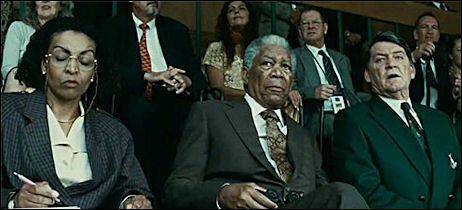
Morgan Freeman (center) as Nelson Mandela in Clint Eastwood’s Invictus.

I’ve seen Invictus myself and on a certain level McCarthy is right. The story of South African president Nelson Mandela (Morgan Freeman) using the symbolism of sport — i.e., urging unanimous and fervent support of the all-white Springboks rugby team in their goal of winning the 1995 World Cup championship — to unify his racially divided nation is, if you’re at peace with director Clint Eastwood‘s even-tempered, mild-minded shooting style, “well told.” I’m just not sure about the material.

To me the term “good story” is synonymous with “good yarn” — a tale that intrigues and enthralls by…well, usually by planting seeds in the beginning that germinate and sprout into a full and satisfying finale — one that feels natural and true and has a good kick or payoff. We all have our definitions for what “full” and “satisfying” means, but I suspect that what McCarthy meant when he said “good story” is one that is about goodness, or one that is “good” to hear and consider because it says “good” things about human nature, especially when a “good” man finds the strength to lead people in the direction of goodness, which is to say forgiveness and a “thumbs up” attitude that echoes Bob Dylan by saying “don’t look back.”

That aside, McCarthy steps back and, in my view, doesn’t full engage with Invictus, certainly not as much as he could if he wanted to. What is in play here is a justified respect for and allegiance to Eastwood, and McCarthy writing about the film in the same settled-down, measured, and un-throttled way that Eastwood deals with Mandela’s rugby story.

Eastwood’s film, says McCarthy, “has a predictable trajectory, but every scene brims with surprising details that accumulate into a rich fabric of history, cultural impressions and emotion.

“Once again in his extraordinary late-career run, Eastwood surprises with his choice of subject matter, here joining a project Freeman had long hoped to realize. In fact, the filmmaker has frequently dealt with racial issues in a conspicuously even-handed manner, most notably in Bird, and hiscalm, equitable, fair-minded directorial temperament dovetails beautifully with that of Mandela, much of whose daily job as depicted here consisted of modifying and confounding the more extreme views of many of his countrymen on both side of the racial divide.

“Mandela is the lynchpin of Invictus, whose title is Latin for “unconquerable” and comes from a stirring 1875 poem by British writer William Ernest Henley. Although far from a conventional biography, Anthony Peckham’s adaptation of John Carlin‘s densely packed book Playing the Enemy commences with Mandela’s extraordinary transition from imprisonment to the leadership of a country that easily could have fallen into a devastating civil war.

“As he takes office, Mandela allows that his greatest challenge will be successfully relaxing the tension between black aspirations and white fears. Pic adroitly avoids becoming mired in the minutiae of political score-settling by summing up racial suspicions through the prism of the new president’s security detail. Mandela’s longtime black bodyguards are shocked when their ‘Comrade President’ forces them to work with some intimidating Afrikaners, experienced toughs who until very recently were no doubt striking terror into the hearts of the black population.

“Directed by Eastwood with straightforward confidence, the film is marbled with innumerable instances of Mandela disarming his presumed opponents while giving pause to those among his natural constituency who might be looking for some payback rather than intelligent restraint.

“Freeman, a beautiful fit for the part even if he doesn’t go all the way with the accent, takes a little while to shake off the man’s saintlike image, and admittedly, the role of such a hallowed contemporary figure does not invite too much complexity, inner exploration or actorly elaboration. That said, Freeman is a constant delight; gradually, one comes to grasp Mandela’s political calculations, certitudes and risks, the troubled personal life he keeps mostly out of sight, and his extraordinary talent for bringing people around to his point of view.

“Where the rugby match is concerned, that talent is manifested by how, over tea, Mandela personally appeals to the captain of the South African team, the Springboks. A blond Afrikaner with no discernible politics, Francois Pienaar (Matt Damon) would just like to lift the squad from its present mediocrity. But Mandela quotes inspiringly from the poem — ‘I am the master of my fate: I am the captain of my soul’ — speaks of leading by example and exceeding expectations, and leaves Pienaar astonished at the idea that they can dare to dream about winning the World Cup.

“Just as it’s disinclined to offer a primer on South African politics, the film refrains from outlining the rules of rugby; the viewer just has to jump in and surmise that it’s something like a cross between soccer and American football. What the film conveys with tart economy is that rugby was a white game, scorned by blacks; as one man puts it, ‘Soccer is a gentleman’s game played by hooligans, rugby is a hooligan’s game played by gentlemen.’

“In a magnificent irony, the team the mostly white South African squad ultimately faces in the title match is a mostly white New Zealand team called (because of their uniforms) the All Blacks. The climactic faceoff, played in front of 62,000 fans at Johannesburg’s Ellis Park Stadium roused by the presence of Mandela himself, lasts 18 minutes of screen time; when such an event plays out like this in real life, it’s often exclaimed that it could only have been scripted for the movies. Here, it’s real life dictating the incredible scenario.

“With the exception of the meeting with Mandela and a couple of family scenes, most of Damon’s screen time is spent in training or on the field, and it’s meant as highest praise to say that, if he weren’t a recognizable film star, you’d never think he were anything other than a South African rugby player. Beefed up a bit (or, perhaps more accurately, slimmed down somewhat from “The Informant!”) and employing, at least to an outsider’s ear, an impeccable accent, Damon blends in beautifully with his fellow players.

“Some of the most amusing and telling scenes throughout involve the bodyguards, whose body language, facial expressions and intonations of minimal lines convey much about the uncertain state of things in the country.

“Shot entirely on location in South Africa, Invictus looks so natural and realistic that it will strike no one as a film dependent upon CGI and visual effects. In fact, the climactic match would not have been possible without them, as virtually the entire crowd was digitally added after the action was filmed in an empty stadium. You really can’t tell.”

McCarthy is right again — Invictus has the best fake multitudes sitting in a stadium CG I’ve ever seen. Very impressive. Cheers to special effects supervisor Cordell McQueen and visual effects coordinator Eva Abramycheva.

Crazy Lady

Maggie Gyllenhaal‘s Crazy Heart performance works for everyone and then some, but is it leading or supporting? I saw it as supporting from the get-go, which didn’t strike me as a problem in the least. The Fox Searchlight guys were feeling differently about this a week or two ago, but maybe they’ve come around.

I shot this with my Canon Elph. Bit of a strange angle but I had to keep it close to pick up her voice. There’s a lot that goes into assembling a decent video interview piece. I have to remind myself not to shoot ones that go on for 30 or 40 minutes. It took forever to load and convert this sucker to mp4 and then cut it up into three portions. I’ve got enough aggravation as it is, and now I’m late for my Thanksgiving dinner.

Mandela Security Guy

The big performance in Invictus is Morgan Freeman‘s Nelson Mandela, as you might expect. And Matt Damon‘s Francois Pienaar is…well, sturdy enough. But the one you remember after these two is South African actor Tony Kgoroge, who plays Mandela’s chief security guy, Jason Tshabalala.


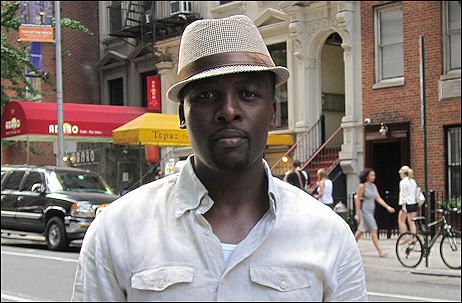
Invictus costar Tony Kgoroge in Manhattan last August

One obvious reason is that Kgoroge is handsome — hunky even — with a current of kindness and compassion about him. And because he’s the most prominent character in the film with an arc, starting with a posture of borderline hostility towards white Afrikaaners to a place of some acceptance and respect at the end. It’s not a great part but a good one. Like I said, memorable. As an assertive guy who’s angry but capable of growth and not too much of a pusher, Kgoroge is a steady personality who does just enough (and is given just enough lines) to keep from fading into the woodwork.

I met Kgoroge at a Manhattan party last summer. We met again a day or two later. He told me about his Invictus role but described it modestly. There was no way to figure how strong his presence would be. Anyway, I’m glad we talked a bit, and I hope he gets a bounce out of Invictus. The only difficulty, of course, is that his last name is a pronunciation problem for Americans. I can’t even imagine how to say it. If I were his agent/manager I’d get him to change it to George.

Cotillard’s Peak

The Weinstein Co. is pushing Marion Cotillard‘s Nine performance in the Best Actress category. She has the meatiest, hurting-est role among the Nine women — i.e., the betrayed wife of Daniel Day Lewis‘s Guido. (She’s also a lead because she sings two songs while all the other actresses sing one.) But nothing she does in Nine comes close to her acting in this scene from Public Enemies. I’m sorry but it’s true.

Ansen on Invictus

Three and a half days before the 11.30 embargo date, Newsweek‘s David Ansen has posted a short review of Clint Eastwood‘s Invictus. Does this mean others will jump the gun and post today or tomorrow or this weekend? A respected icon like Eastwood has little to fear from traditional big-gun critics like Ansen. Their respect for him is such that they’ll always go easy if they’re not 100% delighted. That said…

“A number of sports movies have one-word titles (Rocky, Hoosiers), but they’re not usually in Latin,” Ansen begins. “Clint Eastwood’s Invictus is not your ordinary sports movie, though it comes to a rousing climax at the 1995 Rugby World Cup match between South Africa and New Zealand. The stakes are higher: a nation’s unity hangs in the balance.

Invictus (which means ‘unconquered’) takes place at the intersection of sports and politics. Its hero is Nelson Mandela (Morgan Freeman, naturally), who, in the aftermath of apartheid, has just been elected South Africa’s president after serving 27 years in prison.

“During his incarceration, Mandela studied his Afrikaner enemies and was wise to the role sports played in the national psyche. South Africa’s less-than-sterling rugby team, the Springbok, was as beloved by whites as it was despised by the black population, to whom it had become a symbol of oppression. Yet Mandela, taking a huge political risk, refuses to give in to his supporters’ demand that the team be dismantled and renamed.

“To do so, he sees, would only stoke fear and racial paranoia in the Afrikaner population. Enlisting the team’s captain (Matt Damon) to his side, Mandela challenges him to turn its losing ways around. His goal is to use rugby to bridge the racial divide in his country.

Invictus is not a biopic; nor does it take us deep inside any of its characters — Eastwood views Mandela from a respectful middle distance. It’s about strategic inspiration. We witness a politician at the top of his game: Freeman’s wily Mandela is a master of charm and soft-spoken gravitas. Anthony Peckham‘s sturdy, functional screenplay, based on John Carlin‘s book Playing the Enemy, can be a bit on the nose (and the message songs Eastwood adds are overkill). Yet the lapses fade in the face of such a soul-stirring story — one that would be hard to believe if it were fiction. The wonder of Invictus is that it actually went down this way.”

I’m inclined to respect the embargo unless the dam breaks, in which case holding back won’t matter.

Quiet Time

An Invictus screening begins in 28 minutes (i.e., 6:30 pm) so I don’t have time to write anything about my chat yesterday afternoon with Crazy Heart costar Maggie Gyllenhaal. Okay, I can repeat the general feeling out there that her performance as a 30ish single mom who falls in love with Jeff Bridges‘ roly-poly alcoholic country music star is a quiet, unforced, true-heart thing. More lived-in than “performed.” A supporting standout, in the view of most I’ve spoken to.


Crazy Heart costar Maggie Gyllenhaal at the end of our sit-down yesterday at a low-key place on Tenth Avenue — Tuesday, 11.25.09, 3:25 pm

Gyllenhaal also has the most beautiful eyes I’ve been close to in a long time. There’s something extra-vivid about them live. The last time I saw eyes this radiant and intense was when I got close to Elizabeth Taylor at a Manhattan party in the early ’80s.

I shot some video of our discussion but it’s taking forever to load and convert. Later tonight or tomorrow morning.

“World’s Ending Anyway…”

Mary Walsh is a Canadian comedian who’s created a running bit out of ambushing Canadian politicians as her character, Marg Delahunte. She recently tried this with Sarah Palin during a book signing. I say again — Palin is a flesh-and-blood incarnation of Martin Sheen‘s President Gregg Stillson in David Cronenberg‘s The Dead Zone.

Maestro

A fundamental reason why so many people of taste and refinement have been talking with great admiration about Peter Capaldi‘s In The Loop performance as the sewer-mouthed Malcolm Tucker is due to envy and dream-fulfillment. Capaldi’s tirades have not only made him a dark-horse contender for a Best Supporting Actor nomination but instructed (or reminded) some of us that profanity can be artful — it can be delivered with absolute precision and beauty. You just need a team of brilliant writers feeding you the lines.


In The Loop‘s Peter Capaldi

Swearing can be emotionally cathartic for the speaker, but it’s almost always ugly for the listener. Which is why Capaldi’s imaginative and vigorous motor-mouthing in In The Loop is such a trip. Most if not all of us sound coarse and ill-mannered and pathetic in a 15 year-old boy sort of way on those rare occasions when we swear about something or someone. It would be wonderful — bliss! — if we could swear like Tucker on occasion, or even just once.

The Loop artisans and masons, of course, are the writers. Capaldi just makes their stuff sound right, but of course that’s what all acting basically is, isn’t it? Yesterday Dark Horizon‘s Paul Fischer posted an interview with Capaldi that went like this at one point:

Fischer: “Now, this film is as much about language as it is about character. I’m just wondering how much input did you have into the way that he speaks? I mean – and his use of language. Was there any improv at all, or was it all there on the page?”

Capaldi: “It’s largely all done on the page, particularly with Malcolm, because the writers take a lot of time and put a lot of labor into constructing for him, very, very baroque sentences, and ways of speaking. So, my job is to sort of do a congenial check, to make it look as if this highly-polished text is just tripping off my tongue. So – yes, there’s always a gray area.

“[Actors] throw in bits and pieces. How we do the show, or how we did the film, which is the same way we do the show, is that we nail the text. That’s our first responsibility. We shoot a couple of passes where we nail the text. And thereafter, we’re allowed to do sort of rougher versions, where we can loosen up and throw in our own words, if we like. And also, throughout the process, we have days when we improvise around the material. And sometimes a line or whatever comes up that works, and the writers put that into the shooting script. But I wouldn’t — you know, I would say it’s their work, largely.”

Williams Tradition

What Tennessee Williams plays and film adaptations didn’t feature a handsome (or pretty) young Southern-studcat figure in a prominent role? I’m thinking, I’m thinking. Night of the Iguana, of course. The 1961 film of Summer and Smoke only had Laurence Harvey so that too was an exception. Boom, Last of the Mobile Hot Shots…what others?

In Jodie Markell‘s Loss of a Teardrop Diamond (Paladin, 12.30), the object of desire is played by 28 year-old Chris Evans.