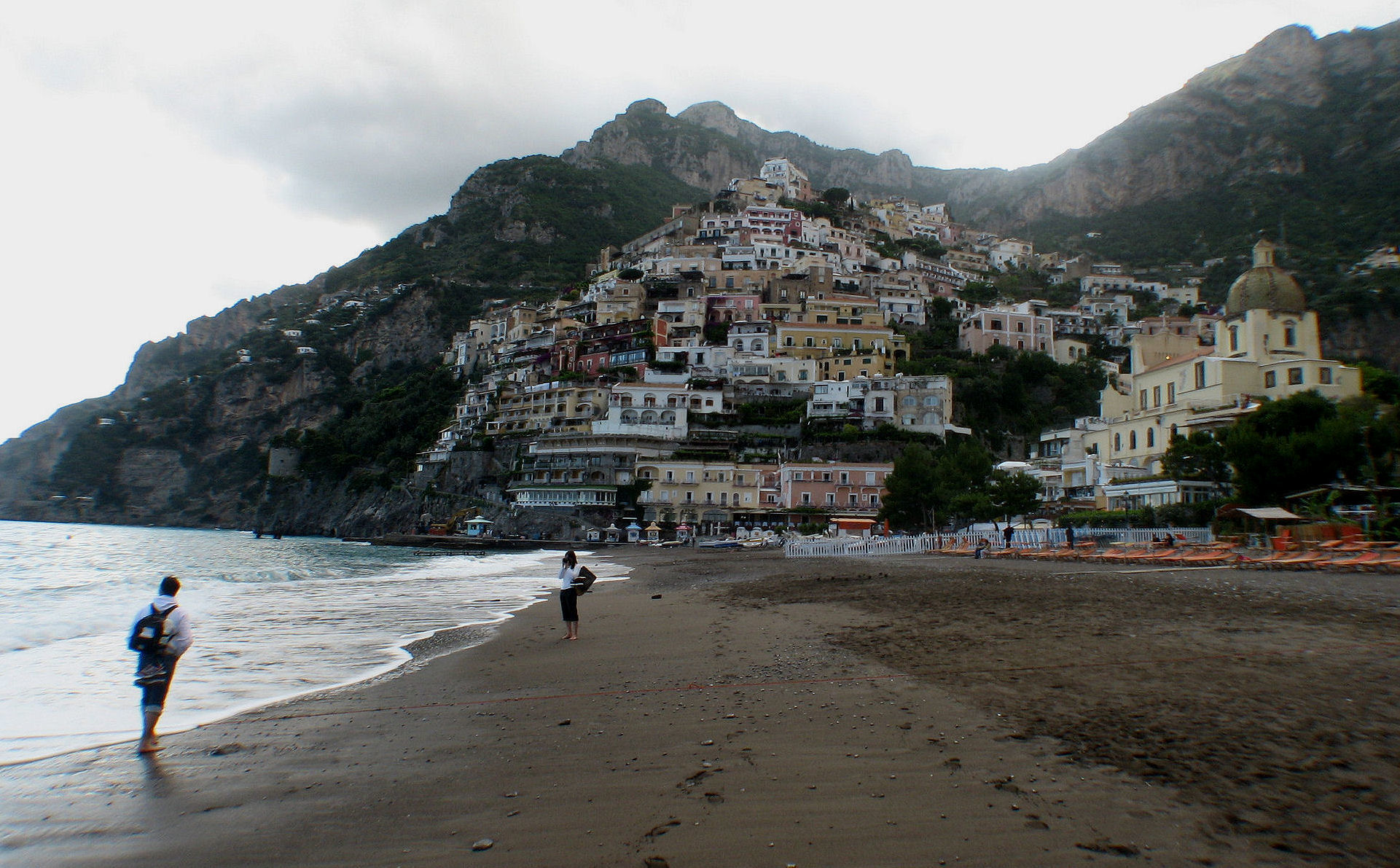
Sunday, 11.28, 8:25 am.
Without the slightest doubt the single most soothing image I have in my entire photo library. Positano has been overtaken and polluted by schmuck tourists, but I’d go back there again in a second. Taken in late May 2007.

One of my many derelictions right now is not having seen John Lee Hancock‘s The Blind Side, which I’m planning to catch tomorrow. It’s a much bigger hit than box-office pundits were expecting, of course. “A 47% uptick from its opening day B.O. with $16.2 million on 3,140 runs…pic’s domestic cume stands at $76.3 million,” Variety reports.
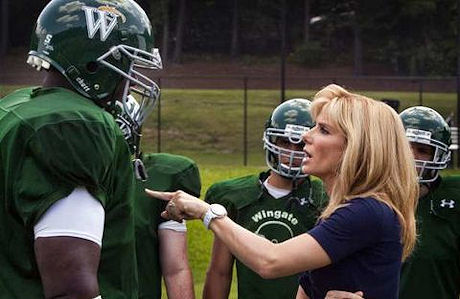
The basic appeal, I’m guessing, is that it’s a good Middle American movie that’s not informed by the neurotic mentalities of the coasts. I heard this morning that a rival distributor (i.e., not a Warner Bros. guy) recently projected to a friend that it will ultimately make north of $200 million. It’s the only film besides Up to have a CinemaScore A-plus so far. Old news, chasing the tail, etc.
“Bright vivid technicolor…like Spielberg directed it…a serial-killer movie meets The Color Purple…Silence of the Lambs meets What Dreams May Come.” — a friend who caught a screening last night in Los Angeles.
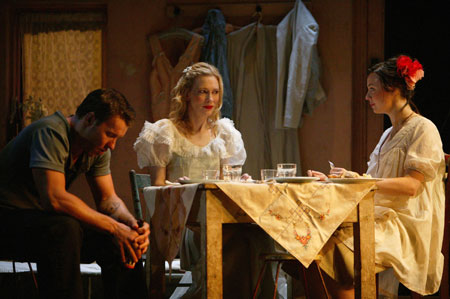
A couple of hours hence I’ll be heading over to BAM’s Harvey Theatre and a matinee performance of the Sydney Theatre Company’s A Streetcar Named Desire, which began yesterday and runs only through 12.20. The lure, of course, is a reputedly devastating Cate Blanchett as Blanche Dubois. The classic Tennessee Williams play was directed by Liv Ullman, and costars Joel Edgerton as Stanley Kowalski and Robin McLeavy as Stanley’s wife and Blanche’s sister, Stella.
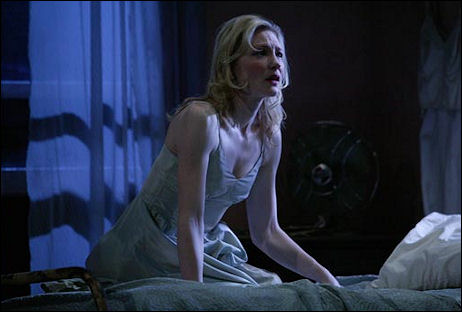
“If Blanchett’s nerve-shattering turn doesn’t knock the wind out of you, then there is nothing on a stage that can blow you away,” wrote Washington Post critic Peter Marks on 11.2. “What Blanchett achieves…amounts to a truly great portrayal — certainly the most heartbreaking Blanche I’ve ever experienced.”
I know the Streetcar dialogue so well I’ll be able to mouth a good part of it along with the actors. Like Winston Churchill mouthing Hamlet from the front row as he watched Richard Burton perform it on the London stage in the ’50s.
The run is totally sold out, of course. Impossible to get tickets except through fiendish scalpers. 190 minutes with intermission, or something like 170 or 175 minutes without. Elia Kazan‘s 1951 film ran 122 minutes, or roughly 50 minutes shorter.
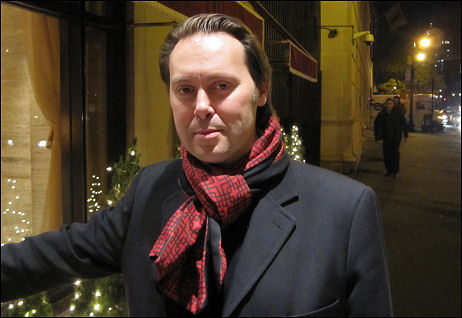
I had a half-hour chat last Tuesday evening with Me and Orson Welles star Christian McKay, and despite enjoying our time and really liking the guy — he’s spirited and razor-sharp and full of buoyancy — I waited five days to post. I don’t know why and I’m sorry. It doesn’t indicate anything. I just fell into a lazy pocket.
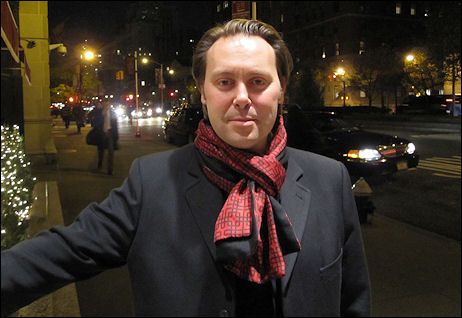
Actually, that’s not true. I was reluctant to get into a McKay thing because as gifted as he seems to be — he’s actually brilliant in MAOW — he’s in his mid 30s now and only just starting to happen, and I knew I’d have to answer what he’s been doing all this time and why he wasn’t on the stick in his early 20s. The answer, he says, is that he was into music when he was younger. The other answer, I suspect, is that, like myself, he was simply a late bloomer.
Whatever — the guy is a British dynamo with one of those “God, I love acting!…I mean, I love being paid attention to!” personalities. He looks like Orson Welles, of course, but he’s obviously himself as well, and after sitting with him for 20 or so minutes and then talking a bit more under a hotel awning out on Park Avenue it seemed obvious that he’s really and truly got it. Which means some combination of heat, hunger, talent, ambition, chutzpah and whatever else. Oh, and McKay smokes cigarettes. And he’s had a battle or two with the bathroom scale.
As I wrote a few days ago, Me and Orson Welles “is absolutely worth seeing for Christian McKay’s thunderbolt performance as the 22 year-old Welles — a headstrong genius in his hormonal-visionary cups. Vincent Donofrio was a fine Welles in Ed Wood (although someone else voiced the dialogue) and Liev Schreiber delivered a reasonably full-bodied Welles in RKO 281, but McKay — 34 or 35 when the film was shot, and looking like he could be 28 or 29 — is the Fo. He’s the standard-bearer and the king of the hill, the guy to beat the next time somebody plays Welles.”
And N.Y. Times critic A.O. Scott wrote that the film contains “the ego and the brilliance [of Orson Welles]..in full blossom. They are captured, with a brio and wit that puts most biopic mummery to shame, by Christian McKay, a British actor with a slender resume and superhuman confidence. His evident relish in the dimensions of this role is a crucial part of the performance. It’s so much fun to play Orson Welles because it must have been at least as much fun to be Orson Welles.”
Since MAOW McKay has performed a small part in Woody Allen‘s next film (i.e., the one shot last summer in London) and a character named Hamilton McMillan in Bernard Rose‘s Mr. Nice.
He was on his way to do a Charlie Rose taping (along with director Richard Linklater and costars Zac Efron and Claire Danes) following our chat, but I’ve searched and searched and can’t find the segment on the Rose site or anywhere else. It doesn’t exist! I also asked the publicist when it’ll air…zip.
And the reaction to Yoostar, the cinema karaoke software with studios licensing clips for Average Joes & Janes to put themselves into movie scenes…? Actually, I’d rather be William Munny in the climax of Unforgiven.
“All the airports kind of feel and look the same now,” Jason Reitman told the N.Y. Times‘ David Carr in an 11.25 interview piece. “Some are more beautiful, some are less beautiful, but for the most part you’re going to find a Starbucks in every airport. You’re going to get your coffee and the USA Today or New York Times in every airport. All the things that you want are there, so you can land anywhere, and you feel at home. You’re given the sense that you’re everywhere, but you’re nowhere; that you are constantly with your community, yet you have no community. There’s kind of a terrific irony to that.”
But you do have community in an airport. You’re surrounded by hundreds of people who are just like yourself. You just don’t usually talk to them as a rule. And some airports are more soothing than others, especially those in Germany and Swtizerland.
As I put it without irony on 9.27…
“No man-made atmosphere makes me feel quite as serene as an airport. When I’m waiting for a plane, I mean. (And after I’m through the security scan.) A blissful feeling of being neither here nor there. All my cares and anxieties suspended. It’s actually kind of beautiful.
“I know and accept, of course, that airport environments are no substitute for anything, least of all the real rock ‘n’ roll of life. I only know what I feel when I’m inside them. I’m in a kind of womb — a place in which the normal heave and pitch of things doesn’t happen or disturb. The appointments, challenges, pressures, deadlines — all that will surround me and more after I’ve landed. Expected, understood. But what a charmed feeling it is to be within an airport with all of that stuff outside, and with nothing to do inside but chill. I especially love three- and four-hour layovers. I adore browsing around, having a cafe au lait, leafing through magazines, looking at the hundreds of travellers. (Especially the women.)”
“I’m really disappointed” in Barack Obama, writes playwright Christopher Durang. “I mean, I know he’s way better than Bush. I guess I miss the oomph that LBJ had both in civil rights and in getting Medicare/Medicaid passed into law. Then he let his mistakes in fighting in Vietnam sink him.
“Obama is cool and charming. But oomph? Seemingly not. Hip and appealing. Yes, but can he do aggressive arm twisting to get something passed? Can he bring some power and aggressiveness to explaining things the country needs, to get people on board?” Not so much. So far.
“And if Obama isn’t the one to change things in a major way for the better — health care, environment, people’s rights — who is? I am a disappointed idealist.”
The Toronto Star‘s Peter Howell has bravely compared Gone With The Wind, a metaphor about the miseries and deprivations of the Great Depression of the 1930s (and a comment about how the nicest people aren’t necessarily the ones who do well in tough times, and vice versa) with New Moon, a stunningly dull and tension-less Mormon metaphor about just saying no to pre-marital sex.
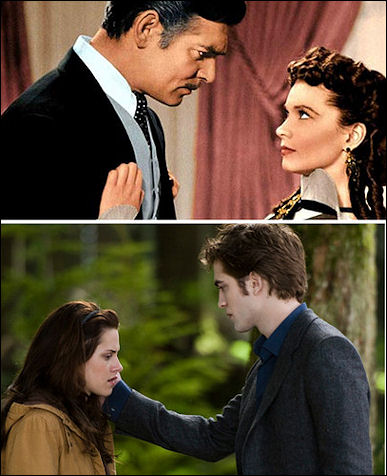
Howell is one of the nicest and smartest guys I know and one of the best film critics bar none, but this article is…uhm, unpersuasive. To me, anyway.
Howell actually calls New Moon a “well made, competently acted” thing that “properly complements the Twilight book series.” It’s “not one of the year’s best movies,” he allows, “but it’s a far cry from the worst.” And the critical slamming of it, he suggests, was due to “the same sexism that prompted many critics to dismiss Sex and the City completely out of hand, simply because it was perceived to be a movie for women, and thus not a movie to be taken at all seriously.”
Nope, wrong. It’s not that New Moon is aimed at women — it’s the obvious fact that Catherine Hardwicke‘s Twilight, released a year ago, did a much better job of tapping into the panting Bella Swan + Edward Cullen current than Chris Weitz did in New Moon. Much. As in don’t even compare them. It’s not that New Moon is too girly and swoony — it’s not girly and swoony enough.
On top of which Howell totally ignores the ghastly season-changing sequence in New Moon that became an instant laughing stock — one of the stupidest such sequences in motion picture history.
The fact that title cards indicating the passing end-of-the-year months were deemed necessary to insert (presumably due to test-screening reactions from Eloi audiences that indicated confusion about why the front lawn had changed color and was thereafter covered with leaves and then snow) is one of the most persuasive and depressing indications that there are some amazingly stupid people out there.
Howell not even mentioning this sequence, which film professors will be showing to their students for decades to come as an indication of societal rot and collapse, completely destroys his other arguments. It’s too glaring and too comical to be brushed under the rug, and failing to at least acknowledge it when a writer is laboring to defend New Moon means that attention isn’t being paid.
And I for one didn’t rip the Sex and the City movie because, as Howell suggests, “it was aimed at women and therefore not to be taken seriously.” I was morally offended by that film. I called it “a grotesque and putrid valentine to the insipid ‘me, my lifestyle and my accessories’ chick culture of the early 21st Century.” I didn’t call it a movie that Satan himself would have been proud to have directed, but I should have.
“The soul of this movie is infected with gross materialism, the flaunting of me-me egos and the endless nurturing of the characters’ greed and/or sense of entitlement,” I said. “It’s all about money to piss away and flashy things to wear and lush places where the the girls lunch and exchange dreary confessional chit-chat. And this, mind you, is where millions of middle-class women in every semi-developed country around the globe live in their dreams. They’re going to this movie right now in multitudes. Sad. Really sad. Because SATC is crap through and through.
“A few items back I called Sex and the City a Taliban recruitment film. All I know is that I felt ashamed, sitting in a Paris movie theatre, that this film, right now, is portraying middle-class female American values, and that this somehow reflects upon the country that I love and care deeply about. It’s a kind of advertisement for the cultural shallowness that’s been spreading like the plague for years, and for what young American womanhood seems to be currently about — what it wants, cherishes, pines for. Not so much the realizing of intriguing ambitions or creative dreams as much as wallowing in consumption as the girls cackle and toss back Margaritas.
“All I know is that the faux-splendor of the movie — the insipid Marie Antoinette-ishness of the damn thing with the look-at-me clothes and sets and nouveau-riche ickiness of the apartments and restaurants — felt to me like a kind of hell.”
The way I hear it Clint Eastwood arrived in South Africa to shoot Invictus on a Friday, never having visited the country before as an explorer looking to absorb and learn. He began shooting two days later (i.e., the following Monday) and, typically for Clint, shot it fairly quickly — two days under schedule, I’m told. He would always finish at five and then, my source says, work out for a couple of hours each day.
My heart and admiration goes out to anyone with that level of vigor and discipline at an age when most people have downshifted if not ceased operations altogether. The guy is amazing — an inspiration. Daily workouts are obviously a way of keeping flush and toned and attuned and overpowering the natural aging process, which tends to begin shutting things down once you’ve hit your late ’70s or thereabouts, if not sooner.
Clint “obviously knows what’s coming” — who doesn’t? — “and that’s why he’s moving so fast and doing one film after another, and making them so cheaply that no one’s going to say ‘no’ and knowing all the while that his brand has an intrinsic value and so on.” I just have to shake my head and go “wow.” Talk about being the captain of your soul.
Pamela Ezell‘s 11.27 Huffington Post Invictus piece notes several parallels between former South African president Nelson Mandela and U.S. president Barack Obama. First black president, humble backgrounds, preachers of tolerance and forgiveness despite haters, etc. But the Mandela-Obama parallel falls apart in Clint Eastwood‘s film when Morgan Freeman‘s Mandela is told he’s risking his political capital, and he replies “the day I am afraid to do that is the day I am no longer fit to lead.”
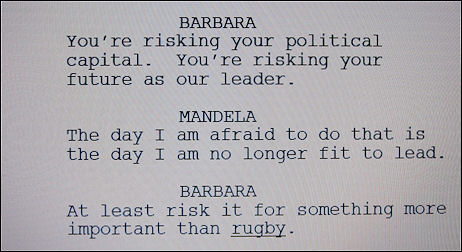
Is there anything less Obama-like than a core belief that a leader must sometimes risk much if not all in order to get the right thing done? Has there ever been a president with less backbone — with more of a mushy cottonball approach to leading and using power than Obama? Has there ever been a president who’s been less inclined to take any risks whatsoever? Who’s been more willing to bend over and defer to his enemies and say to the worst scummiest Republicans, “Hmmm…okay, maybe you guys have a point”?
Here’s another line that Mandela says in the film:
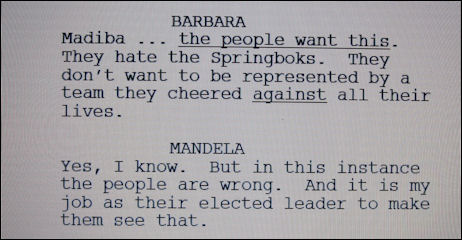
It’ll be an ice-cold day in hell when Barack Obama says to a White House adviser, “In this instance the people are wrong, and it is my job as president to make them see that.” The mantra of Barack Obama is, “We know what to do and we know what’s right, but it’s better to cave in and get along because that way our poll numbers will be steadier. Because…you know, I can’t afford to be seen as an angry black guy. I don’t have that authority that Franklin D. Roosevelt had when he became ‘a traitor to his class.’ The right is too powerful and there too many crazies out there. It’s all I can do to chill them out.”
As everyone knows, the title of Clint Eastwood‘s Invictus is taken from William Ernest Henley‘s short poem of the same title, which was first published in 1875. “Master of my fate, captain of my soul, bloody but unbowed,” etc. It’s one of the best right-wing poems of all time and I respect it as such, but for most of us Henley’s words fly better on the page than they do in real life.
The best stand-alone right-wing sentiment I’ve ever heard is “better a general in hell than a corporal in heaven.” Because for most conservatives, power — the ability to choose and make moves as a rugged stand-alone entity without having to bend over or take any crap from bureaucrats or mealy-mouths — is all.