Will Oz Be Wired…or Not?

Warner Home Video’s Blu-ray restoration of The Wizard of Oz will be out less than a month from now, debuting Tuesday, 9.29. The restored classic will also have a one-day showing on screens nationwide on 9.23, and a special 11 am screening at Manhattan’s Alice Tully Hall (a program presented by the New York Film Festival) on Saturday, 9.26.

But no one has yet spoken about the key qualitative aspect regarding this upgrade of America’s most beloved family film. In a phrase, the question every videophile across the nation will be asking as he/she opens up the Blu-ray package (or as they attend the Oz theatrical screenings) will be “what about the damn wires?”

Presumably the Blu-ray upgrade will look measurably sharper and more distinct than any video version seen before. But does this mean the wires that hold up Ray Bolger’s Scarecrow (to assist in the illusion that he’s hanging from a wooden post among the cornstalks) will look even more vivid than they did in the last Wizard of Oz upgrade, which came out in 2005? Ditto the wires that hold up those flying monkeys serving Margaret Hamilton‘s Wicked Witch of the West?

Nobody spotted the wires when The Wizard of Oz opened in 1939. They couldn’t have with the coarseness of film stock and 1939-era projection technology and the process of three-strip Technicolor alignment being what it was. And nobody ever spotted the wires on any of those TV showings in the ’50s, ’60s and ’70s, or on VHS or laser discs or even on early DVDs. But they were easily detectable on WHV’s 2005 Special Edition, and one can only guess how much clearer they’ll be on the new Blu-ray. Unless wiser heads have prevailed, of course.

One way to deal with the wires would be for the Wizard of Oz images to be slightly softened so as to bury them in a kind of simulated 1939 haze. But the smarter way — hello? — would be for the wires to be digitally erased. I would ask Warner Home Video’s George Feltenstein for a comment, but my experience is that WHV publicity always blows me off on questions like this. Today is Sunday — I’ll try them tomorrow morning.

Obviously the Blu-ray upgrade will be fighting itself if WHV technicians decide to soften the image. This would negate the improved clarity and improved three-strip alignment and the extra-sharp focus that could and should be a dividend of the new Blu-ray version, and is what people will certainly be looking for when they buy it.


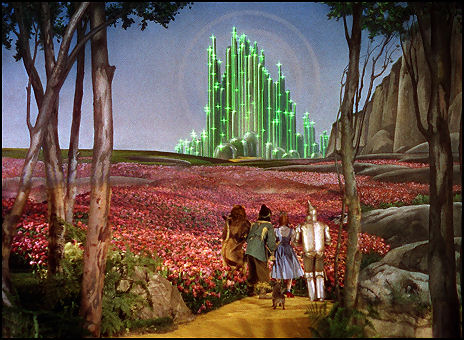
You can see the wires in the above photo (taken off my old 36″ West Hollywood TV) but if you have any kind of recently-manufactured big-ass flat screen, they look much more vivid than indicated here

Let’s hope and pray that WHV went with digital erasure on Oz. It’s been used by other video distributors in the remastering of older films with wire issues (including Mary Poppins and North by Northwest), and is clearly the only enlightened way to go. [Update: HE reader Drew McWeeny informs below that “the restoration work on Oz this time is nothing short of revelatory. There are about four places in the film where they removed wires, but otherwise their efforts were focused on making sure that this is the single best version of a three-strip Technicolor film that I’ve ever laid eyes on.”]

Digital wire removal infamously wasn’t used for the 2005 Paramount Home Video upgrade of the 1953 War of the Worlds.

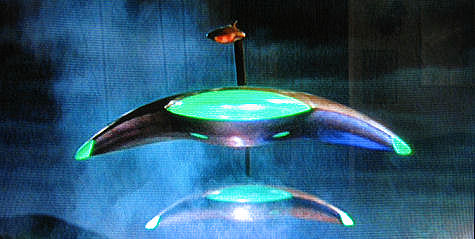
Byron Haskin‘s sci-fi classic provides one of the lushest color-baths in Hollywood history and has always looked sumptuous. But the 2005 DVD pretty much ruined the suspension-of-disbelief element because of the way-too-visible cords holding up the Martian spaceships. You can see them plain as day during scenes of the initial assault against the military…a thicket of blue-tinted wires holding up each one.

Their presence makes it absurd when Clayton Forrester (Gene Barry) explains to General Mann (Les Tremayne) how the Martians keep their bright green ships aloft by using “some form of electro magnetic force” and “balancing the two poles” and so on. The illusion is shot.

The obvious solution was for Paramount Home Video to digitally erase the wires, but they didn’t ask for it (i.e., didn’t want to pay for it) and the pooch was screwed. It would have made perfect symmetrical sense to have done so. Just as digital technology had made this 1953 film look sharper than ever before, it followed that digital technology was needed to recreate the original illusion. The wires weren’t that visible 56 years ago, and they weren’t as visible in Paramount Home Video’s 1999 DVD. Obviously the 2005 War of the Worlds DVD was the provider of “detrimental revisionism” — it showed an image that wasn’t meant to be seen.

Four years ago I spoke about this issue with John Lowry, the head of Lowry Digital who’s done some great clean-up and/or digital restoration work on loads of classic films. He was the one hired by Paramount Home Video to clean up War of the Worlds .

“Our job is always to serve the wishes of the client…we do what the client says …and we didn’t have orders to clean up the wires,” he said. “Plus we were working on a very tight budget.”

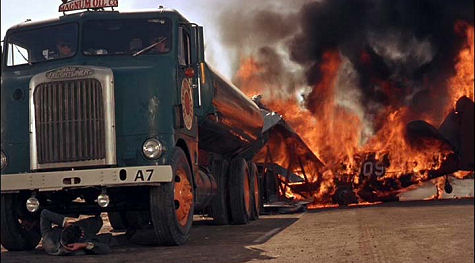
Lowry faced a similar issue when he was doing the digital remastering of Alfred Hitchcock‘s North by Northwest. “We were working on the scene when the crop duster plane crashes into the gas truck,” he recalls, “and there were 25 or 30 frames of that particular shot in which you could see three wires holding up the rather large model of the airplane.

“And I said to myself, my God, too obvious…it spoils the illusion. And I asked myself, what would Hitchcock do? I knew what he would do. Take the wires out of there. So I did, and the Warner Bros. people approved.

“But ever since then we’ve been very attuned to original artistic intent. And with today’s technology, anything that interferes with the story-telling process or which degrades that process, is dead wrong. We got rid of the wires on the Mary Poppins DVD, for the Disney people. We asked and they said ‘get rid of them’ but they had the money to do it.

“When we were working on the snake-pit scene in Raiders of the Lost Ark you could see all kinds of reflections in the glass separating Ford from the snakes, and there was a very conscious decision made by Spielberg to take the reflections out.”


The North by Northwest plane crash scene

Untruths in Advertising

What are some of the most successful flim-flam movie marketing campaigns of all time? Ad and trailer campaigns, I mean, in which the content of a certain film was almost completely hidden and/or ignored, and the marketing guys sold a film that didn’t really exist — at least not in the way it was represented by the one-sheets and trailers. A marketing campaign, in short, that didn’t exaggerate this or that aspect of a film (which all movie campaigns do) as much as one that pretty much deliberately lied about what a film actually was.

And got away with it, I mean — that’s the important part. People showed up and then realized ten of fifteen minutes into the film that they’d been hoodwinked by the ad guys, but they stayed anyway and liked the film and came out and told their friends to go see it. Normally I’d come up with two or three examples to start things off, but let’s just toss it out and see where this goes. And if you can’t think of any strong examples, name some films that maybe should have used a deceptive marketing approach — i.e., films that suffered from an overly sincere and truthful campaign.

An oldie but goodie to start things off…fake, of course, but a satiric example of what a fair number of campaigns have done or tried to do. Successfully, I mean.

How Do I Know?

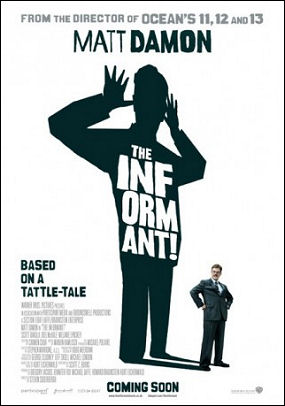
I want The Informant! (Warner Bros., 9.18), which certain parties saw in Los Angeles a week or two ago and which I’ll be seeing fairly soon, to be a dark and sardonic verite satire piece. A movie, I mean, that’s dryly amusing in a way that will leave Eloi viewers cold…yes! Nobody does non-laughy undercurrent humor like Steven Soderbergh. But what if the film isn’t that amusingly whatever, even for guys like myself, and the Warner Bros. poster creators are just trying to sell this idea in a flim-flammy sort of way in order to boost the first-weekend gross?

Confession

“Well, what can I tell ya? Last year, two or three…it goes way back, I suppose. I can remember entertaining suicidal thoughts as a college student. At any rate, I’ve always found life…demanding. I’m the only child of lower middle-class people. I was the glory of my parents, ‘my son the doctor’…you know. I was always top of my class, scholarship to Harvard, the boy genius, the brilliant eccentric. Terrified of women. Clumsy at sports. My home is hell. I left my wife a dozen times. She left me a dozen times. We stay together through a process of attrition. Obviously a sadomasochistic dependency.”

Traumatic Visuals

Yesterday afternoon Los Angeles attorney Eric Spiegelman posted a time-lapse video — 90 minutes compressed into 24 seconds — of the enormous smoke clouds over the 818 and 626 areas over the San Gabriel mountains and near the La Canada, Flintridge, La Cescenta and Altadena areas. Indiewire’s Anne Thompson and L.A. Observed posted it last night. I’m just tagging along — a day late and a dollar short.

A horrendous flame monster threatening to eat your home is one of the worst things that can happen to anyone, and I’m genuinely sorry for anyone out there who’s caught a bad break. Roughly 20,000 acres have been burned so far but apparently not that many homes. Yet. I’ve never experienced anything like this but I’m sure it’s horrific. I wouldn’t wish a fire trauma of any kind on anyone. Not even Glenn Beck .

Chris Gore‘s video doesn’t compare to Spiegelman’s, but he scored verbally by saying “the whole thing’s on fire…this is like a Godzilla movie.” I wonder if he shot this with an iPhone video camera? Probably, I’m guessing, because he didn’t zoom in.

Downhill Droid

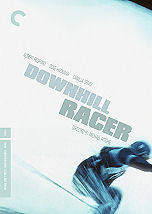
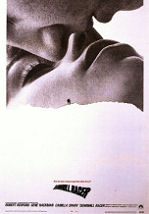
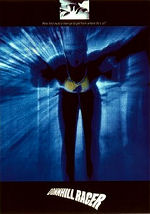
Compare the jacket art for the forthcoming Criterion DVD of Downhill Racer to the art for the two theatrical posters used during the film’s original release. The middle poster is obviously the sexiest and most sophisticated. The electric-blue one on the right is…well, okay. But the Criterion DVD jacket looks like a robot-droid skiier — like Peter Weller‘s Robocop negotiating a slope on the ice planet of Hoth.


(l. to r.) Jacket of forthcoming Criterion Downhill Racer DVD; theatrical release poster #1; alternate theatrical poster.

What was Criterion thinking? The cover makes me almost not want to buy it, and I love this film.

Calm Return

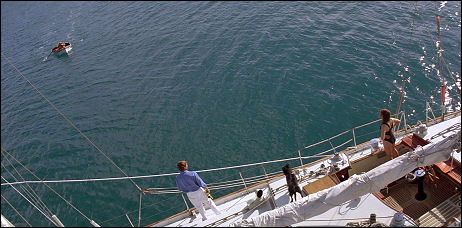
A clean and handsome-looking Blu-ray of Phillip Noyce‘s nicely sculpted Dead Calm (’89) will be out on 9.8.09. Hard to believe it’s been 20 years since I’ve seen it. A very tight and well-ordered thriller, to say the least. It’s a little bit curious to consider the way Nicole Kidman used to look. Sam Neill looked so young back then! (Who didn’t?) It’ll be nice to get a copy before I leave for the Toronto Film Festival.

Noyce, currently in post on Salt, his Angelina Jolie Russian spy movie for Sony, told me yesterday he hasn’t yet seen the Dead Calm Blu-ray.

“I spent several months on the original transfer back in 1990,which I presume was used to guide this version,” he recalled. “The original theatrical film was not presented in Dolby Digital surround, just the analogue Dolby SR. Blu-ray consumers would definitely benefit from a remastered 5.1 digial audio track, which could be included alongside the original. I’ve remastered the DVD sound for all my early Australian films in 5.1,including the mono tracks for Newsfront (’78) and Backroads (’77).”

Last Light

I’m watching the Ted Kennedy funeral procession make its way to Arlington National Cemetery, and particularly the area adjacent to JFK and Bobby Kennedy’s grave with the rough stones and the eternal flame with the biege-colored Custis-Lee Mansion atop the sloping green hill. I’m listening to MSNBC’s Chris Matthews talk about Jimmy Breslin writing that 11.25.63 interview/profile of Clifton Pollard, the guy who dug JFK’s grave. Here‘s that story.

Toronto Wifi Jail

The biggest tech headache of the year is about to take place in Toronto. There is no film festival anywhere in the world that makes people like myself suffer like the Toronto International Film Festival. Compared to Cannes and Sundance and given the generic expectation level of a major film festival, Toronto wifi is similar to the wifi in Oxford, Mississippi. Or nearly.


My iPhone was showing five bars this morning but the AT&T Communication Manager (i.e., the air card software) was saying no dice. It does this from time to time. Actually, more often. Technology lets you down all the time.

A festival without lots of plentiful free wifi all over the place is a drag — that’s all there is to it. Every journalist who attends needs to constantly file, and getting online in Toronto — or more particularly in the areas near theatres and screening rooms — has always been a pain in the neck. Wifi is obtainable, of course, but a lone-wolf journalist has to work and scheme and pay and sometimes walk blocks out of his way in order to get it.

Sundance is sometimes a tough wifi situation, but it’s workable. You can always find it here and there, and my AT&T air card works most of the time. And there’s always the option of Starbucks, wifi cafes and hotels. There’s no using the air card in Cannes because of the ridiculous expense, but there’s good wifi everywhere inside Cannes’ Grand Palais, which has two huge press salons, as well as inside the American Pavillion and in the various hotels on the Croisette. So it’s a pretty good deal in both places.

But good free air in Toronto is elusive and at a premium, and year after year festival chiefs have made no real effort to improve things. There’s only one lousy wifi room inside press headquarters at the Sutton Plaza hotel (a sea of flat screens that are always occupied with a line of people waiting to use them), except there’s no desk space for people with their own laptops to sit down and work upon, as you can do in Cannes. As far as I know the Sutton flat-screen room is pretty much it as far as festival-supplied “air” goes.

You can always go to a Starbucks (I pay them a monthly wifi fee), but Starbucks can be extremely crowded and you never know. Or you can go to a wifi cafe that sells air, but the cost of this adds up. As in France, AT&T air cards are unusable in Toronto due to absurd fees.

It would stand to reason that wifi galore would be available inside the press screening headquarters at the Bloor/Bay Manulife Center, which houses the multi-screen Cineplex Odeon Varsity plex. I’m always looking to file between screenings and there’s a cafe adjacent to the theatre concessions stand that would be perfect for this, but the Cineplex Odeon has never offered wifi, not even on a pay-as-you-go basis. They clearly don’t want people like me hanging around. It’s obviously a deliberate policy.

Festival staffers have use of private-password wifi at the Cineplex Odeon, of course, but journalists aren’t allowed to use it. Naturally! Year in and year out, and things never change. An American visitor can’t get online inside the Cineplex Odeon unless he/she has a Canadian wifi account and an air card, and who wants to spring for that?

The only way to file between Cineplex Odeon Varsity screenings is to walk down to the Starbucks on the level below, but the place is always full of non-working customers taking up tables and just lolling around, reading books and chit-chatting and whatnot. And there’s only one wall outlet if the computer battery is running low. And 80% of the time someone else is always using it for some non-journalistic purpose, or the tables around it are always filled with 20-something women who are always giggling and hanging around and sipping lattes for interminable periods.

Talk Soup

The L.A. County coroner’s ruling about Michael Jackson‘s death being called a homicide isn’t specifically worded, to my understanding. The secondary definition of second-degree murder is “a killing caused by dangerous conduct and the offender’s obvious lack of concern for human life…a middle ground between first-degree murder and voluntary manslaughter.” Dr. Conrad Murray, Jackson’s personal physician, had been thought to be suspected of manslaughter. What’s the precise difference between manslaughter and the kind of second-degree murder described above, and what will be the penalties if Murray is charged with the latter?