Zealots

Still looking for distribution, Alejandro Amenabar‘s Agora will show at the Toronto Film Festival. In my Cannes reaction, posted on 5.18, I called it “a visually ravishing, intelligently scripted historical parable about the evils of religious extremism. And I don’t mean the kind that existed in 4th century Alexandria, which is when and where this $65 million dollar epic is set. I mean the evils of the present-day Taliban and the Neocon-aligned Christian right, and the way Agora metaphorically exposes these movements for what they are.

“As Adam Curtis‘s The Power of Nightmares wisely explained, these two extremist faiths are similar in their loathing for liberalism and militant yearning to turn back the clock and to above all hold high the flag of religious purity. The 9/11 attacks kicked off their holy war against each other — a war that fortified their positions in their respective cultures during the Bush years.

“And now comes Agora, dramatizing how purist zealotry among 4th Century Christians led to the persecuting of Jew and pagans, to the sacking and burning of the great library of Alexandria, and to the murder of Hypatia (Rachel Weisz), the first widely-noted female scholar who taught philosophy, astronomy and mathematics. (Note to whiners: Noting a well documented event that happened 1600 years ago can’t be called a spoiler.)

“Amenabar’s film, an English-language Spanish production that was shot in and around Malta, seems to me like the most thoughtful and intellectually-talky big-screen epic ever made, although there’s a fair amount of strife and sword-stabbing and mob violence all through it. The intense conflicts, exacting and cultured dialogue, dashing visual energy and top-notch performances from Weisz, Max Minghella, Oscar Isaac, Rupert Evans, Ashraf Barhom, Rupert Evans and Michael Lonsdale make Agora more than gripping for its entire 141 minutes. I was surprised, really, that it moved as fast as it did.

Some are calling it too talky or insufficiently emotional, which translates into the imprecise term known as “boring.” It isn’t that, trust me, although I admit it’s hard to imagine the U.S. fans of sludge entertainment being keen to see it. You need to be keyed into what it’s saying about our world and to be rooting against the bad guys (i.e., old-time Christians) to really get into it, I suppose, although the high-quality sheen is unmistakable in every department. It’s well worth it for the CG alone.

Is it an Eloi costume epic? Does it have a muscular macho figure like Brad Pitt in Troy or Russell Crowe in Gladiator driving ther narrative and kicking ass? Does it have an intense erotic relationship as an emotional centerpiece? No — it’s a stirringly shot epic that is essentially cerebral in nature. After looking at the above trailer internet trolls have been calling it boring, stillborn, a tank waiting to happen, etc.

Numbers

On what planet could a 53% second-weekend drop be considered “solid”? This is how box-office analyst Steve Mason has described the projected Inglourious Basterds fall-off this weekend, based on yesterday’s figures.

In the old days a 25%-to-30% second-weekend fall-off was considered a decent hold, a 40% fall-off was thought to be worrisome and a 50% fall-off was a major “uh-oh.” But in today’s era in which some highly-touted films have fallen off 60% and even 70% on their second weekends, a 50% drop is now considered par for the course as in “not great but not catastrophic.” Perspective is all.

Warner Bros.’ 3D The Final Destination brought in $10.5 million yesterday, and is projected to top out Sunday night at $26.3 million. Rob Zombie and the Weinstein Co.’s Halloween 2 earned $6.9 million yesterday (#2 for the day), and is looking at $16.8 million for the weekend. Inglourious Basterds is in third place as we speak, but it’s projected to reach $17.7 million by Sunday night for a ten-day cume of $71.4 million.

I’m not at all pleased to report that Ang Lee‘s Taking Woodstock (Focus) is already dead. I’m not much of a fan, but I feel badly for Lee and producer-screenwriter James Schamus, whom I like and admire. It will pull in slightly less than $4 million by Sunday night, averaging $2800 in 1,393 situations.

Big Fan

The decent, obliging thing to do if you’ve seen Robert Siegel‘s Big Fan is to give it a pass. If you care about independent cinema and you’d like to see at least a trickle of blunt, feisty, low-budget character dramas turning up at Sundance and Toronto and Cannes for years to come, you’ll put away the things that bothered or half-bothered you and just say, “Okay, very cool! Love that pudgy Patton Oswalt angst and the whole lower-depths, lower-middle-class Staten Island loser thing…love the grayness, the bleakness and the spirit-deflating self-loathing…love the shitty story…love the whole package.”

But I can’t do that, man. Because Big Fan wound up frustrating me all to hell.

I love movies that have gotten hold of something genuine and uncomfortably realistic, as Siegel has done here with the life of a sad, pissed-off fat guy named Paul (Oswalt) who works in a parking garage and lives with his braying mom in Staten Island and who lives for New York Giants games (which he can’t afford to attend so he watches the games in the Meadowlands parking lot outside the stadium with a friend, Sal, played by Kevin Corrigan), and who especially lives for his radio time on a sports talk show in which he goes into a vigorous rap about how great the Giants are and how lowly and contemptible the competition is.

Paul and Sal are these wonderfully tasty hopeless-loser characters, and the film is all about this great downbeat, going-nowhere milieu that makes the not-far-away world of the Sopranos seem like the land of Gene Kelly and Brigadoon. Big Fan is basically a very believable thing in just about any respect you’d care to name except — I’m sorry, have I mentioned this? — the story starting in the second act. That’s when it goes off the rails.

It happens after Paul and Sal happen to spot Giants player Quantrell Bishop (Jonathan Hamm) coming out of some low-rent house in Staten Island where he was probably scoring drugs. They tail Bishop to Manhattan and then to a Scores-like club, and follow him inside. They eventually go over to his table to say hi and, like the clueless assholes they are, mention the Staten Island sighting. Which of course makes Bishop angry and defensive, which leads to his flying off the handle and pounding Paul and putting him in the hospital.

So far, so good. And the next turn — Paul so invested in Giants worship that he refuses to press charges against Bishop or sue him for damages, even though he has a solid case and could probably collect big-time, especially with Paul’s ambulance-chasing attorney brother offering to handle the case — is interesting also. But the failure of Bishop to get in touch after Paul lets him off the hook, or for anything of a vaguely positive nature to happen due to Paul’s refusal to hurt the Giants in any way, is immensely disappointing. I simply didn’t believe that Bishop wouldn’t do or say something, and I knew as the story froze and gave up the ghost that Siegel had just…I don’t know what he was doing but I knew he wasn’t doing it.

The story just runs out of gas at this point because there’s really nothing at stake and nowhere to go. It comes to an end with a bizarre incident in a Philadephia bar that felt to me like just another reiteration of loser-dom.

N.Y. Times critic Manohla Dargis has written that the point of Big Fan is that a life filled with so much generous love needs no pity. Oh, yeah? The vibe in the beginning is one of half-articulate nihilism and self-loathing plus stupdi footbal love. The second act vibe is about the same thing. The third and closing act is about half-articulate nihilsm and self-loathing mixed with depression and fanatical stubbornness. What is anyone supposed to do with this? What is the appropriate response if you’re not a film critic? Drive out to the middle of the Verrezano-Narrows bridge and jump off?

Little Bitch

“The tragedy of Tarantino is that he could have been so much more than the Schlock and Awe merchant that he has devolved into,” writes London Independent columnist Johann Hari. “If he had stopped mistaking his DVD collection for a life, he — to borrow a phrase from a real film, etched with real pain — could’ve been a contender.

“When I remember the raw force of Reservoir Dogs, I still hope that he will. It’s not too late. He could do it. How about it, Quentin? Step out into the big world beyond celluloid, and use your incredible talent to tell stories about it. As Mr. Blonde says, ‘Are you going to bark all day, little doggie — or are you going to bite?'”

I was writing post-Jackie Brown comedown pieces like back in ’98 and ’99. It’s hard to think of ’99 as ten years ago but it was. In any event, as I mentioned yesterday, I don’t have a crying need to keep the Tarantino/Inglourious Basterds hate going but Hari’s piece is well written and I like the ending and…what am I making excuses for? Because of the scolding stridency of the pro-Basterds brigade. Well, they’d better grim up and deal with reality. In a way the folks who shouted “FAIL” after Inglourious Basterds premiered at Cannes are like the French resistance. They’ve gone underground since it opened big last weekend, but they’re still holding meetings and planning stealth attacks.

Real Deal?

Is Steven Seagal: Lawman an actual A & E reality series? “The show’s real real…this is not a joke,” Seagal says in the clip. No script, no stunt double, no second chances. It’s getting to a point in which everything is suspect. Nothing is “real” and everything is in quotes. Even if several news sites are writing about it with a straight face. I trust no one. This must be a put-on…no?

“Great White Hope”

Kansas congresswoman Lynn Jenkins yesterday tried to backpedal her 8.19 remark about fellow Republicans seeking a ”great white hope” to challenge President Barack Obama in 2012. The woman was obviously caught in a Freudian slip and is a flat-out liar for saying the remark has been misunderstood or taken out of context. There’s no shortage of ugly in this country. There is in fact a bottomless well of the stuff, most of it coming these days from the white hinterlands. (I should have posted this yesterday.)

A Burnt-Out Case

“I just watched Guillermo Arriaga‘s The Burning Plain with Charlize Theron and Kim Basinger on VOD last night,” entertainment journalist Lewis Beale wrote this morning. “I was surprised it had suddenly popped up on my local cable system, so I went to the IMDB and found it had gone the festival route (Venice, Toronto, Seattle), and that the official TV premiere release date was 8.21.09.

“Okay, it’s not that great a film. Another one of those circuitous, three-stories-that-come-together-eventually plotlines that Arriaga seems obsessed with, except in this case a linear approach would definitely have been more effective. But sheesh…a film with two female Oscar winners doesn’t even get to play the IFC Center or whatever? What happened here? Any interest in looking into this?”

The Burning Plain has a theatrical opening set for 9.18. It says so on the official website and on the IMDB.

But I didn’t have to “look into it.” I saw The Burning Plain at last year’s Toronto Film Festival, and it was clear to everyone that while it was a mildly intriguing heavy-cat drama in some respects (Theron’s promiscuous restaurant hostess tries and fails to suppress teenaged traumatic memories of having unwittingly caused her mother’s death), it just wasn’t laser-beamed or emotionally affecting enough to warrant impassioned reviews or any kind of limited-hang-out awards campaign.

There’s something a little too schematic and bluntly telegraphed about Theron’s past coming back and insisting that she face up to things. We know where stories of this sort are going and that it’s all going to come out in the wash, and so a half-hour into it you’re muttering to yourself, “Okay, all right, what else can you show me?” But there’s nothing else. The story is the story. And you have to ride it out.

Plus there’s a sense in watching it that the spaghetti-narrative trick that Arriaga used with collaborator Alejandro Gonzalez-Inarritu in Amores perros, 21 Grams and Babel has been overworked and is maybe running out of steam. The Burning Plain performances (particularly by Theron, Kim Basinger and Joaquim de Almeida) are very good, and I don’t see any way to fault it craft-wise but there’s not just enough oomph and pizazz to make it a must-see drama.

In short The Burning Plain — a not-bad, half-decent film in some ways — fell between the cracks esteem-wise, and so the Magnolia guys took a hard look, got out the calculator and figured it would make sense to do a VOD and a limited theatrical thing around the same period. (Some kind of limited theatrical opening is set for 9.18.09.) I wish I could have felt more positively about it. It’s far from wretched; it works in some respects. Everyone involved was clearly trying to make something solid and truthful and earnest.

Men Who Broaden Goats

Bizarre as it may seem, the comic material in Grant Heslov‘s The Men Who Stare at Goats (Overture, 11.6) is based on reported truth, or more precisely Jon Ronson‘s 2004 non-fiction book about the U.S. Army’s exploration of New Age concepts and the potential military applications of the paranormal. Does the trailer convey a verite element? You tell me.

Trailers always rely on the crudest and broadest selling points, of course, but this one is clearly suggesting that the tone of Heslov’s film may be on the unsubtle and slapsticky side, almost in a Blake Edwardsy sense. Okay, in a sort-of dry and deadpanny vein. The straight-up, no-funny-business look on George Clooney‘s lean and moustachioed face tells you that.

But what about that shot of an animatronic goat tipping over and falling on its side? That’s an Eloi joke on the level of I Love You, Beth Cooper. And the fact that the Kevin Spacey-Jeff Bridges courtroom confrontation about girls and drugs isn’t funny? And that guy running into a wall? And while I’m sure there’s a no-big-deal explanation, why are formally uniformed Army guys shown wearing long sideburns and facial hair in a wedding reception ceremony? This sets off an alarm bell.

All I can tell you is that before watching the trailer, I was semi-pumped about seeing this film in Toronto. I had presumed Heslov, a very smart guy on Clooney’s wavelength and vice versa, would play down the inherently bizarre material and keep it real and let the wackazoid stuff speak for itself. But now, having seen the trailer, I’m feeling a little bit worried. Okay, maybe I shouldn’t be. Maybe this is just a matter of the Overture trailer guys looking to bring in the dumb-asses.

Heslov directed from a script by Peter Straughan. Ewan McGregor costars with Clooney, Spacey and Bridges. Set in Iraq (but filmed in New Mexico and Puerto Rico), it’s about Bob Wilton (McGregor), a reporter working on a story about Lyn Cassady (Clooney), who claims to be a former secret U.S. Military psychic soldier re-activated post-9/11. Bridges is Bill Django, the founder of the psychic soldier program and Lyn’s mentor. Spacey is Larry Hooper, a former psychic soldier who runs a prison camp in Iraq.

Lays It Out

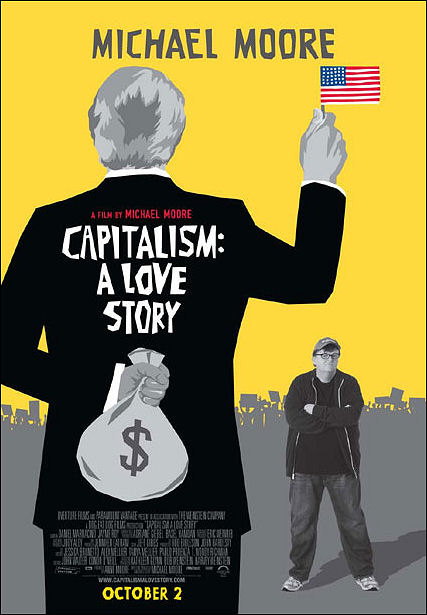
I found this official release poster for Capitalism: A Love Story on In Contention. And then I read some of the comments. Every In Contention reader who says the one-sheet is cool but they need to remove Moore is dealing from a short deck. One, Moore is always the star of his films. His mentality/attitude/snark is the point. He’s the roly-poly Gary Cooper figure ready to stand up to City Hall and/or the Frank Miller gang. And two, he’s depicted as a small-scaled monochrome figure, which suggests a contained ego.

Mucking About

“In Inglourious Basterds, Quentin Tarantino has gone past his usual practice of decorating his movies with homages to others,” writes New Yorker critic David Denby. “This time, he has pulled the film-archive door shut behind him — there’s hardly a flash of light indicating that the world exists outside the cinema except as the basis of a nutbrain fable. The film is skillfully made, but it’s too silly to be enjoyed, even as a joke.

embarrassment: his virtuosity as a maker of images has been overwhelmed by his inanity as an idiot de la cinematheque. Basterds is a hundred and fifty-two minutes long, but Tarantino’s fans will wait for the director’s cut, which no doubt shows Shirley Temple arriving at Treblinka with the Glenn Miller band and performing a special rendition of ‘Baby Take a Bow,’ from the immortal 1934 movie of the same name, before she fetchingly leads the S.S. guards to the gas chamber.”

Piven Off Sushi Hook

Jeremy Piven‘s Speed-The-Plow/sushi defense debacle — a p.r. embarassment that will color Piven’s reputation for the rest of his life — has come to an official end. No more legal threats or fines or procedural hassles…done.

Variety‘s Gordon Cox reported this afternoon that independent arbitrator George Nicolau has found that the actor did not breach his employment contract with producers of Speed-the-Plow, the Broadway revival Piven that abruptly abandoned last December, blaming sushi poisoning.

Let me explain something. No one has ever believed and no one will ever believe Piven’s mercury-poisoning excuse for leaving that show. (It’s never been a secret about high mercury levels in raw fish, so what kind of moron consumes huge amounts of sushi and sashimi on a daily basis without understanding there will be a physical reaction?) Just as Robert Mitchum was never able to fully escape memories of the pot bust that landed him in jail in 1947, Piven will be regarded as Hollywood’s ruling sushi bullshit artist for the rest of his days.

Nicolau also exonerated Piven for having breached the collective bargaining contract between thesps’ union Actors’ Equity Association and the Broadway League, the trade association of legit producers and presenters. “While we respect the decision, we strongly disagree with it,” the Plow producers said in a statement.