The Tread on Borat’s Tires

Laugh-out-loud amusing and “outrageous” as it sometimes is, Sacha Baron Cohen‘s Bruno (Universal, 7.10) — oddly — isn’t all that funny. Certainly not in a convulsive sense. It is sort of heh-heh funny in a dry, observational, “is that all there is?” sense… but what’s that? It’s basically a series of misanthropic “screw you” jokes — 82 minutes worth of effete put-on gags, each one meant to provoke homophobic reactions to SBC’s flamboyantly gay, blonde-coiffed Austrian fashion reporter. The point being to “get” the constipated illiberal, small-minded types by making them look bad.
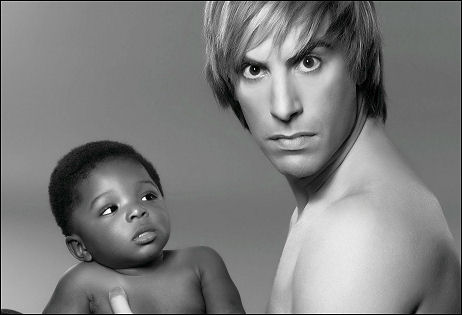
All I can say is that clips and promotions and put-ons are one thing, but when you sit down for a movie you expect a certain build-up of dramatic and emotional elements — you need to see characters and story threads start to take shape and transform and “pay off” in some way. Bruno never even tries to get off the ground in this sense.

Neither did Borat, I realize, but this time the lack of undertow felt like more of an issue. I said to myself about 20 minutes in, “Wow…this isn’t happening.” I said the same thing at the 40-minute mark. Although Bruno has loads of great bits and goofs and snide attitude to spread around. Let no one say it doesn’t score from time to time.

The problem for me is that (a) the tread has worn down on the tires since Borat — a comedy of this kind just doesn’t feel as out-there brash as it did three years ago, in part because it’s harder to believe that the encounters in the film aren’t staged or performed by the victims, (b) the humor is more than a bit cruel and misanthropic at times, and (c) SBC’s Bruno character simply doesn’t work as well as the revolutionary Borat.

Borat was funnier because it was at least faintly conceivable that a dorky moustachioed TV correspondent from a small Kazakhstan backwater could be that culturally clueless. But Bruno is no idiot — he’s from Vienna, knows the fashion world, knows the rules of the game. The joke is supposed to be that he’s so blinded by ego, arrogance, ambition and random sexual arousal that he doesn’t realize how offensive and irritating he is to everyone he meets. And that’s just not buyable.

So what we’re left with is just watching SBC doing his best to put people on and make them squirm as best he can. I’m obviously gay, you’re perhaps a little uncomfortable with gay men, and so I’m going to up the ante more and more until that discomfort tips into some form of hostility (usually suppressed). Over and over and over. Because I’m convinced that you’re a yahoo of some kind, and the point of this film is to expose you as same and too bad if you don’t like it, Ugly American.

For me the best Bruno material has already been seen in the trailers and clip reels. The marketing campaign has been amazing. There’s certainly nothing in the film as good as SBC dropping into Eminem‘s lap on the MTV Award show. Or his recent Tonight Show appearance with Conan. All right, the Arkansas wrestling match sequence comes close, although (again) it’s not really all that hah-hah funny.

My favorite Bruno moment comes when Harrison Ford is confronted by a microphone-wielding SBC and barks a harsh “fuck off!” as he gets into a car. Why did I savor this in particular? Because it’s the only time that a victim expresses more hostility towards SBC than what he/she is getting from SBC to begin with. In short, Ford trumps. He’s saying in effect, “I don’t want to hear it, just go away, you’re not worth it, don’t even start…I’m ahead of you!”

I also liked a visual gag that I’m not going to spoil (although Variety‘s Todd McCarthy already has in his review) that involves a certain part of the male anatomy talking and gyrating.

Who was the first Bruno? Andreas Voutsinas, the thin, devil-bearded gay guy in Mel Brooks‘ original film of The Producers (’68). His character’s name was Carmen Ghia. He was living with Christopher Hewett‘s Roger De Bris (the guy Gene Wilder was referring to when he said “Max, he’s wearing a dress!”), and his first Bruno bit was when he, Wilder and Zero Mostel take a brief elevator ride together and he does a kind of suppressed-erotic-writhing routine.

I agree with McCarthy that the “gotcha!” sequence in which SBC pretends to come on to Ron Paul, who ran in last year’s Republican primaries (and whom my son Dylan was for until he switched to Obama), is “noxious.” When Paul realizes what’s going on he freaks and shows his true homophobic colors, but it didn’t feel fair or right.

I don’t want to sound overly negative here. I did laugh several times during Bruno. I came out in a relatively okay mood, wasn’t pissed off. But a feeling that it didn’t really make it began to grow in the days that followed. I tried writing about it yesterday but the review wouldn’t come, probably because I was torn between admitting to myself that I laughed and chortled at times and also realizing that the film has hostility and believability problems.

Remember that moment in Mad Dog and Glory when Robert DeNiro‘s cop character tells Bill Murray‘s mafioso character (who does a little stand-up) that jokes don’t work as well when they’re “aimed out” and that people tend to laugh more when they’re “aimed a little more in” — i.e., at the teller?
Parking Garage

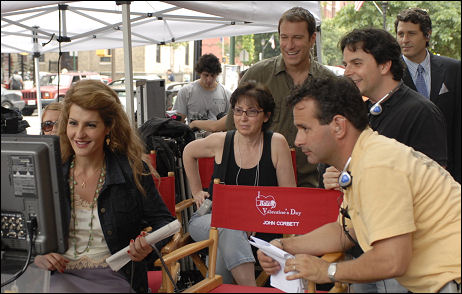
“Is it a sign of impending apocalypse that two terrible Nia Vardalos movies have been released in one month?” asks critic Marshall Fine. “It seemed unlikely that Vardalos could star in a movie flatter or more desultory than My Life in Ruins. But she’s outdone herself with I Hate Valentine’s Day (IFC, 7.3), which she wrote and directed and stars in.


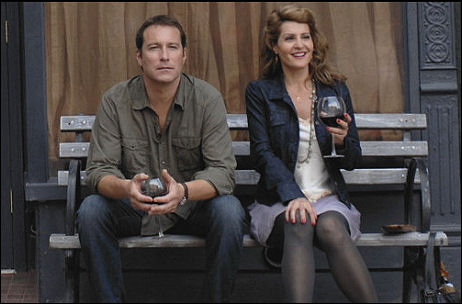
John Corett, Nia Vardalos in I Hate Valentine’s Day

“For good luck, apparently, she cast John Corbett – her love interest in My Big Fat Greek Wedding, – as the male lead. But she could have cast anyone from Brad Pitt to a fencepost and it wouldn’t have made a difference. The writing is that flavorless, the directing that inept.

“Vardalos doesn’t write dialogue; she writes shtick. Riffs on why she hates antiques, riffs on why relationships suck, riffs on — well, really, the whole thing is one long riff, with few laughs and an inevitable destination. As a director, Vardalos is too in love with her own genius. There isn’t a scene that isn’t overlong, mostly because she inserts pauses between each line of dialogue so lengthy you could park a car.

“If you snipped three-to-five seconds from every shot in the film (and, believe me, you could), the movie would barely reach feature length. Better yet, snip away everything after the opening credits and save everyone a lot of time and expense.”

Oh, Come On

A friend wrote last night that “there’s a rumor starting that Eddie Murphy wants to play Michael Jackson in a biopic.” Patently absurd on more levels than I’d care to list, I wrote back. He’s too old, for one thing. He doesn’t remotely resemble Jackson. His voice is all wrong. He isn’t willowy or feathery or girly enough. “I don’t even know why I’m pointing this stuff out because it’s one of the silliest casting ideas I’ve heard in ages,” I concluded.

There’s a film, obviously, in Jackson’s story. But it would have to be called The Damned or, if the producers want to sound less judgmental, How To Ruin Your Life. And they’d need to cast someone who would look exactly like him and could obviously play him to a T. Someone young, androgynous, unknown. Wait…it just hit me. They should do a Cate Blanchett in I’m Not There and cast a young African-American woman. I’m serious.

Does the idea of re-using the title of of Luchino Visconti‘s 1969 classic seem harsh to anyone? Think again. But first re-read all the articles that Maureen Orth wrote about Jackson for Vanity Fair, particularly an April 2003 piece called “Losing His Grip” and a March 2004 followup called “Neverland’s Lost Boys.”

Fake HD

MSNBC switched over to high-def today, although it won’t show up on all the cable systems until early August. It kicked in with my provider, Century Cable, three days ago. So I tuned in this afternoon — channel 723 instead of the regular analog channel 23 — to see how good it looked, and it looked like hell. All pixellated and degraded — basically an analog image with a 16 x 9 aspect ratio. I know what the real thing looks like. This is crap.

Other Side of the Canyon

Variety‘s Anne Thompson has a decidedly negative view of Michael Mann‘s decision to “immerse the audience” in the 1930s by shooting Public Enemies in high-definition video. “HD is clear, harsh, honest” she notes. “It works fine in a contemporary setting like Collateral or Miami Vice. But when audiences watch a period film, no matter how authentically recreated, they aren’t expecting it to look like this.”

On 6.24 I posted the same initial reaction — this is different! not my father’s 1930s! — except I found it exciting and audacious. “Public Enemies is out there with a radical use of razor-sharp, high-def digital widescreen photography that totally says ‘not the early 1930s!’ and ’55-inch LCD screens at Best Buy!’ But at the same time it says ‘actually, this is the real early 1930s without the rat-a-tat-tat Pennies From Heaven squawkbox atmosphere and embroidery and Jimmy Cagney-Paul Muni personalities that you’ve been conditioned to expect.”

Last of Heath

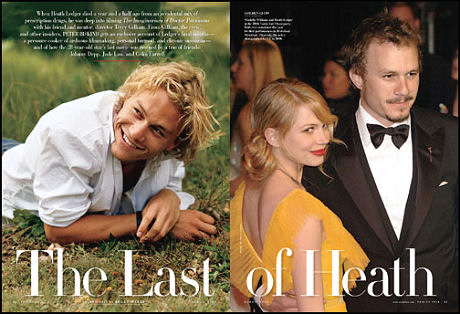
Heath Ledger “was always hesitant to be in a summer blockbuster with the dolls and action figures and everything else that comes with one of those movies,” the late actor’s friend and agent, Steven Alexander, tells Peter Biskind in an upcoming Vanity Fair. “He was afraid it would define him and limit his choices.”

Alexander and other confidantes tell Biskind that “one of the reasons Ledger agreed to do The Dark Knight was that it would be such a long shoot it would give him an excuse to turn down other offers. Ledger had a pay-or-play deal on The Dark Knight — meaning he’d get compensated no matter what — so he felt he had the freedom to do whatever he wanted as the Joker.”

He hoped in fact, that “his performance would be so far-out he’d be fired, and thus become the beneficiary of a lengthy, paid vacation.”

Which is why his Joker performance was so great. Because Ledger didn’t care. The best creative work always….okay, often comes out of a fuck-it mindset. Worry about what you’re going to create or whether or not you’ll be good enough and you’re dead.

No Despair

Not every day can be well organized and super-productive. I was going to bang out my Bruno review (the green light is up) but it wouldn’t happen. When the plane doesn’t lift off the ground and it’s suddenly 4:30 pm when it was only noon an hour earlier, you just have to suck it in and try to do better the next day. And now I have to catch a 6 pm screening of Nia VardalosI Hate Valentine’s Day. And my early-bird DVD seller still doesn’t have Lonely Are The Brave, which streets on 7.7.

Mess

There’s just no end to the ick factor in the Michael Jackson tragedy. Everything that’s being reported sounds sordid and sad. Or it’s been made up. The Sun posted a story today about the late pop singer’s ghastly physical state — appalling — and then TMZ reported that the story is fake. And 95% of the world is repeating the same mantra — “Ignore the facts, deny the damage, ignore what Michael Jackson became — just listen to the music and focus only on his peak-of-popularity years in the ’80s and early ’90s.”

I found it moderately unpleasant to watch Al SharptonAl Sharpton? — and Joe Jackson hold a news conference this morning about delayed funeral arrangements for Michael, matters of executorship and custody of the kids, etc. Because there was no shaking off the feeling that these guys are basically hustlers looking to self-promote, revive the MJ brand, get their cut, bask in media attention, spread around the b.s. and blah-blah.

And on top of all this Universal has decided to cut the 100% non-offensive LaToya Jackson scene out of Bruno altogether.

Split Decision

Denby Delighted: “Michael Mann’s Public Enemies is a ravishing dream of violent gangster life in the thirties — not a tough, funny, and, finally, tragic dream like Bonnie and Clyde but a flowing, velvety fantasia of the crime wave that mesmerized the nation early in the decade.

“The scowling men in long dark coats and hats, led by the fashion-plate bandit John Dillinger (Johnny Depp), march into a grand Midwestern bank with marble floors and brass railings, take over the place, throw the cash in bags, and make their getaway, jumping onto the sideboards of flat-topped black Fords — beautiful cars with curved grilles and rounded headlights that stand straight up from the cars’ bodies.

“It’s the American poetry of crime. Throughout the movie, blazing tommy guns emit little spearheads of flame, just as in a comic book. Men get their skulls bashed with gun butts, and get thrown out of cars, but, despite all the violence, the movie is aesthetically shaped and slightly distanced by the pictorial verve of gangland effrontery — the public aggression that Mann makes inseparable from high style. He keeps the camera moving, and the editing (by Paul Rubell and Jeffrey Ford) reinforces the speed without jamming ragged fragments together in the manner of hack filmmaking. As a piece of direction, Public Enemies is often breathtakingly fast, but it’s always lucid.”

Denby Troubled: “[The film] needed a charge of surprise, and I wish the filmmakers had more forcefully developed two ironies embedded in the material. For all of Hoover and Purvis’s talk of ‘scientific methods,’ the new F.B.I. wins the war not by arresting criminals and sending them to prison but by massacring them.

“And Dillinger, as the movie readily shows, is deluded about himself. He embraces the future, but, actually, his time is over; the new crime syndicates dismiss him as a troublemaking fool. And although the screenplay keeps insisting that he’s intelligent and shrewd, the movie demonstrates the opposite. The character doesn’t quite add up. If he had been given a wild destructive streak, the conception might have made more sense, but Mann seems to trip over his own story by making Dillinger so self-contained and cool. The problem with casting a star as low-key and attractive as Johnny Depp is that you can’t turn him into a man who is, at bottom, a loser.”

Eternal Cage

In recognition of Bernie Madoff having been sentenced to 150 years behind bars, here’s a re-link to that 3.14.09 piece about how I would have escaped and cavorted it if I’d been in Bernie’s shoes. Excerpt: “I’d hire three full-time prostitutes to travel with me, but they’d have to be prostitutes who know how to sail.”

Why didn’t Madoff get 500 years? Or a thousand? I’ve always loved the poetic ring of 20,000 Years in Sing Sing, which is the title of a 1932 Michael Curtiz crime-prison drama with Spencer Tracy and Bette Davis. It comes from author Lewis E. Lawes‘s 1932 novel.

“Been To The Gym?”

I may as well join the crowd and post this HD trailer for Ricky Gervais and Matthew Robinson‘s The Invention of Lying (Warner Bros., 9.25). Trailers always seem to misrepresent what a film actually is (i.e., how it plays) so you always need to take them with a grain. But the basic impression I’m getting is that TIOL may be a little too on-the-nose — an explicit comic thesis going through the movie motions. But maybe not.

Mann’s Women & Mortality Itself

Responding to my recent praise for Michael Mann‘s Public Enemies, legendary film critic F.X. Feeney shared some thoughts earlier this evening, focusing especially on Mann’s history of writing strong and defiant female characters.

“I’m so glad we agree about Public Enemies,” he began. “I think it’s a beautiful confluence of everything I ever loved about Last of the Mohicans and Heat — especially in its sense of America as a still-embattled frontier where men and women continuously invent and re-invent themselves, and protagonists (whether they live within the law or without it) who are defined by their refusals to conform.

“This is one reason I take exception to Mark Harris‘s view that Mann short-shrifts his female characters. Gong Li in Miami Vice goes her own way, at huge risk. So do Madeline Stowe‘s Cora in Mohicans, Ashley Judd in Heat, the angry women played by Diane Venora in Heat and The Insider, Tuesday Weld in Thief.

“Everywhere you look in Mann’s work (The Keep, Manhunter) women are all deeply observed, self-reliant and fully dimensional..

“I will admit La Cotillard takes the coupe du monde in their honors, but then she is not only great in herself but that magnificent hall-of-mirrors moment when Dillinger contemplates her angelic double, Myrna Loy, in Manhattan Melodrama. It seems to me that here, Mann grandly contradicts the old saw that men’s ‘immortal dreams of women’ are ‘unattainable.’ From where Dillinger sits, that dream has been attained quite fully, thank-you-very-much. A ticklish mystery, this.

“I love, too, that Public Enemies dramatizes the great line from Miami Vice — ‘time is luck’ — without having to state it aloud. Mann is contemplating mortality in this movie, more directly and philosophically than ever before — and doing so in the Ernest Hemingway sense of action as a philosophy.

“This is a soulful film that calls no attention to its soulfulness, trusting us to tune in.”

Feeney added the following early this morning:

“I offer what follows with a word of caution to your readers that they really should see Public Enemies before they read too much more about it. Although I’m careful to avoid blatant spoilers here, everybody should have the great pleasure of seeing this unique movie for the first time by their own lights.

“Rereading what I wrote about Dillinger watching Myrna Loy (who bears such a pleasing resemblance to Marion Cotillard’s Billie Frechette), I don’t feel I did this scene or my feelings about it justice.

“The moment is extremely moving in context, as a development in Dillinger’s psyche — he’s not a very reflective guy, but in this moment (courtesy of Mann’s fine filmmaking and Johnny Depp’s translucent acting) we’re given a privileged glimpse as he takes stock of his life.

“That JD has been loved and tasted goodness is something we know well, courtesy of Cotillard. That he’s able to see and appreciate this, as if he were a disembodied spirit regarding his own life with the clarity and compassion of a stranger, is a gift that comes to him courtesy of — wouldn’t you know it — the movies.

“I don’t think there’s another instance in Mann’s work where he’s ever so directly regarded ‘movies’ as a factor in our lives and culture. Celebrity (Ali), yes. Crusading jounalism (The Insider), absolutely. Mann has always been sensitive to the ways people project their personalities in any public arena, but he’s tended to leave ‘movies’ out of the equation.

“Indeed, you could argue that his films are ‘anti-movies’ in the sense that he is relentless about drawing from life, and not the work of other filmmakers. Yet here is a rare moment in which the silver screen is shown to reconcile a man to the chaos of his life.

“This is what I mean when I characterize Public Enemies as a meditation on mortality. It strikes me that Mann is casting a conscious, wondering eye at this art form where he’s spent so much of his own life, and its impact upon souls.”

Reaction: In Contention‘s Kris Tapley respectfully disagrees with some of what Feeney has to say.