In an article about Public Enemies (Universal, 7.1) by the San Francisco Chronicle‘s Ruthe Stein, director Michael Mann says that while gangster John Dillinger (Johnny Depp) and his gang “could plan robberies in a very meticulous fashion, they couldn’t plan next month. They had no concept of the probability that if they kept robbing banks, eventually they would get caught.
“‘They had no plan for the future,’ Mann tells her. ‘They were living for the moment…there was a “disconnect between cause and effect. If you trusted the wrong person and got shot, it wasn’t because of an error of judgment. It just happened.”
“The expressions ‘a bullet with your name on it’ and ‘when your time is up’ were popular in the 1930s,” Stein notes, “and reflect a sense of things being out of your control.”
Never, it seems, in the history of ill-gotten gains has a criminal ever realized that they’re in it for the short haul, and if they were smart they’d sock their loot away in Central America or Bern or the Cayman Islands and carefully plan for the moment when they’d pack their bags and go on the lam. Tony Soprano never got this and look what happened.
I ran into this “manif” (i.e., a political parade) just after emerging from the Olympia plex on rue d’Antibes where I’d just seen Angela Ismailos‘ Great Directors — a concise and well-shot personal tribute doc about Bernardo Bertolucci, Agnes Varda, Stephen Frears, Todd Haynes, David Lynch, Catherine Breillat, Richard Linklater, Ken Loach and John Sayles. It’s a warm reassuring bath of a film, but it’s also about Ismailos’ golden blonde hair — a steady presence from start to finish.
During a Lincoln Center/N.Y. Film festival discussion a little more than eight years ago, director Oliver Stone complained about conservative corporate thinking blocking the films he wanted to make. “Michael Eisner decides I can’t make a movie about Martin Luther King, Jr [because] they’ll be rioting at the gates of Disneyland!,” he said. “That’s bullshit! But that’s what the new world order is.”
That was then and this is now, but I’d much rather see a King movie that Stone might direct rather than a just-announced DreamWorks version that Steven Spielberg, Suzanne de Passe and Madison Jones in league with DreamWorks chief Stacey Snider. A voice is telling me it’ll be far too reverent. A voice is telling me it’ll begin with King’s murder at the Lorraine Motel and then flashback to King’s childhood years. A voice is telling me that with the King family involved DreamWorks will never touch King’s numerous assignations.
I recall reading that a King biopic script was written for Stone sometime in the late ’90s, perhaps by Stephen J. Rivele or Stanley Weiser or somebody like that. I’d spend time tracking it down but I have a 2 pm screening to catch. Later…
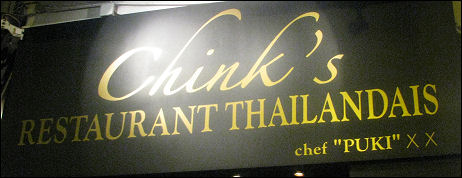
I’m sorry but this startled me. Imagine the reaction in any decent-sized American (or British) city if the owner of a new Thai food restaurant had the same idea for a name. Or, for that matter, if the owner of new Italian place called itself…forget it. It’s just odd.
The American Pavillion is too American — a kind of Club Med haven in the middle of the Cannes Film Festival. The European journalists who hang in the Orange wifi cafe are smart worldly types who speak quietly and do their work. Then you visit the American Pavillion and suddenly you’re in a 90210 realm with kids (i.e., Ampav volunteers) who sound like they grew up in a mall, constantly babbling and laughing at each other’s jokes and going, “Oh, totally…yeah!”
Taking Woodstock writer/producer James Schamus remarked last weekend that it was difficult casting young people today who looked like those in Michael Wadleigh‘s 1970 documentary about the festival. “When you think about it, a generation of people who weren’t fat, who weren’t staring at themselves in the mirror all the time, and not shaving everything off down there, it captures the difference of 40 years right there,” he said. What’s so terrible about airstrips?
Beginning of 11 am press conference for Pedro Almodovar‘s Broken Embraces, which screened this morning at 8:30. A romantic noir about writing, directing, damage and healing, it’s easily the most fully realized, thematically satisfying, self-assured and purely entertaining film of the festival so far. Not as fully emotional as Almodovar’s best films, but on a very high station in the second tier. Way in front of anything I’ve seen so far. The only thing that could knock it off is the Tarantino.
Indiewire’s Eugene Hernandez moderated a panel discussion late this afternoon at the American Pavillion called “It’s a Mad New Media World.” The topic, as you might imagine, was the whole internet journalism-slash-dying old journalism magilla. It went on for a little over an hour, and I’ve got the whole thing recorded right here. There’s no identifying the voices but the two video clips coalesce in certain sections.
The panelists were James Rocchi (MSN Movies and AMCtv.com — glasses, pork-pie hat), The Wrap editor Sharon Waxman (short blond hair), L.A. Times industry reporter John Horn (follically challenged, strong jawline), Variety columnist Anne Thompson (glasses, short brown hair), and Spoutblog’s Karina Longworth (glasses, medium-length black hair).
I’d take a stab at summing up the highlights but it’s 10:50 pm and I’m about to get kicked out of the Orange wifi cafe so that’s all she wrote until I get home later tonight. The first clip contains sum-up remarks everyone was asked to give at the very end about how things will shape up over the next two or three years. The second clip contains some sharp debate here and there.
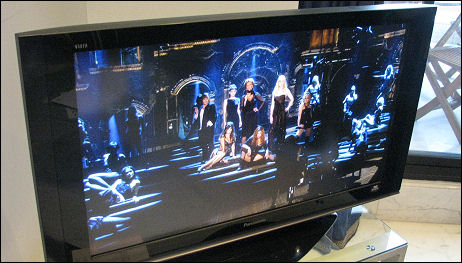
The Weinstein Co. invited a few journalists up to Gray Albion Hotel rooftop suite early this evening to watch a rehearsal reel from Rob Marshall‘s Nine (Weinstein Co., 11.25) as well as the recently released trailer. If you’ve seen the latter you know it’s got that old Rob Marshall/Chicago schwing blended with a jaded erotic male menopause Euro-vibe. It’s a pretty safe bet. People eat this shit up. Even I’m willing to.
The idea is lure the viewer into a moody adult fantasia trip about Italian film director Guido Contini (Daniel Day Lewis) who’s in creative trouble as he prepares a film called Italia. Blocked, midlife crisis, who am I?, great to be rich, love my car, cruising the Italian coast, sensual delights at every turn, I’ll find my way, etc.
The other idea, of course, is to make Nine into an Oscar-competing superhit which will make enough dough to restore the Weinstein Co. to firmer financial footing than it has known over the last three or four years. It’s Harvey Weinstein’s ticket back to the bigtime. By all appearances and indications it looks like a hummer.
Obviously shot with the required sultry attractiveness by Dion Beebe and based, of course, on Arthur Kopit and Maury Yeston’s 1982 Broadway musical, Nine is essentially based (as the play was) on Federico Fellini‘s 8 1/2 (’63).
Call it “Daniel Day looking for inspiration and spending a lot of time with several alluring women” — his wife Luisa (Marion Cotillard) mistress Carla (Penelope Cruz), a muse (Nicole Kidman), a pal and confidante (Judi Dench), his mother (Sophia Loren), a journalist (Kate Hudson) and a prostitute named Saraghina (Stacy Ferguson).
I loved that the rehearsal reel contains some black-and-white footage, which of course harkens back to the Fellini film. The film was shot in London and various Italian locales, including Rome.
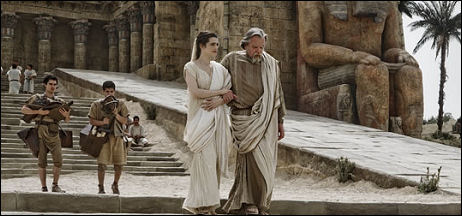
Alejandro Amenabar‘s Agora, which I caught late yesterday morning, is a visually ravishing, intelligently scripted historical parable about the evils of religious extremism. And I don’t mean the kind that existed in 4th century Alexandria, which is when and where this $65 million dollar epic is set. I mean the evils of the present-day Taliban and the Neocon-aligned Christian right, and the way Agora metaphorically exposes these movements for what they are.
As Adam Curtis‘s The Power of Nightmares sagely explained, these two extremist faiths are similar in their loathing for liberalism and militant yearning to turn back the clock and to above all hold high the flag of religious purity. The 9/11 attacks kicked off their holy war against each other — a war that fortified their positions in their respective cultures during the Bush years.
And now comes Agora, dramatizing how purist zealotry among 4th Century Christians led to the persecuting of Jew and pagans, to the sacking and burning of the great library of Alexandria, and to the murder of Hypatia (Rachel Weisz), the first widely-noted female scholar who taught philosophy, astronomy and mathematics. (Note to whiners: Noting a well documented event that happened 1600 years ago can’t be called a spoiler.)
Amenabar’s film, an English-language Spanish production that was shot in and around Malta, seems to me like the most thoughtful and intellectually-talky big-screen epic ever made, although there’s a fair amount of strife and sword-stabbing and mob violence all through it. The intense conflicts, exacting and cultured dialogue, dashing visual energy and top-notch performances from Weisz, Max Minghella, Oscar Isaac, Rupert Evans, Ashraf Barhom, Rupert Evans and Michael Lonsdale make Agora more than gripping for its entire 141 minutes. I was surprised, really, that it moved as fast as it did.
Some are calling it too talky or insufficiently emotional, whcih translates into the imprecise term known as “boring.” It isn’t that, trust me, although I admit it’s hard to imagine the U.S. fans of sludge entertainment being keen to see it. You need to be keyed into what it’s saying about our world and to be rooting against the bad guys (i.e., old-time Christians) to really get into it, I suppose, although the high-quality sheen is unmistakable in every department. It’s well worth it for the CG alone.