Hard Life

Nobody invited me to see The Mysteries of Pittsburgh (Peach Arch, opening today in NY and LA). I’ve asked the film’s p.r. reps if I can get a screener from them so I can sit in a Starbucks somewhere in Manhattan and watch it on my computer. If that doesn’t work I guess I’ll actually pay to see it this afternoon. Because I know Peter Sarsgaard’s performance will be engaging (because he always is), and because I’ve always wanted to see it (despite the buzz) as a way of paying tribute to Sienna Miller‘s ballsiness is calling Pittsburgh “shitsburgh.” She earned my lifelong respect with that one quote. On top of which Pittsburgh deserves the sobriquet — I’ve been there.

Of course, I had a sense from the get-go that The Mysteries of Pittsburgh might be a problem movie. I suspected this when I saw that the director’s name was Rawson Marshall Thurber. That’s one too many names, man. That’s the name of a guy with ego issues or family issues or something. It sounds southern, literary, to-the-manor-born and pretentious as hell. I remember Francis Coppola announcing back in the early ’80s that he was officially dropping “Ford” as his middle name because he knew it sounded too high falutin’ and obnoxious.

Entertainment Weekly‘s Owen Gleiberman gave it a D, which is exceptional given EW’s tendency to grade on a curve. “The paradox of a truly atrocious literary adaptation,” he wrote, “is that everything on screen — a crummy postcollegiate job, a love triangle, even a ?burglary — must be embedded with little wisps of higher ”meaning,” and therefore ends up meaning nothing at all.

“In The Mysteries of Pittsburgh, a stillborn rendering of Michael Chabon’s first novel, Jon Foster plays Art Bechstein, the son of a Jewish gangster (Nick Nolte), but he comes off as the dullest of WASP preppies. His fascination with a young couple — heartfelt Jane (Miller) and her pretentious, chopper-riding, bisexual boyfriend Cleveland (Sarsgaard) — “plays like Gossip Girl written by a bad F. Scott Fitzgerald imitator.”
No Guts, No Glory

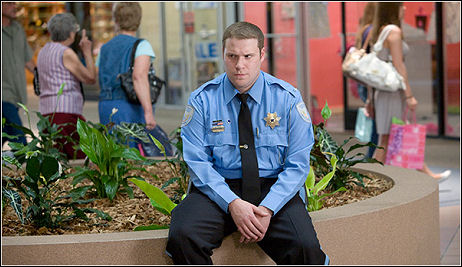
“If you thought Abu Ghraib was a laugh riot then you might love Observe and Report, a potentially brilliant conceptual comedy that fizzles because its writer and director, Jody Hill, doesn’t have the guts to go with his spleen.” — from Manohla Dargis‘s 4.10 N.Y. Times review.

Observe and Report might have been an interesting film if Hill had committed to the dark side and stayed there, but he wants it both ways: to get laughs for being mean and to shake it off and say, ‘No, I was just being goofy and playful.’ But Ronnie isn’t a playful construct; he’d be fascinating if there was consistency to him, if Hill had the depth or the guts to stick with the vision he initially creates. But Observe and Report wants it both ways and ends up with neither.” — from Marshall Fine‘s 4.10.09 review on Hollywood & Fine.

“Hill is a copout compromiser who lacks the courage of his interests and instincts. He’s made a semi-dark nerd-psychopath comedy and (just to be safe) a moronic, logic-free, dumb-ass Paul Blart comedy with an infuriating finale. Particularly for a film that is supposedly delving into the dark side and dealing with human derangement with at least a semblance of bluntness. — from my own 4.7.09 review, called “Citizen’s Arrest.”

The finale “ends on a note of triumph that’s curiously out of keeping with the movie’s own logic. All along we’ve been watching Ronnie slowly hoist himself on the petard of his own unchecked aggression. For there to be even a hint of redemption throws everything that came before into question, and breaks an unwritten contract with the viewer. What’s meant (I think) to be a ‘fuck you’ to action-movie conventions reads instead as a ‘fuck you’ to the audience. Observe and Report tickets should come with a free breath mint, because however hard you’ve been laughing, that ending leaves a seriously bad taste in your mouth.” – from Dana Steven‘s 4.10 review on Slate.

Connection

“I’ve been interviewed by people, I’ve met people willing to be my friend, I’ve met people who found me intriguing. But nobody has ever opened up that Pandora’s box [like James Toback]. Anybody else would think if you ask Mike this, [he’s] going to be upset. But Jim just came out and asked these questions and unlocked a bunch of things that were always in my mind but I would never approach people with them or comment on them. When he came to me on that level, I elaborated with him, and said I understand that way of thinking.” — Mike Tyson speaking to L.A. Weekly critic Scott Foundas about Toback and the relationship that led to Tyson.

Chop Chop

Since his perfectly tempered, career-changing performance as DJay in 2005’s Hustle & Flow, Terrence Howard has made a whole bunch of movies and done a fair amount of TV, and nothing has really worked all that well. Certainly not theatrically. Either the films he chose to make weren’t all that good or Howard wasn’t that good in them, or both. He seems to be pretty much going for the dough. I’m not saying he’s Cuba Gooding but he’d better watch it.

Fighting is the most recent. Before that was Iron Man, The Perfect Holiday, Awake, August Rush (bad), The Brave One, The Hunting Party (bad), Pride, Idlewild, Get Rich or Die Tryin’, Four Brothers. His best run so far was ’04 and ’05 when he made Crash, Ray, The Salon and Hustle & Flow. Quality- and luck-wise it’s been downhill ever since. You have to be in a really good film or land a really good part every four or five years. You can’t just cruise along and pocket the cash.

Shelf Life

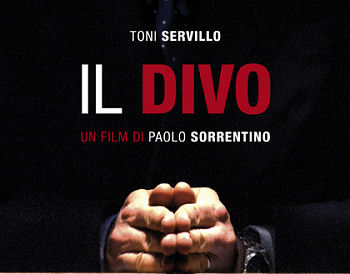
Paolo Sorrentino‘s Il Divo (MPI, 4.24) is an immaculate, highly stylized film about former Italian Prime Minister Giulio Andreotti and his political career, particularly the events that led to revelations about his ties to the Italian mafia and his reported complicity in the murder of a journalist.

I saw it last year in Cannes, and my immediate reaction was basically (a) “a first-rate political drama but probably too Italian to play in the U.S.” and (b) “a brilliant Andreotti performance by Toni Servillo.” I’ll be seeing it again on 4.14 at a special tastemaker screening in midtown Manhattan. MPI is the U.S. distributor, but Focus Features chief James Schamus will be hosting.

Il Divo opened in Italy a few days after its 5.23.09 bow in Cannes. Most of the rest of the world saw it last summer and last fall. Now it’s finally opening here.

Some films are like fruit. They need to be picked when they achieve ripeness, and if you wait too long to eat them they’ll have a diminished quality — they’ll feel too soft and won’t taste as good. Too much time and dust and delay dilutes the potency. You have to see it in a relatively fresh state.

Of course, some movies age well, like wine, and when you wind up seeing them two or five or ten years after their initial theatrical release you sip them and go “aaahhh” — excellent! So is Il Divo fruit or wine? Maybe it’s both. I haven’t decided yet.

A friend thinks I’m a bit off on my shelf-life ttheory. “Many films have come out a year after their Cannes premieres — The Wind That Shakes The Barley (which did very well here), The Last Mistress, Flight of the Red Balloon. I could understand where you’re coming from if Il Divo was a film that was so of-the-moment that its topicality or resonance would have really diminished over time (an Iraq-related film for instance) but Il Divo‘s themes of political power and corruption are pretty evergreen. And its formal brilliance can never age”

Noted

“I don’t know if you know this, but both the MGM and Universal film library have been fully converted to HD format,” a friend writes. “Many of the titles (including some of the films that you mentioned earlier today) are being withheld from consumer distribution so that they can be shown exclusively on HD cable channels that Universal owns.”

The Disappeared

There are plenty of lists of highly regarded films that need to be given an upgrade and a fresh release on DVD or Bluray. The much bigger category, of course, are films that were issued decades ago on VHS (or were never released at all), and need to make their DVD or digital download debut. I’ve been clamoring for years for the release of DVDs (at the very least) of David JonesBetrayal, Frank Perry‘s Play It As It Lays and John Flynn‘s The Outfit, as HE regulars well know.

I scanned through this Pauline Kael capsule review site for some titles that would be at least somewhat diverting to have on DVD or Bluray or both. What I came up with, mostly, was mediocre but watchable junk. Some have cloudy reputations, some were directed by “made” guys, some had good casts, a few starred Sandy Dennis and others are just oddball failures and half-and-halfers from the ’50s, ’60s, ’70s and ’80s.

But older junk has an intrigue that newer junk lacks. Second-tier diversions ain’t what they used to be. 21st Century blow-chunk levels are appalling. Now you get nervy throw-away crap from guys like Jody Hill with their baseball caps and seven-day beard growths and fat asses. Back then crap seemed…I don’t know, tidier or something. A bit more layered and better prepared. Sometimes you got an awkward fumble or flat-out failure from the likes of Robert Mulligan, Mark Rydell, Paul Mazursky, etc. And if you were stuck with a major stinker, there was at least a nude scene or some gratuitous sex thrown in. It was the fashion back then.

I’ve listed about eleven titles for starters. I might not want to own these films, but I’d definitely rent them. Some of them are better than crap-level but they’ve faded from circulation out of boredom or irrelevance. There are hundreds more that make the grade in this sense. I might even run a Part Two tomorrow.

Alex in Wonderland (1969) — director: Paul Mazursky. Cast: Donald Sutherland, Ellen Burstyn, Michael Lerner, Mazursky.

The Actress (1953) — director: George Cukor. Cast: Jean Simmons, Spencer Tracy, Teresa Wright, Anthony Perkins (making his debut), Jackie Coogan.

The Legend of Lylah Clare (1968) — director: Robert Aldrich. Cast: Peter Finch, Kim Novak, Ernest Borgnine.

In The Cool of the Day (1963) — director: Robert Stevens. Cast: Jane Fonda, Peter Finch, Arthur Hill.

That Cold Day in the Park (1969) — director: Robert Altman. Cast: Sandy Dennis, Michael Burns, Susanne Benton, David Garfield, Luana Anders, Michael Murphy.

Up The Down Staircase (1967) — director: Robert Mulligan. Cast: Sandy Dennis, Patrick Bedford, Eileen Heckart, Ruth White, Jean Stapleton.

The Fox (1967) — director: Mark Rydell. Cast: Anne Heywood, Sandy Dennis, Keir Dullea.

Thumb Trippin’ (1972) — director: Quentin Masters.

Midas Run (1969) — director: Alf Kjellin. Cast: Anne Heywood, Richard Crenna, Fred Astaire, Ceasar Romero.

The legendary At Long Last Love (1973) — director: Peter Bogdanovich. Cast: Burt Reynolds, Cybill Shepherd, Madeline Kahn, Duilio Del Prete, Eileen Brennan.

Brewster Mccloud (1972) — dierctor: Robert Altman. Cast: Bud Cort, Sally Kellerman, Michael Murphy, William Windom, Shelley Duvall, Rene Auberjonois, Stacy Keach.

Unfashionable!

Who wrote this mini-review of Barry Lyndon, and what’s happened to this viewpoint (or ones in this general realm) among the 21st Century film culture elite? I’ll tell you what’s happened to his viewpoint. It’s been decreed, elbowed and pooh-poohed out of existence. Well, enough of that. It’s high time for a backlash, dammit. Into the doghouse with Barry Lyndon! A rarified one, I mean. The kind that houses a very rare breed of movie that is simultaneously brilliant and over-praised, and which many have watched 15 or 20 times.

“Thackeray wrote a skittish, fast-moving parody of romantic, sentimental writing. It was about the adventures of an Irish knave who used British hypocrisy for leverage. However, it must have been Barry Lyndon’s ruthless pursuit of wealth and social position rather than his spirit that attracted Stanley Kubrick. His images are fastidiously delicate in the inexpressive, peculiarly chilly manner of the English painters of the period-the mid-18th century-and it’s an ice-pack of a movie, a masterpiece in every insignificant detail.

“Kubrick suppresses most of the active elements that make movies pleasurable. The film says that people are disgusting but things are lovely. And a narrator (Sir Michael Hordern) tells you what’s going to happen before you see it. It’s a coffee-table movie; a stately tour of European high life [that’s] like a three-hour slide show for art-history majors.”

Almost every hip film aficionado and filmmaker you might run into these days swears by Lyndon, and nobody ever says or writes anything like the above. The Lyndon cult is so dug-in and well-established that it’s almost become a fascist dictatorship. There is only one way to process the emotional bloodlessness of Barry Lyndon, and that is to call it timeless, exquisite, masterful, etc.

My view has always been that it dies after Barry marries Lady Lyndon, or the simple reason that his coarse selfishness — the thing that ensures his social and financial downfall — seems to come out of nowhere.

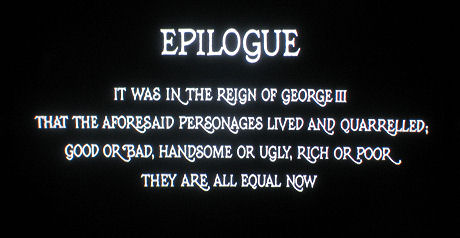
It comes down to simple visual pleasures…yes. The thought-out, strongly fortified kind that has led me to watch the Barry Lyndon DVD 15 or 20 times, even thought I don’t care for the funereal second half. I sit through this section only because I love the Lord Bullington duel sequence and the final epilogue card that states, “Good or bad, handsome or ugly, rich or poor, they are all equal now.”

“We’ll See About That”

A much cooler trailer for Michael Mann‘s Public Enemies (Universal, 7.1.09) than the one that popped through a month ago. More emphasis on John Dillinger (Johnny Depp) enjoying the role of America’s mythical/populist gangster of choice, and a bit more emphasis on doppelganger Melvin Purvis (Christian Bale) and girlfriend Billie Frechette (Marion Cottillard).

But what’s with the mincingm high-pitched British accent that Billy Crudup uses in his performance as J. Edgar Hoover? He sounds like Marlon Brando in Mutiny on the Bounty.

Brown Acid

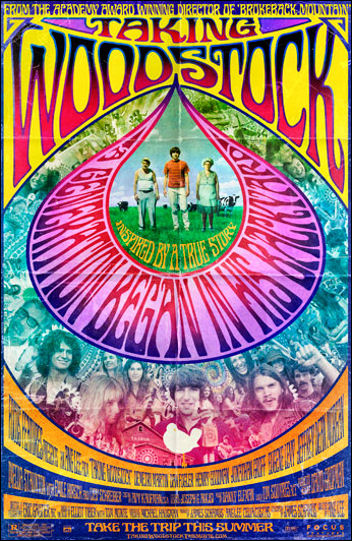
I would have gone this way myself if I were running the marketing for Ang Lee‘s Taking Woodstock (Focus Features). Who wouldn’t? A no-brainer. The film’s 8.14.09 opening, of course, marks the precise 40th anniversary of the opening day of the Woodstock Music Festival, which ran from Friday, 8.15.69 to Sunday, 8.17.69.

Nobody on my side of the fence knows for sure if Taking Woodstock will go to Cannes. It won’t open for another five months, after all. But given the recent buildup with the trailer and poster I’d be stunned if it doesn’t play there.

I love this paragraph from the festival’s Wikipedia page about the anti-youth-culture attitude of the N.Y. Times editors of the day, and their determination to paint the festival in negative terrms. Hooray for Barnard Collier!

“As the only reporter at Woodstock for the first 36 hours or so, Barnard Collier of the New York Times was almost continually pressed by his editors in New York to make the story about the immense traffic jams, the less-than-sanitary conditions, the rampant drug use, the lack of ‘proper policing’, and the presumed dangerousness of so many young people congregating.

“Collier recalls: ‘Every major Times editor up to and including executive editor James Reston insisted that the tenor of the story must be a social catastrophe in the making. It was difficult to persuade them that the relative lack of serious mischief and the fascinating cooperation, caring and politeness among so many people was the significant point. I had to resort to refusing to write the story unless it reflected to a great extent my on-the-scene conviction that ‘peace’ and ‘love’ was the actual emphasis, not the preconceived opinions of Manhattan-bound editors.

“After many acrimonious telephone exchanges, the editors agreed to publish the story as I saw it, and although the nuts-and-bolts matters of gridlock and minor lawbreaking were put close to the lead of the stories, the real flavor of the gathering was permitted to get across. After the first day’s Times story appeared on page 1, the event was widely recognized for the amazing and beautiful accident it was.”

Get Tough

At yesterday’s Congressional hearing in Van Nuys about illegal movie downloading, Steven Soderbergh reportedly suggested that the U.S. should adopt a not-yet-passed French law project (nicknamed DADOPI) that would cut off an offender’s internet service after three warnings. What’s wrong with that idea? It would certainly cut into piracy revenues.

Vanity Fair‘s Julian Sanction, who speaks French, doesn’t care for it. Earlier today he explained the particulars in a mocking way.

(1) “Individuals will be charged not for downloading illegal content, but rather for failing to properly secure their internet access. So even if some guy parks his car behind your house and poaches your service to download, say, the complete works of Jerry Lewis, you will be held responsible.”

(2) “Those charged with illegal downloading will be sent two e-mail warnings, followed by a third warning by registered letter.”

(3) “If offenders re-offend within one year of being warned, their Internet service can be cut off for a period of two months to a year, or one to three months if they promise not to do it again.”

(4) “Offenders whose Internet service is cut off would continue to pay their providers during the period of suspension.

(5) “The law will be retroactive, meaning there is to be no amnesty for people caught downloading content illegally before the law is passed.

(6) “To further discourage illegal downloading, lawmakers have proposed reducing the DVD window to four months rather than six.”

“I Don’t Know…”

What is Billy Bob Thornton‘s problem? What a sullen asshole. QTV host Jian Ghomeshi introduced him as an “Oscar-winning screenwriter, actor, and director” when doing an interview with Thornton and his band, The Boxmasters. Thornton took offense that he was being referred to (in his head) as some kind of musical hobbyist.