Purist Robes

“The Republican Party is like a dying tyrant, mad with syphilis, ironically like that very Stalin they would accuse their enemies of associating with. How else to account for their desperation to resurrect the wraith of Joseph McCarthy; the hammy and baffling utterances from high-level party officials like Boehner and McConnell; the blatant desire on their part to let the country fail out of sheer resentment; the wanton sedition of conservative shit-stirrers ranging from the quasi Madame Defarge Michele Bachmann to the porcine, pill-popping porcine propagandist Rush Limbaugh?

“It is an all-out assault on reason, on progress, on truth. What is the difference between the Republican Party and, say, the Taliban? A rogue by any other name would smell as rank. Their frantic accusations all churned out in a futile effort to explain their current pariah status is as pathetic and draconian as stoning a woman in the street.” — from Steven Weber‘s 4.11 HuffPost, titled “G.O.P. R.I. P.”

The stakes and some of the particulars have changed over the last five years, but as noted in a December 2004 review of Adam Curtis‘s The Power of Nightmares, the differences between the purist Republican right and the Taliban are actually fairly slight.

“The film contends that the anti-western terrorists and the neo-con hardliners in the George W. Bush White House are two peas in a fundamentalist pod, and that they seem to be almost made for each other in an odd way, and they need each other’s hatred to fuel their respective power bases but are, in fact, almost identical in their purist fervor, and are pretty much cut from the same philosophical cloth.

“They’re both enemies of liberal thought and the pursuit of personal fulfillment in the anti-traditionalist, hastened-gratification sense of that term. And they believe that liberal freedoms have eroded the spiritual fabric that has held their respective societies together in the past. Curtis’s doc shows how these two movements have pushed their hardcore agendas over the last four or five decades to save their cultures from what they see as encroaching moral rot.”

Toback at Harvard Club

My interview earlier today with Tyson director James Toback, which happened between 11:30 am and 1 pm at Manhattan’s Harvard Club, was easily the most spirited, relaxed and and enjoyable discussion I’ve had with anyone in a long while, taped or not. (Here’s more of the same.) Toback is one of the most sage observers I’ve ever known, and hands down the greatest gabber — not in a blah-blah, listen-to-me-talk sense but in the vein of a guy who just knows and doesn’t believe in trimming his sails.

Intimidation (even the intimidation that beautiful women impose on the best of us) never seems to affect him. He doesn’t seem to know from hesitancy either. Which is why his discussions with Mike Tyson went so well, which is the main reason, I feel, why Tyson connects.

I had more fun listening to this after the fact (i.e., as I edited it down at a Monticello pizza parlor) than any taped conversation I’ve ever done for Hollywood Elsewhere. Seriously. In large part because our chat was substantive. Here’s part #1 and part #2.

In discussion #2 Toback told me something I didn’t know, which was that two days ago Tyson began to be illegally downloaded. He said that Sony Classics attorneys were doing what they could to have the file taken down, and that it might already be down as we spoke. Toback isn’t horribly disturbed by this as he tends to believe that illegal downloads are seenhelpful to films that have drawn good word-of-mouth. Which would include Tyson, of course.

Hills Are Alive

I’ve been feeling more and more amped about the possibility of Ang Lee’s Taking Woodstock (Focus Features, 8.14.09) playing at Cannes next month, and so I decided on the spur of the moment early this afternoon to rent a car and drive up to the site of the 1969 Woodstock Music and Arts Fair. You can really feel something when you first arrive and take it all in. It’s like visiting Dealey Plaza or Ground Zero. The site is located on Hurd Road right off 17B in Bethel, New York — about a two-hour drive from Manhattan.


4.11.09, 6:35 pm, facing the area where the stage sat at the 1969 Woodstock Music and Arts Fair. A private security guy pulled up in the area behind the stage and told me I wasn’t supposed to be walking around on the field.

4.11.09, 6:35 pm, facing the natural amphitheatre from the area where the stage once stood.

Outcast Adrift

A year ago I ran a brief plea for the DVD release of Carol Reed‘s Outcast of the Islands, which coincidentally aired a month later on Turner Classic Movies. Yesterday, still fired up by the response to Thursday’s “The Disappeared” piece, I came upon this Pauline Kael capsule review.

“A marvellous film (drawn from Joseph Conrad‘s work) that relatively few people have seen,” she began. “It’s probably the only movie that has ever attempted to deal in a complex way with the subject of the civilized man’s ambivalence about the savage. It also contains some of the most remarkable sequences ever filmed by the English director Carol Reed; it’s an uneven movie, but with splendid moments throughout.

Trevor Howard is superb as Willems, who makes himself an outcast first through contemptible irresponsibility and through betrayal of those who trust him, and finally and hopelessly when, against his will, he is attracted to the silent, primitive girl, the terrifying Aissa (played by Kerima). Willems is wrong in almost everything he does, but he represents a gesture toward life; his enemy, Almayer (Robert Morley), is so horribly, pathetically stuffy that his family unit (with Wendy Hiller as his wife and Annabel Morley as his child) is absurdly, painfully funny.

“With Ralph Richardson, whose role is possibly ill-conceived, and George Coulouris, Wilfrid Hyde-White, and Frederick Valk. The screenplay is by William Fairchild; cinematography by John Wilcox.”

I wrote last year that Outcast of the Islands is “a forgotten film that nobody cares about at all. Except, I’m thinking, possibly those obsessives at the Criterion Collection. These fellows are just peculiar enough to put out a remastered version of this British-produced film on DVD.”

Tell It

Unless they’re sick or have found a better, higher-paying gig somewhere else, people almost never resign from cushy prestigious jobs. When somebody leaves a cool job it’s because they’ve been shown the door. So when you write a news story about some highly-placed person resigning, you have to try and convey what really happened. Who did the pushing and for what reason? Generic so-and-so is resigning stories along with generic “I’ve had a great run and am looking forward to the next challenge” statements are awfully damn annoying.

Songbird

You need to check out this new music player that’ll eventually replace iTunes,” Jett wrote a few minutes ago. “It’s called Songbird and is so dynamic. It has so many cool applications.” The download site says the goal “is to create a non-proprietary, cross-platform, extensible tool that will help enable new ways to playback, manage, and discover music. There are lots of ways to contribute your time to the project. We’d love your help! There are several features we’re proud of, but we’ll be the first to admit that others need ironing out, are experimental, or are just plain missing. There’s still a lot to do.”

Orange Wedge

Five and a half hours ago The Oregonian’s Shawn Levy quoted from a Gus Van Sant Twitter post (128 characters) that said the following: “My next film is Dustin Lance Black‘s adaptation of Tom Wolfe‘s The Electric Kool-Aid Acid Test. It’s going to be really funny.” The Twitter post was reportedly taken down after it appeared.

Levy noted that “the project has been in development, but this is the nearest thing to confirmed word that’s appeared anywhere so far. Take that, Variety!” In fact, the book’s Wikipedia page says that “a film adaptation of the book, directed by Gus Van Sant, is expected to be released in 2009. The screenplay was written by Dustin Lance Black, who also worked on the HBO series Big Love and Van Sant’s 2008 film Milk. The movie is being produced by Richard N. Gladstein.”

It might be funny but I’m predicting failure, or certainly an underwhelming reception. Van Sant gets the drug culture thing like no one else, but there’s no story here — Wolfe’s book is about mythology, performance art, wild episodes, characters (Ken Kesey, Neil Cassady, Wavy Gravy), ’60s atmosphere and, of course, the way it’s all described. Spiritual pyschedlic soul-searching material doesn’t play in cinematic terms. It can’t — it’s simultaneously too much and not enough.

(Thanks to HE’s Moises Chiullan for the alert.)

One Third Gone

The first four months are never expected to yield much, certainly not in terms of award-quality fare. But a few made the grade with me. Three or four can be called exceptional, and the rest good, mostly satisfying, decent, or at least diverting in an art-house indie obscura vein. Forget awards eligibility in terms of rules and release dates. This is simply the best of what’s opened so far in ’09, in order of preference.

Except for The Hurt Locker, that is, which opens on 6.26. I’m including it because it’s been showing around and has contributed to the winter-spring current.

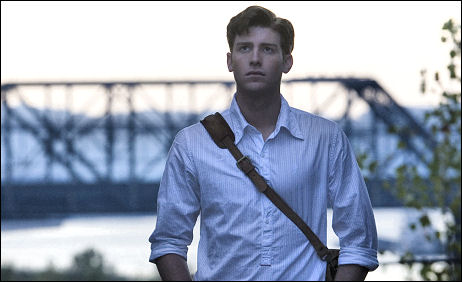
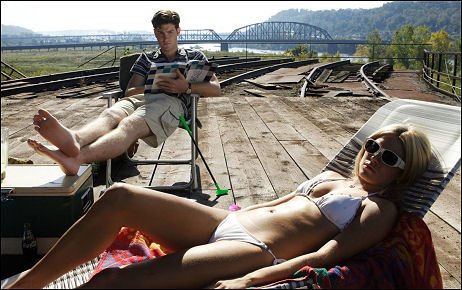
(In order of preference): Kathryn Bigelow‘s The Hurt Locker, Cary Fukunaga‘s Sin Nombre, Greg Mottola‘s Adventureland, James Toback‘s Tyson, Rupert Wyatt‘s The Escapist, Andrezj Wajda‘s Katyn, Kevin McDonald‘s State of Play, strong>Matteo Garrone’s Gomorrah,Ramin Bahrani‘s Goodbye Solo, Tony Gilroy‘s Duplicity, Steve McQueen‘s Hunger, Paolo Sorrentino‘s Il Divo, Carlos ReygadasSilent Light, Terrence DaviesOf Time and the City, Henry Selick‘s Coraline, Tom Tykwer‘s The International, Jan Troell‘s Everlasting Moments, and Adam Del Deo and James D. Stern‘s Every Little Step.

No complaints about my not yet posting multi-paragraph reviews of some of these. If I didn’t review two or three or four it’s because I haven’t fucking felt like it…okay? I’m not a machine. I never got around to seeing Matt Aselton‘s Gigantic, which might have made the list. (Or maybe not.) Ditto strong>Mary Stuart Masterson’s The Cake Eaters. And whatever happened to poor Killshot? Why won’t Harvey let some of us see it?

Detachment

A rental-car guy told me this morning that today is Good Friday. An hour later an ex-girlfriend told me she’s visiting her parents for Passover tomorrow. If not for them I would be thinking about this weekend like any other. No holiday seems very important these days. Religious ones especially. At best, I’m guessing, Easter Sunday is regarded by regular Joes in the same light as President’s Day and Martin Luther King Day. If that. I remember giving a damn about Easter when I was a kid. I played a Roman soldier in a little Easter Sunday pageant in my local Episcopalian church when I was ten or eleven. I hunted for chocolate eggs when I was younger. It all fades away.

Again, Mike’s Murder

Yesterday’s article about movies that never made it to DVD (i.e., “The Disappeared“) got me thinking again about James BridgesMike’s Murder (1984), which I wrote about 13 months ago. The point was to urge Warner Home Video to release it on DVD, and if possible to release the original Bridges cut. A print of this version exists, according to Bridges’ longtime partner Jack Larson (with whom I spoke after the article was posted). And so I’m basically bugging WHV’s George Feltenstein again, is what it comes down to.

Here’s Pauline Kael‘s mini-review: “Debra Winger, in a superb full-scale starring performance, as a radiantly sane young bank teller in LA who has an affair with a curly-haired clear-faced young tennis instructor called Mike (Mark Keyloun). It’s a wobbly affair: She hears from him randomly over the course of two years — whenever the mood hits him, he phones her. One night, he’s supposed to come over late, but he doesn’t show. When she gets a call telling her he’s dead, it’s abrupt, bewildering. She can’t let go of him so quickly, and she tries to find out everything she can.

“Winger has thick, long, loose hair and a deep, sensual beauty in this movie. James Bridges, who directed, wrote the role for her after directing her in Urban Cowboy, and her performance suggests what Antonioni seemed to be trying to get from Jeanne Moreau in La Notte , only it really works with Winger — maybe because there’s nothing sullen or closed about her. The picture is atmospheric yet underpopulated; at times, it feels thin, and it turns into overheated melodrama in a sequence featuring Darrell Larson.

“But its view of the cocaine subculture (or culture) of LA is probably Bridges’ most original and daring effort, and it has a brief, intense appearance by Paul Winfield (as the record producer who brought Mike to LA) that’s right up there with Winger’s acting. With Brooke Alderson, Robert Crosson as Sam, and Daniel Shor as Richard, the performance artist. The Warner executives refused to release the picture until Bridges made some cuts and changes, and they probably breathed a few sighs of relief as they buried it.”

Here’s part of what I wrote last March: “It didn’t register very strongly in the mid-Reagan era because it didn’t shoot for the stratosphere or deliver fierce visceral thrills, which is what audiences seemed to be responding to more and more back then. (The ’70s heyday had drawn to a close, and blunt-impact movies — sci-fi epics, actioners, tits-and-zits comedies — were gaining big- time.) But it handled itself and its subject — the L.A. drug-dealing scene — in a way that was almost deceptively powerful. It’s a sad and somber little piece that leaves a haunting after-vibe.

“And it had some unusually penetrating performances from Debra Winger, Paul Winfield, Mark Keyloun (a newcomer at the time who seemed to work mostly on television after Mike’s Murder and who retired from acting in the early ’90s) and Darrell Larson. There was real ache and loneliness in their emoting. Which lent unusual gravity to a story that structurally was only a murder-mystery.

“I wish I could find at least a fragment of Kael’s New Yorker review online. I remember how her review noted that a N.Y. Times TV page editor had written ‘skip it’ in response to an airing of Mike’s Murder on a New York-area station, and Kael saying in response, ‘Please, don’t skip it.’

Winger plays Betty, a practical minded but lonely bank teller living in Brentwood. She falls for Mike, a light-hearted tennis instructor (Keyloun) who spends a single night with her after a brief flirtation. He’s obviously immature and irresponsible, not returning calls and whatnot, but she can’t let him go. Then after he doesn’t show up for a date, Betty learns to her shock that he’s been slain by drug dealers.

“And so she decides to assuage her pain by looking into his sordid past to learn what happened, and the journey she takes into the toney, drug-dealing underworld that gives Mike’s Murder its strange, unsettling edge.

“An IMDB posting by James Sanford says that Mike’s Murder has “a beautifully evoked, vaguely creepy atmosphere that hangs over every scene….the crime that sets the story in motion remains unsolved at the end, and perhaps that’s how it should be. It’s not important who really killed Mike Chuhutsky, Bridges seems to be saying. Not when it’s so obvious what killed him.”

“It’s been over ten years since I’ve seen Mike’s Murder, but I remember three things in particular: (a) the look of immense sadness on Winfield’s face as his character, a wealthy gay man who had a thing for Mike, considers the character flaws that led to his death, (b) the horrific howl that comes out of Larson, Mike’s not-very-smart best friend, as he’s about to be murdered by thugs for having stolen cocaine from a major dealer who lives in the hills, and (c) a nifty little sequence in the very beginning that shows a hamburger being prepared at Tomy’s on Pico Blvd.”

Off Balance

It seems lamentable that poor Liam Neeson, who’s probably (and of course understandably) not fully himself in the wake of Natasha Richardson‘s death, has agreed to play Zeus, for God’s sake, in a remake of Clash of the Titans under director Louis Leterrier (Transporter 2, The Incredible Hulk). I’m thinking back to Neeson’s expressions of despair in the late ’90s after starring in the double-whammy blue-screen nightmare of Star Wars: The Phantom Menace and The Haunting. He wanted to quit acting, if I correctly recall.

Ralph Fiennes (who has a memorable cameo in The Hurt Locker ) is scheduled to costar in the new version, which is being funded by Warner Bros. It’ll begin production in England later this month.

Laurence Olivier played Zeus in the original 1982 Clash of the Titans — strictly paycheck, an all-time career low.